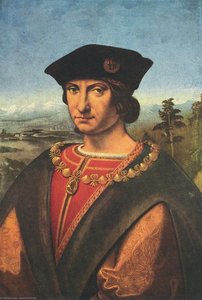
Portrait of Andrea Solari

The 35 Most Famous Andrea Solari Paintings, a Gallery Selection

Updated November 2026 · ranked by our popularity score (searches, visits and orders for each work) · 36 works by Andrea Solari in our catalogue

In short

Of all the originals Andrea Solari left, the most famous is Saint George and Saint Sebastian (1500), in the collection of the Detroit Institute of Arts, Detroit. Close behind it come Christ Blessing (1524) and Christ Bound and Crowned with Thorns (1504). Our catalog holds 36 works by Andrea Solari; the gallery has kept the 35 the world admires most, each shown with its date, its museum and its story.

1460 – 1524, Milan High renaissance Most works: The Louvre

Andrea Solari's top 10 paintings: the gallery's choice

1
Saint George and Saint Sebastian (1500) by Andrea Solari

Saint George and Saint Sebastian

1500 · Oil On Panel · Detroit Institute of Arts, Detroit

In this intimate devotional work, Andrea Solari brings together the figures of two soldier saints. Saint George and Saint Sebastian appear side by side, their presence filling the space with a quiet, spiritual intensity. The painting, titled Saint George and Saint Sebastian, captures a moment of profound stillness. It emerges from the period circa after 1507, a time when the artist's hand moved between the traditions of Italy and the…

2
Christ Blessing (1524) by Andrea Solari

Christ Blessing

1524 · Oil On Panel · Metropolitan Museum of Art, New York

Step closer to observe the quiet gravity of this figure. Within a shallow architectural niche, Christ stands with a composure that feels both monumental and deeply personal. He is captured in a moment of stillness, his dark, wavy hair and beard framing a face that meets your gaze directly. There is no movement here, only the steady weight of a blessing. His right hand is raised, fingers positioned in a…

3
Christ Bound and Crowned with Thorns (1504) by Andrea Solari

Christ Bound and Crowned with Thorns

1504 · Oil On Panel · Philadelphia Museum of Art, Philadelphia

A heavy silence settles over the canvas. The subject is Christ, caught in the quiet aftermath of his trials. His head tilts downward, a gesture of profound sorrow and spiritual gravity. A crown of sharp thorns presses into his brow, its rigid lines cutting through the softness of his skin. His arms are bound by coarse rope, the texture of the fibers rendered with a precision that suggests the bite…

4
Madonna of the Green Cushion (1507) by Andrea Solari

Madonna of the Green Cushion

1507 · Tempera On Panel · The Louvre, Paris

Andrea Solario’s “Madonna of the Green Cushion,” painted around 1507, stands as a testament to the burgeoning Mannerist style emerging from Milan during Leonardo da Vinci's influential period. More than just a depiction of Virgin Mary and Child—a motif deeply rooted in Christian iconography—the painting embodies a sophisticated exploration of light, texture, and psychological nuance that distinguishes it from its predecessors.

5
Mary Magdalen (1524) by Andrea Solari

Mary Magdalen

1524 · Oil On Panel · Walters Art Museum, Baltimore

This Renaissance portrait, executed in 1524, presents a luminous half-length depiction of Mary Magdalen. The subject is positioned centrally against a dark, undifferentiated background, a composition that utilizes chiaroscuro to create a profound sense of depth. She is characterized by a calm and contemplative expression, her head slightly tilted, framed by long, wavy, reddish-blonde hair that cascades over her shoulders. A thin, golden halo encircles her head, signifying her sacred…

6
Giovanni Cristoforo Longoni (1505) by Andrea Solari

Giovanni Cristoforo Longoni

1505 · Oil On Panel · National Gallery, London

A man sits centrally in the foreground of this oil on poplar panel painting from 1505. He is positioned in a medium close-up, wearing heavy, matte black clothing that occupies much of the lower composition. His face is rendered with smooth textures and clear facial features, maintained by even, diffused lighting that suggests an overcast day. In his hands, he holds a small piece of paper. The subject maintains a…

7
Portrait of a Man (1500) by Andrea Solari

Portrait of a Man

1500 · Oil On Canvas · Pinacoteca di Brera, Milan

Before us stands a captivating vision, a portrait that seems plucked from the very heart of the sixteenth century. The subject, a man whose bearing suggests both intellectual depth and carefully curated presentation, meets the viewer's eye with an arresting intensity. His attire—the stark white shirt contrasting sharply with the deep black hat trimmed in opulent gold, paired with the striking splash of red from his wig—speaks volumes about status…

8
Portrait of a Man (1497) by Andrea Solari

Portrait of a Man

1497 · Museum of Fine Arts, Boston

The artwork titled Portrait of a Man is a painting by the artist Andrea Solario. This specific piece is categorized within the portrait genre. It represents a formal depiction of an individual, focusing on the likeness and presence of the subject.

9
Female portrait (1507) by Andrea Solari

Female portrait

1507 · Oil On Panel · Sforza Castle, Milan

In the quiet depths of Andrea Solario’s 1507 Female Portrait, one finds a profound encounter with the soul of the High Renaissance. This exquisite oil painting serves as a masterclass in the art of subtle presence, capturing a young woman whose gaze seems to bridge the gap between the sixteenth century and the modern viewer. The composition is anchored by a striking use of chiarosc else, where a dark, almost…

10
The Entombment (1510) by Andrea Solari

The Entombment

1510 · Oil On Panel · Yale University Art Gallery, New Haven

The emotional impact of the work lies in its restraint. Rather than agitation, there is a controlled, contemplative quality to the grieving figures. The lighting is even, avoiding harsh shadows to maintain a gentle, reverent atmosphere. Through the careful application of color and the subtle modeling of form, the painting captures a specific, heavy stillness. It is a work that invites a slow, steady gaze, focusing the viewer on the…

The Andrea Solari selection continues, 11 to 35

Andrea Solari's famous paintings, period by period

The subjects that held Andrea Solari's eye

The four subjects that come back most often in these originals, each with its finest example.

The museums that keep Andrea Solari's originals

The 8 museums that hold the most of the paintings on this page.

Museum City Works by Andrea Solari Paintings from this list
The Louvre, ParisThe Louvre Paris 4 Madonna of the Green Cushion, Charles d'Amboise, The Crucifixion
Metropolitan Museum of Art, New YorkMetropolitan Museum of Art New York 3 Christ Blessing, Salome with the Head of St John the Baptist, Head of a Bearded Man
National Gallery, LondonNational Gallery London 3 Giovanni Cristoforo Longoni, Man with a Pink Carnation, Virgin and Child
Pinacoteca di Brera, MilanPinacoteca di Brera Milan 2 Portrait of a Man, Madonna dei garofani
Detroit Institute of Arts, DetroitDetroit Institute of Arts Detroit 1 Saint George and Saint Sebastian
Philadelphia Museum of Art, PhiladelphiaPhiladelphia Museum of Art Philadelphia 1 Christ Bound and Crowned with Thorns
Walters Art Museum, BaltimoreWalters Art Museum Baltimore 1 Mary Magdalen
Museum of Fine Arts, BostonMuseum of Fine Arts Boston 1 Portrait of a Man

Andrea Solari decade by decade: the original that defines each

Works per decade

Pick a decade to see the original that defines it.

Collectors' questions about Andrea Solari's paintings

Which work is Andrea Solari most famous for?Reveal the answer

Saint George and Saint Sebastian (1500), Detroit Institute of Arts, Detroit. Christ Blessing (1524) and Christ Bound and Crowned with Thorns (1504) come next.

What age was Andrea Solari when Saint George and Saint Sebastian was made?Reveal the answer

40 years old: Saint George and Saint Sebastian dates from 1500, and Andrea Solari was born in 1460.

What are the ten most famous Andrea Solari paintings?Reveal the answer

Saint George and Saint Sebastian, Christ Blessing, Christ Bound and Crowned with Thorns, Madonna of the Green Cushion, Mary Magdalen, Giovanni Cristoforo Longoni, Portrait of a Man, Portrait of a Man, Female portrait and The Entombment. The ranking above gives each one's year and museum.

How many paintings did Andrea Solari leave?Reveal the answer

Our catalog holds 36 works by Andrea Solari, dated from 1495 to 1524.

In which museums do Andrea Solari's masterpieces hang?Reveal the answer

Mostly in The Louvre (Paris), Metropolitan Museum of Art (New York) and National Gallery (London). The museum table above lists them all.

In which years did Andrea Solari paint the most famous works?Reveal the answer

In 1500s: 16 of the 35 works on this page were made then, Saint George and Saint Sebastian among them.

What are the first and the last famous originals of Andrea Solari?Reveal the answer

On this page, the earliest is Man with a Pink Carnation (1495) and the latest Christ Blessing (1524).

Which subjects did Andrea Solari choose most often?Reveal the answer

Man (9), Beard (5) and Woman (5), across the 35 works on this page.

Which technique did Andrea Solari use most?Reveal the answer

Oil On Panel, for 16 of the 35 works on this page.

To which art movement does Andrea Solari belong?Reveal the answer

High renaissance and Renaissance, judging by the originals on this page.

Which Andrea Solari works hang at the The Louvre?Reveal the answer

Madonna of the Green Cushion, Charles d'Amboise and The Crucifixion: the The Louvre, Paris holds 4 of the works on this page.

Andrea Solari: life and work

Andrea Solario: A Renaissance Bridging Italy and France

Andrea Solario (c. 1460 – 1524), a name often overshadowed by the giants of the Italian Renaissance, nevertheless represents a crucial link between the vibrant artistic currents of Milan and the burgeoning Mannerist style taking root in France. Born into a family steeped in artistic tradition—his father and brothers were sculptors and architects—Solario’s journey was one of constant movement and adaptation, ultimately shaping him into a distinctive painter whose work reflects both his Italian roots and the influences he encountered across Europe.

Early accounts of Solario's life are fragmented, relying heavily on the writings of Bernardo de’ Dominici, a Neapolitan art historian whose chronicles were often colored by conjecture. Despite this uncertainty, it is generally accepted that Solario received his initial training in Venice, a city renowned for its artistic innovation during the late 15th century. The presence of Antonello da Messina, a pivotal figure in Venetian painting known for his pioneering use of oil paint and his naturalistic approach to portraiture, undoubtedly shaped Solario’s early development. The influence is particularly evident in works like “A Man with a Pink Carnation,” a remarkably lifelike depiction that showcases Antonello's signature sculptural modeling and attention to detail.

Milanese Roots and Leonardo’s Shadow

Solario’s career truly took shape in Milan, the artistic heart of Lombardy. He quickly established himself as a sought-after painter, working for prominent families and religious institutions. His style during this period is often described as “Leonardesque,” reflecting his deep admiration for Leonardo da Vinci, who had spent several formative years in Florence. Solario’s paintings demonstrate a keen understanding of Leonardo's techniques—particularly his use of sfumato (the subtle blurring of outlines) to create atmospheric depth and psychological nuance—but he never simply imitated his master. Instead, Solario skillfully integrated these influences into a distinctly personal style.

Notable works from this Milanese phase include “Rest During the Flight to Egypt,” a stunning High Renaissance panel depicting the biblical scene with serene figures and a remarkably detailed landscape background. The composition’s harmony and balance, coupled with its masterful use of color and light, exemplify Solario's artistic maturity. Similarly, his portrait of Charles II d’Amboise, commissioned by the Cardinal, showcases his ability to capture both physical likeness and psychological character.

A Journey North: France and the Influence of Flemish Art

In 1507, Solario embarked on a significant chapter of his career when he was invited to France by Cardinal Georges I d’Amboise. This invitation marked a turning point in his artistic development, exposing him to the vibrant art scene of the Loire Valley and introducing him to the stylistic innovations of the Flemish masters. His time in France resulted in several important commissions, including frescoes for the chapel of Gaillon Castle, where he skillfully blended Italian Renaissance principles with elements of Northern European painting.

The influence of Flemish art is particularly evident in works like “The Lamentation,” a poignant depiction of mourning characterized by its rich colors, dramatic lighting, and expressive figures. Solario’s use of oil paint—a technique that was still relatively new in Italy at the time—allowed him to achieve unprecedented levels of detail and luminosity. This period also saw the creation of smaller panels like “Madonna and Child with a Donor,” demonstrating his continued ability to capture individual likenesses with remarkable accuracy.

Legacy and Historical Significance

Andrea Solario’s legacy is often underestimated, yet he played a vital role in transmitting Renaissance artistic ideas across Europe. He was not merely a follower of Leonardo da Vinci; he was an independent artist who synthesized diverse influences into a unique and compelling style. His work bridges the gap between the early Italian Renaissance and the Mannerist movement that would soon dominate European art. Solario’s paintings offer a valuable glimpse into the artistic exchange that characterized the 16th century, demonstrating how artists could learn from and adapt to the styles of their contemporaries across national boundaries.

Despite the challenges posed by fragmented historical records and the tendency to attribute his work to other painters, Andrea Solario remains a significant figure in Renaissance art. His paintings continue to captivate viewers with their beauty, technical skill, and emotional depth, reminding us of the rich artistic heritage that flourished during this transformative period.