Preview
 Send
Send Share
Share
 Details
 Guide
Guide

 Download
 Similars
 X-Ray
X-Ray Diaporama
 Q&A
Q&A Stats
StatsThe Recitation


 Read More
Giclée / Art Print
Museum-quality giclée or canvas print with fast production and flexible finish options. ( Buy Hand Made Painting Switch to Digital Image)




P118B $10

P118H $10

P118W $10

P438Z $10

P508JH $12

P508YH $12

P805H $10

P805Z $10

P919BZ $10

P919G $10

P919XJ $10

P959ZH $10

P968JZ $12

W106C $8

W218G $10

W218JH $8

W218Y $10

W307PJ $10

W316G $10

W316PJ $8

W316Y $10

W398PJ $8

W4111J $10

W500HY $15

W500JH $15

W692G $12

W849H $8

W940BG $15

W953PJ $8




Pick from our preset sizes that match the artwork's original proportions.

Type the width and the height you need, to fit your frame or your wall. A print can only be cut, never made bigger than the picture, so a size with a different shape loses a part of the image. We send you a digital mockup to approve before we print anything. The picture shown on this page does not show the real cut — only the mockup does.
Worldwide Delivery () in 2 weeks instead of standard 4/5 weeks. (1 November)

Free Worldwide Express Shipping

High-Quality Linen Canvas

Full Shipping Insurance

Customs Tax Refund Guarantee

True Color Matching Guarantee

100-Day Return Policy (Defects Only)

100% Money-Back Guarantee

Bulk Discount Offer
 Glass option is only available in size under 110 CM

The Recitation
Giclée / Art Print
Reproduction Size
-


Total Price
$ 81
A Symphony of Silence: The Essence of The Recitation
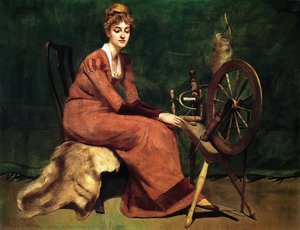
In the quietude of Thomas Wilmer Dewing’s 1891 masterpiece, The Recitation, viewers are invited into a world where time seems to suspend itself. This quintessential example of Tonalist painting transcends a mere depiction of two women in an outdoor setting; it is a profound exploration of mood and atmosphere. The scene unfolds with a gentle, melancholic grace, presenting a woman dressed in black seated prominently in the foreground, while another figure stands slightly behind her, her gaze lost toward the distant horizon. There is a palpable sense of stillness here, an invitation to step away from the clamor of the modern world and enter a space of pure, uninterrupted contemplation.
The emotional weight of the piece is carried by Dewing’s masterful use of color and light. The palette is dominated by a harmonious range of muted greens—from delicate pale celadon to deeper, more somber olive shades. These tones do not merely decorate the landscape; they breathe life into the atmosphere, imbuing the environment with a serenity that is tinged with a subtle, haunting melancholy. The lighting is soft and diffused, casting a gentle glow across the figures without the intrusion of harsh shadows, which further enhances the dreamlike, ethereal quality of the moment.
Technique and the Tonalist Vision
To behold The Recitation is to witness the meticulous skill of an artist deeply rooted in the English Aesthetic tradition. Dewing employs a technique characterized by the layering of thin glazes of oil paint onto the canvas, a process that builds a rich texture and an incredible sense of depth. His brushwork, while appearing loose and expressive, serves a deliberate purpose: to capture the fleeting nuances of light and shadow that define the Tonalist style. This approach allows for a soft, organic blurring of shapes, where lines are not sharply delineated but rather emerge from the atmospheric haze.
This painterly method creates an illusionistic depth that feels remarkably immersive. The texture appears layered and complex, inviting the eye to wander through the lush greenery and settle upon the subtle gradations of color. For the collector or interior designer, this technique offers a sophisticated visual richness; the painting does not demand attention through jarring contrasts but rather commands it through a steady, captivating presence that complements a refined and tranquil interior space.
Symbolism and the Human Experience
Beyond its aesthetic beauty, The Recitation serves as a poignant meditation on solitude and the inner life. The posture of the seated woman—calm, yet deeply absorbed in her own thoughts—suggests a deliberate retreat from external distractions. There is a beautiful tension in the composition between the two figures; the distance between them can be interpreted as a symbol of emotional separation or perhaps an unfulfilled longing. As one figure gazes toward the unreachable horizon, the painting touches upon themes of introspection and the human desire to connect with something beyond the immediate present.
This work stands as a testament to the power of art to capture the intangible. It is a piece that speaks to the soul, offering a sense of peace and a reminder of the beauty found in quiet moments of reflection. Whether viewed as a historical triumph of the American Tonalist movement or as a timeless portrait of human emotion, The Recitation remains an evocative masterpiece, perfect for those who seek to surround themselves with art that inspires deep thought and emotional resonance.
Questions & Answers
How intense are the colors in "The Recitation" by Thomas Wilmer Dewing?
The colors in "The Recitation" by Thomas Wilmer Dewing have a vivid intensity.
Does "The Recitation" show strong light-dark contrasts?
"The Recitation" by Thomas Wilmer Dewing shows a statement contrast between its light and dark areas.
How is "The Recitation" situated historically?
"The Recitation" by Thomas Wilmer Dewing belongs to the Impressionism movement, within the 19th-Century period. Together they give the work its place in art history.
Artist Biography
**early life and training**
thomas wilmer dewing, an american painter, was born on may 4, 1851, in boston, massachusetts. his artistic journey began with a lithographic apprenticeship, which later led him to the prestigious académie julian in paris, where he studied under gustave boulanger and jules lefebvre starting from 1887.**artistic style and notable works**
dewing's artistic style is characterized by his tonalist paintings, a genre deeply rooted in english aestheticism. his preferred subjects were aristocratic women, often depicted in moody, dreamlike surroundings, playing instruments or engaging in introspective activities. * **woman in black: portrait of maria oakey dewing** (1887), a poignant oil on panel, showcases his wife, an accomplished painter with extensive formal art training. * **lady in gold** (1912), now at the brooklyn museum, exemplifies his mastery of capturing the essence of his subjects.**teaching and associations**
dewing was a founding member of the ten american painters in 1898 and taught at the art students league of new york. his association with the society of landscape painters, founded in 1899, further solidified his position within the tonalist movement.**legacy and collections**
* the freer gallery of art at the smithsonian institution has a dedicated room for dewing's works. * notable collectors include john gellatly and charles lang freer.- view thomas wilmer dewing's collection on OriginalUniqueArt
- more on thomas dewing at wikipedia
- explore the freer gallery of art at the smithsonian institution for more tonalist masterpieces.
**later life and death**
dewing's artistic output declined after 1920. he passed away in new york on november 5, 1938, leaving behind a legacy of captivating, ethereal portraits that continue to intrigue art enthusiasts. **key works and collections available for reproduction at OriginalUniqueArt:** * the white dress * woman in black: portrait of maria oakey dewing * lady in gold discover the world's most famous paintings with OriginalUniqueArt's extensive collection
Thomas Wilmer Dewing
1851 - 1938 , United States of America
Quick Facts
- Artistic Movement Or Style: Tonalism
- Artists Who Influenced This Artist:
- Gustave Boulanger
- Jules Lefebvre
- Full Name: Thomas Wilmer Dewing
- Nationality: American
- Notable Artworks:
- Woman in Black: Portrait of Maria Oakey Dewing
- Lady in Gold
- The White Dress
- Spring
- In the Garden
- Place Of Birth: Boston, United States of America
- Date Of Birth: 1851
- Date Of Death: 1938
Related Articles

Impressionistic Landscapes: 10 Masterpieces That Changed Art & Decor
Journey into the heart of Impressionism! Explore 10 masterpieces by Monet, Renoir & Degas that revolutionized landscape art. Discover their stories, techniques & find museum-quality reproductions to elevate your home decor on OriginalUniqueArt.com.

Thomas Wilmer Dewing: Atmospheric Landscapes & the American Tonalist Vision
Explore the captivating world of Thomas Wilmer Dewing, a leading figure in American Tonalism. Discover his evocative paintings, artistic influences, and legacy with OriginalUniqueArt.

Grant Wood & American Regionalism: Identity, Myth & the Rural Landscape
Explore the world of Grant Wood & American Regionalism with OriginalUniqueArt. Discover the symbolism behind 'American Gothic', recurring themes, and the movement's lasting impact on art history. High-quality reproductions available.

Evocations of Place: A Historical Journey Through Landscape Art
Explore the rich history of landscape art with OriginalUniqueArt. Discover renowned artists, movements like Impressionism & Romanticism, and expert guidance for collecting timeless pieces. Find your perfect serene escape today!

Impressionist Landscapes: 10 Masterpieces for Your Home | OriginalUniqueArt
Journey through 10 iconic Impressionist landscapes by Monet, Renoir & Degas. Explore the history, techniques & emotions behind these masterpieces. Find museum-quality reproductions for your home at OriginalUniqueArt.com – where art comes to life! Discover all masterpieces on OriginalUniqueArt.com