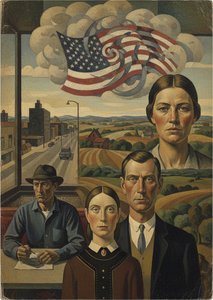
The Genesis of Regionalism: A Response to Modernity
American Regionalism is an American realist modern art movement that included paintings, murals, lithographs, and illustrations depicting realistic scenes of rural and small-town America, primarily in the Midwest. It arose in the 1930s as a response ...
The early decades of the 20th century witnessed a seismic shift in the art world, as European avant-garde movements – Cubism, Surrealism, Futurism – relentlessly challenged traditional notions of representation. While these innovations captivated many American artists, a countercurrent began to emerge, one that sought not to dismantle artistic conventions but to reaffirm them, albeit with a distinctly American inflection. This was Regionalism, and its rise wasn’t merely an aesthetic preference; it was a deliberate reaction against the perceived cosmopolitan detachment of European modernism and the increasing industrialization reshaping the United States. Artists felt a growing disconnect between the art being produced and the realities of everyday life for most Americans – particularly those living outside major urban centers. The Great Depression further intensified this sentiment, fostering a yearning for stability, authenticity, and a celebration of national identity. Regionalism wasn’t about rejecting all modern influences; rather, it was about filtering them through the lens of local experience, focusing on the unique character of specific regions and their inhabitants.
Grant Wood’s Iowa: Defining a Midwestern Aesthetic
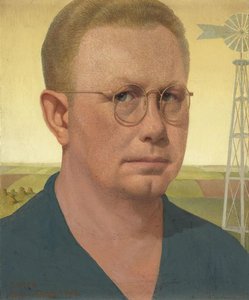 Grant Wood
Discover Grant Wood (1891-1942), the iconic American Regionalist painter of 'American Gothic.' Explore his evocative depictions of Midwest life, influenced by Flemish masters and a uniquely American vision.
At the heart of this movement stood Grant Wood, an artist whose name became inextricably linked with the American Midwest. Born in rural Iowa in 1891, Wood experienced firsthand the rhythms of agricultural life, and it was to this world he would return after periods of study in Chicago and Paris. Unlike many of his contemporaries who embraced abstraction or European styles, Wood found inspiration not in radical experimentation but in the clarity and precision of Northern Renaissance painting – particularly the work of Jan van Eyck. This influence is readily apparent in his meticulous attention to detail, the smooth surfaces of his canvases, and the almost photographic realism he achieved. However, Wood wasn’t simply copying European techniques; he was adapting them to depict a uniquely American subject matter. His Iowa wasn't merely a geographical location but a symbolic representation of rural values – hard work, self-reliance, community, and a deep connection to the land. He sought to capture the essence of this world, not through idealized romanticism, but with a subtle blend of observation and interpretation.
Decoding 'American Gothic': Symbolism, Interpretation & Cultural Impact
 American Gothic
Explore Grant Wood’s iconic ‘American Gothic’! This 1930 masterpiece embodies rural American identity & regionalism. Discover its symbolism, technique & enduring appeal.
No painting embodies the spirit of American Regionalism more powerfully than American Gothic (1930). The image – a stern-faced farmer standing beside his daughter in front of a modest farmhouse with its distinctive gothic window – has become an iconic symbol of American identity. Yet, the painting’s initial reception was far from universally positive. Many Iowans were offended by Wood’s portrayal, perceiving it as a caricature of rural life and a satirical jab at their values. However, as the nation grappled with the economic hardships of the Depression, American Gothic began to resonate more deeply. The painting was interpreted as a celebration of resilience, fortitude, and the enduring strength of the American heartland. The pitchfork held by the farmer became a symbol of hard labor and self-sufficiency, while the gothic window evoked a sense of tradition and stability. Over time, American Gothic transcended its regional origins to become a universally recognized image, endlessly parodied and reinterpreted in popular culture – a testament to its enduring power and symbolic richness.
Beyond the Farmhouse: Exploring Recurring Themes in Wood's Oeuvre
While American Gothic remains his most famous work, Grant Wood’s artistic output was remarkably diverse. Throughout his career, he consistently returned to themes of rural life, small-town communities, and the American landscape. Paintings like Daughters of Revolution (1932) offer a poignant commentary on American identity through striking figures and historical context, subtly questioning notions of progress and tradition. His depictions of everyday scenes – diners, bedrooms, parlors – are imbued with a quiet dignity and a sense of psychological depth. Wood’s Sketch for House in American Gothic (1930) reveals the foundational importance of place in his artistic vision; it wasn't simply about the people but also about the environment that shaped them. He often employed stylized figures and carefully constructed compositions, creating a sense of order and harmony even in scenes depicting ordinary life. Wood’s work is characterized by a meticulous attention to detail, a subtle use of color, and a distinctive blend of realism and interpretation.
Wood and His Contemporaries: Curry, Benton & the Regionalist Circle
Grant Wood wasn't working in isolation; he was part of a larger network of artists who shared his commitment to depicting American life. John Steuart Curry, known for his dynamic depictions of Midwestern landscapes and rural scenes, became a close collaborator and friend. His paintings often captured the energy and vitality of agricultural life with a dramatic flair. Thomas Hart Benton, another key figure in the Regionalist movement, brought a bold, expressive style to his work, focusing on themes of working-class America and social commentary. Wood, Curry, and Benton actively promoted their shared vision, lecturing throughout the country and encouraging other artists to embrace regional subject matter. They believed that American art should be rooted in the unique experiences of its people and landscapes, rejecting the perceived dominance of European styles. While each artist had a distinct voice and approach, they were united by a common desire to create an authentically American form of expression.
The Enduring Legacy of American Regionalism
Although the height of the Regionalist movement was relatively brief – roughly from 1930 to 1935 – its impact on American art and culture continues to be felt today. The movement helped to establish a distinctly American artistic identity, celebrating the values of hard work, self-reliance, and community. Grant Wood’s paintings, in particular, remain powerfully evocative symbols of rural life and the American heartland. His meticulous attention to detail, his subtle use of symbolism, and his distinctive blend of realism and interpretation continue to captivate audiences. While Regionalism eventually faded as a dominant force, its legacy lives on in the work of contemporary artists who seek to explore themes of place, identity, and the enduring power of the American landscape. At OriginalUniqueArt.com, we are proud to offer high-quality reproductions of Grant Wood’s iconic paintings, allowing you to bring a piece of American art history into your home.