Preview
 Send
Send Share
Share
 Details
 Guide
Guide

 Download
 Similars
 X-Ray
X-Ray Diaporama
 Q&A
Q&A Stats
StatsSelf-portrait


 Read More
Giclée / Art Print
Museum-quality giclée or canvas print with fast production and flexible finish options. ( Buy Hand Made Painting Switch to Digital Image)




P118B $10

P118H $10

P118W $10

P438Z $10

P508JH $12

P508YH $12

P805H $10

P805Z $10

P919BZ $10

P919G $10

P919XJ $10

P959ZH $10

P968JZ $12

W106C $8

W218G $10

W218JH $8

W218Y $10

W307PJ $10

W316G $10

W316PJ $8

W316Y $10

W398PJ $8

W4111J $10

W500HY $15

W500JH $15

W692G $12

W849H $8

W940BG $15

W953PJ $8




Pick from our preset sizes that match the artwork's original proportions.

Type the width and the height you need, to fit your frame or your wall. A print can only be cut, never made bigger than the picture, so a size with a different shape loses a part of the image. We send you a digital mockup to approve before we print anything. The picture shown on this page does not show the real cut — only the mockup does.
Worldwide Delivery () in 2 weeks instead of standard 4/5 weeks. (9 November)

Free Worldwide Express Shipping

High-Quality Linen Canvas

Full Shipping Insurance

Customs Tax Refund Guarantee

True Color Matching Guarantee

100-Day Return Policy (Defects Only)

100% Money-Back Guarantee

Bulk Discount Offer
 Glass option is only available in size under 110 CM

Self-portrait
Giclée / Art Print
Reproduction Size
-


Total Price
$ 81
A Baroque Meditation on Identity
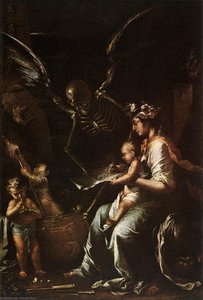
In the turbulent landscape of the seventeenth century, few figures captured the spirit of rebellion and intellectual depth quite like Salvator Rosa. His Self-Portrait, completed around 1645, is far more than a mere record of his physical likeness; it is a profound window into the Baroque soul. As the viewer encounters this masterpiece, they are met with a gaze that is both piercing and introspective, pulling them into a world where the boundaries between the artist’s persona and the weight of philosophical thought begin to blur. The portrait presents Rosa in a moment of quiet, heavy contemplation, seated amidst an ethereal, twilight landscape that seems to pulse with the uncertainty of the era.
The composition is masterfully orchestrated to evoke a sense of intimacy and gravity. By utilizing a tight focus on the subject's face and upper torso, Rosa directs our attention toward the psychological terrain of his own mind. The lighting is quintessentially Baroque, employing a dramatic chiaroscuro that carves the features of his face out of the surrounding darkness. This interplay of light and shadow does not merely provide depth; it creates a sense of movement within the stillness, highlighting the rugged textures of his hair and beard while casting much of the background into an indistinct, mysterious gloom. For the collector or designer, this piece offers a commanding presence, acting as a focal point that commands respect and invites long periods of silent study.
Symbolism and the Scholar's Spirit
Every element within this portrait serves a higher narrative purpose, weaving together the artist’s personal identity with the grander intellectual currents of his time. A laurel wreath encircles his head, a classical symbol of victory and poetic achievement that aligns Rosa with the great thinkers of antiquity, such as Plato. This choice suggests that his true triumph lies not in worldly fame, but in the mastery of thought and the pursuit of wisdom. The painting is often interpreted as a personification of philosophy itself—a meditation on silence, wisdom, and the inevitable march of mortality.
The texture of the work further enhances its symbolic weight. Through a deliberate use of impasto, Rosa applied thick layers of oil paint to create a tactile richness, particularly in the wild, untamed strands of his beard. This technique lends a sense of dynamism and raw energy to the figure, mirroring the artist's own reputation as a provocateur and a rebel. The color palette, dominated by somber ochres, deep browns, and muted reds, reinforces a mood of melancholy and gravity, making it an ideal selection for spaces designed for reflection, such as private libraries, study halls, or sophisticated, moody interior galleries.
A Legacy of Rebellion and Beauty
To possess a reproduction of this work is to hold a piece of history marked by defiance. Created during a period of intense religious and political upheaval in Naples, the portrait reflects Rosa’s engagement with the existential questions of his age. He was an artist who refused to be tethered to a single movement, blending the naturalism of Ribera with a romanticized, almost wild approach to landscape that would influence generations of artists well into the nineteenth century. The emotional impact of the piece lies in this very tension—the struggle between the individual and the infinite.
For those seeking to infuse their surroundings with character and historical depth, this Self-Portrait offers an unparalleled opportunity. It is a work that transcends decoration, providing a conversation piece that speaks of intellectual curiosity and the enduring power of the human spirit. Whether placed in a contemporary setting to provide a striking contrast or within a classical room to enhance its traditional elegance, Rosa’s vision remains as potent and captivating today as it was in 1645.
Questions & Answers
Which period of Salvator Rosa's career does "Self-portrait" belong to?
"Self-portrait" represents the Mature Period of Salvator Rosa.
How is the palette of "Self-portrait" by Salvator Rosa described?
"Self-portrait" by Salvator Rosa uses an earthy color palette. The palette summarizes the work's overall color character.
What is the color identity of "Self-portrait" by Salvator Rosa?
The color identity of "Self-portrait" by Salvator Rosa: an earthy palette, dominated by phthalo green (#1f1f17).
Artist Biography
Early Life, Family and Training
In the outskirts of Naples, specifically in Arenella, Salvator Rosa enters the world. The date of his birth remains a point of historical debate, falling on either June 20 or July 21, 1615. He is born into a family of distinct lineages; his mother, Giulia Greca Rosa, belongs to one of the Greek families of Sicily, while his father, Vito Antonio de Rosa, works as a land surveyor. The shadow of Vesuvius looms over his early years, a geological presence that will eventually shape his visual language.
Conflict defines his path toward a vocation. His father, seeking a more stable and traditional life for his son, intends for Salvator Rosa to enter the priesthood or pursue a career as a lawyer. The convent of the Somaschi Fathers is the destination prepared for him. However, the boy's interests pull elsewhere. He turns away from the religious life to pursue the arts in secret. Under the quiet tutelage of his maternal uncle, Paolo Greco, he begins to master the fundamentals of his craft. This clandestine training continues as he moves toward the guidance of Francesco Fracanzano, absorbing the technical foundations that will later allow him to challenge the established aesthetic norms of the Baroque era.
Artistic Career in Naples, Rome and Florence
The trajectory of Rosa's career shifts with the political and social tides of 17th-century Italy. In 1635, he leaves his native Naples for Rome, entering the undisputed art center of the era. He returns to Naples in 1637, but his presence in the city becomes increasingly volatile. By 1648, the artist is forced to flee Naples entirely after becoming involved in a failed uprising against the Spanish rulers. This period of rebellion marks a definitive break from his early years.
His subsequent movement takes him to Florence. This second period in the city offers a different kind of engagement. Beyond the studio, Rosa immerses himself in the intellectual and sensory life of the Florentine circles. He spends his hours playing music, writing poetry, and studying Stoic philosophy. This multifaceted existence informs the depth of his later output, as his interests in the written word and philosophical thought begin to intersect with his visual practice.
Technique and Style
Rosa’s brushwork rejects the polished surfaces and idealized forms that defined much of the Baroque era. Instead, he embraces an unorthodox and extravagant style, favoring the raw and the untamed. He masters chiaroscuro, utilizing the dramatic interplay of light and shadow to sculpt form and mood. This technique does more than define shapes; it creates a sense of tension across the canvas. His landscapes are not idyllic retreats for contemplation but are instead characterized as wild and rugged. Turbulent skies and jagged, rocky terrain dominate his compositions, reflecting a fascination with the volatile power of nature.
The subject matter often moves away from the common religious scenes of his contemporaries. He frequently selects obscure and esoteric subjects drawn from the Bible, mythology, and the lives of philosophers. This intellectual rigor transforms the landscape from a mere backdrop into a central, active participant in the narrative. In his hands, the environment becomes a stage for moral and philosophical inquiry. He often depicts the human figure as marginal, dwarfed by the immense and often hostile scale of the natural world.
- Pythagoras Emerging from the Underworld (1662)
- Democrito E Protagora (1664)
- Self-Portrait as Philosopher of Silence (1641)
Key Works and Masterpieces
The canvas often becomes a site of intense psychological inquiry. In the 1641 work Self-Portrait as Philosopher of Silence, held at the National Gallery, London, the artist confronts the viewer through a lens of quietude. This piece functions as a meditation on wisdom, utilizing a dark, contemplative atmosphere to establish his identity. Similarly, his 1645 Self-Portrait as a Philosopher at the National Gallery, London, reinforces this persona of the thinking man, moving away from mere representation toward an expression of intellectual rigor.
Nature in Rosa's hands is rarely a peaceful backdrop; it is a turbulent force. Around 1640, Ruins in a Rocky Landscape emerged, a work now in the Cleveland Museum of Art that utilizes classical ruins and iridescent light to suggest a world in flux. This ruggedness extends into his mythological and allegorical compositions. The 1662 Pythagoras Emerging from the Underworld, located at the Kimbell Art Museum, Fort Worth, uses dramatic landscape composition to bridge the gap between the physical and the metaphysical. In the same vein, the 1664 Democrito E Protagora at the Hermitage Museum, Saint Petersburg, employs a philosophical allegory set within a dramatic landscape.
Even religious narratives undergo a transformation under his brush. The Baptism of the Eunuch, created in 1660 and held at the Chrysler Museum of Art, Norfolk, infuses the biblical scene with high drama. His ability to navigate these diverse subjects—from the mythological to the sacred—defines his output.
- Self-Portrait as Philosopher of Silence (1641)
- Pythagoras Emerging from the Underworld (1662)
- Democrito E Protagora (1664)
- The Baptism of the Eunuch (1660)
- Ruins in a Rocky Landscape (about 1640)
Legacy and Influence
The impact of Salvator Rosa ripples through the evolution of Baroque art. His departure from the idealized, orderly landscapes of his contemporaries creates a friction that shifts the direction of 17th-century painting. This influence moves through the decades, reaching into the works of later artists like Luca Giordano. He does not merely paint scenery; he constructs a visual language of turbulence that persists long after his death.
His romanticised landscapes and history paintings exert a heavy presence from the 17th century well into the early 19th century. These works act as prototypes for the romantic landscape, trading the "picturesque" classical views for something far more volatile. Instead of calm, pastoral retreats, he presents a wild and often hostile nature. This shift in perspective anticipates the emotional intensity that would later define the Romantic movement.
The legacy of his vision is found in the tension between the human figure and the untamed wilderness. By centering the landscape as a primary subject rather than a mere backdrop for religious or mythological narratives, he alters the hierarchy of genres. His rugged, rocky terrains and stormy skies provide a blueprint for an aesthetic of the sublime, where nature is a force of awe and introspection rather than a controlled garden.
Where to See the Works Today
The physical remnants of Rosa’s restless career are scattered across the major art capitals of Europe and the Americas. In Saint Petersburg, the Hermitage Museum preserves his early precision in the 1640 Portrait of a Man. Across the continent, the Louvre in Paris maintains a presence through his 1652 Heroic Battle. These works anchor his presence in the great institutional collections of the 17th century.
The artist's philosophical and mythological preoccupations find their way into specialized collections as well. The National Gallery in London holds his 1645 Self-Portrait as a Philosopher, a work that captures his intense engagement with intellectual thought. In Fort Worth, the Kimbell Art Museum houses Pythagoras Emerging from the Underworld, a 1662 composition that highlights his ability to merge myth with dramatic landscape. Meanwhile, the Metropolitan Museum of Art in New York contains his 1656 Bandits on a Rocky Coast, a piece that reflects the rugged, untamed nature he favored.
- Art Gallery of South Australia, Adelaide
- Kunsthistorisches Museum, Vienna
- Musée Des Beaux, Strasbourg
- Chrysler Museum of Art, Norfolk

Salvator Rosa
1615 - 1673 , Italy
Quick Facts
- Artistic Movement Or Style: Baroque
- Artists Or Movements Influenced By This Artist: ['Luca Giordano']
- Artists Who Influenced This Artist:
- Ribera
- Poussin
- Full Name: Salvator Rosa
- Nationality: Italian
- Notable Artworks:
- Pythagoras Emerging from the Underworld
- The Baptism of the Eunuch
- Place Of Birth: Arenella, Italy
- Date Of Birth: 1615
- Date Of Death: 1673
Related Articles

Decoding Baroque Grandeur: A Guide to the Drama and Emotion of 17th-Century Art
Explore the breathtaking drama of 17th-century Baroque art. Our expert guide decodes the use of chiaroscuro, emotional intensity, and historical grandeur to help you appreciate and curate timeless masterpieces for your collection.

Salvator Rosa: A Baroque Rebel's Vision of Landscape, Allegory & the Human Condition
Explore the captivating world of Salvator Rosa, a rebellious Baroque master. Discover his dramatic landscapes, allegorical paintings & lasting influence on Romanticism. Hand-painted reproductions available at OriginalUniqueArt.

Baroque Masterpieces: 10 Paintings That Defined an Era |
Journey through the drama & grandeur of Baroque art! Explore 10 masterpieces by Caravaggio, Rembrandt, Rubens & more. Discover stunning oil paintings, rich colors & timeless stories. Find museum-quality reproductions at .

Drama and Light: A Definitive Guide to the Italian Baroque Masterpieces and the Revolution of Chiaroscuro
Explore the dramatic world of Italian Baroque art. Discover how masters like Caravaggio used chiaroscuro and tenebrism to revolutionize painting through light, shadow, and profound realism. A definitive guide for history lovers and art collectors.
Simon Vouet: A Baroque Master's Journey from Italian Influence to French Classicism
Explore the life & art of Simon Vouet, a pivotal French Baroque painter who introduced Italian styles to France. Discover his masterpieces and lasting influence on 17th-century art.