Preview
 Send
Send Share
Share
 Details
 Guide
Guide

 Download
 Similars
 X-Ray
X-Ray Diaporama
 Stats
StatsInterior with Figures
 Oil
Oil- WallArt
- Baroque Interior Scene
 1663
1663- Early Modern
 58.0 x 69.0 cm
 Metropolitan Museum of Art
 Read More
Hand Made Oil Reproduction
Hand-painted oil on canvas in your size and frame, made to order by our artists. ( Switch to Print Switch to Digital Image)




P118B $10

P118H $10

P118W $10

P438Z $10

P508JH $12

P508YH $12

P805H $10

P805Z $10

P919BZ $10

P919G $10

P919XJ $10

P959ZH $10

P968JZ $12

W106C $8

W218G $10

W218JH $8

W218Y $10

W307PJ $10

W316G $10

W316PJ $8

W316Y $10

W398PJ $8

W4111J $10

W500HY $15

W500JH $15

W692G $12

W849H $8

W940BG $15

W953PJ $8




Pick from our preset sizes that match the artwork's original proportions.

Type the width and the height you need, to fit your frame or your wall. This is hand-painted, so for a size with a different shape the artist can paint a bit more around the picture, or cut a bit — you choose. We send you a digital mockup to approve before the painting starts. The picture shown on this page does not show the real result — only the mockup does.
After order, OriginalUniqueArt.com team will email client for instructions and provide a mockup preview
Worldwide Delivery () in 3/4 weeks instead of standard 5 weeks. (22 October). No compromise on quality.

Free Worldwide Express Shipping

High-Quality Linen Canvas

Full Shipping Insurance

Customs Tax Refund Guarantee

True Color Matching Guarantee

100-Day Return Policy (Defects Only)

100% Money-Back Guarantee

Bulk Discount Offer
 Glass option is only available in size under 110 CM

Interior with Figures
Reproduction Medium
Reproduction Size
-


Total Price
$ 300
A Window into the Dutch Golden Age
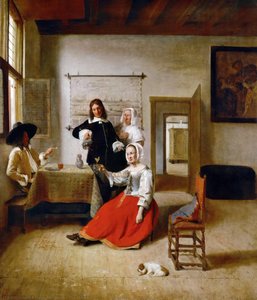
In the quiet, sun-drenched corners of the seventeenth century, Pieter de Hooch captured moments that felt both fleeting and eternal. His masterpiece, "Interior with Figures," painted in 1663, serves as a profound window into the heart of the Dutch Golden Age. This is not merely a painting of a room; it is an invitation into a private world of domestic tranquility and social connection. As we gaze upon the scene, we find ourselves standing alongside the figures, witnessing a gentle gathering that transcends the centuries. The composition centers on a woman seated at a dining table, surrounded by three companions, their presence suggesting a shared meal or a moment of convivial respite. Through De Hooch’s lens, the mundane act of sitting together becomes a sacred ritual of companionship.
The brilliance of this work lies in its masterful command of chiaroscuro—the delicate interplay between light and shadow. De Hooch was a virtuoso of atmosphere, using light not just to illuminate subjects, but to sculpt the very air within the room. A soft, luminous glow seems to permeate the space, catching the edges of the figures and casting gentle shadows that lend a remarkable sense of three-dimensional depth to the canvas. This technique creates an optical illusion so convincing that one can almost feel the warmth of the afternoon sun filtering through a nearby window. For the discerning collector or interior designer, this ability to manipulate light makes the piece a transformative element for any space, capable of adding a layer of sophisticated warmth and luminous texture to a room.
Symbolism and the Beauty of the Everyday
Beyond its technical prowess, "Interior with Figures" is rich with the quiet symbolism characteristic of Dutch genre painting. Every element within the frame serves a purpose in telling a story of prosperity and communal harmony. The bowl resting upon the tabletop is far more than a simple still-life detail; it acts as a symbol of nourishment, hospitality, and the abundance found within a well-ordered home. During this era, the rising middle class sought to celebrate their stability and values through art that honored the domestic sphere. De Hooch captures this perfectly, elevating the everyday routines of bourgeois life to the level of high art. The arrangement of the figures—one man to her left and two others to her right—creates a balanced, harmonious composition that mirrors the social order and peace of the period.
For those looking to bring a sense of historical depth and emotional resonance into their homes, this painting offers an unparalleled connection to the past. It evokes a feeling of nostalgia for a slower, more intentional way of life. The meticulous brushwork captures the subtle textures of fabric, wood, and ceramic, inviting the viewer to linger on the fine details. Whether displayed in a grand gallery or as a focal point in a contemporary living space, a high-quality reproduction of this work serves as a testament to the enduring power of human connection and the quiet beauty found in the most ordinary of moments.
Questions & Answers
What does the 1663 date of "Interior with Figures" correspond to in Pieter de Hooch's career?
The 1663 date places "Interior with Figures" in the Mature Period of Pieter de Hooch's development.
What is the emotional tone of "Interior with Figures" by Pieter de Hooch?
The emotional tone recorded for "Interior with Figures" by Pieter de Hooch is calm. It summarizes the feeling the work expresses.
What does "Interior with Figures" by Pieter de Hooch bring to an interior?
"Interior with Figures" by Pieter de Hooch has an elegant atmosphere and is recommended for a living room. The mood is what the work brings to the space around it.
Artist Biography
early life and training
pieter de hooch, a prominent figure in the dutch golden age, was born on december 20, 1629, in rotterdam, netherlands. he was the eldest of five children to hendrick hendricksz de hooch, a bricklayer, and annetge pieters, a midwife. little is known about his early life, but it is believed that he worked in rotterdam, delft, and amsterdam. de hooch's artistic training took place in haarlem under the landscape painter nicolaes berchem, alongside jacob ochtervelt. this period laid the foundation for his future success as a painter of quiet domestic scenes with an open doorway.artistic style and themes
de hooch's work is characterized by its attention to detail, naturalism, and use of light. his paintings often featured everyday life, reflecting the values and aspirations of the emerging middle class. a notable example of this style is "the courtyard of a house in delft" (1658), which showcases his ability to capture the mundane details of everyday life. de hooch's work also shares themes and compositions with emanuel de witte, but his focus on people and their relationships sets him apart. this is evident in "woman nursing" (1658) and "woman with a baby on her lap" (1658), which demonstrate his interest in domestic scenes.notable works and legacy
some of de hooch's most notable works include:- "the merry drinker" (c. 1650)
- "cardplayers in a sunlit room" (1658)
- "a woman preparing bread and butter for a boy" (1661)
museums and collections
de hooch's work can be found in various museums, including the koninklijk museum voor schone kunsten in antwerp, belgium, which features a vast collection of european art from the 15th to the 20th centuries. discover more about pieter de hooch and his works on OriginalUniqueArt: [https://OriginalUniqueArt.com/@/pieter-de-hooch](https://OriginalUniqueArt.com/@/pieter-de-hooch) /en/art/show/art-d3b4kt-en/ (discover the masterpieces of koninklijk museum voor schone kunsten, belgium) note: the provided links are from OriginalUniqueArt and are relevant to the topic. no external links were added as per the instructions.
Pieter de Hooch
1629 - 1694 , Netherlands
Quick Facts
- Full Name: Pieter Hendricksz de Hooch
- Nationality: Dutch
- Date Of Birth: 1629
- Date Of Death: 1694
- Place Of Birth: Rotterdam, Netherlands
- Notable Artworks:
- The Empty Glass
- Woman Reading a Letter
- Cardplayers in a sunlit room
- A woman preparing bread and butter
- Artistic Movement Or Style: Delft School, Dutch Golden Age
- Artists Who Influenced This Artist: ['Nicolaes Berchem']
- Artists Or Movements Influenced By This Artist: ['Jan Vermeer']
Related Articles

Baroque Drama: Bringing Opulence & Emotion into Contemporary Interiors
Explore the opulent world of Baroque interior design! Discover key elements, modern applications & how to bring dramatic elegance into your home with OriginalUniqueArt.com's authentic reproductions.

Goya's Masterpieces: Explore 25 Iconic Paintings & Art Prints | OriginalUniqueArt
Delve into the world of Francisco Goya with OriginalUniqueArt. Explore 25 iconic paintings – from 'The Third of May' to his haunting Black Paintings. Discover the stories, techniques & emotions behind these Spanish masterpieces. Find museum-quality art reproductions for your home at OriginalUniqueArt.com!

Golden Age Reflections: Dutch Baroque Painting & Cultural Innovation
Explore the Dutch Golden Age of painting! Discover key artists like Vermeer & ter Borch, their innovative techniques, and the rich cultural context behind these Baroque masterpieces. Learn about collecting & appreciating this iconic art period.

Dutch Baroque Masters: 10 Paintings That Shaped an Era | OriginalUniqueArt
Journey through the Golden Age with our guide to the Top 10 Dutch Baroque masterpieces! Explore iconic paintings by Rembrandt, Vermeer & Frans Hals. Find museum-quality art reproductions and elevate your home decor at OriginalUniqueArt.com.
Pieter de Hooch: Illuminating Dutch Domestic Life & Golden Age Charm
Explore the captivating world of Pieter de Hooch, a master of Dutch Golden Age painting. Discover his innovative use of light, intimate domestic scenes, and lasting influence on art history. Learn more at OriginalUniqueArt.