Send
Send Share
Share
 Details
 Guide
Guide

 Download
 Similars
 Diaporama
 Stats
StatsResurrection (detail)


 Read More
Giclée / Art Print
Museum-quality giclée or canvas print with fast production and flexible finish options. ( Buy Hand Made Painting Switch to Digital Image)




































Pick from our preset sizes that match the artwork's original proportions.

Type the width and the height you need, to fit your frame or your wall. A print can only be cut, never made bigger than the picture, so a size with a different shape loses a part of the image. We send you a digital mockup to approve before we print anything. The picture shown on this page does not show the real cut — only the mockup does.
Worldwide Delivery () in 2 weeks instead of standard 4/5 weeks. (23 October)

Free Worldwide Express Shipping

High-Quality Linen Canvas

Full Shipping Insurance

Customs Tax Refund Guarantee

True Color Matching Guarantee

100-Day Return Policy (Defects Only)

100% Money-Back Guarantee

Bulk Discount Offer
 Glass option is only available in size under 110 CM

Resurrection (detail)
Giclée / Art Print
Reproduction Size
-


Total Price
$ 81
A Moment Frozen in Time: The Triumph of Piero della Francesca
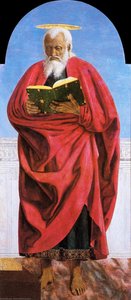
In the quiet, hallowed halls of the Civic Museum of Sansepolcro, there exists a vision of profound spiritual gravity and mathematical grace. Piero della Francesca’s Resurrection is not merely a depiction of a biblical event; it is a masterclass in the Early Renaissance ability to marry the divine with the tangible. Painted around 1463 for the Palazzo della Residenza, this fresco captures the precise moment when the eternal breaks into the temporal world. The scene portrays the pivotal moment following Jesus Christ’s crucifixion—his triumphant emergence from the tomb, surrounded by figures representing disciples and angels. It is a composition that transcends mere storytelling, embodying the core Christian belief in divine redemption and eternal life through a lens of breathtaking visual harmony.
The emotional impact of the work lies in its ability to balance intense drama with an almost otherworldly stillness. As viewers gaze upon the central figure of Christ, arms outstretched and rising from the dead, they are met not with chaotic movement, but with a sense of monumental stability. The figures surrounding him—some appearing as angels, others as startled disciples—react with a spectrum of human emotion, yet all are unified by the artist's signature serenity. For the collector or designer, this piece offers more than just a religious motif; it provides an atmosphere of solemn reverence and intellectual depth that can anchor a room with its commanding presence.
The Geometry of the Divine
What truly distinguishes Piero della Francesca from his contemporaries is his unwavering commitment to disegno—a meticulous rendering of form achieved through careful observation and geometric projection. The painting is a testament to his dual identity as both an artist and a mathematician. Utilizing a sophisticated grid system, Piero employed mathematical principles to ensure accurate proportions and spatial relationships, reflecting the broader humanist preoccupation with understanding the universe through rational laws. This scientific approach creates a sense of divine proportion, where every limb, shadow, and architectural element feels purposefully placed within a cosmic order.
His technique favors clarity over flamboyant ornamentation. Eschewing the overly bright palettes used by some of his peers, Piero employed a muted, sophisticated palette dominated by earthy tones such as ochre, umber, and ivory. This choice of color emphasizes the structural integrity of the figures and the permanence of the scene. The light does not merely illuminate the subjects; it seems to emanate from within the very geometry of the composition, creating an immersive experience that invites long, meditative study. For those seeking a high-quality reproduction, this emphasis on tonal harmony ensures that the artwork integrates seamlessly into refined, classical, or contemporary interiors alike.
A Legacy of Renaissance Humanism
To understand the Resurrection is to understand the seismic shifts occurring in 15th-century Italy. Painted during a period of intense artistic innovation, this work represents a deliberate and sophisticated reaction against prevailing trends. While artists in Florence were pioneering perspectival illusionism, Piero was refining a style that prioritized stability, clarity, and the intellectual rigor of the Early Renaissance. The fresco was originally commissioned for the communal meeting hall of Sansepolcro, intended to be viewed by magistrates and governors as they gathered for council—a reminder that secular governance and spiritual devotion were intimately intertwined.
Today, this masterpiece continues to serve as a cornerstone of art history, offering inspiration to anyone moved by the pursuit of ideal form. Whether displayed as a focal point in a private gallery or as a sophisticated element in a curated living space, a reproduction of this fresco brings with it the weight of history and the beauty of mathematical truth. It remains an enduring symbol of the human spirit's capacity to rise, captured through the eyes of a Tuscan visionary who saw the hand of God in the precision of a line.
Questions & Answers
What technique was used for "Resurrection (detail)" by Piero della Francesca?
"Resurrection (detail)" is executed in fresco.
How old was Piero della Francesca when creating "Resurrection (detail)" in 1463?
When "Resurrection (detail)" was created in 1463, Piero della Francesca - born in 1415 - was 48 years old.
How do movement and era meet in "Resurrection (detail)" by Piero della Francesca?
"Resurrection (detail)" belongs to the Early Renaissance movement, and its creator worked in the Renaissance era.
Artist Biography
The geometry of a quiet life
In the small, sun-drenched town of Sansepolcro, Piero di Benedetto de’ Franceschi lived a life shaped by the precise lines of his surroundings. His father worked with leather and wool, a trade that required a steady hand and an eye for detail. This early environment, far from the crowded workshops of larger cities, provided a foundation of stillness. He learned to see the world through the lens of order. Around 1439, he moved toward Florence, where the air was thick with new ways of seeing. There, he worked alongside Domenico Veneziano and studied the works of Masaccio in the Brancacci Chapel. He did not simply look at these paintings; he measured them. He took the innovations of Brunelleschi and broke them down into mathematical truths.
His hands moved between the brush and the compass. To him, a figure was as much a product of geometry as it was of anatomy. This way of working meant that light did not just fall upon a surface; it defined the volume of every limb and stone. He understood how a single vanishing point could pull a viewer into a deep, constructed space. His mind occupied the space between art and science, treating the canvas as a field for mathematical exploration.
The weight of the fresco
Much of his work remains fixed to the walls of churches in Tuscany. In the Basilica of San Francesco in Arezzo, he spent years working on the cycle of frescoes known as The History of the True Cross. These scenes are not hurried. Each figure possesses a heavy, quiet dignity. He used light and shadow to give weight to the characters, making them feel as solid as the architecture surrounding them. In other works, like the Baptism of Christ, he used a restrained palette to create an atmosphere of clarity. The colors are not loud, yet they possess a luminous quality that seems to come from within the figures themselves.
His approach to composition relied on strict principles:
- The use of linear perspective to create measurable depth.
- A focus on balanced, symmetrical arrangements.
- The application of geometric forms to human anatomy.
- The use of light to define physical volume and mass.
In the Montefeltro Altarpiece, his skill with oil painting allowed for a meticulous rendering of detail in the portraits of Federico da Montefeltro and Battista Sforza. He captured the texture of skin and the weight of fabric with a scientific precision. Even in his more recent works, such as The Nativity, he placed sacred scenes within a recognizable landscape, using the hills and rivers of the Tuscan countryside to ground the divine in the earthly.
A legacy of measurement
Piero was also a writer, documenting his findings in De Prospectiva Pingendi. This treatise on perspective painting shows that his interest in math was not secondary to his art; it was the core of it. He wrote about how to use geometry to represent the three-dimensional world on a flat surface. His work bridged the gap between the older, more decorative Gothic traditions and the new, rational Renaissance style. He sought beauty through proportion and order.
He died in 1492, leaving behind a body of work that influenced those who followed, including Leonardo da Vinci and Raphael. They looked to his mastery of light and his ability to organize space with mathematical certainty. His paintings remain windows into a world where the spiritual and the rational exist in a state of permanent, quiet balance.

Piero della Francesca
1415 - 1492 , Italy
Quick Facts
- Artistic Movement Or Style: Early Renaissance
- Artists Or Movements Influenced By This Artist:
- Leonardo da Vinci
- Raphael
- Artists Who Influenced This Artist:
- Masaccio
- Brunelleschi
- Full Name: Piero di Benedetto de' Franceschi
- Nationality: Italian
- Notable Artworks:
- The History of the True Cross
- Montefeltro Altarpiece
- Baptism of Christ
- The Resurrection
- The Nativity
- Place Of Birth: San Sepolcro, Italy
- Date Of Birth: 1415
- Date Of Death: 1492
Related Articles

The Enduring Legacy of Fresco: Technique, History & Artistic Expression
Explore the rich history & enduring artistry of fresco painting. Discover techniques from Giotto to Michelangelo, conservation efforts, & modern applications. Learn how OriginalUniqueArt brings this timeless art form to your home.

The Fresco as Family Legacy: Preserving Heritage Through Wall Art
Explore the rich history & enduring legacy of fresco painting. Discover how to preserve family heritage through stunning wall art. Expert insights & restoration guidance.
The Enduring Legacy of Fresco Painting: Techniques, History & Contemporary Relevance
Explore the rich history & enduring artistry of fresco painting – from Giotto to Michelangelo! Discover techniques, conservation efforts, & modern applications. Learn how OriginalUniqueArt brings this timeless art form to your home.

The Enduring Legacy of Fresco: Technique, History & Artistic Expression Across Cultures
Explore the rich history & enduring legacy of fresco painting! Discover ancient techniques, Giotto's masterpieces, and modern applications. Expert insights for art lovers & professionals.
Art That Lives With You: The Emotional Power of a Custom Interior Fresco
Discover the emotional power & timeless beauty of custom interior frescoes. Explore history, design tips & expert guidance from – creating lasting legacies.