Menu
Text size

() ·

A painting made for you, by hand

Resurrection (detail)

Hand Made Oil Reproduction

Hand-painted oil on canvas in your size and frame, made to order by our artists. ( Switch to Print Switch to Digital Image)

Collectible Description

Experience the profound geometric precision and spiritual triumph of Piero della Francesca’s Early Renaissance masterpiece The Resurrection, a monumental fresco inviting you to explore its divine beauty.

Artist Biography

An Early Renaissance master known for The History of the True Cross. Discover his geometric precision and serene beauty today.

from ·

Chapter 1

How large should it be?

Slide to change the size; the picture on the left shows the frame at its real width. The proportions of the original are kept.

Standard
custom
CM
INCH

Pick from our preset sizes that match the artwork's original proportions.

width
height

Type the width and the height you need, to fit your frame or your wall. This is hand-painted, so for a size with a different shape the artist can paint a bit more around the picture, or cut a bit — you choose. We send you a digital mockup to approve before the painting starts. The picture shown on this page does not show the real result — only the mockup does.

Chapter 2

How should it arrive?

Choose the edges of the stretched canvas

Choose your frame

Corner sample of the WhiteWrap canvas edge finish, stretched on solid wood bars
White $1
Corner sample of the BlurSideWrap canvas edge finish, stretched on solid wood bars
Blurside $1
Corner sample of the ExtendedWrap canvas edge finish, stretched on solid wood bars
Extended $1
Corner sample of the P118B picture frame: moulded polystyrene, 5 cm wide and 3 cm thick
P118B $10
Corner sample of the P118H picture frame: moulded polystyrene, 5 cm wide and 3 cm thick
P118H $10
Corner sample of the P118W picture frame: moulded polystyrene, 5 cm wide and 3 cm thick
P118W $10
Corner sample of the P438Z picture frame: moulded polystyrene, 5.5 cm wide and 3.5 cm thick
P438Z $10
Corner sample of the P508JH picture frame: moulded polystyrene, 7 cm wide and 3.5 cm thick
P508JH $12
Corner sample of the P508YH picture frame: moulded polystyrene, 7 cm wide and 3.5 cm thick
P508YH $12
Corner sample of the P805H picture frame: moulded polystyrene, 5 cm wide and 3.5 cm thick
P805H $10
Corner sample of the P805Z picture frame: moulded polystyrene, 5 cm wide and 3.5 cm thick
P805Z $10
Corner sample of the P919BZ picture frame: moulded polystyrene, 7 cm wide and 3.5 cm thick
P919BZ $10
Corner sample of the P919G picture frame: moulded polystyrene, 7 cm wide and 3.5 cm thick
P919G $10
Corner sample of the P919XJ picture frame: moulded polystyrene, 7 cm wide and 3.5 cm thick
P919XJ $10
Corner sample of the P959ZH picture frame: moulded polystyrene, 5 cm wide and 3 cm thick
P959ZH $10
Corner sample of the P968JZ picture frame: moulded polystyrene, 6 cm wide and 4 cm thick
P968JZ $12
Corner sample of the W106C picture frame: solid wood, 5 cm wide and 3 cm thick
W106C $8
Corner sample of the W218G picture frame: solid wood, 5 cm wide and 3 cm thick
W218G $10
Corner sample of the W218JH picture frame: solid wood, 5 cm wide and 3 cm thick
W218JH $8
Corner sample of the W218Y picture frame: solid wood, 5 cm wide and 3 cm thick
W218Y $10
Corner sample of the W307PJ picture frame: solid wood, 6 cm wide and 3 cm thick
W307PJ $10
Corner sample of the W316G picture frame: solid wood, 6 cm wide and 3 cm thick
W316G $10
Corner sample of the W316PJ picture frame: solid wood, 6 cm wide and 3 cm thick
W316PJ $8
Corner sample of the W316Y picture frame: solid wood, 6 cm wide and 3 cm thick
W316Y $10
Corner sample of the W398PJ picture frame: solid wood, 5 cm wide and 3 cm thick
W398PJ $8
Corner sample of the W4111J picture frame: solid wood, 6.5 cm wide and 3.5 cm thick
W4111J $10
Corner sample of the W500HY picture frame: solid wood, 7 cm wide and 5 cm thick
W500HY $15
Corner sample of the W500JH picture frame: solid wood, 7 cm wide and 5 cm thick
W500JH $15
Corner sample of the W692G picture frame: solid wood, 8 cm wide and 4 cm thick
W692G $12
Corner sample of the W849H picture frame: solid wood, 5 cm wide and 3 cm thick
W849H $8
Corner sample of the W940BG picture frame: solid wood, 7.5 cm wide and 4.5 cm thick
W940BG $15
Corner sample of the W953PJ picture frame: solid wood, 6 cm wide and 3.5 cm thick
W953PJ $8
Corner sample of the H24-GOLD picture frame: carved wood with gesso, 10 cm wide and 6 cm thick
H24-GOLD $30
Corner sample of the H24-SILVER picture frame: carved wood with gesso, 10 cm wide and 6 cm thick
H24-SILVER $30
Corner sample of the H36-GOLD picture frame: carved wood with gesso, 15 cm wide and 6.5 cm thick
H36-GOLD $45
Corner sample of the H36-SILVER picture frame: carved wood with gesso, 15 cm wide and 6.5 cm thick
H36-SILVER $45
Frame preview
Framed

Moulding: . Overall size with the frame: .

Chapter 3

Who paints it, and should anything change?

Examples of what can be changed: Replace face with customer photo; Add pet (e.g., replace cat with dog); Include hidden message in background; Change background landscape or elements.
After order, OriginalUniqueArt.com team will email client for instructions and provide a mockup preview

Worldwide Delivery () in 3/4 weeks instead of standard 5 weeks. (29 October). No compromise on quality.

Chapter 4

The finishing touches

A nameplate, as in a museum?

Engraved Bronze Plaque Details

This elegant plaque features the artist's name and the title of the artwork, finely engraved for a timeless presentation.

It is made from bronze with a refined, elegant finish. The text is precisely laser-engraved for a sharp and permanent result. Measuring 9x2 cm, the plaque is compact yet easy to read. It's built to be durable and scratch-resistant, offering a professional, museum-quality look. Mounting is simple thanks to the included adhesive backing.

Transparent Acrylic Plaque Details

The plaque includes essential engraved details such as the artist's name, the title of the artwork, the date it was created, the type of media used-like oil on canvas or watercolor-a brief description of the piece, and a QR code that links to the complete artwork information.

It is crafted from clear acrylic, offering a sleek, modern appearance. The text is UV-engraved in black to ensure strong visual contrast. With a size of 10x15 cm, it ensures optimal readability. It comes equipped with two metal hooks for secure wall mounting. The plaque is designed to be weather-resistant, making it suitable for various environments, and it includes interactive features that work seamlessly with smartphone scanning.

Black Acrylic Plaque Details

This elegant plaque includes engraved information such as the artist's name, the title of the artwork, the date it was created, the type of media used (like oil on canvas or watercolor), a short description of the artwork, and a QR code for quick access to more information.

The plaque itself is made from refined black acrylic with a premium finish. The text is laser-engraved in white for high contrast and readability. Its size is 10x15 cm, designed to be easy to read. It comes with two metal hooks for professional mounting. The design is sleek and fits any interior style. It is also weather-resistant and durable, with built-in digital integration for mobile compatibility.

A protective varnish?

When do you need it?

Chapter 5

Your painting, as you ordered it

Resurrection (detail)

Reproduction Medium

Reproduction Size

-

Elite Senior Artist

More detail, finesse, and extra production time

-

Reproduction Frame

-

-

For artworks or reproductions larger than 105 cm (approximately 41 inches) on any side, the frame will be shipped as a kit, disassembled. This method ensures safe delivery and prevents damage during transport.

Professional assembly required - this is not a DIY product.
The kit must be assembled and the canvas stretched by an experienced professional framer, using wood glue (not supplied), a canvas stretching plier and clamps to hold the bars square while the glue dries. Incorrect assembly or uneven canvas tension can permanently damage the artwork and is not covered by our warranty.

  • All solid wood bars are included, precisely cut to size.

  • Assembled with the screws provided, plus wood glue for the corner joints, which is not supplied and must be sourced by your framer.

  • Professional tools are required and not included: a canvas stretching plier (tensioner) and clamps to hold the bars square while the glue dries.

Important:
The corner joints require wood glue, the bars must be held with clamps until the glue is fully dry, and tightening the canvas on the assembled frame requires a canvas stretching plier. None of these are included in the kit. Please arrange an experienced professional framer before ordering this size.

Nameplate

-

-

Protective Varnish

Glossy Varnish (enhances colors, protects against light/moisture)

-

Customize My Artwork

Examples of what can be changed: Replace face with customer photo; Add pet (e.g., replace cat with dog); Include hidden message in background; Change background landscape or elements.

-

Urgent

Worldwide Delivery () in 3/4 weeks instead of standard 5 weeks. (29 October). No compromise on quality.

-

Express Shipping

Worldwide Delivery () in 5 weeks. (5 November).

Included

Total Price

$ 300

Total Price $ 300

Glass option is only available in size under 110 CM

Included with every order

  • Free Worldwide Express Shipping
  • High-Quality Linen Canvas
  • Full Shipping Insurance
  • Customs Tax Refund Guarantee
  • True Color Matching Guarantee
  • 100-Day Return Policy (Defects Only)
  • 100% Money-Back Guarantee
  • Bulk Discount Offer

A Moment Frozen in Time: The Triumph of Piero della Francesca

In the quiet, hallowed halls of the Civic Museum of Sansepolcro, there exists a vision of profound spiritual gravity and mathematical grace. Piero della Francesca’s Resurrection is not merely a depiction of a biblical event; it is a masterclass in the Early Renaissance ability to marry the divine with the tangible. Painted around 1463 for the Palazzo della Residenza, this fresco captures the precise moment when the eternal breaks into the temporal world. The scene portrays the pivotal moment following Jesus Christ’s crucifixion—his triumphant emergence from the tomb, surrounded by figures representing disciples and angels. It is a composition that transcends mere storytelling, embodying the core Christian belief in divine redemption and eternal life through a lens of breathtaking visual harmony.

The emotional impact of the work lies in its ability to balance intense drama with an almost otherworldly stillness. As viewers gaze upon the central figure of Christ, arms outstretched and rising from the dead, they are met not with chaotic movement, but with a sense of monumental stability. The figures surrounding him—some appearing as angels, others as startled disciples—react with a spectrum of human emotion, yet all are unified by the artist's signature serenity. For the collector or designer, this piece offers more than just a religious motif; it provides an atmosphere of solemn reverence and intellectual depth that can anchor a room with its commanding presence.

The Geometry of the Divine

What truly distinguishes Piero della Francesca from his contemporaries is his unwavering commitment to disegno—a meticulous rendering of form achieved through careful observation and geometric projection. The painting is a testament to his dual identity as both an artist and a mathematician. Utilizing a sophisticated grid system, Piero employed mathematical principles to ensure accurate proportions and spatial relationships, reflecting the broader humanist preoccupation with understanding the universe through rational laws. This scientific approach creates a sense of divine proportion, where every limb, shadow, and architectural element feels purposefully placed within a cosmic order.

His technique favors clarity over flamboyant ornamentation. Eschewing the overly bright palettes used by some of his peers, Piero employed a muted, sophisticated palette dominated by earthy tones such as ochre, umber, and ivory. This choice of color emphasizes the structural integrity of the figures and the permanence of the scene. The light does not merely illuminate the subjects; it seems to emanate from within the very geometry of the composition, creating an immersive experience that invites long, meditative study. For those seeking a high-quality reproduction, this emphasis on tonal harmony ensures that the artwork integrates seamlessly into refined, classical, or contemporary interiors alike.

A Legacy of Renaissance Humanism

To understand the Resurrection is to understand the seismic shifts occurring in 15th-century Italy. Painted during a period of intense artistic innovation, this work represents a deliberate and sophisticated reaction against prevailing trends. While artists in Florence were pioneering perspectival illusionism, Piero was refining a style that prioritized stability, clarity, and the intellectual rigor of the Early Renaissance. The fresco was originally commissioned for the communal meeting hall of Sansepolcro, intended to be viewed by magistrates and governors as they gathered for council—a reminder that secular governance and spiritual devotion were intimately intertwined.

Today, this masterpiece continues to serve as a cornerstone of art history, offering inspiration to anyone moved by the pursuit of ideal form. Whether displayed as a focal point in a private gallery or as a sophisticated element in a curated living space, a reproduction of this fresco brings with it the weight of history and the beauty of mathematical truth. It remains an enduring symbol of the human spirit's capacity to rise, captured through the eyes of a Tuscan visionary who saw the hand of God in the precision of a line.

Questions & Answers

What subject and atmosphere does "Resurrection (detail)" by Piero della Francesca combine?

"Resurrection (detail)" by Piero della Francesca combines religious scene, resurrection, jesus christ, medieval art, renaissance fresco, italian painting, biblical narrative with an inspirational atmosphere.

Is "Resurrection (detail)" by Piero della Francesca among the sought-after Early Renaissance artworks?

Within the Early Renaissance movement, "Resurrection (detail)" has an iconic popularity level.

Is there a factsheet about "Resurrection (detail)" by Piero della Francesca for students?

The Guide page of "Resurrection (detail)" by Piero della Francesca offers a printable two-sheet factsheet: the artwork with its identity table, a decade band placing it in the artist's lifetime, other works by the artist, the measured color palette, and ready-to-copy citations in four styles.

More about this painting

Switch to Print Switch to Digital Image Send
Details Guide Add to favorites Download Similars Diaporama Q&A Stats

In numbers

  • 1463the year it was painted
  • 29frames to choose from
  • standard sizes, in its own proportions
  • 5weeks to paint and deliver it
Piero della Francesca

Piero della Francesca

1415 - 1492, Italy

Quick facts about Piero della Francesca

  • Artistic Movement Or Style: Early Renaissance
  • Artists Or Movements Influenced By This Artist:
    • Leonardo da Vinci
    • Raphael
  • Artists Who Influenced This Artist:
    • Masaccio
    • Brunelleschi
  • Full Name: Piero di Benedetto de' Franceschi
  • Nationality: Italian
  • Notable Artworks:
    • The History of the True Cross
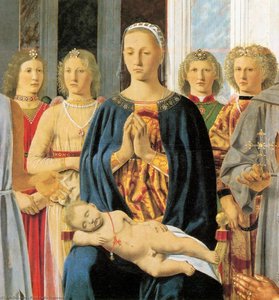
    • Montefeltro Altarpiece
    • Baptism of Christ
    • The Resurrection
    • The Nativity
  • Place Of Birth: San Sepolcro, Italy
  • Date Of Birth: 1415
  • Date Of Death: 1492

Artist Biography

The geometry of a quiet life

In the small, sun-drenched town of Sansepolcro, Piero di Benedetto de’ Franceschi lived a life shaped by the precise lines of his surroundings. His father worked with leather and wool, a trade that required a steady hand and an eye for detail. This early environment, far from the crowded workshops of larger cities, provided a foundation of stillness. He learned to see the world through the lens of order. Around 1439, he moved toward Florence, where the air was thick with new ways of seeing. There, he worked alongside Domenico Veneziano and studied the works of Masaccio in the Brancacci Chapel. He did not simply look at these paintings; he measured them. He took the innovations of Brunelleschi and broke them down into mathematical truths.

His hands moved between the brush and the compass. To him, a figure was as much a product of geometry as it was of anatomy. This way of working meant that light did not just fall upon a surface; it defined the volume of every limb and stone. He understood how a single vanishing point could pull a viewer into a deep, constructed space. His mind occupied the space between art and science, treating the canvas as a field for mathematical exploration.

The weight of the fresco

Much of his work remains fixed to the walls of churches in Tuscany. In the Basilica of San Francesco in Arezzo, he spent years working on the cycle of frescoes known as The History of the True Cross. These scenes are not hurried. Each figure possesses a heavy, quiet dignity. He used light and shadow to give weight to the characters, making them feel as solid as the architecture surrounding them. In other works, like the Baptism of Christ, he used a restrained palette to create an atmosphere of clarity. The colors are not loud, yet they possess a luminous quality that seems to come from within the figures themselves.

His approach to composition relied on strict principles:

  • The use of linear perspective to create measurable depth.
  • A focus on balanced, symmetrical arrangements.
  • The application of geometric forms to human anatomy.
  • The use of light to define physical volume and mass.

In the Montefeltro Altarpiece, his skill with oil painting allowed for a meticulous rendering of detail in the portraits of Federico da Montefeltro and Battista Sforza. He captured the texture of skin and the weight of fabric with a scientific precision. Even in his more recent works, such as The Nativity, he placed sacred scenes within a recognizable landscape, using the hills and rivers of the Tuscan countryside to ground the divine in the earthly.

A legacy of measurement

Piero was also a writer, documenting his findings in De Prospectiva Pingendi. This treatise on perspective painting shows that his interest in math was not secondary to his art; it was the core of it. He wrote about how to use geometry to represent the three-dimensional world on a flat surface. His work bridged the gap between the older, more decorative Gothic traditions and the new, rational Renaissance style. He sought beauty through proportion and order.

He died in 1492, leaving behind a body of work that influenced those who followed, including Leonardo da Vinci and Raphael. They looked to his mastery of light and his ability to organize space with mathematical certainty. His paintings remain windows into a world where the spiritual and the rational exist in a state of permanent, quiet balance.

Quick Facts

  • Medium: Fresco
  • Year: 1463
  • Title: The Resurrection
  • Location: Civic Museum, Sansepolcro
  • Movement: Early Renaissance

Art Quiz

There is only one correct answer for each question.

Question 1:
What is the primary subject matter of Piero della Francesca’s ‘The Resurrection’?
Question 2:
The fresco was commissioned for what purpose?
Question 3:
What artistic technique is Piero della Francesca primarily known for?
Question 4:
According to Smarthistory, what was notable about the fresco’s survival during World War II?
Question 5:
Giovanni Santi, Piero della Francesca’s student and father of Raphael, greatly influenced Piero's style. What is a key characteristic of Santi’s artistic approach?