Preview
 Send
Send Share
Share
 Details
 Guide
Guide

 Download
 Similars
 X-Ray
X-Ray Diaporama
 Stats
StatsThe Grammar


 Read More
Hand Made Oil Reproduction
Hand-painted oil on canvas in your size and frame, made to order by our artists. ( Switch to Print Switch to Digital Image)




P118B $10

P118H $10

P118W $10

P438Z $10

P508JH $12

P508YH $12

P805H $10

P805Z $10

P919BZ $10

P919G $10

P919XJ $10

P959ZH $10

P968JZ $12

W106C $8

W218G $10

W218JH $8

W218Y $10

W307PJ $10

W316G $10

W316PJ $8

W316Y $10

W398PJ $8

W4111J $10

W500HY $15

W500JH $15

W692G $12

W849H $8

W940BG $15

W953PJ $8




Pick from our preset sizes that match the artwork's original proportions.

Type the width and the height you need, to fit your frame or your wall. This is hand-painted, so for a size with a different shape the artist can paint a bit more around the picture, or cut a bit — you choose. We send you a digital mockup to approve before the painting starts. The picture shown on this page does not show the real result — only the mockup does.
After order, OriginalUniqueArt.com team will email client for instructions and provide a mockup preview
Worldwide Delivery () in 3/4 weeks instead of standard 5 weeks. (26 October). No compromise on quality.

Free Worldwide Express Shipping

High-Quality Linen Canvas

Full Shipping Insurance

Customs Tax Refund Guarantee

True Color Matching Guarantee

100-Day Return Policy (Defects Only)

100% Money-Back Guarantee

Bulk Discount Offer
 Glass option is only available in size under 110 CM

The Grammar
Reproduction Medium
Reproduction Size
-


Total Price
$ 300
The Grammar: A Pioneering Exploration of Abstraction
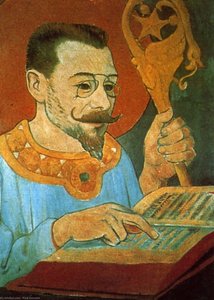
Paul Sérusier’s “Grammar,” painted in 1892, stands as a pivotal work not just within the artist's oeuvre but also as a foundational piece in the development of modern art. More than simply a portrait, it’s an intensely personal and experimental exploration of color, form, and the very nature of representation – a bold step towards abstraction that profoundly influenced generations of artists to come. The painting depicts a woman seated on the ground, absorbed in reading a book, a scene rendered with remarkable intimacy and a deliberate departure from traditional academic styles.
Sérusier’s artistic journey was deeply intertwined with the burgeoning Nabis movement, a group of Symbolist painters who sought to move beyond mere imitation of nature towards expressing inner emotions and spiritual truths. He initially studied at the Académie Julian, but it was his summer sojourn in Pont-Aven, Brittany, that proved transformative. There, under the tutelage of Paul Gauguin – a figure whose influence extended far beyond technique – Sérusier encountered the revolutionary approach of Cloisonnism, championed by Gauguin himself. This style, characterized by sharply defined outlines and areas of flat color applied in small, separate strokes, aimed to mimic the appearance of stained glass, creating a sense of luminous clarity and symbolic resonance.
Cloisonnism and the Language of Color
“Grammar” exemplifies this Cloisonnism technique with striking precision. The woman’s figure is not rendered through subtle gradations of tone but rather defined by bold, distinct outlines – a deliberate simplification that prioritizes color and form over meticulous detail. Sérusier employs a vibrant palette, dominated by deep blues, greens, and ochres, creating an atmosphere both serene and slightly melancholic. The colors aren’t blended; instead, they are applied in small, separate strokes, building up layers of hue and texture. This technique, combined with the flattened perspective, creates a sense of immediacy and directness, as if the painting is capturing a fleeting moment of contemplation.
Crucially, Sérusier’s use of color isn't merely descriptive; it carries symbolic weight. The blues evoke a sense of introspection and mystery, while the greens suggest connection to nature – a key theme in Symbolist art. The muted ochres contribute to the painting’s overall feeling of quietude and contemplation. The deliberate choice of colors, rather than realistic representation, is central to the work's expressive power.
A Study in Form and Abstraction
Beyond its technical mastery, “Grammar” represents a significant shift towards abstraction. While not entirely devoid of recognizable forms – the woman’s figure, the book, the surrounding objects – the painting prioritizes the exploration of color and form over strict representation. The simplified shapes, flattened perspective, and emphasis on pure color anticipate later developments in abstract art, foreshadowing the work of artists like Kandinsky and Mondrian. It's a deliberate move away from photographic realism towards a more subjective and expressive approach to visual language.
The painting’s title, “Grammar,” is particularly intriguing. It suggests that Sérusier was not simply depicting a scene but rather exploring the fundamental building blocks of artistic expression – the elements of color, line, and form – in a way that transcends traditional representation. The book itself becomes a symbol of knowledge and contemplation, inviting the viewer to engage with the painting on a deeper level.
Legacy and Inspiration
“Grammar” remains a vital work in the history of modern art, demonstrating Sérusier’s pioneering spirit and his profound influence on subsequent generations. It's a testament to the power of abstraction to convey emotion, ideas, and spiritual truths. Reproductions of this evocative painting continue to inspire artists and collectors alike, offering a glimpse into the heart of artistic innovation and the enduring quest for new forms of visual expression.
Questions & Answers
What are the date and style of "The Grammar" by Paul Sérusier?
"The Grammar" by Paul Sérusier is dated 1892 and belongs to Cloisonnism / Nabis.
What art movement does "The Grammar" by Paul Sérusier belong to?
The movement associated with "The Grammar" by Paul Sérusier is Cloisonnism / Nabis. This classification situates the work among related artists and artworks.
How can "The Grammar" by Paul Sérusier be used in home decor?
"The Grammar" is suggested for reflective, and the recommended space is a living room.
Artist Biography
early life and education
paul sérusier, a french painter, was born on november 9, 1864, in paris. he studied at the académie julian, where he became a monitor in the mid-1880s. this marked the beginning of his artistic journey, which would eventually lead him to pioneer abstract art and inspire the avant-garde nabis movement, synthetism, and cloisonnism.artistic career
in the summer of 1888, sérusier traveled to pont-aven, where he joined a small group of artists centered around paul gauguin. under gauguin's close supervision, sérusier painted "the talisman," an extreme exercise in cloisonnism that approximated pure abstraction. this piece showcased his innovative style and willingness to experiment with new techniques. as a post-impressionist painter, sérusier was part of the group les nabis, alongside pierre bonnard, édouard vuillard, and maurice denis. although not as widely recognized as some of his peers, sérusier's contributions to the development of abstract art are undeniable.notable works and legacy
some of sérusier's notable works include:- l'averse (1893), musée d'orsay, paris
- portrait of paul ranson (1890), musée d'orsay, paris
- melancholy (1890)
- the snake eaters (1894), muzeum narodowe, warsaw
artistic movement and influence
sérusier's work was influenced by cloisonnism, a style characterized by bold and flat forms separated by dark contours. this movement, which emerged in the late 19th century, played a significant role in shaping the development of modern art.- explore more on cloisonnism: the cloisonnism art movement
- discover sérusier's work: paul serusier | OriginalUniqueArt.com
- learn about the nabis movement: the nabis art movement

Paul Sérusier
1864 - 1927 , France
Quick Facts
- Full Name: Louis-Paul-Henri Sérusier
- Nationality: French
- Date Of Birth: 1864
- Date Of Death: 1927
- Place Of Birth: Paris, France
- Notable Artworks:
- The Talisman
- Landscape at the Bois d’Amour
- Artistic Movement Or Style: Post-Impressionism
- Artists Who Influenced This Artist:
- Paul Gauguin
- Maurice Denis
Related Articles

Abstract Expressionism's 10 Defining Masterpieces |
Explore 10 defining Abstract Expressionism masterpieces by Pollock, Rothko & de Kooning. Discover the stories behind these iconic paintings and find museum-quality art reproductions to elevate your home decor on .

Geometric Abstraction's 10 Defining Masterpieces | Art for Your Home - OriginalUniqueArt
Explore 10 defining masterpieces of Geometric Abstraction! Discover Kandinsky, Mondrian & Malevich’s iconic works. Find museum-quality art reproductions and curated decor ideas to elevate your home at OriginalUniqueArt.com.

Cézanne's Masterpieces: 25 Iconic Artworks to Transform Your Space
Journey through 25 iconic artworks by Paul Cézanne – a master of Impressionism and Post-Impressionism. Explore his landscapes, still lifes, and the stories behind these timeless masterpieces. Discover museum-quality reproductions & curated decor at OriginalUniqueArt.com.
Paul Sérusier: Pioneering Synthetism & The Nabis’ Symbolic Revolution
Discover Paul Sérusier's pivotal role in the Nabis movement & the birth of Synthetism. Explore 'The Talisman,' his influence on modern art, and a deeper understanding of this symbolic revolution. Expert analysis & insights.
Paul Klee's Masterpieces: Explore 25 Iconic Paintings & Prints | OriginalUniqueArt
Journey through Paul Klee's 25 most iconic paintings & prints. Explore his abstract style, Bauhaus influence, and vibrant color palettes. Find museum-quality art reproductions & decor ideas at OriginalUniqueArt.com. Discover all masterpieces online.