The Pont-Aven Genesis: Sérusier’s Encounter with Gauguin
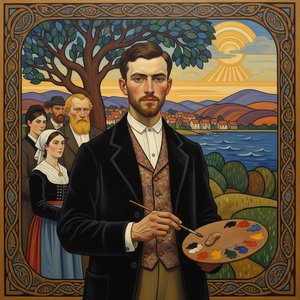
The story of Paul Sérusier is inextricably linked to a single, transformative summer spent in the Breton village of Pont-Aven during 1888. While many artists sought refuge in this remote corner of France, drawn by its rugged landscapes and vibrant light, it was his encounter with Paul Gauguin that proved decisive for Sérusier’s artistic trajectory—and, arguably, for the course of modern painting itself. Arriving at a moment when Impressionism's descriptive ambitions were beginning to feel exhausted, Sérusier found in Gauguin not merely a fellow artist but a philosophical guide. Gauguin challenged conventional notions of representation, urging him to move beyond mimicking nature and instead to distill its essence through simplified forms and intensely subjective color. This wasn’t simply about *how* to paint; it was about *why*. The prevailing academic approach, with its emphasis on meticulous realism, felt increasingly hollow. Gauguin proposed a radical alternative: to create art that resonated with inner vision, imbued with symbolic meaning rather than photographic accuracy.
The pivotal moment occurred during an en plein air painting session in the Bois d’Amour. Gauguin instructed Sérusier to paint not what he *saw*, but how he *felt* about what he saw. The resulting small panel, a landscape rendered with flat planes of vivid color and bold outlines—a work that would become known as ‘The Talisman’—wasn't a faithful depiction of the Breton countryside. It was an assertion of artistic autonomy, a declaration of independence from representational constraints. This wasn’t merely a stylistic departure; it was a foundational act for a new aesthetic sensibility.
‘The Talisman’: A Paradigm Shift in Painting
‘The Talisman’ is deceptively simple in its appearance: trees and foliage rendered in blocks of red, yellow, blue, and green against a dark background. Yet, its impact reverberated far beyond the confines of Pont-Aven. Upon his return to Paris, Sérusier presented the painting to his fellow students at the Académie Julian. The reaction was initially one of bewilderment, even scorn. However, for a select group—including Pierre Bonnard, Édouard Vuillard, and Maurice Denis—it proved to be a revelation. They recognized in it a potent alternative to academic conventions, a pathway towards a more expressive and symbolic form of art. The painting became their “talisman,” a touchstone around which they coalesced into what would become known as the Nabis – a name derived from the Hebrew word for prophet, signifying their ambition to infuse art with spiritual meaning.
What made ‘The Talisman’ so revolutionary wasn't just its aesthetic qualities but also the story surrounding its creation. Maurice Denis famously recounted Gauguin’s instructions—the emphasis on using color directly from the tube, the rejection of naturalistic shading, and the prioritization of subjective experience. This narrative transformed the painting into a symbol of artistic liberation, a testament to the power of inner vision. It wasn't about replicating reality; it was about creating a new one, governed by the artist’s own aesthetic principles.
Synthetism Defined: Beyond Impressionism and Towards Abstraction
Synthetism is a term used by Post-Impressionist artists like Paul Gauguin, Émile Bernard and Louis Anquetin to distinguish their work stylistically from Impressionism. Earlier, Synthetism has been connected to the term Cloisonnism, and later to Symbo...
The term “Synthetism,” coined in opposition to Impressionism, encapsulates the Nabis’ core artistic philosophy. Impressionism sought to capture fleeting moments of light and atmosphere through broken brushstrokes and a focus on optical perception. Synthetism, by contrast, aimed to synthesize three fundamental elements: the outward appearance of natural forms, the artist's feelings about their subject, and the purity of aesthetic considerations—line, color, and form. It wasn’t simply about rejecting Impressionism; it was about building something entirely new upon its foundations.
This pursuit led to a deliberate flattening of pictorial space, an emphasis on decorative patterns, and a rejection of traditional perspective. Artists like Sérusier sought to create paintings that were not windows onto the world but self-contained aesthetic objects. The influence of Japanese prints—with their bold outlines, flat planes of color, and stylized compositions—was particularly significant. Synthetism wasn’t about eliminating representation altogether; rather, it was about transforming it into something more symbolic and expressive. The goal was to create a “colored equivalent” – an artwork that conveyed emotion and meaning through abstract formal relations.
The Nabis Circle: Shared Aesthetics & Spiritual Concerns
The Nabis were not a monolithic group; they embraced a diverse range of styles and approaches. However, they were united by a shared aesthetic sensibility—a rejection of naturalism in favor of simplification, abstraction, and symbolic meaning. Beyond their formal innovations, the Nabis were also deeply engaged with spiritual concerns. Many were drawn to esoteric philosophies, occult ceremonies, and religious symbolism. This interest is evident in works like Sérusier’s *Portrait of Paul Ranson in Nabi Costume*, which depicts a fellow artist adorned in robes suggestive of ritualistic attire.
Maurice Denis, perhaps the most articulate theorist among the Nabis, famously declared that “a painting—before being a battle horse, a nude woman, or some anecdote—is essentially a flat surface covered with colors arranged in a certain order.” This statement encapsulates their commitment to formal considerations and their rejection of narrative content. The Nabis sought to create paintings that were not merely representations of the world but embodiments of spiritual ideas. They believed that art had the power to transcend the material realm, offering glimpses into a higher reality.
Sérusier's Influence and Legacy: Shaping Modern Art
While the Nabis as a group disbanded in the late 1890s, their influence on modern art was profound. Sérusier’s ‘The Talisman,’ in particular, served as a catalyst for subsequent artistic movements—including Fauvism and Cubism. His emphasis on subjective color, simplified forms, and symbolic meaning paved the way for artists like Matisse and Picasso to explore new modes of expression.
Synthetism, as pioneered by Sérusier and his fellow Nabis, challenged conventional notions of representation and opened up new possibilities for artistic experimentation. His legacy extends beyond specific stylistic innovations; it lies in his unwavering commitment to artistic autonomy and his belief that art should be guided by inner vision rather than external constraints. The impact of his work continues to resonate today, inspiring artists to explore the expressive power of color, form, and symbolism.
Exploring Sérusier’s Oeuvre: Key Works and Recurring Themes
Beyond ‘The Talisman,’ Sérusier produced a diverse body of work characterized by recurring themes—landscapes, portraits, and Breton subjects. His *Mother and Child on a Breton Landscape* exemplifies his Synthetist style, with its bold colors, geometric forms, and serene atmosphere. He often depicted scenes of everyday life imbued with symbolic meaning, transforming ordinary moments into evocative meditations on spirituality and the human condition.
Throughout his career, Sérusier remained committed to teaching, sharing his aesthetic principles with a new generation of artists at the Académie Ranson. His book *ABC de la peinture*, published in 1921, codified his artistic philosophy and served as a guide for aspiring painters. Sérusier’s work offers a compelling glimpse into the origins of modern art—a testament to the power of individual vision and the enduring quest for aesthetic liberation.
Discover more exceptional artworks and explore the rich history of painting at OriginalUniqueArt.com, where masterpieces are brought to life through handmade oil paintings and museum-quality prints.