Preview
 Send
Send Share
Share
 Details
 Guide
Guide

 Download
 Similars
 X-Ray
X-Ray Diaporama
 Q&A
Q&A Stats
StatsLa lutte bretonne


 Read More
Giclée / Art Print
Museum-quality giclée or canvas print with fast production and flexible finish options. ( Buy Hand Made Painting Switch to Digital Image)




P118B $10

P118H $10

P118W $10

P438Z $10

P508JH $12

P508YH $12

P805H $10

P805Z $10

P919BZ $10

P919G $10

P919XJ $10

P959ZH $10

P968JZ $12

W106C $8

W218G $10

W218JH $8

W218Y $10

W307PJ $10

W316G $10

W316PJ $8

W316Y $10

W398PJ $8

W4111J $10

W500HY $15

W500JH $15

W692G $12

W849H $8

W940BG $15

W953PJ $8




Pick from our preset sizes that match the artwork's original proportions.

Type the width and the height you need, to fit your frame or your wall. A print can only be cut, never made bigger than the picture, so a size with a different shape loses a part of the image. We send you a digital mockup to approve before we print anything. The picture shown on this page does not show the real cut — only the mockup does.
Worldwide Delivery () in 2 weeks instead of standard 4/5 weeks. (1 November)

Free Worldwide Express Shipping

High-Quality Linen Canvas

Full Shipping Insurance

Customs Tax Refund Guarantee

True Color Matching Guarantee

100-Day Return Policy (Defects Only)

100% Money-Back Guarantee

Bulk Discount Offer
 Glass option is only available in size under 110 CM

La lutte bretonne
Giclée / Art Print
Reproduction Size
-


Total Price
$ 81
A Primal Encounter in Breton Color
In the vibrant tapestry of late nineteenth-century French art, few works capture the raw, unbridled energy of folk tradition quite like Paul Sérusier's La Lutte bretonne. Completed in 1890, this masterpiece serves as a profound window into the soul of Brittany, moving far beyond a mere depiction of a wrestling match to become an evocative exploration of human struggle and cultural identity. The scene unfolds with an immediate, visceral intensity, placing the viewer directly within a circle of onlookers gathered to witness a physical altercation between two men. As they grapple in the center of the frame, the surrounding crowd—composed largely of women adorned in the iconic, intricate white coifs of Breton tradition—stands as a silent, watchful collective, their presence grounding the chaotic movement of the fighters in a sense of communal ritual.
The painting is a triumph of Cloisonnism, a bold stylistic departure from the soft, atmospheric nuances of traditional Impressionism. Heavily influenced by the mentorship of Paul Gauguin, Sérusier utilized thick, dark outlines to encase patches of saturated color, much like the leaded glass of a cathedral window. This technique strips away unnecessary anatomical detail in favor of a powerful, flattened graphic impact. The artist’s palette is particularly striking; he employs energetic bursts of reds and yellows that seem to pulse against the canvas, mirroring the heat and exertion of the wrestling match itself. For the discerning collector or interior designer, this use of pigment offers a dynamic focal point, capable of injecting a sense of rhythmic vitality and warmth into any sophisticated space.
Symbolism and the Spirit of the Nabis
Beyond its surface-level action, La Lutte bretonne is steeped in the symbolic preoccupations of the Nabis movement. During this era, artists sought to reject the polished, artificial perfection of the Parisian salons, turning instead toward what they perceived as the "primitive" and authentic beauty of rural life. The wrestling match serves as a potent metaphor for opposing forces—the tension between strength and vulnerability, or perhaps the struggle of tradition against the encroaching modernity of the Belle Époque. Every brushstroke is an intentional step away from realism and toward Synthetism, where the goal is to synthesize the external observation of nature with the internal emotional response of the artist.
To possess a reproduction of this work is to invite a piece of art history into one's home that celebrates the beauty of the unadorned and the profound depth of folk heritage. The painting does not merely decorate a wall; it commands attention through its structural boldness and its ability to evoke a sense of timelessness. Whether placed in a contemporary gallery setting or a classic study, Sérusier’s work continues to resonate with anyone moved by the intersection of raw human emotion and the deliberate, masterful application of color and form.
Questions & Answers
Which room is "La lutte bretonne" by Paul Sérusier recommended for?
A reproduction of "La lutte bretonne" fits well in a living room.
What is the creation date of "La lutte bretonne" by Paul Sérusier?
The creation of "La lutte bretonne" by Paul Sérusier is dated 1890.
Where in Paul Sérusier's career does "La lutte bretonne" fall, given its date?
The 1890 date places "La lutte bretonne" in the Mature Period of Paul Sérusier's development.
Artist Biography
early life and education
paul sérusier, a french painter, was born on november 9, 1864, in paris. he studied at the académie julian, where he became a monitor in the mid-1880s. this marked the beginning of his artistic journey, which would eventually lead him to pioneer abstract art and inspire the avant-garde nabis movement, synthetism, and cloisonnism.artistic career
in the summer of 1888, sérusier traveled to pont-aven, where he joined a small group of artists centered around paul gauguin. under gauguin's close supervision, sérusier painted "the talisman," an extreme exercise in cloisonnism that approximated pure abstraction. this piece showcased his innovative style and willingness to experiment with new techniques. as a post-impressionist painter, sérusier was part of the group les nabis, alongside pierre bonnard, édouard vuillard, and maurice denis. although not as widely recognized as some of his peers, sérusier's contributions to the development of abstract art are undeniable.notable works and legacy
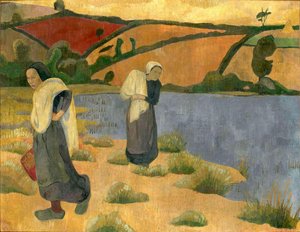
some of sérusier's notable works include:- l'averse (1893), musée d'orsay, paris
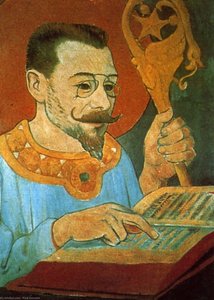
- portrait of paul ranson (1890), musée d'orsay, paris
- melancholy (1890)
- the snake eaters (1894), muzeum narodowe, warsaw
artistic movement and influence
sérusier's work was influenced by cloisonnism, a style characterized by bold and flat forms separated by dark contours. this movement, which emerged in the late 19th century, played a significant role in shaping the development of modern art.- explore more on cloisonnism: the cloisonnism art movement
- discover sérusier's work: paul serusier | OriginalUniqueArt.com
- learn about the nabis movement: the nabis art movement

Paul Sérusier
1864 - 1927 , France
Quick Facts
- Full Name: Louis-Paul-Henri Sérusier
- Nationality: French
- Date Of Birth: 1864
- Date Of Death: 1927
- Place Of Birth: Paris, France
- Notable Artworks:
- The Talisman
- Landscape at the Bois d’Amour
- Artistic Movement Or Style: Post-Impressionism
- Artists Who Influenced This Artist:
- Paul Gauguin
- Maurice Denis
Related Articles

Mastering Abstraction: The Top 25 Essential Artworks by Paul Klee
Explore 25 iconic Paul Klee masterpieces and his Bauhaus legacy. Discover the full collection online at OriginalUniqueArt.com.
Roger de la Fresnaye: Cubism, Tradition & the Search for Order in Early 20th-Century French Painting
Explore the captivating world of Roger de la Fresnaye, a pivotal French Cubist painter. Discover his unique blend of tradition & modernity, influences, and lasting legacy with OriginalUniqueArt.

25 Must-See Masterpieces at La Biennale di Venezia: A Journey Through Venice's Art Soul
Explore 25 iconic masterpieces from La Biennale di Venezia. Discover timeless art legends on OriginalUniqueArt.com.

Mastering Form: The 25 Greatest Paintings by Paul Cézanne
Explore 25 iconic Paul Cézanne masterpieces and his Post-Impressionist legacy. Discover the full collection online at OriginalUniqueArt.com.
Paul Sérusier: Pioneering Synthetism & The Nabis’ Symbolic Revolution
Discover Paul Sérusier's pivotal role in the Nabis movement & the birth of Synthetism. Explore 'The Talisman,' his influence on modern art, and a deeper understanding of this symbolic revolution. Expert analysis & insights.