Early Influences: Symbolism and Academic Foundations
 Wikipedia: Roger de La Fresnaye
Roger de La Fresnaye (French: [ʁɔʒe də la fʁɛnɛ]; 11 July 1885 – 27 November 1925) was a French Cubist painter. == Early years and education == La Fresnaye was born in Le Mans where his father, an officer in the French army, was temporarily station...
Roger de la Fresnaye, a name often whispered alongside the pioneers of Cubism, occupies a fascinatingly nuanced position within the artistic ferment of early 20th-century France. While celebrated for his geometric explorations, to understand La Fresnaye is to recognize an artist deeply rooted in tradition, one whose journey began not with radical abstraction but with the lyrical sensibilities of Symbolism and the rigorous discipline of academic training. Born into a family steeped in aristocratic heritage – a lineage connected to the Château de La Fresnaye in Falaise – he initially pursued studies at the Académie Julian and the École des Beaux-Arts in Paris, absorbing the established principles of composition and draftsmanship. However, it was his time at the Ranson Academy under Maurice Denis and Paul Sérusier that truly ignited his artistic sensibility. These masters instilled within him a reverence for color as an expressive force, a subjective element capable of conveying mood and emotion rather than merely replicating visual reality. This early exposure to the Nabis group’s dreamlike atmospheres and stylistic character would prove pivotal, subtly informing his later experiments with form.
Works like Woman with Chrysanthemums (1909) exemplify this formative period. Though not yet Cubist in execution, the painting reveals a nascent interest in flattening perspective and simplifying shapes – tendencies that foreshadow his future direction. The delicate balance of color and composition, reminiscent of Denis’s harmonious arrangements, demonstrates La Fresnaye's initial inclination towards a more decorative aesthetic, a sensitivity that would distinguish him from some of his more austere Cubist contemporaries. This foundation wasn’t merely a stepping stone; it was an integral part of his artistic identity, providing a counterpoint to the intellectual rigor he would later embrace.
The Embrace of Cubism: A Unique French Interpretation
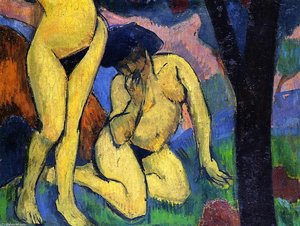 Two Nudes in a Landscape
Explore 'Two Nudes in a Landscape' by Roger De La Fresnaye – a stunning Fauvist oil painting showcasing bold colors & dynamic composition. Discover this 1910 masterpiece at the Musée des Beaux-Arts, Nancy.
Around 1910, La Fresnaye began a deliberate engagement with Cubism, drawn in by the revolutionary spirit of Pablo Picasso and Georges Braque. However, his adoption of this new language wasn’t one of wholesale imitation. Unlike the analytical dismantling of form favored by these pioneers, La Fresnaye sought to synthesize Cubist principles with his inherent lyrical sensibility and classical training. He didn't abandon representation entirely; instead, he infused geometric structures with a vibrant energy and a distinctly French elegance. This unique approach is evident in early works where fragmented forms are rendered in bold, saturated colors – blues, yellows, and reds that echo the influence of Robert Delaunay’s Orphism. He wasn’t interested in purely abstract compositions; his figures remained recognizable, albeit fractured and reassembled from multiple perspectives.
This period marked a crucial turning point, as La Fresnaye began to explore the possibilities of representing space and movement through geometric abstraction. He sought not merely to depict objects but to convey their essence, their underlying structure and dynamic relationships. This exploration wasn’t confined to the canvas; it extended to his broader artistic philosophy, influencing his approach to composition and color theory.
Section d'Or and the Pursuit of Geometric Harmony
 Wikipedia: Section d'Or
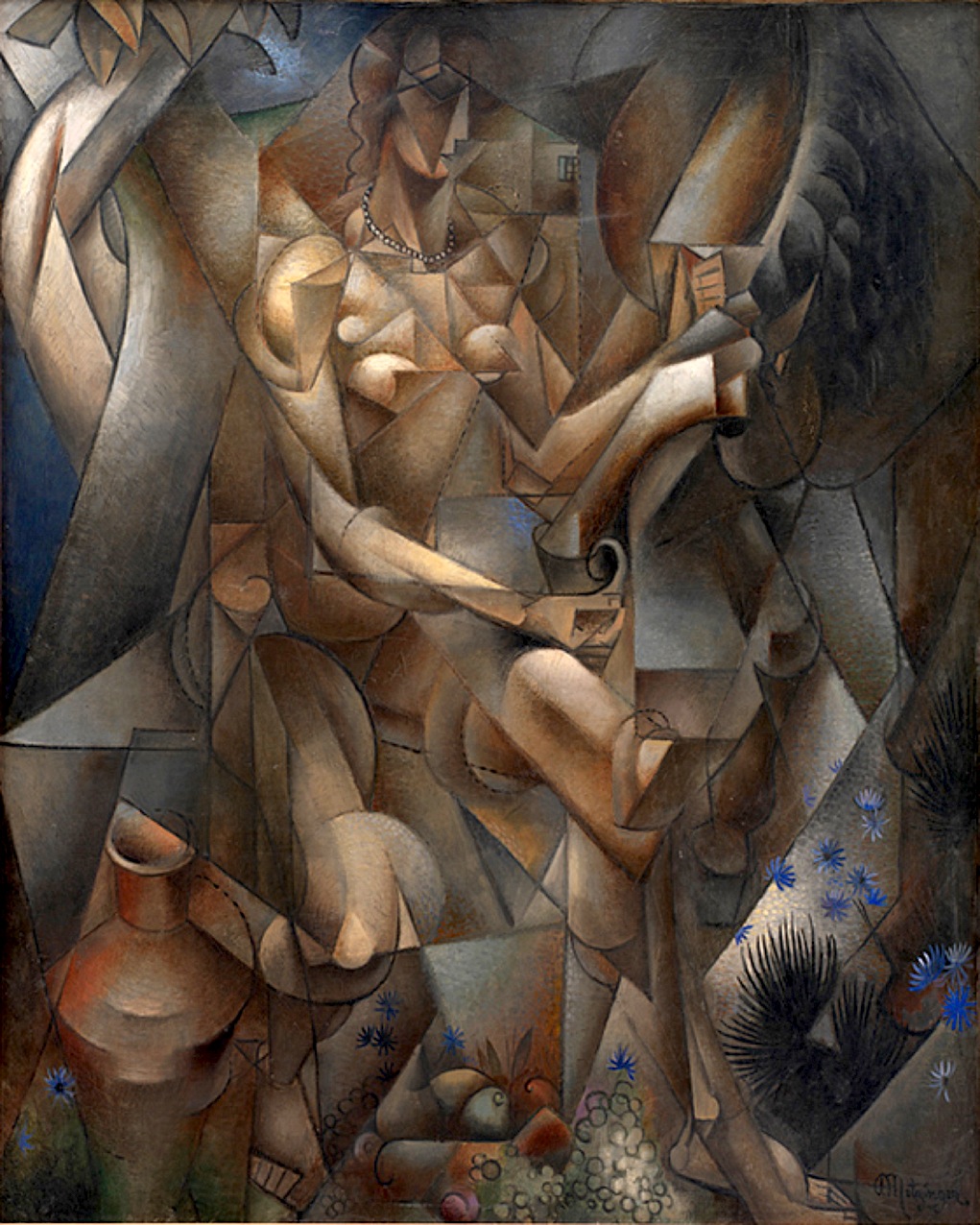
The Section d'Or ("Golden Section"), also known as Groupe de Puteaux or Puteaux Group, was a collective of painters, sculptors, poets and critics associated with Cubism and Orphism. Based in the Parisian suburbs, the group held regular meetings at th...
La Fresnaye’s commitment to these ideas led him to join the Section d'Or group in 1912, a collective of artists dedicated to exploring the mathematical principles underlying beauty. Alongside figures like Jean Metzinger, Albert Gleizes, and Jacques Villon, he participated in exhibitions that sought to demonstrate the inherent harmony between art and science. The Section d’Or believed that Cubism wasn't merely an aesthetic choice but a logical extension of natural laws – specifically, the golden ratio, or divine proportion, found throughout nature and architecture. This pursuit of geometric order is palpable in his paintings from this period.
The group’s controversial showing at the Salon des Indépendants in 1911 solidified their presence on the Parisian art scene, though it also sparked debate and criticism. La Fresnaye's contributions to these exhibitions showcased his ability to balance intellectual rigor with aesthetic appeal, creating works that were both challenging and visually captivating. His involvement with Section d’Or wasn’t simply about adopting a mathematical formula; it was about seeking a deeper understanding of form, space, and the underlying principles governing artistic creation.
Color, Composition, and La Fresnaye’s Distinctive Style
What truly sets La Fresnaye apart is his masterful use of color. While embracing Cubist fragmentation, he never relinquished his sensitivity to chromatic harmony. His paintings are characterized by a vibrant palette – often employing bold blues, yellows, and reds – that imbues his geometric compositions with an emotional resonance rarely found in the work of his contemporaries. This distinctive style is particularly evident in works like The Conquest of the Air (1913), perhaps his most famous painting. Here, he depicts himself and his brother outdoors, seemingly suspended within a dynamic interplay of planes and colors, with a balloon subtly hinting at aspirations for freedom and transcendence.
Beyond color, La Fresnaye’s compositions are notable for their carefully considered balance and rhythmic structure. He often employed overlapping forms and intersecting lines to create a sense of depth and movement, drawing the viewer's eye across the canvas. This deliberate arrangement wasn’t accidental; it was a conscious effort to create harmonious relationships between shapes and colors, reflecting his belief in the underlying order governing artistic creation. His paintings aren’t simply depictions of reality; they are carefully constructed visual experiences designed to evoke specific emotions and sensations.
A Patriotic Interlude: War Paintings and Shifting Focus
The outbreak of World War I profoundly impacted La Fresnaye's artistic trajectory. He enlisted in the French army, but his health deteriorated rapidly due to tuberculosis contracted during service. This experience led to a significant shift in his subject matter, as he turned his attention to depicting the realities of war – soldiers’ life in the field, scenes of camaraderie and hardship. These paintings, though still informed by Cubist principles, are marked by a newfound sense of realism and emotional weight.
However, this period also signaled a turning point away from radical abstraction. As his health continued to decline, La Fresnaye abandoned the city for the cleaner air of the Mediterranean coast. He increasingly focused on portraiture and landscapes executed in a more linear style, abandoning the complex geometric structures that had defined his earlier work. These later paintings, while less overtly Cubist, possess a poignant beauty and lyrical quality, reflecting a man confronting mortality with grace and introspection.
Legacy and Influence: Reconciling Tradition with Modernity
Roger de la Fresnaye’s career was tragically cut short by his untimely death in 1925 at the age of forty. Despite his relatively brief artistic life, he left an indelible mark on the landscape of early 20th-century French painting. He stands as a compelling example of an artist who successfully reconciled tradition with modernity, synthesizing the lyrical sensibilities of Symbolism with the intellectual rigor of Cubism. His unique blend of geometric abstraction and vibrant color continues to captivate audiences today.
While often overshadowed by his more radical contemporaries, La Fresnaye’s work offers a valuable perspective on the complexities of artistic innovation. He wasn't simply following a trend; he was forging his own path, guided by a deep understanding of art history and a profound sensitivity to color and composition. His paintings serve as a testament to the enduring power of individual vision and the importance of finding harmony between intellectual exploration and emotional expression. Discover the captivating world of Roger de la Fresnaye with OriginalUniqueArt, where museum-quality reproductions bring his masterpieces into your home.