
 Preview
 Send
Send Share
Share
 Details
 Guide
Guide

 Download
 Similars
 X-Ray
X-Ray Diaporama
 Q&A
Q&A Stats
StatsSelf-Portrait


 Read More
Giclée / Art Print
Museum-quality giclée or canvas print with fast production and flexible finish options. ( Buy Hand Made Painting Switch to Digital Image)




P118B $10

P118H $10

P118W $10

P438Z $10

P508JH $12

P508YH $12

P805H $10

P805Z $10

P919BZ $10

P919G $10

P919XJ $10

P959ZH $10

P968JZ $12

W106C $8

W218G $10

W218JH $8

W218Y $10

W307PJ $10

W316G $10

W316PJ $8

W316Y $10

W398PJ $8

W4111J $10

W500HY $15

W500JH $15

W692G $12

W849H $8

W940BG $15

W953PJ $8




Pick from our preset sizes that match the artwork's original proportions.

Type the width and the height you need, to fit your frame or your wall. A print can only be cut, never made bigger than the picture, so a size with a different shape loses a part of the image. We send you a digital mockup to approve before we print anything. The picture shown on this page does not show the real cut — only the mockup does.
Worldwide Delivery () in 2 weeks instead of standard 4/5 weeks. (10 November)

Free Worldwide Express Shipping

High-Quality Linen Canvas

Full Shipping Insurance

Customs Tax Refund Guarantee

True Color Matching Guarantee

100-Day Return Policy (Defects Only)

100% Money-Back Guarantee

Bulk Discount Offer
 Glass option is only available in size under 110 CM

Self-Portrait
Giclée / Art Print
Reproduction Size
-


Total Price
$ 81
The Quiet Resonance of Genius: A Portrait of Marietta Robusti
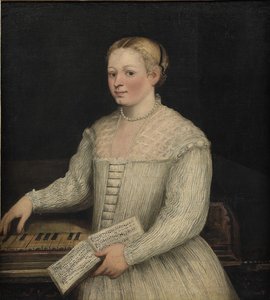
To stand before this depiction of Marietta Robusti is to encounter not merely a likeness, but a moment suspended in the rich, vibrant tapestry of late Renaissance Venice. The air around her seems thick with the scent of aged varnish and the ghost notes of music yet unplayed. She is captured in an intimate, three-quarter pose, seated before the elegant expanse of a harpsichord. Her gaze, though directed slightly away from the viewer, possesses an undeniable intelligence—a quiet dignity that speaks volumes of her intellect and artistic immersion. The composition itself guides the eye with masterful subtlety; the gentle diagonal sweep created by her posture and the instrument anchors the scene, while the dark, undifferentiated background serves to heighten the luminosity emanating solely from her figure.
Technique and Material Mastery
The artist, working in a style deeply rooted in Venetian portraiture, demonstrates an exquisite command of oil paint. One can almost feel the meticulous layering that gives depth to the textures presented. Observe the contrast between the smooth, porcelain quality of her skin—highlighted by soft, diffused light catching her cheekbone—and the crisp articulation of the lace at her collar. The handling of fabric is particularly noteworthy; the woven texture of her gown and the delicate folds suggest a painter who understood how light interacts with different materials. The inclusion of sheet music adds another layer of technical brilliance, requiring fine, precise lines to delineate the paper's edges against the polished wood of the keyboard. This attention to varied surface quality elevates the piece beyond simple representation into a study of material existence.
A Window into Venetian Culture and Ambition
This portrait is more than just a depiction of a musician; it is a cultural artifact from 1580 Venice. Marietta, daughter of the celebrated Tintoretto, lived within an environment where artistic genius was both nurtured and constrained by social expectation. The presence of the instrument and music serves as potent symbolism: it speaks to her cultivated talent, perhaps hinting at patronage or the intellectual life afforded to women of means. Her attire subtly communicates her standing within Venetian society. It is a portrait steeped in the gravity of an era where art was inextricably linked to status, making her quiet composure feel like a declaration of self-worth.
Emotional Echoes for the Modern Collector
For the contemporary collector or designer seeking pieces that breathe history into modern interiors, this reproduction offers profound emotional resonance. The mood is one of contemplative beauty—a sense of focused artistry and enduring grace. It invites quiet reflection, suggesting that true genius often resides not in grand pronouncements, but in moments of deep concentration. Owning a piece like this allows one to curate an atmosphere steeped in the romance of the Renaissance masters, bringing home a tangible echo of Venetian brilliance.
Questions & Answers
What color intensity does "Self-Portrait" by Marietta Robusti have?
"Self-Portrait" by Marietta Robusti shows a monochromatic color intensity.
What is the emotional tone of "Self-Portrait" by Marietta Robusti?
The emotional tone recorded for "Self-Portrait" by Marietta Robusti is reflective. It summarizes the feeling the work expresses.
Where does "Self-Portrait" fall in Marietta Robusti's career?
Within Marietta Robusti's career, "Self-Portrait" falls in the Renaissance. The phase helps compare it with the artist's other works.
Artist Biography
Marietta Robusti: A Venetian Daughter’s Brushstroke
The world of 16th-century Venice, a crucible of artistic innovation and social constraint, produced a remarkable figure – Marietta Robusti, often known as “la Tintoretta.” Daughter of the celebrated master Jacopo Robusti, better recognized as Tintoretto, she navigated a challenging landscape for female artists, leaving behind a legacy of subtle brilliance and a poignant story of ambition, family, and untimely death. Her life, shrouded in some mystery due to limited primary sources, offers a fascinating glimpse into the dynamics of Venetian art production during a pivotal era.
Born around 1560 – though the exact year remains debated between 1555 and 1560 – Marietta’s early life was inextricably linked to her father's workshop. Tintoretto’s studio wasn’t merely a place of work; it was a vibrant, collaborative environment where artistic techniques were honed through shared experience. While the precise nature of her training remains somewhat elusive, it is believed that she contributed significantly to Tintoretto’s projects, primarily executing backgrounds and blocking out figures – tasks typically assigned to women within the established workshop hierarchy. This wasn't simply menial labor; it was a crucial element in the creation process, allowing her to absorb the master’s techniques and develop her own artistic sensibility.
A Daughter’s Apprenticeship and Artistic Identity
Marietta’s nickname, “la Tintoretta,” reflects both her lineage and her distinctive style. It translates as "little dyer girl," a nod to her grandfather's profession – a tintore, or dyer – and subtly alludes to the vibrant colors that characterized Tintoretto’s work. Her family history was complex; her father had married Faustina Episcopi, who later died, and he subsequently remarried, adding three half-brothers to his immediate family. This blended familial structure undoubtedly influenced Marietta's upbringing.
Interestingly, accounts from the time reveal that Marietta adopted a masculine guise – dressing as a boy – during her early years with Tintoretto. This unconventional choice wasn’t simply a childish whim; it was a deliberate strategy to gain access to the workshop and participate more fully in the artistic process, defying societal expectations for women at the time. Carlo Ridolfi, Tintoretto's biographer, vividly describes this period, highlighting Marietta’s close bond with her father and his evident affection for her.
Notable Works and Artistic Style
Despite the limitations placed upon female artists, Marietta Robusti managed to leave a discernible mark on Venetian art. While she didn’t receive independent commissions for major religious works like altarpieces – a common path for male painters – her contributions are nonetheless significant. The most widely accepted attribution is to her “Venetian Woman” (circa 1580), currently housed in the Uffizi Gallery in Florence. This portrait, rich with opulent colors and elegant detail, showcases her ability to capture likeness and convey a sense of dignified composure.
Furthermore, she assisted her father on several notable paintings, including “Portrait of Ottavio Strada” (1567), demonstrating her understanding of Tintoretto’s signature *chiaroscuro* technique – the dramatic use of light and shadow that defines his style. Her work often involved creating atmospheric backgrounds and subtly shaping figures within a composition, contributing to the overall harmony and dynamism of the paintings.
A Tragic End and Lasting Legacy
Marietta’s life was tragically cut short in 1590 at the age of thirty. She died during childbirth, a common fate for women of that era. Her death profoundly affected Tintoretto, who reportedly created a poignant posthumous portrait of her on her deathbed – an image that speaks volumes about their deep and enduring connection.
Following her demise, Marietta’s artistic achievements were largely overshadowed by those of her father. However, in more recent decades, scholars have begun to recognize the significance of her contributions and challenge the traditional narrative that has relegated her to a footnote in Venetian art history. Her story serves as a powerful reminder of the obstacles faced by female artists during the Renaissance and the enduring legacy of a talented woman who defied convention through her skill, determination, and familial ties.
Further Exploration
- Marietta Robusti (1554 - 1590) - OriginalUniqueArt.com: Explore her biography and artworks on OriginalUniqueArt.com
- Portrait of Ottavio Strada: Discover this masterpiece on OriginalUniqueArt.com
- Venetian Woman (attributed): View the ‘Venetian Woman’ on OriginalUniqueArt.com
- Wikipedia - Marietta Robusti: Read more about her life and work on Wikipedia
Marietta Robusti
1554 - 1590 , Italy
Quick Facts
- Full Name: Marietta Robusti
- Nationality: Italian
- Date Of Birth: 1554
- Date Of Death: 1590
- Place Of Birth: Venice, Italy
- Notable Artworks:
- Self-portrait
- Portrait of Ottavio Strada
- Artistic Movement Or Style: Renaissance
- Artists Who Influenced This Artist: ['Tintoretto']
- Artists Or Movements Influenced By This Artist: ['Tintoretto']
Related Articles

The Inner Landscape: Exploring Themes of Introspection in Visual Art Across Movements & Eras
Explore the captivating world of introspective art! Discover how artists across eras – from Rembrandt to Kahlo – used self-portraiture to reveal their inner worlds and emotional depths. A journey through art history & psychology.

Master of Drama: The 25 Greatest Artworks by Jacopo Tintoretto
Explore 25 dramatic Tintoretto masterpieces of the Venetian Renaissance. Discover museum-quality art on OriginalUniqueArt.com.

The Echo of Self: Reflectivity as a Core Theme in Art History & Contemporary Practice
Explore the rich history of self-representation in art, from Renaissance masters to modern innovators. Discover how artists use portraiture to reveal identity, emotion & the depths of the human psyche. Expert insights for collectors.

The Enduring Legacy of Formal Portraiture: Power, Identity & Artistic Exploration
Explore the rich history of formal portraiture & its enduring power to capture identity and shape perception. Discover investment-worthy artworks, expert appraisals, and custom reproduction services at OriginalUniqueArt.
Reflecting the Self: A History of Portraiture & Psychological Insight
Explore the fascinating history of self-portraiture from Renaissance masters like Dürer & Rembrandt to modern interpretations. Discover the psychological insights and artistic techniques behind these iconic works. Expert analysis for art enthusiasts.


