Preview
 Send
Send Share
Share
 Details
 Guide
Guide

 Download
 Similars
 X-Ray
X-Ray Diaporama
 Stats
StatsThe Four Elements: Earth
 Oil On Canvas
- WallArt
- Northern Renaissance
 1569
1569 158.0 x 215.0 cm
 National Gallery
 Read More
Hand Made Oil Reproduction
Hand-painted oil on canvas in your size and frame, made to order by our artists. ( Switch to Print Switch to Digital Image)




P118B $10

P118H $10

P118W $10

P438Z $10

P508JH $12

P508YH $12

P805H $10

P805Z $10

P919BZ $10

P919G $10

P919XJ $10

P959ZH $10

P968JZ $12

W106C $8

W218G $10

W218JH $8

W218Y $10

W307PJ $10

W316G $10

W316PJ $8

W316Y $10

W398PJ $8

W4111J $10

W500HY $15

W500JH $15

W692G $12

W849H $8

W940BG $15

W953PJ $8




Pick from our preset sizes that match the artwork's original proportions.

Type the width and the height you need, to fit your frame or your wall. This is hand-painted, so for a size with a different shape the artist can paint a bit more around the picture, or cut a bit — you choose. We send you a digital mockup to approve before the painting starts. The picture shown on this page does not show the real result — only the mockup does.
After order, OriginalUniqueArt.com team will email client for instructions and provide a mockup preview
Worldwide Delivery () in 3/4 weeks instead of standard 5 weeks. (14 October). No compromise on quality.

Free Worldwide Express Shipping

High-Quality Linen Canvas

Full Shipping Insurance

Customs Tax Refund Guarantee

True Color Matching Guarantee

100-Day Return Policy (Defects Only)

100% Money-Back Guarantee

Bulk Discount Offer
 Glass option is only available in size under 110 CM

The Four Elements: Earth
Reproduction Medium
Reproduction Size
-


Total Price
$ 300
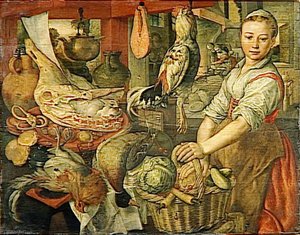
The Four Elements: Earth – A Window into Early Netherlandish Life
Joachim Beuckelaer’s “The Four Elements: Earth,” painted in 1569, is more than just a still life; it's a meticulously crafted tableau vivant, offering a rare glimpse into the daily rhythms and symbolic preoccupations of early 16th-century Antwerp. This remarkable work, now housed at the National Gallery in London, stands as a pivotal piece in the development of both genre painting and the nascent field of still life art. Beuckelaer’s genius lies not merely in his technical skill – though that is undeniably impressive – but in his ability to elevate the commonplace, transforming everyday scenes into narratives brimming with subtle meaning.
The scene unfolds within a modestly sized domestic interior, dominated by an abundance of fruits and vegetables. A riot of color—deep reds of cherries and pomegranates, vibrant greens of leafy cabbages and leeks, sunny yellows of lemons and melons—assault the senses, creating a palpable feeling of richness and plenty. The composition is carefully balanced, drawing the eye across the table laden with provisions, towards the two women engaged in their tasks. These aren’t idealized figures; they are working women, their sleeves rolled up, faces flushed from exertion, suggesting a life rooted in labor and practicality. The inclusion of a cat curled contentedly amongst the produce adds an unexpected touch of domesticity and perhaps even hints at the element of water – a symbol often associated with feline grace and fluidity.
A Symphony of Symbolism
Beuckelaer’s work is deeply intertwined with the prevailing symbolic language of the era. The arrangement of the produce isn't arbitrary; each item carries a specific weight, contributing to the painting’s layered meaning. The sheer variety—a testament to the seasons and the region’s agricultural bounty—represents Earth in its most tangible form: sustenance, fertility, and the cycle of life. The presence of apples, scattered throughout the scene, is particularly noteworthy; they have long been associated with knowledge, temptation, and earthly delights – a subtle reminder of the balance between material prosperity and spiritual contemplation.
Crucially, “The Four Elements: Earth” isn’t presented in isolation. It belongs to a series of four paintings—Water, Air, and Fire—each depicting a different element alongside a biblical narrative. In this case, the background reveals the Flight into Egypt, with Mary and Joseph traversing a bridge, offering a visual counterpoint to the earthly abundance before us. This juxtaposition highlights a key theme in Beuckelaer’s work: the tension between the material world and the spiritual realm, a central concern for artists of the time grappling with religious upheaval and social change.
Technique and Context
Executed in oil on wood panel, “The Four Elements: Earth” showcases Beuckelaer's mastery of *sfumato* – a subtle blurring of edges and colors that creates an atmospheric depth and lends the scene a remarkable sense of realism. The artist’s meticulous attention to detail is evident in every rendered leaf, every glistening droplet of moisture, and every carefully positioned fruit. The use of light is particularly effective, illuminating the table and casting soft shadows, drawing the viewer into the heart of the composition.
Painted during a period of significant political and religious instability in the Netherlands – the waning years of the Beeldenstorm (the iconoclastic movement of 1566) – “The Four Elements: Earth” reflects a shift away from purely religious subjects towards more secular themes. Beuckelaer’s market scenes, like this one, offered a way to celebrate the everyday realities of life while subtly engaging with broader cultural and theological concerns. The painting's popularity suggests a desire for beauty and comfort amidst uncertainty, a yearning for connection to the tangible world.
A Timeless Appeal
“The Four Elements: Earth” remains a captivating work of art, offering viewers a rich tapestry of visual and symbolic information. Its vibrant colors, meticulous detail, and subtle narrative invite contemplation on themes of abundance, labor, faith, and the enduring connection between humanity and the natural world. Whether viewed as a masterful example of genre painting or a poignant reflection of its historical context, this remarkable work continues to resonate with audiences today, serving as a testament to Joachim Beuckelaer’s artistic vision and his pivotal role in shaping the course of art history.
Questions & Answers
Is "The Four Elements: Earth" typical of what Joachim Beuckelaer usually created?
"The Four Elements: Earth" depicts market scene, food still life, four elements, biblical scene, vegetable display, dutch painting, domesticity, while Joachim Beuckelaer's recorded themes are flemish market scenes, aertsen influence, domestic life, everyday objects, religious allegory, biblical tales, symbolic food, four elements. Comparing the two shows how the work relates to the artist's usual subjects.
Which artist is "The Four Elements: Earth" attributed to?
"The Four Elements: Earth" was created by Joachim Beuckelaer. The information on this page describes Joachim Beuckelaer's original work.
What subjects appear in "The Four Elements: Earth" by Joachim Beuckelaer?
The themes present in "The Four Elements: Earth" by Joachim Beuckelaer include market scene, food still life, four elements, biblical scene, vegetable display, dutch painting, domesticity. Together they summarize the artwork's subject matter.
Artist Biography
A Life Immersed in the Everyday: Joachim Beuckelaer and the Dawn of Still Life
Joachim Beuckelaer, a name perhaps less instantly recognizable than his contemporaries, occupies a pivotal position in the history of Flemish painting. Born around 1533 in Antwerp, a city then pulsing with artistic innovation, he emerged as a master of scenes depicting the bustling world of markets and kitchens. These weren’t merely depictions of daily life; they were carefully constructed narratives, often subtly interwoven with religious symbolism, that signaled a shift in artistic focus—a move towards observing and celebrating the tangible realities of existence alongside traditional spiritual themes. Beuckelaer wasn't simply *painting* what he saw; he was elevating the commonplace to a level worthy of artistic attention, laying crucial groundwork for the development of still life as an independent genre. His family background steeped in artistry—his father, Mattheus Beuckeleer, and uncle, Pieter Aertsen, were both established painters—provided him with early exposure and training. It was within his uncle’s workshop that he likely honed his skills, absorbing Aertsen's pioneering approach to market scenes before ultimately surpassing him in technical prowess and nuanced storytelling.The Antwerp Workshop and Artistic Development
Antwerp during the 16th century was a vibrant hub of commerce and culture, and Beuckelaer’s art reflects this energy. He became an independent master within the Guild of Saint Luke in 1560, solidifying his place within the artistic community. However, he didn't simply replicate Aertsen’s style; he refined it, adding layers of complexity and detail. While Aertsen often presented a somewhat chaotic abundance, Beuckelaer brought a greater sense of order and clarity to his compositions. His scenes are meticulously arranged, with each object rendered with remarkable precision—the glistening scales of fish, the plumpness of fruit, the sheen of pewter vessels. This dedication to realism wasn’t merely about technical skill; it was about imbuing these everyday objects with a sense of presence and significance. The Four Elements series stands as a testament to this approach—a set of paintings depicting fish markets that simultaneously celebrate the bounty of nature and subtly allude to biblical narratives, with twelve varieties of fish representing the apostles and Christ’s miracle of the loaves and fishes unfolding in the background. This ability to seamlessly blend the secular and the sacred became a hallmark of his work.Kitchens as Canvases: Symbolism and Narrative
Beyond market scenes, Beuckelaer also excelled at depicting kitchens—spaces brimming with activity and symbolic potential. His Kitchen Scene with Christ at Emmaus, for example, is a particularly striking example of his innovative approach. He doesn’t simply depict the biblical story as a separate scene; he integrates it directly into the bustling environment of a kitchen, where preparations for a meal are underway. This juxtaposition creates a powerful sense of immediacy and invites viewers to contemplate the spiritual significance of everyday acts. The abundance of food in these scenes wasn't merely decorative; it often carried symbolic weight—representing prosperity, fertility, or even temptation. Beuckelaer’s skill lay in his ability to imbue these seemingly mundane settings with layers of meaning, transforming them into compelling visual narratives. He also ventured into pure still life compositions, such as Still Life of a Carcass (1563), considered one of the earliest dated examples of this subject, further demonstrating his mastery of detail and realism and pushing the boundaries of artistic convention.Legacy and Influence: A Bridge to New Artistic Horizons
Joachim Beuckelaer’s influence extended far beyond his own lifetime. His detailed depictions of everyday life paved the way for a new generation of artists who would further explore the possibilities of still life painting. Artists like Frans Snyders, known for his lavish and elaborate displays of food, directly built upon the foundations laid by Beuckelaer. His impact wasn’t limited to Northern Europe; his work also resonated with Italian painters such as Vincenzo Campi, demonstrating the widespread appeal of his innovative approach. By shifting the focus from primarily religious themes towards more secular subjects—while still retaining a subtle spiritual undercurrent—Beuckelaer played a crucial role in transforming Flemish art and anticipating the artistic trends that would define the centuries to come. He died around 1573, leaving behind a body of work that continues to captivate and inspire, reminding us of the beauty and significance hidden within the ordinary moments of life.
Joachim Beuckelaer
1533 - 1573 , Belgium
Quick Facts
- Full Name: Joachim Beuckelaer
- Nationality: Flemish
- Date Of Birth: 1533
- Date Of Death: 1573
- Place Of Birth: Antwerp, Belgium
- Notable Artworks:
- Four Elements series
- Kitchen Scene with Christ
- Still Life of a Carcass
- Artistic Movement Or Style: Renaissance art
- Artists Who Influenced This Artist: ['Pieter Aertsen']
- Artists Or Movements Influenced By This Artist:
- Frans Snyders
- Vincenzo Campi
Related Articles
Clyfford Still's Abstract Expressionism: A Study of Color, Form & the Existential Landscape
Explore the profound world of Clyfford Still's Abstract Expressionism with OriginalUniqueArt. Discover his unique style, existential themes & investment potential. Expert analysis for discerning collectors.
Gastronomic Canvas: Culinary Aesthetics & Artistic Representation for Hotel Design
Explore the captivating intersection of culinary arts & artistic representation for hotel design. Discover techniques to elevate dining experiences through visual harmony, composition, and inspiration from classic still life painting.
The Enduring Appeal of Still Life: A Historical & Contemporary Exploration
Explore the rich history & symbolism of still life painting with OriginalUniqueArt. Discover masterpieces from the Dutch Golden Age, learn about vanitas art, and find expert guidance for collecting timeless artworks.
Abraham Hendricksz van Beyeren: Pioneering Dutch Still Life & the Banquet Tradition
Explore the captivating world of Dutch Golden Age still life with Abraham van Beyeren. Discover his innovative techniques, symbolic banquet scenes & lasting influence on art history. Learn about collecting these masterpieces.

Silent Narratives: Exploring the Enduring Appeal of Still Life Painting Across Centuries
Explore the rich history of still life painting with OriginalUniqueArt. Discover Dutch Masters, decode vanitas symbolism & learn about collecting timeless art. Expert insights and museum-quality reproductions.