() ·

A painting made for you, by hand

The Cook

Hand Made Oil Reproduction

Hand-painted oil on canvas in your size and frame, made to order by our artists. ( Switch to Print Switch to Digital Image)

Collectible Description

Discover "The Cook" by Joachim Beuckelaer – a stunning Flemish masterpiece capturing a bustling kitchen scene with remarkable detail and realism. Explore this iconic work of art's history, techniques & reproduction options.

Artist Biography

Joachim Beuckelaer (1533-1573) was a Flemish painter famed for vibrant market & kitchen scenes, skillfully blending everyday life with religious symbolism. A pioneer of still life art.

from ·

Chapter 1

How large should it be?

Slide to change the size; the picture on the left shows the frame at its real width. The proportions of the original are kept.

Standard
custom
CM
INCH

Pick from our preset sizes that match the artwork's original proportions.

width
height

Type the width and the height you need, to fit your frame or your wall. This is hand-painted, so for a size with a different shape the artist can paint a bit more around the picture, or cut a bit — you choose. We send you a digital mockup to approve before the painting starts. The picture shown on this page does not show the real result — only the mockup does.

Chapter 2

How should it arrive?

Choose the edges of the stretched canvas

Choose your frame

Corner sample of the WhiteWrap canvas edge finish, stretched on solid wood bars
White $1
Corner sample of the BlurSideWrap canvas edge finish, stretched on solid wood bars
Blurside $1
Corner sample of the ExtendedWrap canvas edge finish, stretched on solid wood bars
Extended $1
Corner sample of the P118B picture frame: moulded polystyrene, 5 cm wide and 3 cm thick
P118B $10
Corner sample of the P118H picture frame: moulded polystyrene, 5 cm wide and 3 cm thick
P118H $10
Corner sample of the P118W picture frame: moulded polystyrene, 5 cm wide and 3 cm thick
P118W $10
Corner sample of the P438Z picture frame: moulded polystyrene, 5.5 cm wide and 3.5 cm thick
P438Z $10
Corner sample of the P508JH picture frame: moulded polystyrene, 7 cm wide and 3.5 cm thick
P508JH $12
Corner sample of the P508YH picture frame: moulded polystyrene, 7 cm wide and 3.5 cm thick
P508YH $12
Corner sample of the P805H picture frame: moulded polystyrene, 5 cm wide and 3.5 cm thick
P805H $10
Corner sample of the P805Z picture frame: moulded polystyrene, 5 cm wide and 3.5 cm thick
P805Z $10
Corner sample of the P919BZ picture frame: moulded polystyrene, 7 cm wide and 3.5 cm thick
P919BZ $10
Corner sample of the P919G picture frame: moulded polystyrene, 7 cm wide and 3.5 cm thick
P919G $10
Corner sample of the P919XJ picture frame: moulded polystyrene, 7 cm wide and 3.5 cm thick
P919XJ $10
Corner sample of the P959ZH picture frame: moulded polystyrene, 5 cm wide and 3 cm thick
P959ZH $10
Corner sample of the P968JZ picture frame: moulded polystyrene, 6 cm wide and 4 cm thick
P968JZ $12
Corner sample of the W106C picture frame: solid wood, 5 cm wide and 3 cm thick
W106C $8
Corner sample of the W218G picture frame: solid wood, 5 cm wide and 3 cm thick
W218G $10
Corner sample of the W218JH picture frame: solid wood, 5 cm wide and 3 cm thick
W218JH $8
Corner sample of the W218Y picture frame: solid wood, 5 cm wide and 3 cm thick
W218Y $10
Corner sample of the W307PJ picture frame: solid wood, 6 cm wide and 3 cm thick
W307PJ $10
Corner sample of the W316G picture frame: solid wood, 6 cm wide and 3 cm thick
W316G $10
Corner sample of the W316PJ picture frame: solid wood, 6 cm wide and 3 cm thick
W316PJ $8
Corner sample of the W316Y picture frame: solid wood, 6 cm wide and 3 cm thick
W316Y $10
Corner sample of the W398PJ picture frame: solid wood, 5 cm wide and 3 cm thick
W398PJ $8
Corner sample of the W4111J picture frame: solid wood, 6.5 cm wide and 3.5 cm thick
W4111J $10
Corner sample of the W500HY picture frame: solid wood, 7 cm wide and 5 cm thick
W500HY $15
Corner sample of the W500JH picture frame: solid wood, 7 cm wide and 5 cm thick
W500JH $15
Corner sample of the W692G picture frame: solid wood, 8 cm wide and 4 cm thick
W692G $12
Corner sample of the W849H picture frame: solid wood, 5 cm wide and 3 cm thick
W849H $8
Corner sample of the W940BG picture frame: solid wood, 7.5 cm wide and 4.5 cm thick
W940BG $15
Corner sample of the W953PJ picture frame: solid wood, 6 cm wide and 3.5 cm thick
W953PJ $8
Corner sample of the H24-GOLD picture frame: carved wood with gesso, 10 cm wide and 6 cm thick
H24-GOLD $30
Corner sample of the H24-SILVER picture frame: carved wood with gesso, 10 cm wide and 6 cm thick
H24-SILVER $30
Corner sample of the H36-GOLD picture frame: carved wood with gesso, 15 cm wide and 6.5 cm thick
H36-GOLD $45
Corner sample of the H36-SILVER picture frame: carved wood with gesso, 15 cm wide and 6.5 cm thick
H36-SILVER $45
Frame preview
Framed

Moulding: . Overall size with the frame: .

Chapter 3

Who paints it, and should anything change?

Examples of what can be changed: Replace face with customer photo; Add pet (e.g., replace cat with dog); Include hidden message in background; Change background landscape or elements.
After order, OriginalUniqueArt.com team will email client for instructions and provide a mockup preview

Worldwide Delivery () in 3/4 weeks instead of standard 5 weeks. (6 November). No compromise on quality.

Chapter 4

The finishing touches

A nameplate, as in a museum?

Engraved Bronze Plaque Details

This elegant plaque features the artist's name and the title of the artwork, finely engraved for a timeless presentation.

It is made from bronze with a refined, elegant finish. The text is precisely laser-engraved for a sharp and permanent result. Measuring 9x2 cm, the plaque is compact yet easy to read. It's built to be durable and scratch-resistant, offering a professional, museum-quality look. Mounting is simple thanks to the included adhesive backing.

Transparent Acrylic Plaque Details

The plaque includes essential engraved details such as the artist's name, the title of the artwork, the date it was created, the type of media used-like oil on canvas or watercolor-a brief description of the piece, and a QR code that links to the complete artwork information.

It is crafted from clear acrylic, offering a sleek, modern appearance. The text is UV-engraved in black to ensure strong visual contrast. With a size of 10x15 cm, it ensures optimal readability. It comes equipped with two metal hooks for secure wall mounting. The plaque is designed to be weather-resistant, making it suitable for various environments, and it includes interactive features that work seamlessly with smartphone scanning.

Black Acrylic Plaque Details

This elegant plaque includes engraved information such as the artist's name, the title of the artwork, the date it was created, the type of media used (like oil on canvas or watercolor), a short description of the artwork, and a QR code for quick access to more information.

The plaque itself is made from refined black acrylic with a premium finish. The text is laser-engraved in white for high contrast and readability. Its size is 10x15 cm, designed to be easy to read. It comes with two metal hooks for professional mounting. The design is sleek and fits any interior style. It is also weather-resistant and durable, with built-in digital integration for mobile compatibility.

A protective varnish?

When do you need it?

Chapter 5

Your painting, as you ordered it

The Cook

Reproduction Medium

Reproduction Size

-

Elite Senior Artist

More detail, finesse, and extra production time

-

Reproduction Frame

-

-

For artworks or reproductions larger than 105 cm (approximately 41 inches) on any side, the frame will be shipped as a kit, disassembled. This method ensures safe delivery and prevents damage during transport.

Professional assembly required - this is not a DIY product.
The kit must be assembled and the canvas stretched by an experienced professional framer, using wood glue (not supplied), a canvas stretching plier and clamps to hold the bars square while the glue dries. Incorrect assembly or uneven canvas tension can permanently damage the artwork and is not covered by our warranty.

  • All solid wood bars are included, precisely cut to size.

  • Assembled with the screws provided, plus wood glue for the corner joints, which is not supplied and must be sourced by your framer.

  • Professional tools are required and not included: a canvas stretching plier (tensioner) and clamps to hold the bars square while the glue dries.

Important:
The corner joints require wood glue, the bars must be held with clamps until the glue is fully dry, and tightening the canvas on the assembled frame requires a canvas stretching plier. None of these are included in the kit. Please arrange an experienced professional framer before ordering this size.

Nameplate

-

-

Protective Varnish

Glossy Varnish (enhances colors, protects against light/moisture)

-

Customize My Artwork

Examples of what can be changed: Replace face with customer photo; Add pet (e.g., replace cat with dog); Include hidden message in background; Change background landscape or elements.

-

Urgent

Worldwide Delivery () in 3/4 weeks instead of standard 5 weeks. (6 November). No compromise on quality.

-

Express Shipping

Worldwide Delivery () in 5 weeks. (13 November).

Included

Total Price

$ 300

Total Price $ 300

Glass option is only available in size under 110 CM

Included with every order

  • Free Worldwide Express Shipping
  • High-Quality Linen Canvas
  • Full Shipping Insurance
  • Customs Tax Refund Guarantee
  • True Color Matching Guarantee
  • 100-Day Return Policy (Defects Only)
  • 100% Money-Back Guarantee
  • Bulk Discount Offer

A Culinary Canvas: Unveiling Joachim Beuckelaer’s “The Cook”

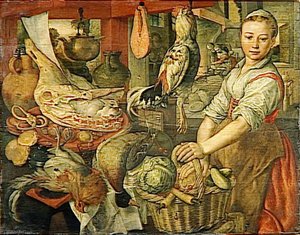
Joachim Beuckelaer's "The Cook," painted in 1574, isn’t merely a depiction of a kitchen scene; it’s a meticulously crafted tableau vivant—a snapshot of daily life imbued with subtle symbolism and remarkable technical skill. This oil on canvas, currently residing within the Kunsthistorisches Museum in Vienna, transports us to a bustling domestic space, radiating warmth and inviting contemplation. Beuckelaer, a master of the market and kitchen genre, inherited his artistic lineage from his uncle, Pieter Aertsen, absorbing and refining a style characterized by earthy tones and an almost obsessive attention to detail. The painting’s power lies not just in its realism but in its ability to evoke a specific atmosphere—a sense of abundance, industry, and the quiet rhythms of domesticity.

Joachim Beuckelaer - Portrait of Joachim Beuckelaer

The Anatomy of Abundance: Detail and Symbolism

At first glance, “The Cook” presents a seemingly straightforward scene: a woman, dressed in the practical attire of her time—a white blouse with puffy sleeves and a vibrant red skirt—is diligently plucking feathers from a chicken. However, a closer examination reveals layers of intricate detail and subtle symbolism. The artist’s mastery is evident in every brushstroke; the textures of the fabrics are rendered with astonishing accuracy, the feathers shimmer with lifelike realism, and the reflections on the large copper pot hint at the heat of the hearth. Beyond the immediate depiction of food preparation, Beuckelaer incorporates elements that speak to broader themes. The basket overflowing with fruit—apples, oranges, and other seasonal delights—represents not just sustenance but also prosperity and abundance. The presence of a biblical scene in the background, depicting Mary visiting Martha, subtly reinforces the importance of spiritual nourishment alongside earthly pleasures.

The arrangement itself is carefully considered. The central figure, the cook, anchors the composition, while the surrounding elements—the utensils, ingredients, and even the glimpse of people outside the window—are arranged in a balanced, symmetrical manner. This deliberate composition contributes to the painting’s overall sense of harmony and order, reflecting the values of Renaissance art.

A Window into the 16th Century: Context and Influences

To fully appreciate “The Cook,” it's crucial to understand its historical context. Painted during a period of religious upheaval in Europe—the Beeldenstorm (iconoclastic movement)—Beuckelaer’s work represents a shift away from purely religious subjects towards a celebration of the everyday world. His style, heavily influenced by his uncle Pieter Aertsen, is characterized by an earthy palette and a focus on domestic scenes filled with realistic details. The inclusion of staffage—figures engaged in various activities—adds to the painting’s narrative quality, creating a sense of immediacy and inviting the viewer to step into the scene. Beuckelaer's work also reflects the growing interest in still life as an independent genre, foreshadowing its eventual prominence in 17th-century Dutch art.

Reproductions and Legacy: Bringing “The Cook” Home

At OriginalUniqueArt.com, we are proud to offer meticulously crafted oil painting reproductions of Joachim Beuckelaer’s "The Cook." Our skilled artisans painstakingly recreate every detail of the original, ensuring that your reproduction captures the painting's warmth, realism, and subtle symbolism. Whether you’re an art enthusiast, a collector, or simply seeking a beautiful addition to your home décor, our reproductions provide a stunning way to experience this remarkable work of Flemish art. For further information about Joachim Beuckelaer and his artistic legacy, we encourage you to explore the resources available on Wikipedia (Wikipedia) or visit our website at OriginalUniqueArt.com.

Questions & Answers

What feeling is "The Cook" associated with?

"The Cook" by Joachim Beuckelaer conveys a comforting emotional tone.

What is the format of "The Cook"?

The format of "The Cook" is portrait. This is useful when planning where a reproduction will be placed.

How do the colors of "The Cook" by Joachim Beuckelaer relate to its emotion?

In "The Cook", earthy colors accompany a comforting feeling.

More about this painting

Preview AR preview Switch to Print Switch to Digital Image Send
Details Guide Add to favorites Download Similars X-Ray Diaporama Q&A Stats

In numbers

  • 1574the year it was painted
  • 29frames to choose from
  • standard sizes, in its own proportions
  • 5weeks to paint and deliver it
Joachim Beuckelaer

Joachim Beuckelaer

1533 - 1573, Belgium

Quick facts about Joachim Beuckelaer

  • Full Name: Joachim Beuckelaer
  • Nationality: Flemish
  • Date Of Birth: 1533
  • Date Of Death: 1573
  • Place Of Birth: Antwerp, Belgium
  • Notable Artworks:
    • Four Elements series
    • Kitchen Scene with Christ
    • Still Life of a Carcass
  • Artistic Movement Or Style: Renaissance art
  • Artists Who Influenced This Artist: ['Pieter Aertsen']
  • Artists Or Movements Influenced By This Artist:
    • Frans Snyders
    • Vincenzo Campi

Artist Biography

A Life Immersed in the Everyday: Joachim Beuckelaer and the Dawn of Still Life

Joachim Beuckelaer, a name perhaps less instantly recognizable than his contemporaries, occupies a pivotal position in the history of Flemish painting. Born around 1533 in Antwerp, a city then pulsing with artistic innovation, he emerged as a master of scenes depicting the bustling world of markets and kitchens. These weren’t merely depictions of daily life; they were carefully constructed narratives, often subtly interwoven with religious symbolism, that signaled a shift in artistic focus—a move towards observing and celebrating the tangible realities of existence alongside traditional spiritual themes. Beuckelaer wasn't simply *painting* what he saw; he was elevating the commonplace to a level worthy of artistic attention, laying crucial groundwork for the development of still life as an independent genre. His family background steeped in artistry—his father, Mattheus Beuckeleer, and uncle, Pieter Aertsen, were both established painters—provided him with early exposure and training. It was within his uncle’s workshop that he likely honed his skills, absorbing Aertsen's pioneering approach to market scenes before ultimately surpassing him in technical prowess and nuanced storytelling.

The Antwerp Workshop and Artistic Development

Antwerp during the 16th century was a vibrant hub of commerce and culture, and Beuckelaer’s art reflects this energy. He became an independent master within the Guild of Saint Luke in 1560, solidifying his place within the artistic community. However, he didn't simply replicate Aertsen’s style; he refined it, adding layers of complexity and detail. While Aertsen often presented a somewhat chaotic abundance, Beuckelaer brought a greater sense of order and clarity to his compositions. His scenes are meticulously arranged, with each object rendered with remarkable precision—the glistening scales of fish, the plumpness of fruit, the sheen of pewter vessels. This dedication to realism wasn’t merely about technical skill; it was about imbuing these everyday objects with a sense of presence and significance. The Four Elements series stands as a testament to this approach—a set of paintings depicting fish markets that simultaneously celebrate the bounty of nature and subtly allude to biblical narratives, with twelve varieties of fish representing the apostles and Christ’s miracle of the loaves and fishes unfolding in the background. This ability to seamlessly blend the secular and the sacred became a hallmark of his work.

Kitchens as Canvases: Symbolism and Narrative

Beyond market scenes, Beuckelaer also excelled at depicting kitchens—spaces brimming with activity and symbolic potential. His Kitchen Scene with Christ at Emmaus, for example, is a particularly striking example of his innovative approach. He doesn’t simply depict the biblical story as a separate scene; he integrates it directly into the bustling environment of a kitchen, where preparations for a meal are underway. This juxtaposition creates a powerful sense of immediacy and invites viewers to contemplate the spiritual significance of everyday acts. The abundance of food in these scenes wasn't merely decorative; it often carried symbolic weight—representing prosperity, fertility, or even temptation. Beuckelaer’s skill lay in his ability to imbue these seemingly mundane settings with layers of meaning, transforming them into compelling visual narratives. He also ventured into pure still life compositions, such as Still Life of a Carcass (1563), considered one of the earliest dated examples of this subject, further demonstrating his mastery of detail and realism and pushing the boundaries of artistic convention.

Legacy and Influence: A Bridge to New Artistic Horizons

Joachim Beuckelaer’s influence extended far beyond his own lifetime. His detailed depictions of everyday life paved the way for a new generation of artists who would further explore the possibilities of still life painting. Artists like Frans Snyders, known for his lavish and elaborate displays of food, directly built upon the foundations laid by Beuckelaer. His impact wasn’t limited to Northern Europe; his work also resonated with Italian painters such as Vincenzo Campi, demonstrating the widespread appeal of his innovative approach. By shifting the focus from primarily religious themes towards more secular subjects—while still retaining a subtle spiritual undercurrent—Beuckelaer played a crucial role in transforming Flemish art and anticipating the artistic trends that would define the centuries to come. He died around 1573, leaving behind a body of work that continues to captivate and inspire, reminding us of the beauty and significance hidden within the ordinary moments of life.

Quick Facts

  • Year: 1574
  • Influences: Pieter Aertsen
  • Notable elements: Detailed food display
  • Artistic style: Flemish realism
  • Medium: Oil on canvas

Art Quiz

There is only one correct answer for each question.

Question 1:
What is the primary subject depicted in Joachim Beuckelaer’s ‘The Cook’?
Question 2:
According to the image description, what is prominently displayed on the table in ‘The Cook’?
Question 3:
Which artistic movement is most closely associated with Joachim Beuckelaer’s work?
Question 4:
What is a key characteristic of Beuckelaer's use of color in ‘The Cook’?
Question 5:
The image description mentions a window in the background of ‘The Cook’. What purpose does this window serve?