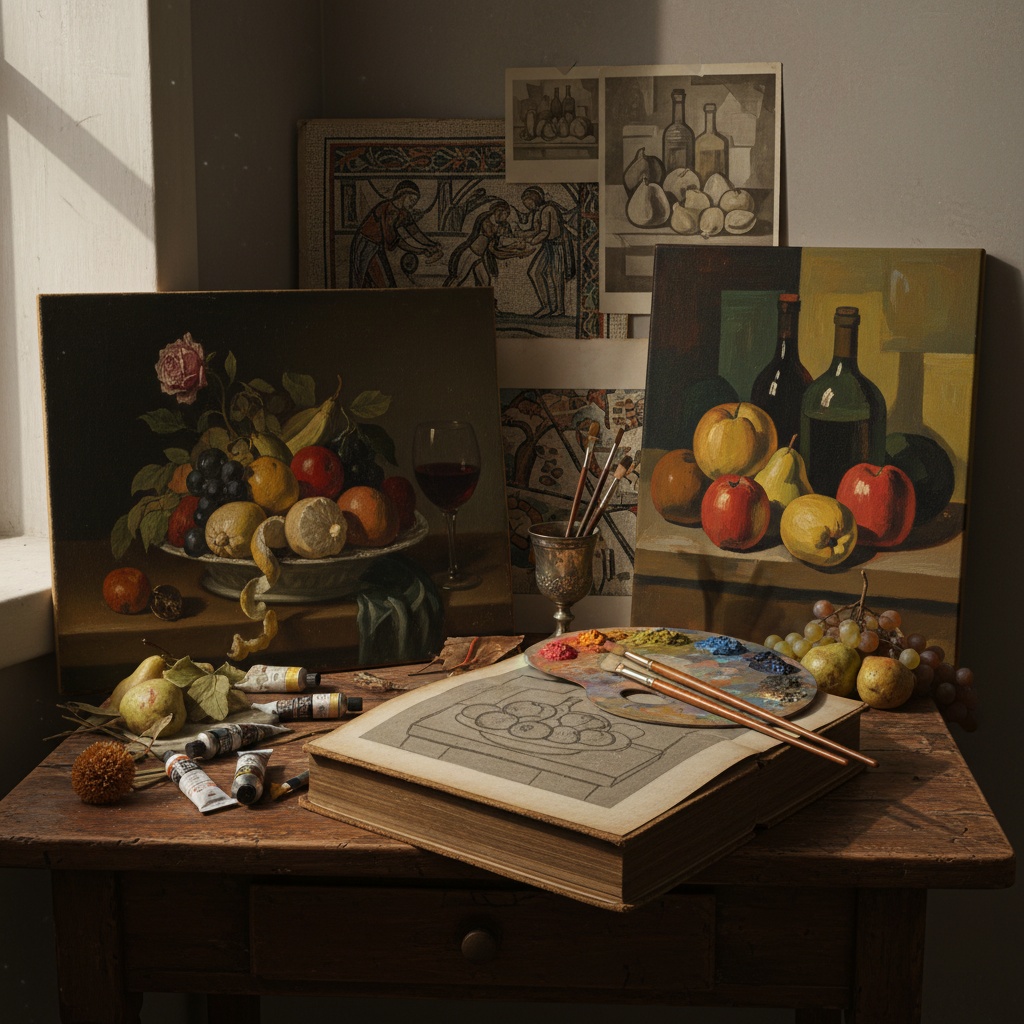
The Genesis of Still Life: From Ancient Origins to Renaissance Symbolism
A still life (pl.: still lifes) is a work of art depicting mostly inanimate subject matter, typically commonplace objects which are either natural (food, flowers, dead animals, plants, rocks, shells, etc.) or human-made (drinking glasses, books, vase...
Though often perceived as a quiet corner of the art world, still life painting boasts a lineage stretching back millennia. Its roots aren’t found in grand narratives or heroic figures, but rather in the humble details of daily existence – the fruits offered to deities in ancient Egypt, the meticulously rendered glassware adorning Roman mosaics at Pompeii. These early examples weren't simply decorative; they were imbued with ritualistic significance, intended to provide sustenance and comfort even beyond earthly life. The Romans, particularly, demonstrated a remarkable skill for depicting textures and light on commonplace objects, foreshadowing the realism that would define later still life traditions. However, these depictions remained largely ancillary, serving as components within larger compositions rather than existing as independent works of art.
It wasn’t until the Renaissance that still life began to emerge as a distinct artistic pursuit, though even then it rarely stood alone. Artists like Leonardo da Vinci and Albrecht Dürer incorporated meticulously observed objects into their religious scenes – a bowl of fruit representing abundance, a single flower symbolizing purity. These weren't merely exercises in technical skill; they were laden with symbolic meaning, reflecting the burgeoning humanist philosophies of the era. The careful arrangement of these elements often alluded to biblical stories or moral lessons, demanding a discerning eye from the viewer. The increasing focus on naturalism during this period laid the groundwork for the genre’s eventual flourishing.
Dutch Masters and the Golden Age of Still Life: A Flourishing of Realism
 Still-Life with Pie, Silver Ewer and Crab
Exquisite Baroque still life by Willem Claesz. Heda featuring a decadent table setting – pie, silver & crab. Explore the somber elegance and masterful realism of this Dutch Golden Age masterpiece.
The 17th century Netherlands witnessed an unprecedented explosion in still life painting, a phenomenon inextricably linked to the country's burgeoning economic prosperity and its embrace of Protestant values. With religious art taking a backseat, artists turned their attention to secular subjects – banquets laden with delicacies, meticulously arranged flowers, gleaming silver vessels. This wasn’t simply about depicting wealth; it was about celebrating the beauty of the everyday world, a testament to God's creation. Artists like Willem Claesz. Heda and Andries Benedetti elevated this genre to new heights, achieving an astonishing level of realism that continues to captivate viewers today.
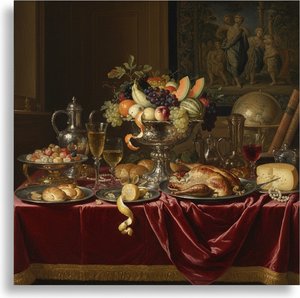
Willem Claesz. Heda’s Still-Life with Pie, Silver Ewer and Crab exemplifies the somber elegance characteristic of Dutch Golden Age still life. The dark background throws the opulent table setting into sharp relief, highlighting the textures of the pie crust, the sheen of the silver, and the delicate fragility of the crab. The composition isn’t merely visually appealing; it's a meditation on transience – the pie will be eaten, the silver tarnished, the crab decayed. Andries Benedetti, in his 1646 Still-Life, similarly demonstrates a mastery of light and shadow, creating a dramatic chiaroscuro effect that imbues the scene with a sense of depth and richness. These artists weren’t simply painters; they were observers, meticulously documenting the world around them with an unparalleled attention to detail.
Vanitas – More Than Meets the Eye: Decoding the Symbolic Language of Mortality
Emerging alongside the Dutch Golden Age, the vanitas still life presented a more somber reflection on earthly existence. Derived from the Latin word for “emptiness,” these paintings served as potent reminders of the futility of pleasure and the inevitability of death. Skulls, decaying fruit, extinguished candles, wilting flowers – these were not merely morbid symbols but rather allegorical representations of life’s fleeting nature. An overturned hourglass symbolized the passage of time, while musical instruments alluded to the ephemeral quality of beauty and joy.
François van Daellen’s Vanitas Still Life, for example, is a masterclass in symbolic composition. The skull serves as an obvious memento mori, but the surrounding objects – books, manuscripts, a partially consumed meal – further reinforce the message of mortality. The delicate rendering belies the painting's profound philosophical weight, inviting viewers to contemplate their own existence and the impermanence of all things. Similarly, Jan Jansz. Treck’s 1648 vanitas piece utilizes a complex arrangement of objects to convey this same message, subtly reminding us that even art itself is subject to decay.
Chiaroscuro and Composition: The Technical Brilliance Behind Captivating Arrangements
In art, chiaroscuro (English: kee-AR-ə-SKOOR-oh, -SKURE-, Italian: [ˌkjaroˈskuːro]; lit. 'light-dark') is the use of strong contrasts between light and dark, usually bold contrasts affecting a whole composition. It is also a technical term used by ...
The captivating power of still life painting isn’t solely attributable to its symbolic content; it also lies in the artists' masterful command of technique. Chiaroscuro, the dramatic use of light and shadow, was a defining characteristic of many Dutch Golden Age and Baroque still lifes. By carefully manipulating light sources, artists could create a sense of depth, volume, and realism that brought their subjects to life. This wasn’t simply about replicating appearances; it was about creating an emotional atmosphere, drawing the viewer into the scene.
Beyond chiaroscuro, composition played a crucial role in conveying meaning and engaging the eye. Artists carefully arranged objects to create visual harmony and balance, often employing diagonal lines or pyramidal structures to guide the viewer’s gaze. The choice of colors, textures, and materials also contributed to the overall effect. The juxtaposition of smooth surfaces with rough ones, vibrant hues with muted tones – these were deliberate choices designed to enhance the painting's aesthetic appeal and symbolic resonance. Benjamin Blake’s haunting still life exemplifies this technical prowess, utilizing dramatic chiaroscuro to highlight poignant birds and rich textures.
Beyond Representation: Still Life’s Evolution in Modern Art & Contemporary Practice
While the Dutch Golden Age may be considered the zenith of traditional still life painting, the genre continued to evolve throughout subsequent centuries. Modern artists challenged conventional notions of representation, experimenting with abstraction, cubism, and surrealism. Paul Cézanne famously used still life as a vehicle for exploring form and perspective, paving the way for new approaches to composition and color. Later, artists like Giorgio Morandi stripped away extraneous details, focusing on the essential shapes and volumes of everyday objects.
Today, contemporary artists continue to push the boundaries of still life painting, incorporating diverse materials and techniques. From hyperrealistic depictions to conceptual installations, the genre remains a vibrant and relevant form of artistic expression. The underlying themes – mortality, transience, beauty, and the human condition – continue to resonate with audiences, demonstrating the enduring power of this seemingly simple art form.
Collecting Still Life: Building a Narrative Through Timeless Beauty
Acquiring a still life painting is more than simply purchasing an aesthetically pleasing object; it’s about investing in a rich artistic tradition and connecting with centuries of history. Whether you're drawn to the realism of Dutch Masters, the symbolic depth of vanitas paintings, or the innovative approaches of modern artists, there’s a still life out there to suit every taste and sensibility.
When building a collection, consider the artist’s style, the painting’s subject matter, and its historical context. A carefully curated selection can tell a compelling story, reflecting your personal interests and values. OriginalUniqueArt.com offers a vast library of museum-quality reproductions, allowing you to bring these timeless masterpieces into your home. From custom oil paintings based on your favorite works to expertly framed prints, we provide the tools and resources you need to create a collection that will inspire and delight for generations to come. Explore our selection today and discover the silent narratives waiting to be unveiled.