Preview
 Send
Send Share
Share
 Details
 Guide
Guide

 Download
 Similars
 X-Ray
X-Ray Diaporama
 Stats
StatsDog Pointing a Partridge
 Acrylic On Canvas
- WallArt
- Rococo
 1725
1725 129.0 x 162.0 cm
 Hermitage Museum
 Read More
Giclée / Art Print
Museum-quality giclée or canvas print with fast production and flexible finish options. ( Buy Hand Made Painting Switch to Digital Image)




P118B $10

P118H $10

P118W $10

P438Z $10

P508JH $12

P508YH $12

P805H $10

P805Z $10

P919BZ $10

P919G $10

P919XJ $10

P959ZH $10

P968JZ $12

W106C $8

W218G $10

W218JH $8

W218Y $10

W307PJ $10

W316G $10

W316PJ $8

W316Y $10

W398PJ $8

W4111J $10

W500HY $15

W500JH $15

W692G $12

W849H $8

W940BG $15

W953PJ $8




Pick from our preset sizes that match the artwork's original proportions.

Type the width and the height you need, to fit your frame or your wall. A print can only be cut, never made bigger than the picture, so a size with a different shape loses a part of the image. We send you a digital mockup to approve before we print anything. The picture shown on this page does not show the real cut — only the mockup does.
Worldwide Delivery () in 2 weeks instead of standard 4/5 weeks. (23 October)

Free Worldwide Express Shipping

High-Quality Linen Canvas

Full Shipping Insurance

Customs Tax Refund Guarantee

True Color Matching Guarantee

100-Day Return Policy (Defects Only)

100% Money-Back Guarantee

Bulk Discount Offer
 Glass option is only available in size under 110 CM

Dog Pointing a Partridge
Giclée / Art Print
Reproduction Size
-


Total Price
$ 81
A Moment of Focused Grace: Oudry’s “Dog Pointing a Partridge”
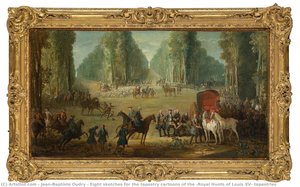
Jean-Baptiste Oudry's "Dog Pointing a Partridge," painted in 1725, isn’t merely a depiction of a hunt; it’s a distillation of the Rococo spirit – an elegant tableau capturing a fleeting moment of intense concentration and the harmonious relationship between man and animal. The painting immediately draws the eye to the dog, a magnificent specimen of the Pointer breed, utterly absorbed in its task. Its head is lowered, tail held high in anticipation, and posture radiating unwavering focus. This isn’t a clumsy or frantic pursuit; it's a controlled, almost meditative state, suggesting an innate understanding of scent and instinct. The Partridge, perched delicately amongst the grasses, becomes a secondary subject, almost a reward for this dedicated vigilance.
The Rococo Palette and Precise Observation
Oudry’s mastery lies in his meticulous observation and the skillful application of Rococo techniques. The painting is rendered in a remarkably detailed black and white, emphasizing form and texture rather than relying on vibrant color. This monochrome palette was common for hunting scenes at the time, allowing Oudry to concentrate on capturing the nuances of light and shadow – the way it falls across the dog’s fur, the delicate details of the bird's plumage, and the undulating surface of the grass. The brushstrokes are smooth and refined, contributing to a sense of serenity and control. Notice how he uses subtle gradations of tone to create depth and volume, particularly in the dog’s musculature and the surrounding foliage. The composition itself is carefully balanced, with the elements arranged to guide the viewer's eye through the scene – from the rock at the foreground, up to the bird and then back down to the dog.
- Technique: Oil on canvas, demonstrating Oudry’s command of chiaroscuro (light and shadow).
- Composition: Balanced arrangement drawing the eye through the scene.
- Brushwork: Smooth, refined strokes contributing to a sense of serenity.
A Royal Pursuit and Aristocratic Leisure
“Dog Pointing a Partridge” reflects the aristocratic pursuits of 18th-century France, specifically the royal hunt. These scenes weren’t simply records of hunting expeditions; they were carefully constructed displays of wealth, skill, and social status. Oudry was commissioned by figures like Noël-Antoine de Mérou, director of the Royal Beauvais Tapestry Manufactory, to create designs for tapestries depicting similar hunts – a testament to their popularity and importance within courtly life. The painting embodies the Rococo fascination with leisure, elegance, and the idealized depiction of aristocratic pursuits. The dog’s posture speaks volumes about the values of the time: loyalty, discipline, and an appreciation for the natural world—all carefully curated and presented for a discerning audience.
Symbolism and Emotional Resonance
Beyond its technical brilliance, the painting holds symbolic weight. The dog represents not just a hunting tool but also a companion – a loyal friend engaged in a shared activity. The Partridge, often associated with fertility and renewal, adds another layer of meaning to the scene. The overall effect is one of quiet grace and focused intensity. It’s a moment frozen in time, capturing the beauty of nature and the harmonious relationship between man and animal—a timeless image that continues to resonate with viewers today. Reproductions allow us to appreciate Oudry's skill and bring this elegant scene into our own homes, offering a glimpse into the refined world of 18th-century French aristocracy.
Questions & Answers
Can I use augmented reality to see "Dog Pointing a Partridge" by Jean-Baptiste Oudry in my room?
"Dog Pointing a Partridge" by Jean-Baptiste Oudry can be previewed on your own wall with the artwork's AR Preview page, using augmented reality on a compatible device.
What atmosphere would a reproduction of "Dog Pointing a Partridge" by Jean-Baptiste Oudry bring to a room?
The elegant atmosphere of "Dog Pointing a Partridge" by Jean-Baptiste Oudry matches its recommended space: a living room.
Are the colors of "Dog Pointing a Partridge" by Jean-Baptiste Oudry vivid or muted?
"Dog Pointing a Partridge" by Jean-Baptiste Oudry is recorded with a subtle color saturation and a monochromatic intensity.
Artist Biography
Jean-Baptiste Oudry: A Life in Art
Early Life and Training
- Born: March 17, 1686, in Paris, France.
- Oudry came from an artistic family; his father, Jacques Oudry, was a painter and art dealer. His mother, Nicole Papillon, was related to the engraver Jean-Baptiste-Michel Papillon.
- He began his training at the Académie de Saint-Luc, studying under Nicolas de Largillière from 1707 to 1712. This foundational period shaped his early skills in portraiture and observation.
- He quickly progressed, becoming an assistant professor at the Académie de Saint-Luc in 1714 and a full professor by 1717.
Artistic Development and Style
- Initially focused on portraiture, Oudry gradually expanded his repertoire to include still lifes, particularly of fruits and animals, as well as religious subjects.
- His style evolved towards the Rococo, characterized by elegance, naturalism, and a playful depiction of aristocratic life and leisure.
- Oudry’s meticulous attention to detail and his ability to capture the textures and characteristics of animals became hallmarks of his work.
- He demonstrated mastery in both painting and design, seamlessly transitioning between canvas and tapestry creation.
Major Achievements and Notable Works
- The Pastoral Amusements (Les Amusements Champêtres): A series of tapestries designed for the Royal Beauvais Tapestry Manufactory, showcasing idyllic scenes of rural life and hunting.
- Louis XV Hunting a Deer in the Forest of Saint-Germain (1730): This painting solidified Oudry’s reputation as the official painter of the royal hunt. It exemplifies his skill in depicting both the grandeur of the hunt and the natural environment.
- Royal Hunts of Louis XV (Chasses Royales Gobelins): A series of tapestry designs for the Gobelins Manufactory, further establishing Oudry’s prominence as a tapestry designer.
- Numerous portraits of dead game commissioned by King Louis XV, demonstrating his expertise in animal anatomy and still life composition.
Influences and Legacy
- Influenced By: Nicolas de Largillière played a crucial role in Oudry’s early artistic development, providing foundational training in portraiture and technique.
- Oudry's work influenced subsequent generations of animal painters and tapestry designers. His naturalistic style and attention to detail set a new standard for depicting wildlife.
- He contributed significantly to the decorative arts of the French court, creating luxurious tapestries that adorned royal residences.
Historical Significance
- Oudry’s work provides valuable insights into 18th-century aristocratic life and the importance of hunting as a pastime for the French nobility.
- His tapestries are considered masterpieces of French decorative art, showcasing the technical skill and artistic creativity of the period.
- He was appointed to prestigious positions within the Académie Royale de Peinture et de Sculpture, demonstrating his recognition as a leading artist of his time.
- Died: April 30, 1755, leaving behind a legacy of exquisite paintings and tapestries that continue to be admired today.

Jean-Baptiste Oudry
1686 - 1755 , France
Quick Facts
- Name: Jean-Baptiste Oudry
- Movement: Rococo
- Birth Date: 17 March 1686
- Death Date: 30 April 1755
- Birth Place: Paris, France
- Nationality: French
- Date Of Birth: 1686
- Date Of Death: 1755
- Influenced By: Nicolas de Largillière
- Notable Works:
- The Pastoral Amusements
- Louis XV hunting a deer in the forest of Saint-Germain
- Place Of Birth: Paris, France
Related Articles
Animalia: Exploring the Enduring Presence of Animals in Art & Interior Design
Explore the rich history of animal symbolism in art, from ancient mythology to modern masterpieces. Discover how animals have inspired artists for centuries and learn how to incorporate these powerful motifs into your home décor.
The Pursuit of Power & Prestige: Hunting Scenes in Western Art
Explore the rich history of hunting scenes in Western art, from royal pursuits to powerful allegories. Discover masterpieces & expert insights for discerning collectors. OriginalUniqueArt offers museum-quality reproductions.

Rococo's Radiant Legacy: 10 Masterpieces for Your Home |
Indulge in the elegance of Rococo! Explore 10 masterpieces by Fragonard, Boucher & Watteau. Discover the stories behind these iconic paintings and bring timeless art to your home with museum-quality reproductions from .
Beastly Brushstrokes: A Historical Journey Through Animal Painting & Aesthetic Movements
Explore the rich history of animal painting across cultures & movements. Discover iconic artists, symbolism, collecting trends & expert art consultation at OriginalUniqueArt.com.

The Rococo Aesthetic: Opulence, Rebellion & the Pursuit of Pleasure in 18th-Century Art
Explore the opulent world of Rococo art! Discover its origins, key artists like Watteau & Boucher, and lasting influence on design. Expert insights for collectors & enthusiasts.