Preview
 Send
Send Share
Share
 Details
 Guide
Guide

 Download
 Similars
 X-Ray
X-Ray Diaporama
 Q&A
Q&A Stats
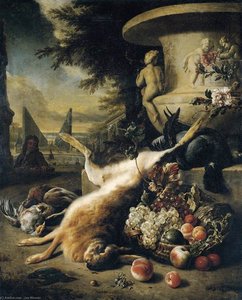
StatsDead Hare and Partridges

- 91.0 x 74.0 cm


 Read More
Giclée / Art Print
Museum-quality giclée or canvas print with fast production and flexible finish options. ( Buy Hand Made Painting Switch to Digital Image)




P118B $10

P118H $10

P118W $10

P438Z $10

P508JH $12

P508YH $12

P805H $10

P805Z $10

P919BZ $10

P919G $10

P919XJ $10

P959ZH $10

P968JZ $12

W106C $8

W218G $10

W218JH $8

W218Y $10

W307PJ $10

W316G $10

W316PJ $8

W316Y $10

W398PJ $8

W4111J $10

W500HY $15

W500JH $15

W692G $12

W849H $8

W940BG $15

W953PJ $8




Pick from our preset sizes that match the artwork's original proportions.

Type the width and the height you need, to fit your frame or your wall. A print can only be cut, never made bigger than the picture, so a size with a different shape loses a part of the image. We send you a digital mockup to approve before we print anything. The picture shown on this page does not show the real cut — only the mockup does.
Worldwide Delivery () in 2 weeks instead of standard 4/5 weeks. (11 November)

Free Worldwide Express Shipping

High-Quality Linen Canvas

Full Shipping Insurance

Customs Tax Refund Guarantee

True Color Matching Guarantee

100-Day Return Policy (Defects Only)

100% Money-Back Guarantee

Bulk Discount Offer
 Glass option is only available in size under 110 CM

Dead Hare and Partridges
Giclée / Art Print
Reproduction Size
-


Total Price
$ 81
A Stillness After the Hunt: Exploring Jan Weenix's Depiction of Nature's Cycle
To gaze upon Jan Weenix’s Dead Hare and Partridges is to step into a moment suspended between violence and quiet repose. This painting, executed around 1690, is far more than a mere collection of deceased fauna; it is a profound meditation on the relentless cycle of life, death, and sustenance that underpins the natural world. The composition immediately draws the eye to the central figure—the fallen hare, its head held in an almost defiant stillness against the earth. This arresting tableau, characteristic of the meticulous realism prized during the Dutch Golden Age, invites the viewer into a private, contemplative space where the drama of the hunt has just concluded.
Mastery of Detail and Naturalism
Weenix’s technical prowess is evident in every feather and sinew. His handling of texture is nothing short of breathtaking; one can almost feel the coarse fur of the hare against the rough branches supporting the perching birds. The artist possessed an unparalleled gift for rendering organic matter with scientific accuracy, yet imbued it with a painterly grace. Observe the smaller details: the scattered birds in the background, seemingly oblivious to the central drama, add layers of depth and narrative complexity. These elements work together to create a believable ecosystem captured on canvas, showcasing Weenix’s deep observational skills honed through years of studying the natural world around him.
Symbolism Woven into the Landscape
In the tradition of Dutch genre painting, such scenes often carry rich symbolic weight. The dead game speaks directly to themes of mortality and transience—vanitas motifs that were deeply resonant in 17th-century thought. Yet, this is not a purely morbid depiction. The presence of life continuing around the carcass, the birds feeding, suggests nature’s immediate resilience. It whispers of renewal; even in death, there is sustenance, and thus, promise for what comes next. For the modern collector or designer, this piece offers a sophisticated contemplation on impermanence, adding an intellectual depth to any space.
A Touch of Dutch Golden Age Elegance
Jan Weenix stood within a lineage that valued empirical observation alongside artistic flair. His work embodies the pinnacle of Dutch realism—a style that celebrated the tangible beauty of everyday life while elevating it to the realm of high art. Owning a reproduction of this piece allows one to bring home not just a painting, but a carefully curated piece of history. It speaks to an era when the material world was studied with intense devotion, resulting in works that feel both intimately familiar and eternally grand.
Questions & Answers
What stage of Jan Weenix's development does "Dead Hare and Partridges" represent?
"Dead Hare and Partridges" belongs to the Mature Period of Jan Weenix's career. This classification relates the work to the artist's development.
What color harmony does "Dead Hare and Partridges" by Jan Weenix display?
The colors of "Dead Hare and Partridges" by Jan Weenix show a strong color unity harmony. Harmony describes how the colors relate to each other.
When was "Dead Hare and Partridges" created, and to which movement does it belong?
"Dead Hare and Partridges" by Jan Weenix is dated 1690 and belongs to Dutch Golden Age.
Artist Biography
A Legacy of Dutch Realism: The Life and Art of Jan Weenix
Jan Weenix, born in Amsterdam in 1641, emerged from a lineage steeped in artistic tradition, inheriting a passion for painting from his father, the esteemed Jan Baptist Weenix. While precise details surrounding his early years remain somewhat elusive, it’s clear that young Jan received foundational training within his father's workshop, absorbing techniques crucial to depicting both still life and animal subjects—a hallmark of Dutch Golden Age artistry. This familial influence wasn’t merely technical; it instilled a deep appreciation for the meticulous observation of nature and a commitment to rendering its beauty with striking realism. The elder Weenix’s own artistic journey, including sojourns in Italy that infused his work with an Italianate sensibility, undoubtedly shaped Jan's developing aesthetic as well. Though initially overshadowed by his father’s reputation, Jan quickly distinguished himself, forging a unique path within the vibrant landscape of 17th-century Dutch painting.The Flourishing of a Baroque Style
Weenix’s artistic style blossomed during the height of the Baroque period, and it reflects the era's penchant for drama, rich detail, and dynamic composition. He wasn’t working in isolation; influences from contemporaries like Hendrick Cornelisz Vroom, renowned for his marine paintings, and potentially other animalier specialists such as Melchior de Hondecoeter and Gillis Claesz d'Hondecoeter, subtly informed his approach. However, Weenix synthesized these inspirations into a style distinctly his own. His canvases are characterized by an almost photographic precision in the rendering of textures—the sheen of feathers, the softness of fur, the delicate translucence of fruit – all achieved through masterful brushwork and a keen understanding of light and shadow. Chiaroscuro, the dramatic interplay between light and dark, is employed to create depth and visual interest, drawing the viewer into the scene with compelling realism. A vibrant color palette further enlivens his subjects, imbuing them with a sense of immediacy and vitality. He possessed an exceptional skill in arranging elements within the frame, creating balanced and harmonious compositions that are both visually appealing and narratively engaging.Masterpieces and Patronage
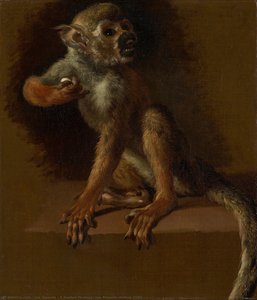
Throughout his career, Jan Weenix produced a substantial body of work celebrated for its technical brilliance and captivating subject matter. Paintings like Hunting and Fruit Still Life next to a Garden Vase (1714) exemplify his ability to seamlessly integrate diverse elements—game birds, luscious fruits, architectural details – into a complex and visually stunning arrangement. Still Life with a Hare and other Game (1697) showcases his mastery of animal anatomy and texture, capturing the lifelike quality of his subjects with remarkable accuracy. Even smaller works, such as A Seated Monkey (before 1685), reveal his talent for imbuing animals with personality and expressive character. This skill did not go unnoticed by prominent patrons. In 1702, Weenix received an invitation to the court of Johann Wilhelm, Elector Palatine, where he worked alongside other renowned artists, creating large-scale hunting scenes for Schloss Bensberg—a testament to his growing reputation and artistic prowess. These commissions provided him with both financial security and opportunities to further refine his skills.A Lasting Influence on Dutch Art
Jan Weenix played a pivotal role in popularizing hunting still lifes and game paintings during the Baroque period, elevating these genres beyond mere decoration. His works were highly sought after by collectors, contributing significantly to the development of Dutch artistic traditions. He didn’t simply replicate nature; he interpreted it through his unique lens, imbuing his paintings with a sense of realism, drama, and aesthetic beauty that resonated deeply with contemporary audiences. His legacy extends beyond his own creations; his daughter, Maria Weenix, continued the family tradition as a skilled flower painter, ensuring that the Weenix name remained synonymous with artistic excellence for generations to come. Today, Jan Weenix’s paintings are treasured in museums and private collections worldwide, continuing to inspire artists and captivate audiences with their masterful depictions of the natural world—a testament to his enduring contribution to the rich tapestry of Dutch art history.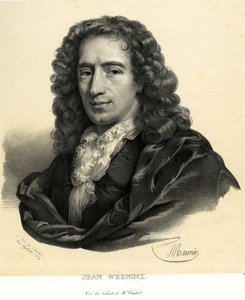
Jan Weenix
1641 - 1719 , Netherlands
Quick Facts
- Artistic Movement Or Style: Dutch Baroque
- Artists Or Movements Influenced By This Artist: ['Maria Weenix']
- Artists Who Influenced This Artist:
- Jan Baptist Weenix
- Hendrick Vroom
- Date Of Birth: 1641
- Date Of Death: 1719
- Full Name: Jan Weenix
- Nationality: Dutch
- Notable Artworks:
- Hunting and Fruit Still Life
- Still Life with a Hare
- A Seated Monkey
- The White Peacock
- Place Of Birth: Amsterdam, Netherlands
Related Articles

Silent Narratives: Exploring the Enduring Appeal of Still Life Painting Across Centuries
Explore the rich history of still life painting with OriginalUniqueArt. Discover Dutch Masters, decode vanitas symbolism & learn about collecting timeless art. Expert insights and museum-quality reproductions.

Jan Jansz Wijnants: A Study in Dutch Golden Age Still Life & Floral Transience
Explore the captivating world of Jan Wijnants and Dutch Golden Age still life painting. Discover symbolism, masterful techniques & lasting influence on floral art history. Learn more!
Jan Steen: A Master of Dutch Genre Painting & the Golden Age
Explore the life & art of Jan Steen, a leading Dutch Golden Age painter renowned for his humorous genre scenes & insightful social commentary. Discover his techniques, legacy, and collecting tips.

Dutch Masters: 10 Golden Age Paintings That Still Inspire |
Journey into the Dutch Golden Age! Explore 10 iconic paintings by Rembrandt, Vermeer & Hals. Discover the stories behind these Baroque masterpieces and find museum-quality art reproductions to elevate your home decor on .
Abraham Hendricksz van Beyeren: Pioneering Dutch Still Life & the Banquet Tradition
Explore the captivating world of Dutch Golden Age still life with Abraham van Beyeren. Discover his innovative techniques, symbolic banquet scenes & lasting influence on art history. Learn about collecting these masterpieces.