Preview
 Send
Send Share
Share
 Details
 Guide
Guide

 Download
 Similars
 X-Ray
X-Ray Diaporama
 Q&A
Q&A Stats
StatsThe Young Bather

- 130.0 x 97.0 cm


 Read More
Giclée / Art Print
Museum-quality giclée or canvas print with fast production and flexible finish options. ( Buy Hand Made Painting Switch to Digital Image)




P118B $10

P118H $10

P118W $10

P438Z $10

P508JH $12

P508YH $12

P805H $10

P805Z $10

P919BZ $10

P919G $10

P919XJ $10

P959ZH $10

P968JZ $12

W106C $8

W218G $10

W218JH $8

W218Y $10

W307PJ $10

W316G $10

W316PJ $8

W316Y $10

W398PJ $8

W4111J $10

W500HY $15

W500JH $15

W692G $12

W849H $8

W940BG $15

W953PJ $8




Pick from our preset sizes that match the artwork's original proportions.

Type the width and the height you need, to fit your frame or your wall. A print can only be cut, never made bigger than the picture, so a size with a different shape loses a part of the image. We send you a digital mockup to approve before we print anything. The picture shown on this page does not show the real cut — only the mockup does.
Worldwide Delivery () in 2 weeks instead of standard 4/5 weeks. (9 November)

Free Worldwide Express Shipping

High-Quality Linen Canvas

Full Shipping Insurance

Customs Tax Refund Guarantee

True Color Matching Guarantee

100-Day Return Policy (Defects Only)

100% Money-Back Guarantee

Bulk Discount Offer
 Glass option is only available in size under 110 CM

The Young Bather
Giclée / Art Print
Reproduction Size
-


Total Price
$ 81
A Moment of Quietude: Gustave Courbet’s “The Young Bather”
Gustave Courbet's "The Young Bather," painted in 1866, isn’t merely a depiction of a woman enjoying the water; it’s a carefully constructed tableau brimming with quiet defiance and a profound engagement with the realities of late 19th-century France. This work, now housed within the Metropolitan Museum of Art in New York, represents a pivotal moment in Courbet's career – a bold assertion of realism against the prevailing romanticized ideals dominating the art world. The painting immediately draws the viewer into a sun-drenched woodland scene, where a young woman, bathed in dappled light, occupies the central space with an almost unnerving sense of naturalism. Her posture is relaxed yet alert, her gaze lowered towards the water, suggesting both vulnerability and self-possession.
The Scandalous Nude: Challenging Artistic Conventions
Courbet’s decision to portray a nude female figure in an outdoor setting was, at the time of its exhibition, profoundly controversial. The subject matter itself – a realistic, unidealized depiction of the human body – directly challenged the academic standards that prioritized mythological or historical subjects and emphasized idealized beauty. Critics initially condemned the painting for its perceived vulgarity, arguing it lacked artistic merit and violated societal norms. However, as art historian Albert Boime has noted, this very controversy served to elevate the work’s significance, forcing a critical examination of the role of the nude in art and society. The woman's physicality isn't presented with overt sensuality; rather, it embodies a celebration of the female form in its natural state – a radical statement for the era.
Technique and Composition: A Masterclass in Realism
Courbet’s masterful technique is immediately apparent. He employs a meticulous observation of light and shadow, creating a remarkably tangible sense of depth and texture within the painting. The application of paint is deliberately rough and unpolished, mirroring the immediacy of direct observation. Notice how he captures the play of sunlight on the water's surface, the delicate folds of the woman’s dress, and the intricate details of the surrounding foliage. The muted palette – dominated by greens, blues, and earthy browns – contributes to a sense of tranquility while simultaneously emphasizing the materiality of the scene. The composition itself is carefully balanced; the figure occupies a central position, yet she doesn't dominate the space, allowing the viewer to fully appreciate the beauty of the natural setting.
Symbolism and Emotional Resonance
"The Young Bather" transcends a simple depiction of a woman enjoying a bath. It speaks to themes of independence, self-sufficiency, and a connection with nature. The phrase “health itself” attributed to one critic highlights the painting’s potential symbolism – a return to primal instincts and a rejection of artificial constraints. Courbet's deliberate choice of a woodland setting further reinforces this idea, suggesting a sanctuary away from societal pressures. The woman’s gaze downwards can be interpreted as a moment of introspection, a quiet communion with her own body and the surrounding environment. Ultimately, the painting evokes a feeling of serene contemplation – a reminder to appreciate the simple pleasures of life and to embrace one's own individuality.
OriginalUniqueArt offers exquisite, hand-painted reproductions of “The Young Bather,” allowing you to bring this iconic masterpiece into your home or office. Our artists meticulously recreate Courbet’s nuanced style and vibrant palette, ensuring a faithful representation of this pivotal work in art history. Explore our collection today and experience the enduring power of Courbet's vision.
Questions & Answers
Can I see "The Young Bather" by Gustave Courbet under different lights?
The X-Ray page of "The Young Bather" by Gustave Courbet is an interactive viewer that lets you slide through eleven optical layers of the artwork's image, including an X-ray style view.
What atmosphere does "The Young Bather" have?
The overall mood of "The Young Bather" by Gustave Courbet is calm. The mood describes the general atmosphere of the work.
Do the colors of "The Young Bather" appear strong or soft?
The colors in "The Young Bather" by Gustave Courbet have a monochromatic intensity.
Artist Biography
The Life and Identity of Gustave Courbet
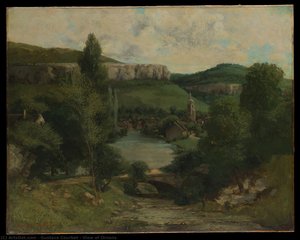
Jean Désiré Gustave Courbet was born on June 10, 1819, in Ornans, France. He was the eldest child and only son of Régis and Sylvie Oudot Courbet. Growing up in the department of Doubs, his early years were shaped by the landscape of his home. He lived through a period of significant social change in France, eventually becoming the leader of the Realism movement. His approach to painting was defined by a refusal to look away from the unvarnished truth of the world around him.
His life was marked by a certain stubbornness toward the established order. He did not seek to paint the myths or the idealized figures favored by the academies. Instead, he focused on the tangible. He looked at the grit of the earth and the heavy fatigue of the people who worked it. This commitment to the real was not a mere choice of subject, but a way of seeing that challenged the very foundations of 19th-century painting. He remained a figure of defiance until his death on December 31, 1877.
Early Life, Family and Training
The quiet village of Ornans, France, provided the backdrop for his beginnings. He grew up in a household alongside his sisters, Zoé, Zélie, and Juliette. While his path was not predetermined, his mother saw his inclination toward drawing and offered the encouragement needed to follow that impulse. This early support helped steer him away from other pursuits and toward the canvas.
In 1839, he moved to Paris. The city offered a different kind of education than the one found in the countryside. He spent much of his time in the Louvre, studying the works of the old masters. This period of observation was not spent in isolation; he also gained practical experience through work in various studios. He spent time in the studios of Steuben and Hesse, and later worked in the studios of Nicolas-Auguste and Suisse. These years were spent learning the mechanics of his craft through direct contact with the tools and methods of established painters.
The Development of a Realist Style
Courbet turned away from the polished finish of academic conventions and the dramatic ideals of Romanticism. He chose to prioritize observation over imagination, seeking to depict the world without embellishment. This meant looking at what was actually present rather than what tradition suggested should be there. He focused on the truth of the subject, often choosing to present the mundane and the unidealized as his primary focus.
His approach to the canvas was physical and direct. He favored an impasto style, applying paint thickly to emphasize the materiality of the medium itself. Using both the brush and the palette knife, he built up layers that gave the surface a tangible, heavy quality. Rather than blending colors into smooth transitions, he used fine brushstrokes to create clear borders. This technique allowed him to capture the grit and texture of his subjects with a sense of immediacy.
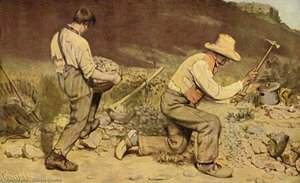
- The Stone Breakers (1849–50)
- A Burial at Ornans (1849–50)
- The Meeting or Bonjour Monsieur Courbet (1854)
Major Works and Artistic Achievements
The brushwork often feels heavy, as if the paint itself carries the weight of the subject. In 1849, he finished The Stone Breakers, a depiction of manual labor that was later destroyed during World War II. He brought the provincial life of his home to the public eye in 1850-51 with A Burial at Ornans. This large canvas presented a funeral without the usual polished grace, showing people with faces marked by boredom or resignation. By 1853, his work The Bathers was being shown at the Paris Salon, a piece that caused a stir because of its unidealized female form and the way it sat within a landscape.
His later years saw a shift toward the raw power of the natural world. In 1866, he painted The Origin of the World, a work that focused on the human body with startling closeness. He also captured the movement of the sea in The Wave, completed in 1870. His landscapes often reflected the specific textures of the coast or the cliffs, such as in The Cliffs at Etretat after the Storm, painted in 1869. Even in social scenes like The Meeting, made in 1854, there is a focus on the immediate, unadorned reality of a meeting on a road.
- The Painter's Studio (1855)
- The Meeting or Bonjour Monsieur Courbet (1854)
- The Origin of the World (1866)
Patrons and Artistic Independence
Financial freedom changed the way Courbet approached his canvas. A significant turning point came through his relationship with Alfred Bruyas, a collector who provided the means to work without catering to the tastes of the official salons. Bruyas purchased The Bathers, a decision that helped Courbet move away from the need for institutional approval. This support allowed the artist to maintain a sense of autonomy, choosing his own subjects rather than following the dictates of the academy. Later, Bruyas commissioned The Meeting, also known as Bonjour Monsieur Courbet, which reflected this established connection between patron and painter.
This independence was tested when the official jury rejected his large-scale works. In 1855, rather than retreating, Courbet took a more direct approach to his audience. He built the Pavilion of Realism, a temporary wooden structure located near the official exhibition site. By setting up his own space, he bypassed the gatekeepers of the art world and presented his vision on his own terms. This act of defiance ensured that his work could be seen by the public, regardless of the opinions held by the establishment.
- The Bathers
- The Meeting
Later Years and Death
The political shifts of 1871 brought a sudden end to his time in Paris. His involvement in the Paris Commune led to a period of exile. He moved across the border to Switzerland, seeking a life away from the immediate turmoil of the French capital. This was not a brief departure; he remained in Switzerland from 1873 until his death.
Life in exile was marked by the weight of his previous actions and the financial burdens imposed upon him. He lived in this quiet landscape, far from the salons and the debates of his youth. The focus of his existence shifted toward the mountains and the stillness of the Swiss terrain. He died in La Tour-de-Peilz, Switzerland.
Legacy and Influence on Modern Art
The shift from Romanticism toward the modern era found its momentum in the way he handled paint and subject. By choosing to depict the grit of stone and the heavy fatigue of a laborer's brow, he moved art away from the polished myths of the past. This focus on the tangible and the unvarnished provided a foundation for the Impressionists and Post-Impressionists. They looked to his method of observing the world directly, rather than through the lens of idealized beauty. Even the Cubists found a connection in his approach to form and the materiality of the medium.
His work carried a weight that went beyond the canvas. By bringing the lives of the working class and the provincial landscape into the center of high art, he changed what was considered worthy of a large-scale painting. This emphasis on social commentary created a path for later artists who used their brushes to engage with the political and social realities of their own times. He did not seek to flatter his viewers, but to show them the world as it actually existed, from the shadows of a forest to the dust of a roadside.
Where to See the Works Today
His canvases are scattered across several major collections, inviting a close look at the textures of his paint. In Paris, the Musée d'Orsay holds 21 of his works, including the large-scale A Burial at Ornans. The Louvre also contains 3 of his pieces, while the Musée du Petit Palais keeps 6. These works allow for a direct encounter with the heavy, impasto layers he applied to the surface.
Across the Atlantic, the Metropolitan Museum of Art in New York maintains a significant presence of his output with 21 works in its collection. You might find Woman with a Mirror or The Fishing Boat among them. In France, the Musée Fabre in Montpellier holds 12 of his paintings, offering a space to observe the way he handled light and shadow in his portraits and landscapes.
- The Meeting or Bonjour Monsieur Courbet (1854)
- The Painter's Studio (1855)
- The Origin of the World (1866)
- The Young Bather (1866)

Gustave Courbet
1819 - 1877 , France
Quick Facts
- Artistic Movement Or Style: Realism
- Artists Or Movements Influenced By This Artist:
- Impressionists
- Post-Impressionists
- Artists Who Influenced This Artist:
- Eugène Delacroix
- Théodore Géricault
- Caravaggio
- Full Name: Jean Désiré Gustave Courbet
- Nationality: French
- Notable Artworks:
- The Stone Breakers
- A Burial at Ornans
- The Painter's Studio
- The Meeting
- Place Of Birth: Orléans, France
- Date Of Birth: 1819
- Date Of Death: 1877
Related Articles

Romantic Realism's Finest: 10 Masterpieces for Your Home | OriginalUniqueArt
Explore 10 defining masterpieces of Romantic Realism! Discover Courbet, Millet & Daumier's powerful paintings—capturing emotion and social realities. Find museum-quality reproductions for your home at OriginalUniqueArt.com.

Golden Masterpieces: The Top 25 Greatest Artworks by Gustav Klimt
Explore 25 iconic Gustav Klimt masterpieces from the Golden Phase. Discover museum-quality art on OriginalUniqueArt.com.
Realism's Revolution: 10 Masterpieces That Changed Art |
Explore 10 defining Realism masterpieces – Courbet, Millet & more. Discover the stories behind these iconic paintings and their impact on art history. Find museum-quality reproductions for your home at !
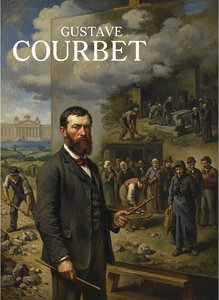
Gustave Courbet: Realism's Revolutionary Vision & the Social Canvas of 19th-Century France
Explore the revolutionary art of Gustave Courbet, pioneer of Realism. Discover his iconic paintings, social commentary, and lasting impact on 19th-century French art history. Expert analysis & insights.
Realism in Art: Origins, Techniques & Enduring Influence – A Comprehensive Exploration
Explore the captivating world of Realism in art! Discover key artists like Courbet, groundbreaking techniques & its lasting impact on society and modern painting. Expert insights at OriginalUniqueArt.