Introduction
Imagine a world saturated with romantic ideals, heroic narratives, and meticulously polished portrayals of life… then picture artists daring to look away from those conventions, choosing instead to confront the raw, unvarnished truth. This is the essence of Realism – an art movement born not from lofty aspirations but from a profound desire to depict the everyday world as it truly was .
Emerging in mid-19th century France, Realism arose as a reaction against both Romanticism and Neoclassicism. The Industrial Revolution had irrevocably altered society, bringing with it urbanization, social upheaval, and a growing awareness of the plight of the working class. Artists like Gustave Courbet, Honoré Daumier, and Jean-François Millet turned their gaze towards these realities – the lives of laborers, the hardships of rural existence, and the complexities of modern life – subjects previously deemed unworthy of artistic attention.
This wasn’t merely about technical skill; it was a radical act. To paint what one saw , without embellishment or idealization, challenged established norms and sparked considerable controversy. These artists weren't interested in depicting historical grandeur or mythological scenes; they sought to capture the fleeting moments of contemporary existence, often focusing on the marginalized and overlooked.
The masterpieces that define this movement are more than just beautiful paintings; they’re windows into a specific time and place, offering poignant commentary on social issues, human dignity, and the complexities of the human condition. They continue to resonate today because their themes – inequality, poverty, the struggle for survival – remain strikingly relevant in our own world.
Over the next few pages, we’ll embark on a journey through ten exceptional artworks that embody the spirit of Realism. Prepare to be moved, challenged, and inspired by these powerful depictions of life as it truly is—and to consider how their legacy continues to shape our understanding of art and society.
Olympia - Édouard Manet
 Olympia - Édouard Manet
A gaze that shattered conventions, a silence that spoke volumes – Édouard Manet’s Olympia , completed in 1863, remains an eternally provocative masterpiece.
Immortalized among the Top 10 Realist paintings for its audacious departure from academic tradition, Olympia isn't simply a nude; it is a confrontation. Manet dared to depict a contemporary woman – believed to be a courtesan – with an unflinching directness that scandalized Parisian society.
The painting’s power lies in its deliberate rejection of idealized beauty. The stark composition, flattened forms, and loose brushstrokes emphasize form over illusion, creating a sense of unsettling realism. Olympia's cool detachment and unwavering gaze challenge the viewer, refusing passive observation and demanding recognition. Notice the rumpled sheets, the black cat – symbols of independence – and the bouquet of flowers presented by her Black servant, hinting at patronage and societal complexities.
Beyond its technical brilliance, Olympia sparked a crucial dialogue about class, race, and the commodification of women. Its influence reverberates through modern art, paving the way for Impressionism and beyond. Today, a reproduction of Olympia can infuse a space with a sense of sophisticated rebellion, reminding us to question established norms and embrace artistic freedom. It’s a timeless piece that continues to provoke thought and inspire conversation – a testament to the enduring power of Realist art.
The Fog Warning - Winslow Homer
 The Fog Warning - Winslow Homer
A moment suspended between hope and peril – Winslow Homer’s The Fog Warning (1885) captures a universal feeling of solitude and the enduring human struggle against the elements.
This masterpiece rightfully claims its place among the Top 10 Realist paintings, not merely for its technical brilliance but for its profound emotional resonance. Homer eschews romanticized depictions of maritime life, instead presenting an unflinching portrayal of a fisherman battling choppy waves and an encroaching fog – a scene that speaks to the precariousness of existence.
The painting’s power lies in its masterful use of oil paint; visible brushstrokes convey the weight and movement of the water, while a muted palette reinforces the somber mood. Notice the solitary figure, dwarfed by the immensity of the sea, embodying human vulnerability. The approaching fog isn't just weather; it represents an unseen threat, urging the fisherman towards safe harbor.
Originally titled “Halibut Fishing,” the renaming to The Fog Warning underscores this central narrative. Today, a reproduction of this iconic work can bring a sense of quiet contemplation and resilience into your home. At , we faithfully preserve the texture and emotion of Homer’s original brushwork, allowing you to experience the power of Realist art firsthand – a timeless reminder of humanity's enduring connection to nature.
Man at the Window - Gustave Caillebotte
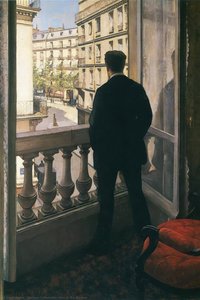 Man at the Window - Gustave Caillebotte
A silent observer at a Parisian window – Gustave Caillebotte’s Man at the Window (1875) captures a fleeting moment of introspection, forever suspended in time.
This masterpiece earns its place among the Top 10 Realist paintings for its nuanced portrayal of modern life and quiet emotional depth. While often linked to Impressionism, Caillebotte’s meticulous detail and precise observation ground the scene in tangible reality, offering a captivating glimpse into the changing urban landscape of Paris.
The composition is powerfully structured around vertical lines – the window frame, the man's form, and the towering architecture – emphasizing a sense of enclosure. Notice the striking red chair, a bold splash of color that draws the eye and adds symbolic weight. The muted palette and subtle layering create depth, while nuanced brushwork captures both the smoothness of textiles and the rough texture of stone.
More than just a depiction of a man gazing out a window, this painting invites us to contemplate themes of isolation, anonymity, and the beauty found within everyday moments. A reproduction of Man at the Window can bring a sense of calm sophistication into your home – a timeless reminder of the power of Realist art to capture the complexities of the human experience.
The origin of the world - Gustave Courbet
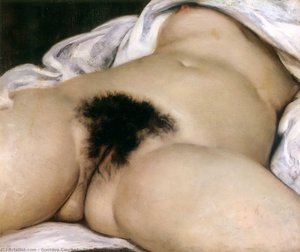 The origin of the world - Gustave Courbet
A whisper of flesh, a challenge to convention – Gustave Courbet’s The Origin of the World (1866) remains an eternally provocative masterpiece of Realist art.
Immortalized among the Top 10 for its groundbreaking depiction of the female form, this painting transcends mere representation. Rejecting idealized beauty standards, Courbet presents a strikingly direct and unapologetic vision of naturalism that continues to ignite discussion today.
The close-up composition tightly crops the figure, eliminating any contextualizing elements and forcing an intimate confrontation between viewer and subject. Notice the masterful use of light and shadow – subtly blended lines define form while emphasizing the body’s curves and textures. The deliberate rendering of pubic hair, scandalous for its time, underscores Courbet’s commitment to truthful representation.
More than just anatomical accuracy, this artwork invites deeper contemplation. A reproduction of The Origin of the World can bring a sense of quiet power and artistic rebellion into your home – a timeless reminder of the courage it takes to challenge norms and embrace the beauty of the human form. It’s a piece that sparks conversation and celebrates the enduring legacy of Realist painting.
The Stone Breakers - Gustave Courbet
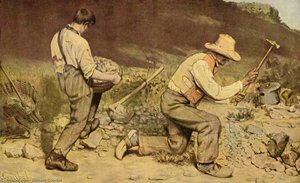 The Stone Breakers - Gustave Courbet
Dust motes dancing in the afternoon sun, the rhythmic clang of a hammer against stone – Gustave Courbet’s The Stone Breakers (1849) captures a moment of quiet desperation and enduring labor.
This painting stands out among the Top 10 Realist masterpieces for its unflinching portrayal of everyday life, specifically the backbreaking work of two laborers. Rejecting romanticized ideals, Courbet presents us with an unvarnished view of rural poverty and the dignity found within hardship.
Notice the earthy tones – browns, ochres, muted yellows – that mirror the landscape itself. The composition is divided between the foreground figures and a serene background, creating a stark contrast between labor and nature. Courbet’s meticulous attention to detail, from the worn clothing to the rough texture of the stone, evokes empathy and admiration for these often-overlooked individuals.
A reproduction of The Stone Breakers can bring a sense of grounded authenticity into your home – a timeless reminder of human resilience and the beauty found in simplicity. It’s a piece that invites reflection on our own connection to labor, nature, and the enduring power of Realist art.
Lane with poplars near Nuenen - Vincent Willem van Gogh
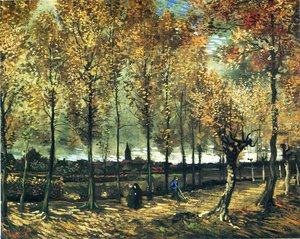 Lane with poplars near Nuenen - Vincent Willem van Gogh
A quiet path bathed in golden light – Vincent van Gogh’s Lane with Poplars near Nuenen (1885) captures a fleeting moment of tranquility and foreshadows the emotionally charged landscapes that would define his career.
This painting earns its place among the Top 10 Realist masterpieces as a pivotal work in Van Gogh’s artistic development. While rooted in the tradition of depicting everyday life, it subtly hints at the expressiveness and vibrant brushwork he'd become renowned for.
Notice the verticality of the towering poplar trees – natural framing devices that draw the eye deep into the scene. The earthy tones and rich greens realistically depict the foliage, yet it’s Van Gogh’s technique that truly captivates: loose, expressive brushstrokes create a sense of movement within the landscape, imbuing it with life and energy.
A reproduction of Lane with Poplars near Nuenen can bring a sense of calm sophistication into your home – a timeless reminder of Van Gogh’s burgeoning talent and the beauty found in the Dutch countryside. It's a piece that invites contemplation and celebrates the enduring power of Realist art.
Woman with a Parrot - Gustave Courbet
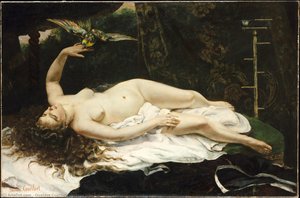 Woman with a Parrot - Gustave Courbet
A whisper of skin against lush foliage – Gustave Courbet’s Woman with a Parrot (1866) captures an intimate moment of vulnerability and natural grace, forever suspended in time.
This painting earns its place among the Top 10 Realist masterpieces for its masterful blend of sensuality and authenticity. Rejecting idealized forms, Courbet presents us with the raw beauty of the human form, inviting viewers into a deeply personal connection.
Notice the soft, diffused lighting that enhances the three-dimensionality of the figure, casting gentle shadows that accentuate her curves. The rich tapestry of colors – deep greens and browns contrasted with flesh tones – creates an atmosphere of serenity and introspection. And then there’s the parrot, a symbol of freedom and grace, adding a layer of intrigue to the scene.
A reproduction of Woman with a Parrot can bring a sense of quiet sophistication into your home – a timeless reminder of Courbet’s revolutionary approach to art and the enduring power of Realist painting. It's a piece that invites contemplation and celebrates the beauty found in everyday life.
Harvesters Resting - Jean-François Millet
 Harvesters Resting - Jean-François Millet
The scent of sun-baked earth, the quiet camaraderie of shared labor – Jean-François Millet’s Harvesters Resting (1853) captures a fleeting moment of respite in the lives of rural workers.
This painting rightfully claims its place among the Top 10 Realist masterpieces for its poignant depiction of everyday life and unwavering commitment to authenticity. Rejecting idealized pastoral scenes, Millet presents us with the raw beauty and dignity of agricultural labor.
Notice the earthy tones – browns, beiges, and muted greens – that ground the scene in realism. The composition is rich with organic lines and flowing contours, creating a sense of harmony and depth. Subtle hints of blue and white add contrast and visual interest, while Millet’s meticulous brushwork captures the textures of fabric, skin, and rope.
A reproduction of Harvesters Resting can bring a sense of quiet contemplation into your home – a timeless reminder of human resilience and the beauty found in simplicity. At , we faithfully preserve the emotion and texture of Millet’s original brushwork, allowing you to experience the power of Realist art firsthand.
Honoré Daumier Nous voulons Barabbas (Ecce Homo) We want Barabbas (Ecce Homo) - Honoré Daumier
 Honoré Daumier Nous voulons Barabbas (Ecce Homo) We want Barabbas (Ecce Homo) - Honoré Daumier
A collective breath held in a moment of moral reckoning – Honoré Daumier’s Nous voulons Barabbas (Ecce Homo) (1852) plunges us into the heart of a biblical drama, resonating with themes of injustice and societal complicity.
This painting earns its place among the Top 10 Realist masterpieces for its raw emotional power and unflinching critique of human nature. Daumier’s loose, vigorous brushstrokes and layered textures convey a sense of urgency and collective vulnerability, inviting us to confront uncomfortable truths about our own choices.
Notice the subdued, earthy color palette – browns, blacks, and ochres – that enhances the somber mood. The expressive faces and gestures of the figures symbolize collective suffering and moral dilemmas. Daumier doesn’t simply depict a scene; he evokes a feeling of anxiety and alienation, compelling us to question societal norms.
A reproduction of Nous voulons Barabbas (Ecce Homo) can bring a sense of profound reflection into your home – a timeless reminder of the enduring relevance of social conscience and spiritual empathy. It's a piece that invites contemplation and sparks meaningful conversations.
The Flute Concert at Sanssouci (sketch) - Adolph von Menzel
 The Flute Concert at Sanssouci (sketch) - Adolph von Menzel
A whisper of silk gowns and the lilting melody of a flute – Adolph von Menzel’s The Flute Concert at Sanssouci (sketch) (1848) transports us to an era of cultural elegance and aristocratic refinement.
This sketch earns its place among the Top 10 Realist masterpieces for its ability to capture a fleeting moment of beauty and social harmony. Menzel’s loose, energetic brushstrokes and dynamic use of light evoke a sense of vitality and intimacy, inviting us into this vibrant scene.
Notice the warm, luminous color palette – rich golds, browns, and ochres contrasted with cooler blues – that enhances the atmosphere of warmth and sophistication. The textured surfaces and layered paint suggest a tactile richness, drawing you closer to the music and conversation unfolding within the palace walls.
A reproduction of The Flute Concert at Sanssouci (sketch) can bring a sense of quiet prestige into your home – a timeless reminder of the enduring power of art and social connection. At , we faithfully preserve Menzel’s original vision, allowing you to experience this masterpiece firsthand.
Conclusion
As the light fades on these ten canvases, we find ourselves not merely concluding a journey through art history, but returning to the enduring questions they pose about our shared humanity. These Realist masterpieces—from Courbet’s unflinching gaze at labor and society to Millet’s tender portrayals of rural life, from Daumier’s searing social critiques to Menzel’s elegant interiors—are not relics of a distant past, but living presences that continue to resonate with our own experiences.
They remind us that art is not simply about beauty or skill, but about empathy, truth, and the courage to confront the complexities of life. The brushstrokes we’ve explored hold echoes of human struggle, moments of quiet dignity, and a profound longing for connection—themes that transcend time and culture.
And in their enduring power lies an invitation: to bring these visions into our own spaces, to allow them to shape the way we see our homes, our emotions, and our world. To surround ourselves with art that speaks to our hearts, challenges our perspectives, and reminds us of the beauty and fragility of the human spirit.
Explore full collection and discover the timeless masterpieces that await you—and perhaps, a new reflection of yourself within their depths.