
 Preview
 Send
Send Share
Share
 Details
 Guide
Guide

 Download
 Similars
 X-Ray
X-Ray Diaporama
 Q&A
Q&A Stats
StatsMadame Charles Max

- 205.0 x 100.0 cm


 Read More
Giclée / Art Print
Museum-quality giclée or canvas print with fast production and flexible finish options. ( Buy Hand Made Painting Switch to Digital Image)




P118B $10

P118H $10

P118W $10

P438Z $10

P508JH $12

P508YH $12

P805H $10

P805Z $10

P919BZ $10

P919G $10

P919XJ $10

P959ZH $10

P968JZ $12

W106C $8

W218G $10

W218JH $8

W218Y $10

W307PJ $10

W316G $10

W316PJ $8

W316Y $10

W398PJ $8

W4111J $10

W500HY $15

W500JH $15

W692G $12

W849H $8

W940BG $15

W953PJ $8




Pick from our preset sizes that match the artwork's original proportions.

Type the width and the height you need, to fit your frame or your wall. A print can only be cut, never made bigger than the picture, so a size with a different shape loses a part of the image. We send you a digital mockup to approve before we print anything. The picture shown on this page does not show the real cut — only the mockup does.
Worldwide Delivery () in 2 weeks instead of standard 4/5 weeks. (12 November)

Free Worldwide Express Shipping

High-Quality Linen Canvas

Full Shipping Insurance

Customs Tax Refund Guarantee

True Color Matching Guarantee

100-Day Return Policy (Defects Only)

100% Money-Back Guarantee

Bulk Discount Offer
 Glass option is only available in size under 110 CM

Madame Charles Max
Giclée / Art Print
Reproduction Size
-


Total Price
$ 81
A Glimpse of Parisian Elegance: Giovanni Boldini’s “Madame Charles Max”
Giovanni Boldini's "Madame Charles Max," painted in 1896, isn’t merely a portrait; it’s a meticulously crafted distillation of Belle Époque glamour and the captivating allure of Parisian society. Held within the esteemed Musée d’Orsay, this full-length masterpiece offers a rare glimpse into the world of high society, capturing not just a likeness but an essence – the poised confidence and subtle sensuality of Madame Charles Max herself. Boldini, often dubbed the “Master of Swish” for his signature flowing brushwork and dynamic compositions, expertly blends realism with impressionistic techniques to create an image that simultaneously feels both immediate and timeless. The painting’s muted color palette—predominantly shades of grey, silver, and delicate pink—evokes a sense of understated luxury, mirroring the refined atmosphere of the salons where such portraits were commissioned.The Dance of Line and Light: Boldini's Technique
At the heart of "Madame Charles Max" lies Boldini’s masterful command of line and light. He employs a technique characterized by delicate, almost hesitant brushstrokes—a hallmark he earned from his encounter with the Macchiaioli movement in Italy. These “saber cuts,” as they were known, create an illusion of fluidity and movement within the fabric of the woman's dress, suggesting a subtle, graceful step. The drapery isn’t rendered with heavy detail but rather through a series of layered washes of color, capturing the play of light on silk and creating a remarkable sense of texture. Boldini’s use of diffused lighting is equally crucial; it softens the subject’s features, highlighting her delicate complexion and the subtle curve of her smile while simultaneously casting gentle shadows that define her form with exquisite precision. The receding curtain backdrop isn't just a decorative element; it establishes depth and subtly frames the figure, drawing the viewer into the scene.A Portrait of Status and Personality
Beyond its technical brilliance, “Madame Charles Max” is deeply symbolic. Commissioned for a woman of considerable social standing—Jeanne Max, a celebrated singer known for hosting lavish gatherings in Paris—the portrait speaks volumes about wealth, status, and sophistication. Boldini doesn’t simply depict her appearance; he captures her personality – a quiet confidence, an air of relaxed elegance, and perhaps even a hint of playful allure. The slightly off-center composition adds to this sense of dynamism, suggesting a moment captured in motion rather than a static representation. The pose itself—a subtle turn towards the viewer—invites engagement, creating a feeling of intimacy despite the formality of the subject’s attire. It's a portrait designed not just to be admired but to be *experienced*.Historical Context and Artistic Legacy
Painted during the height of the Belle Époque, “Madame Charles Max” reflects the era’s fascination with beauty, luxury, and social spectacle. Boldini was at the peak of his career, capturing the spirit of Parisian society with a distinctive blend of realism and impressionism. His work stands alongside that of Degas and Monet, reflecting the artistic currents of the time. The painting's influence can be seen in subsequent portraiture, demonstrating Boldini’s lasting impact on the genre. The fact that it remains in the Musée d’Orsay underscores its significance as a pivotal example of late 19th-century art—a testament to Boldini’s skill and his ability to capture the essence of a bygone era.Bringing “Madame Charles Max” Home
OriginalUniqueArt offers meticulously crafted, hand-painted reproductions of Giovanni Boldini's "Madame Charles Max," allowing you to bring this iconic work into your own space. Each reproduction is created using traditional oil painting techniques and archival materials, ensuring that it faithfully captures the original’s beauty and nuance. Whether you are an art collector, a design enthusiast, or simply someone who appreciates exquisite artistry, a OriginalUniqueArt reproduction of “Madame Charles Max” will serve as a stunning centerpiece—a timeless reminder of Parisian elegance and Boldini's unparalleled talent.Questions & Answers
What subject and atmosphere does "Madame Charles Max" by Giovanni Boldini combine?
"Madame Charles Max" by Giovanni Boldini combines portraiture, belle epoque, fashion, elegance, parisian society, boldini, swish style, socialite with an elegant atmosphere.
Which artist is "Madame Charles Max" attributed to?
The artist behind "Madame Charles Max" is Giovanni Boldini. The work is catalogued under Giovanni Boldini's name.
How do contrast and harmony combine in "Madame Charles Max"?
The color analysis of "Madame Charles Max" by Giovanni Boldini records a statement contrast and a discordant palette harmony.
Artist Biography
Early Life, Family and Training
Giovanni Boldini entered the world on 31 December 1842 in Ferrara, Italy. He was born into a household where the visual arts were a matter of daily practice; his father was a painter who specialized in religious subjects. This domestic environment provided a foundational understanding of the craft, shaping the boy's early perception of color and form. He grew up alongside his brother, Luigi Boldini, who would eventually pursue a career as an architect.
The trajectory of his development moved toward Florence in 1862. He spent six years in the city, a period dedicated to the study and pursuit of painting. While he did not strictly adhere to the formal academic curriculum, his time in Florence allowed him to engage with the evolving artistic currents of the era. It was during these formative years that the foundations of his technical skill were laid, moving him away from the traditional religious themes of his father toward a more personal expression.
The Formative Years in Florence
In 1862, Boldini moved to Florence, a transition that would fundamentally alter the trajectory of his career. While he only infrequently attended classes at the Academy of Fine Arts, his true education occurred in the cafes and studios of the city. It was here that he encountered the Macchiaioli, a group of realist painters who acted as Italian precursors to Impressionism. Their focus on light and spontaneous execution provided a necessary counterpoint to the rigid academic traditions of the time.
These formative years were defined by a growing circle of peers. Through his associations with artists such as Michele Gordigiani and Telemaco Signorini, Boldini began to find his footing within the professional art community. These early friendships provided more than mere companionship; they offered the social and professional confidence required to begin exhibiting his works to the public. This period of experimentation allowed him to move beyond his father's religious subject matter toward the more secular, observational style that would eventually define his reputation.
Success in London and Paris
After leaving the academic structures of Italy, Boldini sought his fortune in London, where his talent for capturing the essence of his subjects began to yield professional rewards. He found a steady stream of commissions from the upper echelons of British society, securing his reputation through portraits of notable figures such as Lady Holland and the Duchess of Westminster. This period of success established him as a painter capable of navigating the complex social requirements of high-society portraiture.
In 1872, Boldini moved to Paris, a city that would remain his home for the remainder of his life. The French capital offered a different kind of energy, one that suited his developing sensibilities. Within the Parisian artistic circles, he formed a friendship with Edgar Degas, moving through a social landscape that was both demanding and intellectually stimulating. He became a fixture of the Belle Époque, a painter whose presence was felt in the very salons he sought to document.
- Portrait of Lady Holland
- Portrait of the Duchess of Westminster
Technique and Artistic Style
Boldini’s brushwork possessed a restless, kinetic energy that earned him the moniker "Master of Swish." His method relied on a sophisticated tension between precision and spontaneity. He frequently combined short, staccato marks with smooth, flowing legato passages, creating a surface that seemed to vibrate with the movement of his subjects. This approach allowed him to capture the fleeting essence of a gesture or a glance, translating the physical presence of a person into a sense of rapid, elegant motion.
The construction of his canvases was a deliberate, layered process. He employed a meticulous build-up of paint to achieve complex surface effects, moving from detailed underdrawings toward a freer, more expressive application of color. This technique allowed him to balance descriptive realism with a loose, visible brushwork that prioritized the impression of character over rigid anatomical accuracy. His palette evolved significantly over his career, notably incorporating a predominance of cobalt blue after 1871 and the introduction of strontium yellow in 1894.
The physical texture of his work often mirrored the social dynamism of the Belle Époque. By utilizing impasto strokes, he could suggest the sheen of silk or the quick movement of a gown, making the medium itself part of the portrait's narrative. His ability to marry these technical complexities with a sense of bravura ensured that his subjects appeared not as static figures, but as living entities caught in a moment of transition.
Notable Portraits and Commissions
By the late 19th century, Boldini had established himself as the most fashionable portrait painter in Paris. He became a fixture within the salons of the aristocracy, a man whose brush was sought after by the very people who defined the era's social hierarchy. His ability to capture the essence of the Belle Époque made him a favorite among Parisian high society, where a sitting with him was a mark of distinction. He did not merely record faces; he documented the energy of a specific social class.
His professional standing reached a peak of official recognition when he was nominated as the commissioner of the Italian section of the Paris Exposition in 1889. This responsibility reflected his influence within the international art community and his deep connection to both his Italian roots and his adopted French home. For his contributions to the arts and his significant role in this appointment, he was awarded the Légion d'honneur. This honor solidified his status as a central figure in the cultural life of Paris.
His commissions often involved the most prominent figures of the day, ranging from socialites to members of the nobility. Some of these notable subjects include:
- Lady Holland
- The Duchess of Westminster
- Count Robert de Montesquiou
- Princess Marthe-Lucile Bibesco
Key Works of the Artist
Boldini’s brushwork often mirrored the restless energy of the era he documented. In his 1884 work, The Mondona Singer, he utilized impasto brushstrokes—a combination of short staccato marks and smooth, flowing legato passages—to evoke the sound of music. This piece, currently housed at the Gallerie d'Arte Moderna e Contemporanea di Ferrara, demonstrates his ability to translate auditory energy into visual texture. Similarly, Lady with a Guitar, held at The Walters Art Museum, uses these exuberant strokes to surround a solitary musician, suggesting a sense of movement and sound through the very application of paint.
His ability to capture the essence of a person was perhaps most evident in his more intimate studies. His 1892 Self Portrait offers a rare, contemplative look at the artist himself, rendered with a precision that contrasts with his more gestural social portraits. By the turn of the century, his style had become a hallmark of Parisian high society. This is seen in the 1908 portrait of Gladys Deacon, a work that reflects the sophisticated surface effects and meticulous build-up of paint layers that defined his mature period.
- Lilia Monti née Countess Magnoni, 1864
- Diego Martelli, 1865
- Self-portrait while looking at a painting, 1865
- A Guitar Player, 1873
- Crossing the Street, 1875
- Girl Reading in a Salon, 1876
Later Years and Death
The twilight of Boldini's career was marked by a quiet retreat from the social circles he once dominated. As the artistic landscape shifted, his distinctive presence in the Parisian salons began to fade. He was eventually superseded by a new generation of painters, including artists such as Vandongens, Etcheverrys, and Domergues, whose styles resonated more deeply with the changing tastes of the era. This transition saw the man who had once been the visual chronicler of high society move toward a period of stillness. In his final years, he had not painted for many years.
He passed away in Paris on 11 January 1931. Though he had spent much of his life navigating the cosmopolitan energy of France, his final return was to his roots. He was buried in his city of origin, Ferrara. His departure marked the end of a life spent capturing the movement and elegance of a bygone age, leaving behind a body of work that remains tied to the spirit of the Belle Époque.
Legacy and Artistic Influence
Boldini’s presence in the salons of the late 19th century was unmistakable. His work was the talk of numerous social gatherings, where his racy and advanced style challenged the more rigid conventions of the era. He was a prominent Italian painter celebrated for his portraits, landscapes, and genre scenes, yet it was his ability to capture movement and fleeting moments that truly defined his reputation. This kinetic energy earned him the nickname "Master of Swish," a title that reflected the fluid, gestural nature of his brushwork.
The artist’s influence extended beyond the mere documentation of high society. By blending precise, descriptive details with loose, visible brushwork, he created a sense of immediacy that resonated with the changing sensibilities of the Belle Époque. His approach was often seen as a bridge between the meticulous traditions of the past and the more spontaneous, fractured visions of modernism. Even as tastes shifted and he was eventually superseded by newer, more daring movements, his ability to translate the energy of a subject into a single, sweeping gesture remained a distinct hallmark of his career.
- Lady with a Guitar (1872)
- Self Portrait (1892)
- Portrait of Gladys Deacon (1908)
Where to See His Works Today
To encounter the physical presence of Boldini’s brushwork, one must look to the institutions that preserved his place in the social fabric of the late nineteenth century. In Ferrara, Italy, the Museo Giovanni Boldini resides within the Palazzo Massari. This biographical museum houses a significant collection, including works donated by the artist's widow, offering a direct connection to his origins and his evolution from a student of the Macchiaioli to a fixture of Parisian life.
His reach extends far beyond his birthplace, finding permanent homes in major international collections. The Musée d'Orsay in Paris maintains several of his paintings, keeping his spirit tethered to the city where he achieved his greatest fame. Across the Atlantic, the Metropolitan Museum of Art in New York holds his work, ensuring his specific brand of elegance remains accessible to a global audience. In the United States, the Sterling and Francine Clark Art Institute in Williamsburg also preserves a selection of his canvases, allowing viewers to observe the texture of his impasto and his characteristic, sweeping gestures in person.
- Lilia Monti née Countess Magnoni, 1864
- A Guitar Player, 1873
- Madame Charles Max, 1896
- Portrait of Princess Marthe-Lucile Bibesco, 1911

Giovanni Boldini
1842 - 1931 , Italy
Quick Facts
- Artistic Movement Or Style: Impressionism, Belle Époque
- Artists Or Movements Influenced By This Artist: ['Contemporary portraiture']
- Artists Who Influenced This Artist:
- Macchiaioli
- John Singer Sargent
- Paul Helleu
- Full Name: Giovanni Boldini
- Nationality: Italian
- Notable Artworks:
- Lilia Monti née Countess Magnoni
- Diego Martelli
- Self-portrait while looking at a painting
- A Guitar Player
- Crossing the Street
- Girl Reading in a Salon
- Woman at a Piano
- Newspaperman in Paris
- Henri Rochefort
- Madame Leclanche
- Emanuele Muzio at the Podium
- Recital
- The Mondona Singer
- Ritratto di Giuseppe Verdi Seduto
- The Red Café
- Woman in Black
- Portrait of Princess Marisconovo
- Portrait of Georges de Bellio
- Portrait of the Countess de Martel de Janville
- Madame Charles Max
- Portrait of the Artist Ernest Ange Duez
- Count Robert de Montesquiou
- Cleo de Merode
- Miss Bell
- Princes Radziwill with Red Ribbon
- Spanish Dancer at the Moulin Rouge
- Consuelo, Duchess of Marlborough
- Portrait of Princess Marthe-Lucile Bibesco
- Portrait of a Lady Lina Bilitis
- Portrait of Donna Franca Florio
- Reclining Nude
- The Woman in Red
- Portrait of John Singer Sargent
- Lady in the mirror
- Portrait of the Painter Joaquin Araujo Ruano
- American Lady
- Woman with a Parasol
- Enrico Gallerie D
- Blond lady in evening gown
- Place Of Birth: Ferrara, Italy
- Date Of Birth: 1842
- Date Of Death: 1931
Related Articles
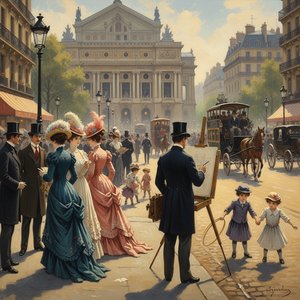
Jean-Georges Béraud: Capturing Parisian Life in the Belle Époque
Explore the captivating world of Jean-Georges Béraud, master painter of Belle Époque Paris. Discover his iconic scenes, artistic evolution, and social commentary. A deep dive into 19th-century French art.
Step into Elegance: Discover the Timeless Beauty and Opulence of Belle Époque Art
Immerse yourself in the splendor of Belle Époque art. From Art Nouveau to Impressionism, OriginalUniqueArt.com provides exquisite, hand-painted oil reproductions and custom portraits. Discover timeless elegance and expert artistry to elevate your home decor with confidence.

Giovanni Boldini: A Study in Belle Époque Portraiture & the Cult of Personality
Explore the captivating world of Giovanni Boldini, master of Belle Époque portraiture. Discover his signature style, iconic works like 'Miss Bell,' and lasting influence on art history. Expert analysis for collectors.
Echoes of 1882: Art, Culture & the Belle Époque's Lasting Impression
Explore the art & culture of the Belle Époque! Discover Impressionism, Realism, and iconic Parisian paintings from Degas, Béraud & more. High-quality reproductions at OriginalUniqueArt.
Echoes of a Turning Century: Artistic Responses to 1902 – A Year of Transition & Innovation
Explore the captivating art of 1902 – a pivotal year bridging Belle Époque elegance & Modernism's dawn. Discover artists like Chéret, Boldini & Luminist masters. Expert insights for collectors at OriginalUniqueArt.


