Text size

() ·

A painting made for you, by hand

A Young Man

Hand Made Oil Reproduction

Hand-painted oil on canvas in your size and frame, made to order by our artists. ( Switch to Print Switch to Digital Image)

Collectible Description

Artist Biography

A master of Venetian atmosphere and color, famous for The Tempest. Discover the poetic mystery of his legendary works today.

from ·

Chapter 1

How large should it be?

Slide to change the size; the picture on the left shows the frame at its real width. The proportions of the original are kept.

Standard
custom
CM
INCH

Pick from our preset sizes that match the artwork's original proportions.

width
height

Type the width and the height you need, to fit your frame or your wall. This is hand-painted, so for a size with a different shape the artist can paint a bit more around the picture, or cut a bit — you choose. We send you a digital mockup to approve before the painting starts. The picture shown on this page does not show the real result — only the mockup does.

Chapter 2

How should it arrive?

Choose the edges of the stretched canvas

Choose your frame

Corner sample of the WhiteWrap canvas edge finish, stretched on solid wood bars
White $1
Corner sample of the BlurSideWrap canvas edge finish, stretched on solid wood bars
Blurside $1
Corner sample of the ExtendedWrap canvas edge finish, stretched on solid wood bars
Extended $1
Corner sample of the P118B picture frame: moulded polystyrene, 5 cm wide and 3 cm thick
P118B $10
Corner sample of the P118H picture frame: moulded polystyrene, 5 cm wide and 3 cm thick
P118H $10
Corner sample of the P118W picture frame: moulded polystyrene, 5 cm wide and 3 cm thick
P118W $10
Corner sample of the P438Z picture frame: moulded polystyrene, 5.5 cm wide and 3.5 cm thick
P438Z $10
Corner sample of the P508JH picture frame: moulded polystyrene, 7 cm wide and 3.5 cm thick
P508JH $12
Corner sample of the P508YH picture frame: moulded polystyrene, 7 cm wide and 3.5 cm thick
P508YH $12
Corner sample of the P805H picture frame: moulded polystyrene, 5 cm wide and 3.5 cm thick
P805H $10
Corner sample of the P805Z picture frame: moulded polystyrene, 5 cm wide and 3.5 cm thick
P805Z $10
Corner sample of the P919BZ picture frame: moulded polystyrene, 7 cm wide and 3.5 cm thick
P919BZ $10
Corner sample of the P919G picture frame: moulded polystyrene, 7 cm wide and 3.5 cm thick
P919G $10
Corner sample of the P919XJ picture frame: moulded polystyrene, 7 cm wide and 3.5 cm thick
P919XJ $10
Corner sample of the P959ZH picture frame: moulded polystyrene, 5 cm wide and 3 cm thick
P959ZH $10
Corner sample of the P968JZ picture frame: moulded polystyrene, 6 cm wide and 4 cm thick
P968JZ $12
Corner sample of the W106C picture frame: solid wood, 5 cm wide and 3 cm thick
W106C $8
Corner sample of the W218G picture frame: solid wood, 5 cm wide and 3 cm thick
W218G $10
Corner sample of the W218JH picture frame: solid wood, 5 cm wide and 3 cm thick
W218JH $8
Corner sample of the W218Y picture frame: solid wood, 5 cm wide and 3 cm thick
W218Y $10
Corner sample of the W307PJ picture frame: solid wood, 6 cm wide and 3 cm thick
W307PJ $10
Corner sample of the W316G picture frame: solid wood, 6 cm wide and 3 cm thick
W316G $10
Corner sample of the W316PJ picture frame: solid wood, 6 cm wide and 3 cm thick
W316PJ $8
Corner sample of the W316Y picture frame: solid wood, 6 cm wide and 3 cm thick
W316Y $10
Corner sample of the W398PJ picture frame: solid wood, 5 cm wide and 3 cm thick
W398PJ $8
Corner sample of the W4111J picture frame: solid wood, 6.5 cm wide and 3.5 cm thick
W4111J $10
Corner sample of the W500HY picture frame: solid wood, 7 cm wide and 5 cm thick
W500HY $15
Corner sample of the W500JH picture frame: solid wood, 7 cm wide and 5 cm thick
W500JH $15
Corner sample of the W692G picture frame: solid wood, 8 cm wide and 4 cm thick
W692G $12
Corner sample of the W849H picture frame: solid wood, 5 cm wide and 3 cm thick
W849H $8
Corner sample of the W940BG picture frame: solid wood, 7.5 cm wide and 4.5 cm thick
W940BG $15
Corner sample of the W953PJ picture frame: solid wood, 6 cm wide and 3.5 cm thick
W953PJ $8
Corner sample of the H24-GOLD picture frame: carved wood with gesso, 10 cm wide and 6 cm thick
H24-GOLD $30
Corner sample of the H24-SILVER picture frame: carved wood with gesso, 10 cm wide and 6 cm thick
H24-SILVER $30
Corner sample of the H36-GOLD picture frame: carved wood with gesso, 15 cm wide and 6.5 cm thick
H36-GOLD $45
Corner sample of the H36-SILVER picture frame: carved wood with gesso, 15 cm wide and 6.5 cm thick
H36-SILVER $45
Frame preview
Framed

Moulding: . Overall size with the frame: .

Chapter 3

Who paints it, and should anything change?

Examples of what can be changed: Replace face with customer photo; Add pet (e.g., replace cat with dog); Include hidden message in background; Change background landscape or elements.
After order, OriginalUniqueArt.com team will email client for instructions and provide a mockup preview

Worldwide Delivery () in 3/4 weeks instead of standard 5 weeks. (9 November). No compromise on quality.

Chapter 4

The finishing touches

A nameplate, as in a museum?

Engraved Bronze Plaque Details

This elegant plaque features the artist's name and the title of the artwork, finely engraved for a timeless presentation.

It is made from bronze with a refined, elegant finish. The text is precisely laser-engraved for a sharp and permanent result. Measuring 9x2 cm, the plaque is compact yet easy to read. It's built to be durable and scratch-resistant, offering a professional, museum-quality look. Mounting is simple thanks to the included adhesive backing.

Transparent Acrylic Plaque Details

The plaque includes essential engraved details such as the artist's name, the title of the artwork, the date it was created, the type of media used-like oil on canvas or watercolor-a brief description of the piece, and a QR code that links to the complete artwork information.

It is crafted from clear acrylic, offering a sleek, modern appearance. The text is UV-engraved in black to ensure strong visual contrast. With a size of 10x15 cm, it ensures optimal readability. It comes equipped with two metal hooks for secure wall mounting. The plaque is designed to be weather-resistant, making it suitable for various environments, and it includes interactive features that work seamlessly with smartphone scanning.

Black Acrylic Plaque Details

This elegant plaque includes engraved information such as the artist's name, the title of the artwork, the date it was created, the type of media used (like oil on canvas or watercolor), a short description of the artwork, and a QR code for quick access to more information.

The plaque itself is made from refined black acrylic with a premium finish. The text is laser-engraved in white for high contrast and readability. Its size is 10x15 cm, designed to be easy to read. It comes with two metal hooks for professional mounting. The design is sleek and fits any interior style. It is also weather-resistant and durable, with built-in digital integration for mobile compatibility.

A protective varnish?

When do you need it?

Chapter 5

Your painting, as you ordered it

A Young Man

Reproduction Medium

Reproduction Size

-

Elite Senior Artist

More detail, finesse, and extra production time

-

Reproduction Frame

-

-

For artworks or reproductions larger than 105 cm (approximately 41 inches) on any side, the frame will be shipped as a kit, disassembled. This method ensures safe delivery and prevents damage during transport.

Professional assembly required - this is not a DIY product.
The kit must be assembled and the canvas stretched by an experienced professional framer, using wood glue (not supplied), a canvas stretching plier and clamps to hold the bars square while the glue dries. Incorrect assembly or uneven canvas tension can permanently damage the artwork and is not covered by our warranty.

  • All solid wood bars are included, precisely cut to size.

  • Assembled with the screws provided, plus wood glue for the corner joints, which is not supplied and must be sourced by your framer.

  • Professional tools are required and not included: a canvas stretching plier (tensioner) and clamps to hold the bars square while the glue dries.

Important:
The corner joints require wood glue, the bars must be held with clamps until the glue is fully dry, and tightening the canvas on the assembled frame requires a canvas stretching plier. None of these are included in the kit. Please arrange an experienced professional framer before ordering this size.

Nameplate

-

-

Protective Varnish

Glossy Varnish (enhances colors, protects against light/moisture)

-

Customize My Artwork

Examples of what can be changed: Replace face with customer photo; Add pet (e.g., replace cat with dog); Include hidden message in background; Change background landscape or elements.

-

Urgent

Worldwide Delivery () in 3/4 weeks instead of standard 5 weeks. (9 November). No compromise on quality.

-

Express Shipping

Worldwide Delivery () in 5 weeks. (16 November).

Included

Total Price

$ 300

Total Price $ 300

Glass option is only available in size under 110 CM

Included with every order

  • Free Worldwide Express Shipping
  • High-Quality Linen Canvas
  • Full Shipping Insurance
  • Customs Tax Refund Guarantee
  • True Color Matching Guarantee
  • 100-Day Return Policy (Defects Only)
  • 100% Money-Back Guarantee
  • Bulk Discount Offer

Introduction

This article will provide an overview of the painting 'A Young Man' by Giorgione, including information about the artist, the painting title, media, style and other relevant details.

The Artist: Giorgione (Giorgio Barbarelli Da Castelfranco)

Giorgione was an illustrious High Renaissance painter from the Venetian school who left an indelible mark despite his brief career and limited confirmed works. His paintings are lauded for their lyrical and enigmatic qualities, with only a handful being definitively credited to him.

The Painting: A Young Man

'A Young Man' is an oil painting on canvas that measures 58 x 46 cm. The painting is currently held in the Staatliche Museen, Berlin.

Style and Technique

Giorgione was known for his innovative use of oil paint and his loose brushwork, which created a soft and atmospheric effect. In 'A Young Man', Giorgione used a darker ground and painted progressively from darker to lighter tones, creating a sense of light emerging from the darkness.

Subject Matter

'A Young Man' is a portrait painting, which was a major force in Italian Renaissance painting and beyond. Giorgione introduced a new quality of soulfulness and intimacy into portraiture, expanding its expressive range by introducing motifs and compositional devices associated with other types of picture.

Context

Giorgione was one of the main artists of the Venetian school, which included Giorgione, Titian, Tintoretto, Paolo Veronese, and Jacopo Bassano and his sons. The Venetian painting art movement began with the work of Giovanni Bellini and his brother Gentile Bellini and their workshops.

Conclusion

'A Young Man' by Giorgione is a masterpiece of High Renaissance painting that showcases the artist's innovative use of oil paint, loose brushwork, and atmospheric effect. The painting is an excellent example of the Venetian painting art movement and the new quality of soulfulness and intimacy introduced into portraiture by Giorgione.

Related Paintings

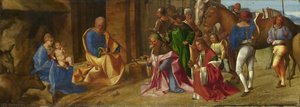
If you are interested in Giorgione's paintings, you can also view our reproductions of his other works, such as: - Adoration of the Shepherds - Portrait of a Young Man

Sources

For more information about Giorgione and his paintings, please visit our website Giorgione (Giorgio Barbarelli Da Castelfranco) or consult the following sources: - National Gallery of Art, Giorgione and the High Renaissance in Venice - Web Gallery of Art, Portrait of a Young Man by GIORGIONE - Museum of Fine Arts Budapest, Portrait of a Young Man (The Broccardo Portrait) - Giorgione - Encyclopædia Britannica, Giorgione | Italian Renaissance Painter & Master of Color

Questions & Answers

What use and space are recommended for "A Young Man" by Giorgione?

"A Young Man" by Giorgione is recommended for accent, ideally in a living room. Use and space together guide where a reproduction fits.

What is the luminance of "A Young Man" by Giorgione?

"A Young Man" by Giorgione has a dark luminance. Luminance describes how much light the colors appear to reflect.

Which color stands out most in "A Young Man"?

The dominant color of "A Young Man" by Giorgione is phthalo green (#30211b).

More about this painting

Preview AR preview Switch to Print Switch to Digital Image Send
Details Guide Add to favorites Download Similars X-Ray Diaporama Q&A Stats

In numbers

  • 29frames to choose from
  • standard sizes, in its own proportions
  • 5weeks to paint and deliver it
Giorgione

Giorgione

1477 - 1510, Italy

Quick facts about Giorgione

  • Artistic Movement Or Style: Venetian School
  • Artists Or Movements Influenced By This Artist: ['Titian']
  • Artists Who Influenced This Artist: ['Giovanni Bellini']
  • Full Name: Giorgio Barbarelli da Castelfranco
  • Nationality: Italian
  • Notable Artworks:
    • The Tempest
    • Pastoral Concert
    • Sleeping Venus
    • Judith
  • Place Of Birth: Castel Franco Veneto, Italy
  • Date Of Birth: 1477
  • Date Of Death: 1510

Artist Biography

The Life and Identity of Giorgione

To understand the trajectory of the Venetian school, one must confront the shadow cast by Giorgione. He was an Italian painter of the Venetian school during the High Renaissance, yet his biography remains a collection of fragments. Born in the small town of Castelfranco Veneto, Italy, around 1477 or 1478, he operated within a culture that valued both technical precision and atmospheric depth. His identity was as layered as his oil glazes. While history knows him by the name Giorgione, this was a nickname earned through his tall stature. His actual name was likely Zorzi.

His career was a brief, intense flash in the history of the Republic of Venice. He died around 1510 at the age of thirty-two or thirty-three, a death that cut short a period of intense stylistic transition. This early passing left a void that his contemporaries had to fill, turning his limited output into a subject of intense scrutiny. He did not rely on a long, documented life to establish his presence; instead, his impact is measured by the suddenness of his departure and the specific, moody qualities he introduced to the Venetian landscape.

Early Life and Artistic Training

Giorgione’s origins lie in Castelfranco Veneto, Italy. While the exact year of his birth remains a subject of debate, his presence in the Venetian art scene was established early. He did not work in a vacuum; his development was shaped by the rigorous traditions of the Venetian school. He likely apprenticed under Giovanni Bellini, the dominant figure of the era. This connection provided him with a foundation in the established techniques of the time before he began to deviate from them. His training was not merely about imitation but about absorbing the technical language of a leading master.

By the time he was established in Venice, he was recognized as a professional peer to other significant painters. Records identify him as a colleague of the master Vincenzo Catena. This status indicates that he had moved beyond the stage of a mere student and was actively participating in the competitive professional landscape of the Republic. His early career was defined by this transition from a student of Bellini to a recognized practitioner working alongside his contemporaries.

Patrons and Early Commissions

Giorgione’s early career was defined by high-level access to the Venetian power structure. He secured commissions from the most influential figures of the Republic, proving his utility to the state long before his death. The Council of Ten, the supreme governing body of Venice, commissioned him to produce a work for the Hall of the Audience in the Doge's Palace. This was no minor task. It placed his output directly within the political heart of the city. His ability to navigate these circles is further evidenced by his portraits of prominent figures, including Doge Agostino Barbarigo. These early assignments demonstrate that he was already a recognized professional with the technical skill required for state-level portraiture.

His work also addressed the private, often somber, needs of the Venetian nobility. Tuzio Costanzo commissioned a painting from the artist in memory of his son, Matteo. This type of personal, commemorative work highlights the artist's role in the social and religious rituals of the time. Even his native region provided significant work; in 1504, he was tasked with painting an altarpiece for the cathedral in Castelfranco Veneto. These diverse commissions—ranging from state halls to private memorials and religious altarpieces—show a painter who was deeply integrated into the functional fabric of Venetian life.

Technique and Artistic Style

Giorgione’s approach fundamentally shifted the focus of Venetian painting from the rigid, linear precision of the Florentine tradition toward a sensory experience defined by color and atmosphere. He moved away from the heavy reliance on disegno, instead utilizing oil paint to construct the illusion of texture, light, and air. This technical mastery allowed him to build depth through the sophisticated layering of pigments rather than through sharp, structural outlines. By employing sfumato—the use of subtle gradations of tone—he softened the edges of his subjects, allowing them to merge into their surroundings. This method prioritized an overall harmony over the pursuit of meticulous, isolated detail.

His innovation extended beyond technical execution into the very nature of subject matter. Giorgione introduced a range of themes that functioned through mood rather than through explicit narrative. He moved away from the requirement that a painting must tell a clear story, often presenting scenes that exist to embody a specific feeling or a lyrical quality. This shift allowed for a sense of ambiguity, where the landscape and the figures exist in a state of quiet tension. In works like The Tempest, the atmosphere itself becomes a primary subject, as much as the figures depicted within it.

Key Masterpieces and Notable Works

Giorgione’s output remains defined by a refusal to provide easy answers. The Tempest, dated between 1506 and 1508, remains a primary example of this ambiguity, presenting a scene that resists a single, definitive reading. Similarly, Pastoral Concert (c. 1509) prioritizes mood over a clear narrative, a technique that shifted the focus of Venetian painting toward atmosphere. His 1508 work, The Three Philosophers, further demonstrates this ability to use landscape and light to create a sense of mystery rather than a simple historical or religious record.

The artist also redefined the depiction of the human form and its relationship to the natural world. The Sleeping Venus is a significant departure from previous traditions, establishing a specific genre of reclining nudes. In Judith, executed around 1504, he explored intense subject matter through a lens of subtle tonal shifts. His 1506 oil on canvas, Laura, is particularly notable as it is the only work he signed and dated, providing a rare, concrete anchor in his otherwise elusive career. This work shows a clear transition toward a style defined by muted colors and sfumato.

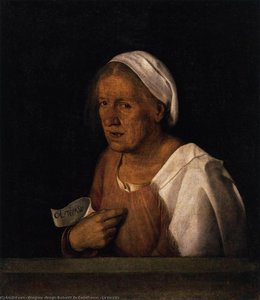
Other significant works highlight his range in both religious and secular themes. The Castelfranco Madonna (c. 1503/04) uses a high throne and landscape to bridge the gap between the divine and the earthly. His 1506 painting, The Old Woman, functions as an allegory of time, while his portraiture continues to emphasize psychological depth through careful composition. These works collectively prove that his impact was rooted in a specific, technical mastery of light and color.

Circle and Artistic Influence

Giorgione’s impact is measured by the lineage of painters who absorbed his approach to atmosphere and color. His most significant connection was his mentorship of Titian, who would eventually dominate the High Renaissance. This transition from Giorgione’s moody, poetic sensibility to Titian’s more robust style defined the trajectory of Venetian art. Beyond Titian, his direct teaching shaped the hands of several notable figures, including Dosso Dossi, Giovanni da Udine, Andrea Schiavone, and Francesco Torbido. These artists carried his specific methods into the next generation of Venetian production.

The reach of his style extended into the works of many others who did not necessarily study under him directly but operated within the stylistic wake he created. Palma Vecchio and Giovanni Cariani both utilized the tonal depth and light-driven compositions that Giorgione pioneered. Similarly, Sebastiano del Piombo integrated these Venetian qualities into his own practice. His influence was not a single, rigid school but a widespread shift in how painters handled the relationship between landscape and subject. This shift moved the focus away from strict line toward a more sensory, atmospheric execution.

Legacy and Historical Significance

Giorgione’s impact is measured by the fundamental shift he forced upon Venetian painting. He acted as the essential bridge between the established traditions of the early Venetian masters and the radical innovations later perfected by Titian. By moving away from the rigid, linear constraints of the Florentine school, he helped establish the foundations of the Venetian School of Italian Renaissance painting. His work prioritized the sensory experience of light and atmosphere over the mathematical precision of drawing. This shift changed how color was used to define form, moving the focus from the outline to the essence of the subject itself.

His influence stems from a refusal to adhere to strict narrative clarity. By emphasizing poetic mood and atmospheric effects, he opened doors for subsequent generations to explore art as a medium for emotion rather than just storytelling. This approach allowed for a new kind of visual language where the landscape and the subject exist in a state of shared, often ambiguous, tension. He remains a primary symbol of artistic freedom and innovation, proving that a painter could prioritize feeling and suggestion over literal accuracy.

  • The Tempest (c. 1506-1508)
  • Pastoral Concert (c. 1509)
  • Sleeping Venus (c. 1510)
  • Judith (1504)

Where to See His Works Today

To encounter the physical reality of Giorgione's impact, one must travel across Europe's major museum collections. His presence is felt most strongly in Vienna, where the Kunsthistorisches Museum houses several significant pieces, including the Portrait of Francesco Maria della Rovere. This collection provides a clear look at his ability to handle individual likenesses. In London, the National Gallery preserves The Adoration of the Kings, a work that demonstrates his early command of religious subject matter.

The landscape and mythological shifts he introduced are anchored in Paris and Dresden. The Louvre holds Pastoral Concert (Fête champêtre), a work central to understanding his departure from strict narrative. Meanwhile, the Gemäldegalerie Alte Meister in Dresden contains The Sleeping Venus, a painting that fundamentally altered the depiction of the female nude in Western art. These works are not mere relics; they are the primary evidence of his technical shifts.

Venice and St. Petersburg offer the most direct connections to his most debated and intense compositions. The Gallerie dell'Accademia in Venice holds The Tempest, a painting that remains a central point of study for its ambiguous atmosphere. In Russia, the Hermitage Museum preserves Judith, providing a rare look at his handling of dramatic, high-stakes subject matter. These specific locations hold the actual surfaces where his innovations in color and light were first realized.

Quick Facts

  • Subject or theme: Portraiture; Soulfulness & intimacy
  • Title: A Young Man
  • Notable elements or techniques: Dark ground; progressive tonal layering
  • Dimensions: 58 x 46 cm
  • Location: Staatliche Museen, Berlin

Art Quiz

There is only one correct answer for each question.

Question 1:
What is the primary artistic style associated with Giorgione?
Question 2:
Where was 'A Young Man' originally housed?
Question 3:
Giorgione is known for his innovative use of what artistic technique?
Question 4:
What was Giorgione's main contribution to portraiture?
Question 5:
Which artistic movement did Giorgione belong to?