Preview
 Send
Send Share
Share
 Details
 Guide
Guide

 Download
 Similars
 X-Ray
X-Ray Diaporama
 Stats
StatsCeres
 Acrylic On Canvas
- WallArt
- Early Venetian Renaissance
 1510
1510 745.0 x 545.0 cm
 Read More
Hand Made Oil Reproduction
Hand-painted oil on canvas in your size and frame, made to order by our artists. ( Switch to Print Switch to Digital Image)




P118B $10

P118H $10

P118W $10

P438Z $10

P508JH $12

P508YH $12

P805H $10

P805Z $10

P919BZ $10

P919G $10

P919XJ $10

P959ZH $10

P968JZ $12

W106C $8

W218G $10

W218JH $8

W218Y $10

W307PJ $10

W316G $10

W316PJ $8

W316Y $10

W398PJ $8

W4111J $10

W500HY $15

W500JH $15

W692G $12

W849H $8

W940BG $15

W953PJ $8




Pick from our preset sizes that match the artwork's original proportions.

Type the width and the height you need, to fit your frame or your wall. This is hand-painted, so for a size with a different shape the artist can paint a bit more around the picture, or cut a bit — you choose. We send you a digital mockup to approve before the painting starts. The picture shown on this page does not show the real result — only the mockup does.
After order, OriginalUniqueArt.com team will email client for instructions and provide a mockup preview
Worldwide Delivery () in 3/4 weeks instead of standard 5 weeks. (25 October). No compromise on quality.

Free Worldwide Express Shipping

High-Quality Linen Canvas

Full Shipping Insurance

Customs Tax Refund Guarantee

True Color Matching Guarantee

100-Day Return Policy (Defects Only)

100% Money-Back Guarantee

Bulk Discount Offer
 Glass option is only available in size under 110 CM

Ceres
Reproduction Medium
Reproduction Size
-


Total Price
$ 300
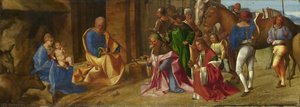
Giorgione’s ‘The Tempest’: A Venetian Masterpiece of Atmosphere and Mystery
Giorgio Barbarelli da Castelfranco, known universally as Giorgione (1477 – 1510), remains one of the most perplexing enigmas within the canon of Early Venetian Renaissance painting. Unlike many artists of his era whose biographies offer detailed accounts of their lives and careers, Giorgione’s story is fragmented—a tapestry woven from sparse historical records primarily gleaned from Giorgio Vasari’s biographical sketches. Born in Castelfranco Veneto, a town nestled on the outskirts of Venice, Giorgione’s artistic journey began under the tutelage of Giovanni Bellini, absorbing the established stylistic conventions before embarking upon an independent exploration that would ultimately redefine Venetian art.
‘The Tempest,’ housed in the Gallerie Venezia Palazzo Ducale, exemplifies Giorgione's unparalleled mastery of atmospheric illusionism and psychological subtlety. Painted circa 1506-1508, this monumental canvas depicts a shadowy interior scene—a room dominated by a woman seated on a stone bench beneath a tempestuous sky glimpsed through arched windows. The painting’s brilliance lies not merely in its technical virtuosity but also in its profound emotional resonance.
Technique and Innovation: Giorgione's Pioneering Approach
Giorgione revolutionized Venetian painting with his groundbreaking use of sfumato—a technique perfected by Bellini and subsequently embraced by Leonardo da Vinci—that achieved an unprecedented level of tonal gradation. Layers upon layers of translucent glaze meticulously blended to create soft, hazy contours that dissolved boundaries between light and dark. This masterful manipulation of color and texture wasn’t simply decorative; it served as a conduit for conveying mood and emotion with remarkable precision.
- Color Palette: Giorgione favored muted hues—ochres, siennas, blues—creating an ethereal palette that prioritized tonal harmony over vibrant chromatic contrasts.
- Glazing Technique: The application of thin layers of translucent glaze allowed for gradual color transformations and enhanced the painting’s luminous quality.
- Compositional Ambiguity: Giorgione deliberately avoided conventional perspectival conventions, opting instead for a flattened space that fostered psychological depth and uncertainty.
Historical Context and Venetian Artistic Identity
‘The Tempest’ emerged during a period of artistic ferment in Venice—a city grappling with the legacy of Dante Alighieri's ‘Divine Comedy’ and increasingly attuned to humanist ideals. Giorgione’s painting reflects this intellectual climate, prioritizing contemplation and psychological exploration over literal representation. It stands as a testament to Venetian artists’ commitment to capturing not just what was seen but also what was felt—a pursuit that distinguished Venice from other European capitals.
Symbolism and Emotional Impact: Decoding the Tempest
The tempestuous sky serves as a powerful symbol of inner turmoil—representing both external forces and psychological anxieties. The woman’s enigmatic gaze invites viewers to contemplate her thoughts and emotions, prompting questions about identity, desire, and fate. Giorgione's deliberate ambiguity ensures that ‘The Tempest’ remains perpetually open to interpretation, captivating audiences across centuries with its haunting beauty and enduring mystery.
A Legacy of Atmospheric Illusionism
Giorgione’s influence extends far beyond the confines of Venetian painting. His pioneering sfumato technique profoundly impacted subsequent generations of artists—including Leonardo da Vinci and Raphael—solidifying his place as a cornerstone of Western art history. ‘The Tempest,’ therefore, isn't merely a stunning visual experience; it is an embodiment of Giorgione’s artistic vision—a testament to the transformative power of atmosphere, emotion, and psychological insight.
Questions & Answers
Where in the home does a reproduction of "Ceres" fit well?
A reproduction of "Ceres" fits well in a living room.
Who is "Ceres" suggested for as a present, and for what use?
"Ceres" is suggested for wedding as a present, with accent in mind.
What national origin stands behind the Early Venetian Renaissance of "Ceres"?
The Early Venetian Renaissance work "Ceres" was made by an artist born in Italy.
Artist Biography
A Venetian Enigma: The Life and Legacy of Giorgione
Giorgio Barbarelli da Castelfranco, known to the world as Giorgione, remains one of the most elusive and captivating figures in Renaissance art. Born in the small town of Castelfranco Veneto near Venice around 1477 or 1478 – the exact year is debated – his tragically short life, ending around 1510 at the age of thirty-two or thirty-three, belies an artistic impact that continues to resonate centuries later. Unlike many of his contemporaries whose lives are well documented, Giorgione’s story is shrouded in mystery, pieced together from scant historical records and the often romanticized accounts of Giorgio Vasari. What we do know suggests a man deeply immersed in the vibrant culture of Venice, a city that fostered both artistic innovation and a sensual appreciation for beauty. He likely apprenticed under Giovanni Bellini, a leading Venetian painter, absorbing the established traditions before forging his own unique path. Early commissions included portraits of prominent figures like Doge Agostino Barbarigo, demonstrating an immediate talent for capturing likeness and status. However, it was in his departure from conventional subject matter and his revolutionary approach to painting that Giorgione truly distinguished himself.Poetic Visions: Style and Innovation
Giorgione’s artistic style marked a significant break from the prevailing Florentine emphasis on linear perspective and precise draftsmanship. He championed color, atmosphere, and an evocative moodiness that became hallmarks of the Venetian school. His technique involved softening outlines, employing subtle gradations of tone – *sfumato* – to create atmospheric effects, and prioritizing overall harmony over meticulous detail. This approach wasn’t merely a technical choice; it reflected a fundamentally different artistic sensibility. Giorgione sought not to replicate reality but to capture its essence, its fleeting emotions, and its poetic resonance. His paintings often feature enigmatic subjects and ambiguous narratives, inviting viewers into a world of contemplation rather than offering clear-cut stories. The Tempest, perhaps his most famous work, exemplifies this perfectly. The scene – a soldier and a nursing mother amidst a stormy landscape – has baffled art historians for centuries, its meaning remaining tantalizingly out of reach. Similarly, Pastoral Concert (Fête champêtre) presents an idyllic gathering of musicians in a pastoral setting, celebrated not for any specific narrative but for its harmonious composition and lyrical quality. These works weren’t intended to be puzzles to solve; they were meant to evoke feelings, moods, and a sense of wonder.Masterpieces and Enduring Influence
Though his output was limited by his untimely death, Giorgione left behind a small but profoundly influential body of work. Sleeping Venus, likely completed with assistance from Titian after Giorgione’s passing, is an iconic depiction of the goddess, showcasing his mastery of color and form. The languid pose and soft flesh tones embody the Venetian appreciation for sensuality and beauty. Other notable works include Judith, an early example of his developing style, and portraits that reveal a keen ability to capture the character and essence of his subjects. Giorgione’s influence extended far beyond his own paintings. He was a mentor to Titian, who would become one of the most celebrated artists of the High Renaissance, carrying forward Giorgione's innovations in color and atmospheric painting. The emphasis on color and atmosphere profoundly impacted the development of Venetian painting, distinguishing it from the Florentine tradition and establishing Venice as a major center for artistic innovation.A Lasting Legacy: Giorgione’s Historical Significance
Despite his brief career, Giorgione occupies a pivotal position in art history. He bridged the gap between earlier Venetian traditions and the innovations of Titian and other later masters, fundamentally altering the course of Italian painting. His emphasis on poetic mood, atmospheric effects, and ambiguous narratives paved the way for new artistic explorations and inspired generations of artists. The very mystery surrounding his life and work has contributed to his enduring mystique and appeal. He remains a symbol of artistic freedom, innovation, and the power of suggestion – a painter who dared to prioritize feeling over form, atmosphere over accuracy, and poetry over narrative.Key Works by Giorgione
- The Tempest (c. 1506-1508)
- Pastoral Concert (Fête champêtre) (c. 1509)
- Sleeping Venus (c. 1510)
- Judith (1504)
- Portrait of a Venetian Gentleman

Giorgione
1477 - 1510 , Italy
Quick Facts
- Artistic Movement Or Style: Venetian School
- Artists Or Movements Influenced By This Artist:
- Titian
- Venetian School
- Artists Who Influenced This Artist: ['Giovanni Bellini']
- Full Name: Giorgio Barbarelli da Castelfranco
- Nationality: Italian
- Notable Artworks:
- The Tempest
- Pastoral Concert
- Sleeping Venus
- Judith
- Portrait of a Venetian Gentleman
- Place Of Birth: Castel Franco Veneto, Italy
- Date Of Birth: 1477
- Date Of Death: 1510
Related Articles

Venetian Renaissance: The Mastery of Color, Light, and the Art of Colorito
Explore the luminous mastery of the Venetian Renaissance. Discover how masters like Titian and Giorgione revolutionized art through colorito, light, and atmosphere. An expert guide to the golden age of Italian painting for collectors and enthusiasts.

Giorgione: Enigma and Innovation in Early Venetian Renaissance Painting
Explore the enigmatic world of Giorgione, a pivotal figure in the Venetian Renaissance. Discover his innovative techniques, iconic paintings like 'The Tempest', and lasting influence on art history. Learn more at OriginalUniqueArt.
Venetian Renaissance: The Golden Age of Color, Light, and Luminous Artistry
Embark on a journey through the Venetian Renaissance. Discover how masters like Giorgione and Titian revolutionized art through luminous color and light. Explore the profound legacy of the Venetian School and its enduring influence on the world of fine art.

Jacopo Tintoretto's Masterpieces: 25 Paintings That Define Venetian Drama | OriginalUniqueArt
Explore 25 breathtaking masterpieces by Jacopo Tintoretto, the Venetian master of drama and light. Discover the stories behind iconic Renaissance paintings & find museum-quality art reproductions to elevate your home decor on OriginalUniqueArt.com.

The Golden Light of Innovation: Exploring the Venetian Renaissance Art Movement (1430–1580)
Explore the Golden Age of Venetian art (1430–1580). Discover Giorgione, Titian & Tintoretto's techniques, the 'colorito' revolution, and lasting influence. Expert insights for collectors & enthusiasts.