Menu
Text size

() ·

A painting made for you, by hand

Reed-Stacks

Hand Made Oil Reproduction

Hand-painted oil on canvas in your size and frame, made to order by our artists. ( Switch to Print Switch to Digital Image)

Collectible Description

Artist Biography

Discover Franz Marc (1880-1916), a German Expressionist pioneer & Der Blaue Reiter co-founder. Explore his iconic animal paintings, vibrant colors, and spiritual themes. Learn about his legacy!

from ·

Chapter 1

How large should it be?

Slide to change the size; the picture on the left shows the frame at its real width. The proportions of the original are kept.

Standard
custom
CM
INCH

Pick from our preset sizes that match the artwork's original proportions.

width
height

Type the width and the height you need, to fit your frame or your wall. This is hand-painted, so for a size with a different shape the artist can paint a bit more around the picture, or cut a bit — you choose. We send you a digital mockup to approve before the painting starts. The picture shown on this page does not show the real result — only the mockup does.

Chapter 2

How should it arrive?

Choose the edges of the stretched canvas

Choose your frame

Corner sample of the WhiteWrap canvas edge finish, stretched on solid wood bars
White $1
Corner sample of the BlurSideWrap canvas edge finish, stretched on solid wood bars
Blurside $1
Corner sample of the ExtendedWrap canvas edge finish, stretched on solid wood bars
Extended $1
Corner sample of the P118B picture frame: moulded polystyrene, 5 cm wide and 3 cm thick
P118B $10
Corner sample of the P118H picture frame: moulded polystyrene, 5 cm wide and 3 cm thick
P118H $10
Corner sample of the P118W picture frame: moulded polystyrene, 5 cm wide and 3 cm thick
P118W $10
Corner sample of the P438Z picture frame: moulded polystyrene, 5.5 cm wide and 3.5 cm thick
P438Z $10
Corner sample of the P508JH picture frame: moulded polystyrene, 7 cm wide and 3.5 cm thick
P508JH $12
Corner sample of the P508YH picture frame: moulded polystyrene, 7 cm wide and 3.5 cm thick
P508YH $12
Corner sample of the P805H picture frame: moulded polystyrene, 5 cm wide and 3.5 cm thick
P805H $10
Corner sample of the P805Z picture frame: moulded polystyrene, 5 cm wide and 3.5 cm thick
P805Z $10
Corner sample of the P919BZ picture frame: moulded polystyrene, 7 cm wide and 3.5 cm thick
P919BZ $10
Corner sample of the P919G picture frame: moulded polystyrene, 7 cm wide and 3.5 cm thick
P919G $10
Corner sample of the P919XJ picture frame: moulded polystyrene, 7 cm wide and 3.5 cm thick
P919XJ $10
Corner sample of the P959ZH picture frame: moulded polystyrene, 5 cm wide and 3 cm thick
P959ZH $10
Corner sample of the P968JZ picture frame: moulded polystyrene, 6 cm wide and 4 cm thick
P968JZ $12
Corner sample of the W106C picture frame: solid wood, 5 cm wide and 3 cm thick
W106C $8
Corner sample of the W218G picture frame: solid wood, 5 cm wide and 3 cm thick
W218G $10
Corner sample of the W218JH picture frame: solid wood, 5 cm wide and 3 cm thick
W218JH $8
Corner sample of the W218Y picture frame: solid wood, 5 cm wide and 3 cm thick
W218Y $10
Corner sample of the W307PJ picture frame: solid wood, 6 cm wide and 3 cm thick
W307PJ $10
Corner sample of the W316G picture frame: solid wood, 6 cm wide and 3 cm thick
W316G $10
Corner sample of the W316PJ picture frame: solid wood, 6 cm wide and 3 cm thick
W316PJ $8
Corner sample of the W316Y picture frame: solid wood, 6 cm wide and 3 cm thick
W316Y $10
Corner sample of the W398PJ picture frame: solid wood, 5 cm wide and 3 cm thick
W398PJ $8
Corner sample of the W4111J picture frame: solid wood, 6.5 cm wide and 3.5 cm thick
W4111J $10
Corner sample of the W500HY picture frame: solid wood, 7 cm wide and 5 cm thick
W500HY $15
Corner sample of the W500JH picture frame: solid wood, 7 cm wide and 5 cm thick
W500JH $15
Corner sample of the W692G picture frame: solid wood, 8 cm wide and 4 cm thick
W692G $12
Corner sample of the W849H picture frame: solid wood, 5 cm wide and 3 cm thick
W849H $8
Corner sample of the W940BG picture frame: solid wood, 7.5 cm wide and 4.5 cm thick
W940BG $15
Corner sample of the W953PJ picture frame: solid wood, 6 cm wide and 3.5 cm thick
W953PJ $8
Corner sample of the H24-GOLD picture frame: carved wood with gesso, 10 cm wide and 6 cm thick
H24-GOLD $30
Corner sample of the H24-SILVER picture frame: carved wood with gesso, 10 cm wide and 6 cm thick
H24-SILVER $30
Corner sample of the H36-GOLD picture frame: carved wood with gesso, 15 cm wide and 6.5 cm thick
H36-GOLD $45
Corner sample of the H36-SILVER picture frame: carved wood with gesso, 15 cm wide and 6.5 cm thick
H36-SILVER $45
Frame preview
Framed

Moulding: . Overall size with the frame: .

Chapter 3

Who paints it, and should anything change?

Examples of what can be changed: Replace face with customer photo; Add pet (e.g., replace cat with dog); Include hidden message in background; Change background landscape or elements.
After order, OriginalUniqueArt.com team will email client for instructions and provide a mockup preview

Worldwide Delivery () in 3/4 weeks instead of standard 5 weeks. (30 October). No compromise on quality.

Chapter 4

The finishing touches

A nameplate, as in a museum?

Engraved Bronze Plaque Details

This elegant plaque features the artist's name and the title of the artwork, finely engraved for a timeless presentation.

It is made from bronze with a refined, elegant finish. The text is precisely laser-engraved for a sharp and permanent result. Measuring 9x2 cm, the plaque is compact yet easy to read. It's built to be durable and scratch-resistant, offering a professional, museum-quality look. Mounting is simple thanks to the included adhesive backing.

Transparent Acrylic Plaque Details

The plaque includes essential engraved details such as the artist's name, the title of the artwork, the date it was created, the type of media used-like oil on canvas or watercolor-a brief description of the piece, and a QR code that links to the complete artwork information.

It is crafted from clear acrylic, offering a sleek, modern appearance. The text is UV-engraved in black to ensure strong visual contrast. With a size of 10x15 cm, it ensures optimal readability. It comes equipped with two metal hooks for secure wall mounting. The plaque is designed to be weather-resistant, making it suitable for various environments, and it includes interactive features that work seamlessly with smartphone scanning.

Black Acrylic Plaque Details

This elegant plaque includes engraved information such as the artist's name, the title of the artwork, the date it was created, the type of media used (like oil on canvas or watercolor), a short description of the artwork, and a QR code for quick access to more information.

The plaque itself is made from refined black acrylic with a premium finish. The text is laser-engraved in white for high contrast and readability. Its size is 10x15 cm, designed to be easy to read. It comes with two metal hooks for professional mounting. The design is sleek and fits any interior style. It is also weather-resistant and durable, with built-in digital integration for mobile compatibility.

A protective varnish?

When do you need it?

Chapter 5

Your painting, as you ordered it

Reed-Stacks

Reproduction Medium

Reproduction Size

-

Elite Senior Artist

More detail, finesse, and extra production time

-

Reproduction Frame

-

-

For artworks or reproductions larger than 105 cm (approximately 41 inches) on any side, the frame will be shipped as a kit, disassembled. This method ensures safe delivery and prevents damage during transport.

Professional assembly required - this is not a DIY product.
The kit must be assembled and the canvas stretched by an experienced professional framer, using wood glue (not supplied), a canvas stretching plier and clamps to hold the bars square while the glue dries. Incorrect assembly or uneven canvas tension can permanently damage the artwork and is not covered by our warranty.

  • All solid wood bars are included, precisely cut to size.

  • Assembled with the screws provided, plus wood glue for the corner joints, which is not supplied and must be sourced by your framer.

  • Professional tools are required and not included: a canvas stretching plier (tensioner) and clamps to hold the bars square while the glue dries.

Important:
The corner joints require wood glue, the bars must be held with clamps until the glue is fully dry, and tightening the canvas on the assembled frame requires a canvas stretching plier. None of these are included in the kit. Please arrange an experienced professional framer before ordering this size.

Nameplate

-

-

Protective Varnish

Glossy Varnish (enhances colors, protects against light/moisture)

-

Customize My Artwork

Examples of what can be changed: Replace face with customer photo; Add pet (e.g., replace cat with dog); Include hidden message in background; Change background landscape or elements.

-

Urgent

Worldwide Delivery () in 3/4 weeks instead of standard 5 weeks. (30 October). No compromise on quality.

-

Express Shipping

Worldwide Delivery () in 5 weeks. (6 November).

Included

Total Price

$ 300

Total Price $ 300

Glass option is only available in size under 110 CM

Included with every order

  • Free Worldwide Express Shipping
  • High-Quality Linen Canvas
  • Full Shipping Insurance
  • Customs Tax Refund Guarantee
  • True Color Matching Guarantee
  • 100-Day Return Policy (Defects Only)
  • 100% Money-Back Guarantee
  • Bulk Discount Offer

A Symphony of Color and Rural Reverie: Exploring Franz Marc’s *Reed-Stacks*

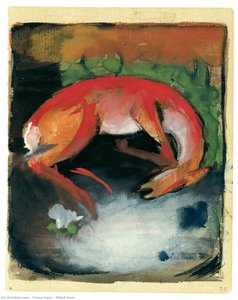
Franz Marc's 1909 painting, *Reed-Stacks*, isn’t merely a depiction of agricultural labor; it’s a profound meditation on the interconnectedness between humanity and nature. This work, rendered in Marc’s signature vibrant palette and deeply felt symbolism, captures a fleeting moment in the German countryside – a scene imbued with an almost palpable spiritual resonance. The painting presents five substantial stacks of reeds or straw, meticulously arranged to create a sense of spatial depth and inviting the viewer into their shadowed recesses. These aren't simply piles of harvested material; they become monumental forms, suggesting both the bounty of the land and the quiet industry that sustains it.

Marc’s artistic journey was profoundly shaped by his early interest in theology, a pursuit that instilled within him a belief in art’s capacity to transcend the purely representational. This conviction is powerfully evident in *Reed-Stacks*. The artist deliberately eschews photographic realism, instead prioritizing emotional and spiritual truth. The muted earth tones – ochres, browns, and deep greens – are punctuated by bursts of intense color: a vibrant blue that seems to emanate from within the reeds themselves, and touches of crimson hinting at the lifeblood of the land. This chromatic intensity isn’t arbitrary; it reflects Marc's belief in the inherent spiritual qualities residing within natural forms.

The Language of Color and Animal Spirit

Marc’s distinctive style, firmly rooted in the burgeoning Expressionist movement, is immediately recognizable. He employed a simplified, almost childlike approach to form, prioritizing color and emotional impact over meticulous detail. This simplification allows the viewer to connect with the essence of the scene – the feeling of warmth, the quiet dignity of rural life, and perhaps even a sense of ancient wisdom. The use of bold, non-naturalistic colors is particularly significant. Marc wasn’t aiming for literal representation; he was translating his *felt* experience of the landscape into visual terms. He frequently drew inspiration from animals, believing they possessed a deeper understanding of the world's spiritual truths. This influence can be seen in the way the reeds are rendered – their forms subtly reminiscent of animal bodies, suggesting a kinship between humankind and the natural kingdom.

  • Color Theory: Marc’s masterful use of complementary colors—particularly blue and red—creates visual excitement and dynamism within the composition.
  • Simplified Forms: The reduction of forms to their essential shapes contributes to the painting's emotional intensity.
  • Symbolic Representation: The reeds themselves become symbols of fertility, abundance, and the cyclical rhythms of nature.

Historical Context and Artistic Influences

Created in 1909, *Reed-Stacks* sits within a pivotal moment in Marc’s artistic development. Following his initial exposure to Vincent van Gogh's expressive brushwork and vibrant color palette – an encounter that profoundly impacted his own approach to painting – Marc continued to explore themes of spirituality and the natural world. The late 1900s saw Expressionism gaining momentum, challenging traditional academic conventions and prioritizing subjective experience. *Reed-Stacks* exemplifies this shift, moving beyond mere representation to convey a deeply felt emotional response to the landscape.

Furthermore, Marc’s interest in folklore and mythology informed his work. The image of the reed stacks evokes ancient agricultural rituals and beliefs surrounding fertility and prosperity. It's not surprising that Marc was drawn to this subject matter; it resonated with his broader exploration of the spiritual dimensions of rural life.

A Timeless Reflection: Reproduction and Interior Design

OriginalUniqueArt offers exceptional, hand-painted reproductions of *Reed-Stacks*, meticulously crafted to capture the essence of Marc’s original vision. These reproductions faithfully recreate the painting's vibrant colors, expressive brushwork, and profound emotional depth. Whether adorning a contemporary living room or a study dedicated to art history, this iconic work will undoubtedly serve as a captivating focal point. The scale and color palette lend themselves beautifully to a variety of interior design styles, from rustic farmhouse chic to modern minimalist spaces. A OriginalUniqueArt reproduction allows you to bring the spirit of rural Germany – and Marc’s profound spiritual insights – into your home.

Questions & Answers

At what age did Franz Marc make "Reed-Stacks"?

Franz Marc was 29 years old when creating "Reed-Stacks" in 1909. The age is computed from the artist's birth year, 1880.

What luminance does "Reed-Stacks" by Franz Marc have?

The colors of "Reed-Stacks" show a bright balance luminance.

What color leads the composition of "Reed-Stacks" by Franz Marc?

The dominant color of "Reed-Stacks" by Franz Marc is rosy brown (#9f9294).

More about this painting

Preview AR preview Switch to Print Switch to Digital Image Send
Details Guide Add to favorites Download Similars X-Ray Diaporama Q&A Stats

In numbers

  • 1909the year it was painted
  • 29frames to choose from
  • standard sizes, in its own proportions
  • 5weeks to paint and deliver it
Franz Marc

Franz Marc

1880 - 1916, Germany

Quick facts about Franz Marc

  • Artistic Movement Or Style: German Expressionism
  • Artists Or Movements Influenced By This Artist: ['Der Blaue Reiter']
  • Artists Who Influenced This Artist:
    • Vincent van Gogh
    • Robert Delaunay
  • Full Name: Franz Moritz Wilhelm Marc
  • Nationality: German
  • Notable Artworks:
    • The Tiger
    • Red Deer
    • The Tower of Blue Horses
  • Place Of Birth: Munich, Germany
  • Date Of Birth: 1880
  • Date Of Death: 1916

Artist Biography

A Life Immersed in Color and Spirit

Franz Moritz Wilhelm Marc, born in Munich in 1880, was a painter whose brief but intensely focused career irrevocably altered the course of German Expressionism. His story is one of profound spiritual seeking translated into a vibrant visual language, a quest to understand the essence of life through the purity he found in the natural world—particularly within the animal kingdom. Initially influenced by his father, Wilhelm Marc, a landscape painter, young Franz’s artistic path wasn't immediately certain. He briefly considered theology, grappling with questions of faith and existence before ultimately dedicating himself to art at the Academy of Fine Arts in Munich. These early explorations into religious thought would remain deeply embedded within his work, shaping his belief that art could be a conduit for spiritual experience. His academic training provided him with technical foundations, but it was encounters with the works of Vincent van Gogh during visits to Paris that truly ignited his artistic vision. Van Gogh’s emotive use of color and raw expression resonated profoundly with Marc, liberating him from conventional techniques and setting him on a path toward a more subjective and emotionally charged style.

The Blue Rider and a New Artistic Vision

Marc's artistic development wasn’t solitary; it flourished within the dynamic context of early 20th-century Munich. He experimented with various artist groups, including the Neue Künstlervereinigung München, before co-founding *Der Blaue Reiter* (The Blue Rider) in 1911 alongside Wassily Kandinsky. This wasn’t merely a group or an exhibition series; it was a philosophical and artistic revolution. *Der Blaue Reiter* sought to move beyond mere representation, aiming instead to express inner spiritual truths through abstraction and symbolic color. The journal of the same name became a platform for disseminating these ideas, showcasing not only their own work but also that of other forward-thinking artists and exploring diverse cultural influences from folk art to primitive sculpture. Marc’s contributions during this period were pivotal. He moved away from depicting landscapes as static scenes, instead focusing on animals—horses, deer, foxes—as vessels of spiritual energy. These weren't simply animal portraits; they were symbolic representations of innocence, harmony, and a connection to the natural world that he believed humanity had lost. The influence of Robert Delaunay’s exploration of abstract forms and vibrant colors further propelled Marc toward simplification and heightened emotional expression in his work. Paintings like *The Tiger* (1912) and *Red Deer* (1912) exemplify this shift, showcasing bold color choices and a growing focus on the inherent qualities of his subjects rather than realistic depiction.

Symbolism, Color, and the Essence of Being

Marc’s artistic style is immediately recognizable for its distinctive use of color and form. He didn't employ color descriptively; instead, he imbued it with symbolic meaning. Blue represented spirituality and masculinity, yellow signified joy and femininity, and red embodied violence and materiality. These weren’t arbitrary choices but a carefully constructed system designed to convey specific emotional and philosophical ideas. His animals aren’t merely subjects; they are embodiments of these concepts. The simplification of forms—reducing figures to their essential shapes—further emphasized the underlying spiritual essence he sought to capture. *The Tower of Blue Horses* (1913), sadly lost during World War II, is perhaps the most iconic example of this approach, a powerful and evocative composition that encapsulates his artistic vision. He believed animals possessed an inherent purity and connection to nature that humans had forfeited through societal constraints and intellectualization. By portraying them with such reverence and symbolic weight, Marc sought to remind viewers of this lost harmony and inspire a deeper appreciation for the natural world. His work wasn’t about depicting *what* he saw but rather *how* he felt—a deeply personal and spiritual response to his surroundings.

A Tragic End and Lasting Legacy

The outbreak of World War I in 1914 dramatically altered Marc's life and artistic trajectory. Despite seeking exemption due to his status as an artist, he was drafted into the German army, serving as a cavalryman. The horrors of war deeply affected him, yet even amidst the chaos, he continued to paint, finding solace and meaning in his art. Tragically, Franz Marc died on March 4, 1916, at the Battle of Verdun, a devastating loss for the art world. His untimely death cut short a career brimming with potential, but it also cemented his place as a pivotal figure in modern art history. His work continues to resonate today, influencing generations of artists and captivating audiences with its emotional depth and spiritual resonance. Marc’s paintings are exhibited in major museums worldwide, including the Lenbachhaus in Munich, which holds an extensive collection of his work. He is remembered not only as a pioneer of German Expressionism but also as a visionary artist who dared to explore the profound connection between art, spirituality, and the natural world—a legacy that continues to inspire awe and contemplation. His artistic vision remains a testament to the power of art to transcend the material realm and touch upon something deeper within the human spirit.

Quick Facts

  • Artist: Franz Marc
  • Subject or theme: Rural life
  • Movement: Expressionism
  • Title: Reed-Stacks

Art Quiz

There is only one correct answer for each question.

Question 1:
Franz Marc’s ‘Reed-Stacks’ primarily reflects which artistic movement?
Question 2:
The presence of the reed stacks in ‘Reed-Stacks’ is most likely intended to symbolize:
Question 3:
Considering Franz Marc’s biography, what influenced his artistic focus on the natural world?
Question 4:
The composition of ‘Reed-Stacks’ utilizes elements that create an impression of depth. Which technique is MOST evident in this portrayal?
Question 5:
What year was ‘Reed-Stacks’ painted, providing context for its artistic style and themes?