Academic Realism · 1887
Composition study (Ferdinand Hodler, 1887)
Ferdinand Hodler (1853–1918) made Composition study. It dates from 1887. It belongs to the Academic Realism movement. It is made in oil on canvas. It is kept at National Gallery of Bosnia and Herzegovina in Sarajevo, Bosnia and Herzegovina. It measures 26 × 22 cm.
- 1887
- Oil On Canvas
- 26 × 22 cm
- National Gallery of Bosnia and Herzegovina, Sarajevo

 Preview

 Hand Made Oil Painting
 Send
 Share
 Fact sheet


 Download
 Similars
 X-Ray
 Diaporama
 Q&A

 Stats
Composition study, in brief
- Title
- Composition study
- Artist
- Ferdinand Hodler (1853–1918)
- Artist born in
- Bern, Switzerland
- Date
- 1887
- Medium
- Oil On Canvas
- Dimensions
- 26 × 22 cm
- Where to see it
- National Gallery of Bosnia and Herzegovina, Sarajevo, Bosnia and Herzegovina
- Movement
- Academic Realism
- Subject
- weightlifting, human form, anatomy, study, sketch, exercise
What does Composition study depict?
Composition Study – A Window into Hodler’s Soul
Ferdinand Hodler's "Composition Study," created in 1887, isn’t merely a sketch of three figures engaged in strenuous activity; it’s a profound meditation on the human condition, rendered with an arresting blend of anatomical precision and evocative symbolism. This work, now housed within the Tretyakov Gallery in Moscow, offers a rare glimpse into the artist's deeply personal vision – a world shaped by loss, contemplation, and a fascination with the ephemeral beauty of existence. The piece immediately draws the eye with its stark contrasts: the dark, almost brooding grey-brown tones of the pencil lines against the aged, neutral surface of the paper create an immediate sense of weight and seriousness. Hodler’s technique is deceptively simple yet remarkably powerful; he eschews elaborate shading or detailed rendering in favor of a confident, linear approach that emphasizes form and movement with remarkable economy.
The Anatomy of Effort – A Study in Human Form
At first glance, the composition depicts three men locked in what appears to be a grueling weightlifting exercise. However, Hodler doesn’t offer a realistic portrayal of physical exertion. Instead, he strips away extraneous detail, focusing instead on the essential lines and angles that define the figures' postures. The musculature is suggested with sharp, decisive strokes, conveying strength and strain without resorting to photographic accuracy. Notice how the diagonal lines of their bodies create a dynamic tension, mirroring the implied struggle within each individual. The arrangement isn’t haphazard; it’s carefully constructed to draw the viewer’s eye across the page, creating a sense of movement and narrative – a silent drama unfolding before our eyes.
Symbolism and the Weight of Mortality
Beyond its anatomical interest, “Composition Study” is rich in symbolic meaning. The figures themselves are often interpreted as representations of mortality and the inevitability of fate. Hodler’s early life was marked by profound loss – the deaths of his father and two brothers at a young age instilled within him a deep awareness of human vulnerability. This personal experience undoubtedly informs the work's somber mood and its exploration of themes related to death, remembrance, and the passage of time. The grid lines overlaid on the drawing—a technique frequently employed by Hodler—further emphasize this sense of structure and order imposed upon chaos, perhaps reflecting a desire to impose meaning onto an inherently unpredictable existence.
A Bridge Between Eras – Hodler’s Legacy
“Composition Study” stands as a pivotal work in the career of Ferdinand Hodler, bridging the gap between academic realism and the burgeoning Symbolist movement. Influenced by Renaissance anatomical studies—particularly those focused on depicting the human form with scientific accuracy—Hodler nevertheless departs from traditional representation, prioritizing emotional resonance over literal depiction. The piece’s stark simplicity and evocative power have resonated with viewers for over a century, cementing Hodler's place as one of Switzerland’s most important artists. Reproductions of this compelling work offer an accessible way to experience the depth and complexity of Hodler’s artistic vision, bringing his poignant reflections on life, death, and the human spirit into any space.
- Artist: Ferdinand Hodler
- Year: 1887
- Medium: Graphite pencil on paper
- Size: 26 x 22 cm
- Location: Tretyakov Gallery, Moscow
Consider commissioning a hand-painted reproduction to bring the intensity and emotional depth of “Composition Study” into your home or office. Each reproduction is meticulously crafted by skilled artisans, ensuring an authentic representation of Hodler’s original masterpiece.
Which museum holds Composition study?
National Gallery of Bosnia and Herzegovina
Sarajevo, Bosnia and Herzegovina
A Sanctuary of Resilience: The Soul of Sarajevo In the beating heart of Sarajevo, a city that has weathered the most profound storms of the twentieth century, stands the National Gallery of Bosnia and Herzegovina as a luminous testament to the enduring power of human creativity. To walk through its doors is to enter a space where the scars of history meet the triumph of the artistic spirit, offering a profound dialogue between a turbulent past and an aspirational future. It serves as a sanctuary where the collective memory of a people is preserved within the delicate strokes of paint and the heavy textures of stone.


High-resolution images of Composition study

Ferdinand Hodler, Composition study (1887), National Gallery of Bosnia and Herzegovina. Public domain.
Colours matched to the original by a digital expert, the file finely retouched, faithful to the artist's brushwork.
Own the high-resolution fileQuestions on Composition study, answered
Where can I see the original "Composition study" by Ferdinand Hodler?
You can see the original "Composition study" at the National Gallery of Bosnia and Herzegovina, Sarajevo, Bosnia and Herzegovina.
In what year was "Composition study" by Ferdinand Hodler created?
"Composition study" by Ferdinand Hodler was created in 1887.
What technique was used for "Composition study" by Ferdinand Hodler?
"Composition study" is executed in oil on canvas.
How big is the original "Composition study"?
The recorded dimensions of "Composition study" by Ferdinand Hodler are 26 x 22 cm. Reproductions can be ordered in other sizes while keeping the same proportions.
What does "Composition study" by Ferdinand Hodler depict?
"Composition study" by Ferdinand Hodler depicts: weightlifting, human form, anatomy, study, sketch, exercise, strength, graphite.
Is "Composition study" by Ferdinand Hodler in the public domain?
"Composition study" by Ferdinand Hodler is in the public domain - its copyright has expired. This status governs how the image of the work may be reproduced.
Who created "Composition study"?
"Composition study" is attributed to Ferdinand Hodler.
What style does "Composition study" belong to?
The movement associated with "Composition study" by Ferdinand Hodler is Academic Realism. This classification situates the work among related artists and artworks.
Where does "Composition study" fall in Ferdinand Hodler's career?
"Composition study" represents the Mature Period of Ferdinand Hodler.
About the artist, Ferdinand Hodler
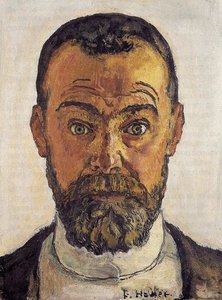
1853–1918, Switzerland
Ferdinand Hodler
The Architecture of Mortality Born in Bern, Switzerland, in 1853, Ferdinand Hodler’s early years were defined by a quiet, persistent grief. Before he reached adolescence, the tuberculosis that claimed his father and two younger brothers left a void in his household. This early encounter with loss became a recurring motif in his work, a shadow that would follow him from the modest beginnings of his apprenticeship to the heights of his professional career. He began his training as a decorative painter, assisting his stepfather with commercial sign-work, a practical education that instilled in him a precise command of line and form.
Also by Ferdinand Hodler
 Eiger, Monch and Jungfrau in Moonlight1908
 Woman in Ecstasy1911
 Sunset on Lake Geneva1915
 Study of two figures1897

Essays around Composition study
 Visualizing Sorrow: How Historical Art Captures the Universal Experience of LossExplore how masters like David and Munch visually capture grief through art history. Discover the profound language of loss today.
 Mastering Parallelism: The 25 Greatest Artworks by Ferdinand HodlerImmerse yourself in the rhythmic beauty of Ferdinand Hodler. Explore 25 iconic masterpieces of Swiss Symbolism and Parallelism, from emotiv…
 Mastering Composition: The Secrets of the Rule of Thirds, Golden Ratio, and Diagonals in Impressionist ArtDiscover the invisible architecture of Impressionism. Explore how the Rule of Thirds, Golden Ratio, and dynamic diagonals create the lumino…