The Rise of Academic Realism: Context & Foundations
Academic art, academicism, or academism, is a style of painting and sculpture produced under the influence of European academies of art. This method extended its influence throughout the Western world over several centuries, from its origins in Italy...
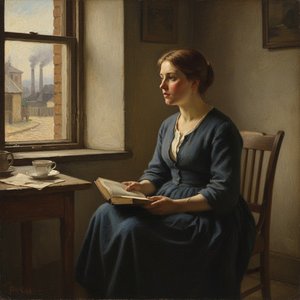
The mid-19th century witnessed a seismic shift in the artistic landscape, a deliberate turning away from the emotional fervor of Romanticism and towards a more grounded, objective representation of the world. This wasn’t merely a stylistic change; it was a philosophical response to the rapidly evolving social and political climate of Europe. The Industrial Revolution had irrevocably altered daily life, and with it came a desire for art that reflected this new reality – not idealized landscapes or heroic narratives, but the lives of ordinary people, the grit of urban existence, and the unvarnished truth of contemporary society. This burgeoning movement found its formal expression in Academic Realism, though to understand its emergence fully requires acknowledging the institution from which it sprang: the Académie des Beaux-Arts in France.
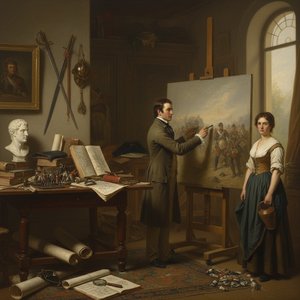
For centuries, the Académie had dictated artistic standards, emphasizing classical principles – precise draftsmanship, anatomical accuracy, and historical or mythological subject matter. However, by the early 19th century, a growing dissatisfaction with these rigid conventions began to surface. Artists felt constrained by the prescribed themes and techniques, yearning for greater freedom of expression. While Academic Realism initially existed *within* the framework of the Académie, it gradually redefined its boundaries. Artists like Gustave Courbet didn’t reject technique; rather, they applied the rigorous training they received to depict subjects previously deemed unworthy of artistic attention – laborers, peasants, and scenes from everyday life. This was a radical act, challenging not only aesthetic norms but also societal hierarchies.
The political upheavals of 1848 further fueled this shift. The revolutions across Europe exposed deep social inequalities, prompting artists to engage with the realities of poverty, injustice, and the struggles of the working class. Realism became a vehicle for social commentary, though often subtly embedded within meticulously rendered depictions of everyday life. It wasn’t necessarily about overt political statements; it was about presenting an honest portrayal of the world as it was, allowing viewers to draw their own conclusions.
Core Techniques of Academic Realism: Mastering Form & Detail
 A Waterfall in the Jura
Gustave Courbet’s “A Waterfall in the Jura” (1876) exemplifies Realism by portraying nature without idealization—a bold statement reflecting the artistic spirit of its time and mirroring the grandeur of Leicester Town Hall's construction. Admire this...
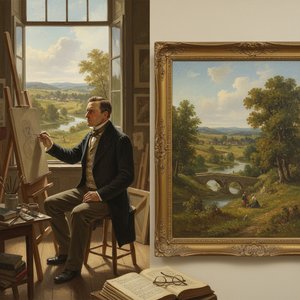
Despite its rejection of Romantic idealism, Academic Realism placed immense emphasis on technical skill. Artists underwent rigorous training in anatomy, perspective, and composition – skills honed through years of dedicated study. The goal wasn’t simply to *represent* reality but to recreate it with astonishing accuracy. This demanded a mastery of oil painting techniques, including layering, glazing, and chiaroscuro (the dramatic use of light and shadow). Unlike the loose brushwork favored by later Impressionists, Academic Realist paintings are characterized by smooth surfaces, precise details, and a remarkable sense of depth.
Consider Gustave Courbet’s “A Waterfall in the Jura.” While seemingly a straightforward landscape, it exemplifies the meticulous observation and technical prowess that defined the movement. The textures of the rocks, the cascading water, and the lush foliage are rendered with breathtaking realism. This wasn't achieved through spontaneous expression but through careful study and painstaking execution. Similarly, artists like Jean-François Millet focused on capturing the physicality of labor – the weight of a shovel, the strain in a worker’s muscles, the texture of rough clothing. This required an intimate understanding of anatomy and form.
Composition also played a crucial role. While rejecting grand historical narratives, Academic Realist artists still understood the importance of visual balance and harmony. They often employed classical compositional principles – such as pyramidal structures or balanced asymmetry – to create visually compelling works that drew the viewer’s eye to key elements within the scene. The emphasis was on creating a sense of solidity and permanence, reflecting the weightiness of the subjects depicted.
Key Figures & Masterpieces: Ingres, Bouguereau & Beyond
 Portrait of Monsieur Brun
Explore Édouard Manet's iconic Portrait of Monsieur Brun (1879), a masterpiece blending Realism & Impressionism. Discover its composition, symbolism & lasting influence on modern art – available as exquisite handmade reproductions.
While Courbet is often considered the leading figure of Realism, it’s important to recognize that the movement encompassed a diverse range of artists with varying approaches. Jean-Auguste-Dominique Ingres, though often associated with Neoclassicism, laid some of the groundwork for Academic Realism through his emphasis on precise draftsmanship and anatomical accuracy. His portraits, such as “Portrait of Monsieur Brun,” demonstrate a meticulous attention to detail and a commitment to capturing the likeness of his subjects with unflinching honesty.
William-Adolphe Bouguereau represents another facet of Academic Realism – one that often focused on idealized depictions of classical mythology and allegorical scenes. While seemingly at odds with Courbet’s focus on contemporary life, Bouguereau shared a similar commitment to technical skill and anatomical accuracy. His paintings, such as “The Birth of Venus,” showcase his mastery of oil painting techniques and his ability to create incredibly lifelike figures. However, it's crucial to note that Bouguereau’s idealized representations were often criticized for being overly sentimental and lacking in social commentary.
Edgar Degas, though later associated with Impressionism, began his career as an Academic Realist painter. His early works, such as “Dancers on Set,” demonstrate a meticulous observation of movement and light, foreshadowing his later explorations of ballet dancers. These paintings reveal a fascination with the everyday lives of ordinary people – in this case, the world of Parisian ballerinas – and a commitment to capturing their reality with unflinching honesty.
Academic Realism vs. The Avant-Garde: A Clash of Ideologies
As Academic Realism gained prominence, it inevitably came into conflict with emerging avant-garde movements, particularly Impressionism. While both movements rejected traditional academic conventions, they did so for different reasons and with vastly different approaches. Impressionists sought to capture fleeting moments and the subjective experience of light and color, often prioritizing atmosphere over precise detail. They embraced loose brushwork and spontaneous expression, rejecting the meticulous techniques favored by Academic Realists.
This clash of ideologies culminated in a series of Salon rejections and public debates. The Impressionists’ unconventional style was initially met with ridicule and scorn from critics who dismissed their work as unfinished or lacking in skill. However, over time, Impressionism gained acceptance and eventually became one of the most beloved art movements in history. The conflict between Academic Realism and the avant-garde highlights a fundamental tension within the art world – the balance between tradition and innovation, technique and expression.
The rise of photography also played a significant role in this dynamic. As cameras became increasingly capable of capturing realistic images, painters began to question the necessity of purely representational art. This prompted them to explore new avenues of expression, leading to the development of abstract and non-representational styles.
The Legacy of Academic Realism: Influence on Modern Art & Contemporary Practice
Despite its eventual decline in prominence, Academic Realism left an indelible mark on the history of art. Its emphasis on technical skill and meticulous observation continues to inspire artists today. Many contemporary realist painters draw inspiration from the techniques and principles pioneered by Courbet, Millet, and Bouguereau, demonstrating a renewed appreciation for craftsmanship and attention to detail.
Furthermore, Academic Realism’s commitment to social commentary paved the way for later movements that explicitly addressed political and economic issues. The movement’s focus on ordinary people and everyday life challenged traditional hierarchies and broadened the scope of artistic subject matter. Even artists who rejected its stylistic conventions were influenced by its underlying principles – the desire to engage with the world around them and to create art that reflected the realities of their time.
At OriginalUniqueArt, we celebrate the enduring legacy of Academic Realism, offering high-quality reproductions of masterpieces by Courbet, Ingres, Bouguereau, and other key figures. Explore our collection today and discover the beauty and power of this influential art movement. Whether you’re a seasoned collector or simply beginning your artistic journey, we invite you to experience the timeless appeal of Academic Realism.