Expressionism
Prophet (Emil Nolde)
Emil Nolde (1867–1956) made Prophet. It belongs to the Expressionism movement. It is made in woodcut.
- Woodcut

 Preview

 Hand Made Oil Painting
 Send
 Share
 Fact sheet


 Download
 Similars
 X-Ray
 Diaporama
 Q&A

 Stats
Prophet, in brief
- Title
- Prophet
- Artist
- Emil Nolde (1867–1956)
- Artist born in
- Nolde, Denmark
- Medium
- Woodcut
- Movement
- Expressionism
- Period
- Modern
- Subject
- man, face, beard, black and white, portrait, eyes
What does Prophet depict?
The Portrait of Prophet by Emil Nolde
In Prophet, the German Expressionist painter Emil Nolde captures a man who exists between the physical and the divine. The subject is a portrait of a man likely intended to represent a prophet, a figure carved from shadow and light. His beard and hairstyle suggest a man from a distant past or a religious leader, a person shaped by the weight of revelation. The face is a landscape of heavy lines and stark contrasts.
The man’s intense gaze pierces through the grain of the medium. A furrowed brow carries the imprint of deep emotion, perhaps a mixture of sadness, concern, or a singular, driving determination. This is not a likeness of a person in repose, but a study of a soul under pressure. The features are simplified, stripped of unnecessary detail to reveal the raw essence of the subject's internal state.
Emil Nolde uses the starkness of the form to emphasize this spiritual tension. Every line serves the gravity of the man's expression. The eyes do not merely look; they witness. The stillness of the portrait holds a quiet, heavy ache.
Composition and Visual Elements
The man's face occupies the center, a heavy presence that fills most of the frame. His head tilts slightly, caught in a moment of quiet anguish or deep contemplation. Around him, the background remains largely empty, a void that forces the eye back to the subject's features. There is no horizon, only the weight of the gaze.
Bold, thick lines carve the anatomy of the man. They define the coarse texture of his beard, the sharp ridge of his nose, and the deep-set hollows of his eyes. These lines are not smooth; they are angular and sharp, cutting through the space to shape his hair and facial structure. The geometry is simplified, reducing the man to essential, striking forms.
The color palette is stripped of all distraction. It exists in a narrow world of black and white, bridged only by subtle shades of grey. This lack of color heightens the dramatic tension, turning the portrait into a study of light and shadow. The starkness leaves no room for anything but the raw emotion of the expression.
Technique and Artistic Medium
The work emerges from the physical resistance of wood. This woodcut print relies on the deliberate act of carving lines into a solid block to define its form. Each stroke is a subtraction, a removal of material that leaves behind a sharp, angular topography. The artist works with wood, ink, and paper to translate a vision into a permanent, tactile presence.
Ink meets the paper through the pressure of the press. This contact creates a grainy texture across the surface, a subtle roughness that speaks of the material's origin. The depth of the shadows and the brightness of the highlights depend entirely on the variation of the lines. Thicker cuts hold more ink to create heavy shadows, while thinner, delicate lines allow the paper to breathe through the composition. The result is a stark, high-contrast landscape of light and dark.
The medium demands a directness of hand. There is no blending here, only the immediate impact of the carved edge. The grain of the wood and the weight of the ink settle into the fibers of the paper, creating a surface that feels both raw and finished. It is a quiet collision of tool and grain.
High-resolution images of Prophet
Emil Nolde, Prophet. Public domain.
Colours matched to the original by a digital expert, the file finely retouched, faithful to the artist's brushwork.
Own the high-resolution fileQuestions on Prophet, answered
What medium is "Prophet" by Emil Nolde executed in?
Emil Nolde used the woodcut technique for "Prophet". The technique defines the material nature of the original work.
What is "Prophet" about?
The subjects of "Prophet" are man, face, beard, black and white, portrait, eyes.
Is "Prophet" free of copyright?
"Prophet" by Emil Nolde is in the public domain - its copyright has expired. This status governs how the image of the work may be reproduced.
Who created "Prophet"?
"Prophet" was created by Emil Nolde. The information on this page describes Emil Nolde's original work.
What art movement does "Prophet" by Emil Nolde belong to?
"Prophet" by Emil Nolde belongs to the Expressionism movement. This movement provides the stylistic context of the work.
Why is the copyright status of "Prophet" what it is?
"Prophet" by Emil Nolde is in the public domain - its copyright has expired. Copyright terms are measured from the artist's death, and Emil Nolde died in 1956.
What does "Prophet" share with the rest of Emil Nolde's output?
Within Emil Nolde's output, "Prophet" sits in the Expressionism style, alongside the themes of post-impressionism, die brücke, religious themes, expressionist style.
Where does "Prophet" stand among Emil Nolde's recurring subjects?
Among Emil Nolde's recorded themes - post-impressionism, die brücke, religious themes, expressionist style - "Prophet" brings its own focus on man, face, beard, black and white, portrait, eyes.
About the artist, Emil Nolde
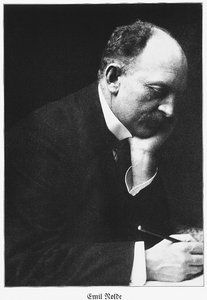
1867–1956, Denmark
Emil Nolde
The Life and Identity of Emile Nolde Born Hans Emil Hansen on 7 August 1867, the man who would become known as Emile Nolde grew up near the village of Nolde in the Duchy of Schleswig. His early years were shaped by the rural, agrarian life of his family. He eventually moved away from this path, choosing instead to work as a wood carver and furniture decorator. This tactile, physical labor preceded his shift toward painting and printmaking.
Also by Emil Nolde
 Sunset
 Sea with Red Sky
 Couple on the beach1903
 Masks1911
Essays around Prophet
 Stone and Sinew: The Sculptural Foundations of Modigliani’s PortraitsExplore the sculptural roots and structural mastery of Modigliani's portraits. Discover the secrets behind his iconic, carved style now.
 Expressionism vs. New Objectivity: Emotion vs. Precision in German ArtMaster the tension between Expressionist emotion and New Objectivity precision. Explore the soul of German modern art now.
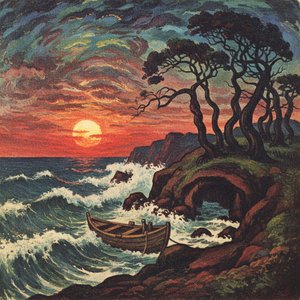 Emile Nolde: A Journey into Expressionist Nature & the Primal SelfExplore the powerful Expressionism of Emile Nolde – a pioneer of emotive landscapes & spiritual themes. Discover his journey, influences, a…