Early Life & Influences: Forging an Independent Path
 Wikipedia: Emil Nolde
Emil Nolde (born Hans Emil Hansen; 7 August 1867 – 13 April 1956) was a German painter and printmaker. He was one of the first Expressionists, a member of Die Brücke, and was one of the first oil painting and watercolor painters of the early 20th cen...
Hans Emil Hansen, born in the small North Frisian village of Nolde in 1867, embarked on a path decidedly divergent from his family’s agrarian roots. The windswept landscapes and devoutly religious atmosphere of his upbringing would prove formative, though initially resisted. His early ambitions lay not with brush and canvas but with woodcarving – a craft he pursued diligently, yet found ultimately unsatisfying. A period of wandering followed, marked by studies in Karlsruhe and Munich, where he grappled with academic constraints that stifled his burgeoning artistic vision. It was during these formative years that he adopted the name Emil Nolde, a symbolic severance from familial expectation and an embrace of his individual creative identity. This act foreshadowed a career defined by its uncompromising independence – a refusal to conform to prevailing aesthetic norms. His initial attempts at painting were met with rejection from the Munich Academy, yet this setback only fueled his determination. He sought private instruction, immersing himself in the burgeoning Impressionist scene and developing a unique sensitivity to color that would become a hallmark of his style.
The Brücke Connection & Nolde's Distinctive Style
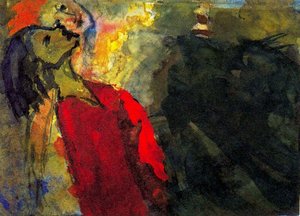 Figures Craning their Necks
Experience raw emotion in Emil Nolde's 'Figures Craning their Necks.' This Expressionist masterpiece uses bold colors and loose brushstrokes to depict figures lost in wonder, capturing a moment of aspiration and awe.
In 1906, Nolde was invited to join *Die Brücke* (The Bridge), a group of Dresden-based artists who were radically challenging artistic conventions. This association, though brief – lasting only a year – proved pivotal. While sharing the group’s rejection of academic realism and embrace of raw emotion, Nolde quickly established his own distinct voice within the Expressionist movement. Unlike Kirchner or Heckel's focus on urban alienation, Nolde’s work often turned inward, exploring themes of spirituality, nature, and the human condition with an intensity that bordered on the mystical. His brushwork became increasingly gestural, abandoning precise representation in favor of conveying feeling through vibrant color and dynamic composition. He wasn’t interested in depicting *what* he saw, but rather *how* it made him feel – a crucial distinction that set his work apart. This period witnessed the emergence of key stylistic elements: flattened perspectives, bold outlines, and an almost primal use of color, particularly golden yellows and deep reds which imbued his canvases with a luminous quality.
Nature as Spiritual Realm: Landscapes of Intense Emotion
For Nolde, nature was not merely a subject for artistic depiction; it was a conduit to the spiritual realm. His landscapes are rarely serene or idyllic. Instead, they pulsate with an almost overwhelming energy – brooding storm-scapes, turbulent seascapes, and fields ablaze with color evoke a sense of awe, fear, and profound connection to the natural world. He sought to capture not the outward appearance of nature but its inner essence, its vital force. This pursuit led him on expeditions to remote locations, including the German South Seas in 1913-14, where he documented indigenous cultures with a fascination that bordered on ethnographic study. These experiences profoundly influenced his palette and subject matter, introducing new forms and motifs into his work. Paintings like ‘Marsh Landscape’ exemplify this approach – the scene is rendered not as a realistic portrayal but as an emotional response to the raw power and beauty of the environment.
Primitivism and the Search for Authentic Expression
Nolde's fascination with “primitive” art—specifically, the art of non-Western cultures—was central to his artistic philosophy. He believed that these cultures possessed a directness and authenticity lost in Western civilization, unburdened by academic conventions or societal constraints. He collected masks, sculptures, and other artifacts from Africa, Oceania, and the Americas, studying their forms and incorporating them into his own work. This wasn’t simply an aesthetic appropriation; it was a search for a more fundamental mode of expression – a way to tap into universal human emotions and experiences. His paintings often feature stylized figures with exaggerated features, reminiscent of tribal art, reflecting this desire to connect with primal energies. However, it's crucial to acknowledge the complex context of this fascination, recognizing that his engagement with “primitivism” was shaped by the colonial attitudes of his time. He sought a purity of expression, believing these cultures represented an uncorrupted artistic impulse, but his perspective was inevitably filtered through a Western lens.
Controversy, Condemnation & Lasting Legacy
Nolde’s career was marked by both acclaim and controversy. His bold style often clashed with conservative sensibilities, leading to exclusion from prominent art societies. However, the most devastating blow came during the Nazi regime. Despite his early sympathy for nationalist ideologies, his work was deemed “degenerate” – a label that resulted in the confiscation of over 1,052 paintings and a ban on artistic creation after 1941. He continued to paint in secret, driven by an unwavering commitment to his vision. Following World War II, Nolde’s reputation underwent a remarkable rehabilitation. His work was recognized as a pivotal contribution to the development of Expressionism, influencing generations of artists with its raw emotional power and innovative use of color. Today, Emile Nolde stands as a complex and compelling figure – a pioneer who challenged artistic conventions, explored profound spiritual themes, and left an indelible mark on the landscape of modern art. His paintings continue to resonate with viewers, offering a glimpse into the depths of human emotion and the enduring beauty of the natural world. Hand-painted reproductions allow audiences worldwide to experience the intensity and vibrancy of Nolde’s vision firsthand.