
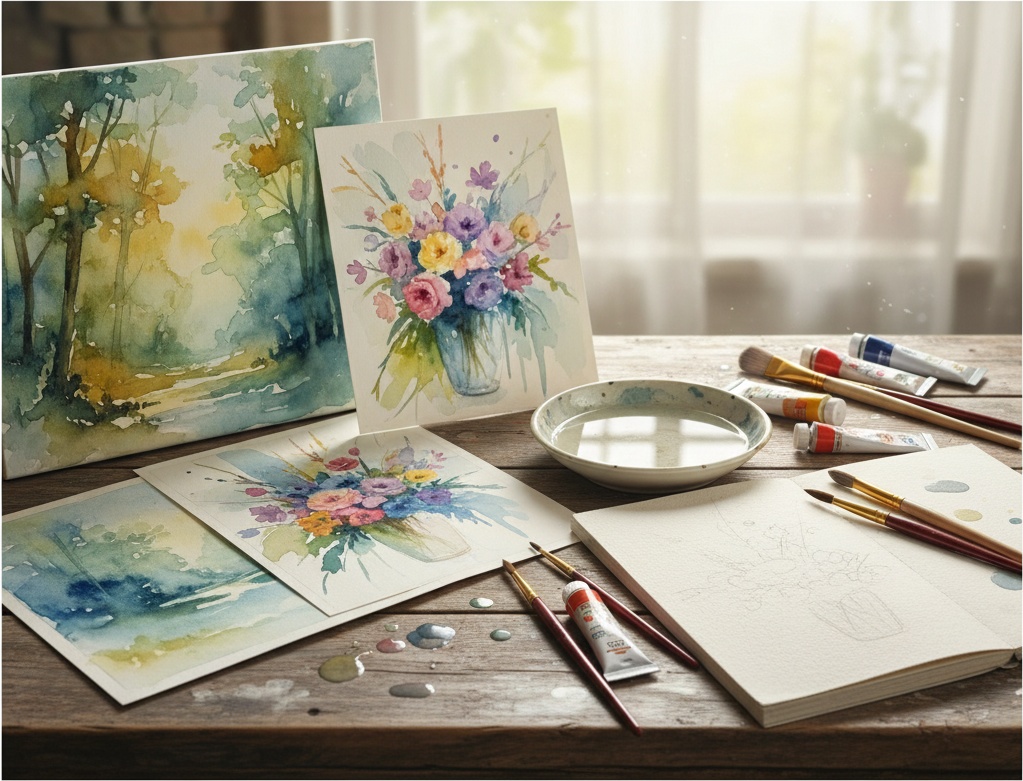
A History Painted in Light: The Evolution of Watercolor
 The Enduring Appeal of Watercolor: History, Techniques & Contemporary Practice
Explore the captivating world of watercolor painting! Discover its rich history, essential techniques, influential artists, and collecting tips. A comprehensive guide for art enthusiasts.
The story of watercolor is, in many ways, the story of humanity’s enduring fascination with light and its ephemeral qualities. While cave paintings represent the earliest expressions of artistic impulse, the deliberate use of pigments suspended in water – the very essence of watercolor – can be traced back to ancient Egypt, adorning papyrus scrolls and illuminating manuscripts. However, it wasn't until the Renaissance that watercolor truly began its ascent as a distinct art form, championed by masters like Albrecht Dürer whose botanical studies and landscapes demonstrated an unprecedented level of detail and sensitivity. Dürer’s meticulous approach, though rooted in precise observation, hinted at the medium’s potential for capturing not just *what* was seen, but *how* it felt to see it – a quality that would define watercolor's trajectory.
For centuries, watercolors often served as preliminary sketches or studies for larger oil paintings. Baroque artists employed them for quick impressions of landscapes and figures, valuable tools in the planning stages of more monumental works. Yet, within this practical application lay the seeds of its future independence. The 18th century witnessed a burgeoning interest in naturalism, particularly in England, where watercolor became inextricably linked with scientific illustration, topographical recording, and the aristocratic pursuit of picturesque scenery. Mapmakers, military officers, and amateur artists alike embraced its portability and immediacy. This period saw the rise of what were known as ‘tinted drawings,’ precursors to the fully realized watercolors we admire today.
The 19th century marked a turning point. Artists began to explore watercolor not merely as a preparatory tool but as an end in itself, elevating it to the status of a major artistic medium. The English school flourished, with figures like J.M.W. Turner pushing the boundaries of atmospheric effects and expressive color. Simultaneously, across the Atlantic, artists such as John James Audubon immortalized North American birdlife with breathtaking precision and vibrant hues, establishing watercolor as a cornerstone of wildlife illustration.
The Essence of Transparency: Understanding Watercolor Techniques
Watercolor (American English) or watercolour (Commonwealth English; see spelling differences), also aquarelle (French: [akwaʁɛl]; from Italian diminutive of Latin aqua 'water'), is a painting method in which the paints are made of pigments suspended ...
What distinguishes watercolor from other painting mediums is its inherent transparency. Unlike oils or acrylics which build opacity through layers of pigment, watercolor relies on the luminosity of the white paper beneath to create brilliance and depth. This characteristic dictates a unique approach to technique, demanding careful planning and an understanding of how colors interact when layered. The ‘wet-on-wet’ technique, for example – applying paint to dampened paper – allows colors to bleed and blend seamlessly, creating soft edges and atmospheric washes. Conversely, the ‘wet-on-dry’ method offers greater control, enabling artists to build up precise details and defined shapes.
The quality of the water itself is paramount. Pure, distilled water ensures that pigments remain vibrant and untainted. The choice of paper also profoundly impacts the final result. Cotton papers, prized for their absorbency and durability, are favored by professional watercolorists. Cold-pressed papers offer a textured surface ideal for capturing granular effects, while hot-pressed papers provide a smoother finish suitable for intricate detail. Beyond these fundamental techniques lies a world of nuanced approaches: glazing – layering translucent washes to create depth and complexity; lifting – removing paint with a brush or sponge to reveal underlying layers; dry brushing – using minimal water to achieve textured strokes.
Achieving luminous effects requires not only technical skill but also an intuitive understanding of color theory. Watercolorists often employ complementary colors to enhance vibrancy, utilizing the interplay between warm and cool tones to create visual interest. Mastering value control—the manipulation of light and shadow—is equally crucial for conveying form and depth. The challenge lies in harnessing the fluidity of water and pigment to achieve a delicate balance between control and spontaneity.
Masters of Aqueous Hue: Influential Artists & Their Styles
Throughout history, certain artists have distinguished themselves as true masters of watercolor, pushing the boundaries of the medium and leaving an indelible mark on its evolution. J.M.W. Turner, a titan of Romanticism, revolutionized landscape painting with his evocative depictions of light, atmosphere, and turbulent seascapes. His watercolors are characterized by their loose brushwork, dramatic washes, and masterful use of color to convey emotional intensity.
John James Audubon’s *Birds of America* stands as a testament to the power of watercolor in scientific illustration. His meticulously detailed paintings not only captured the anatomical accuracy of each species but also conveyed their vitality and character. Winslow Homer, an American realist painter, embraced watercolor for its ability to capture the rugged beauty of coastal landscapes and scenes of everyday life. His bold compositions, dynamic brushwork, and evocative use of color reflect his deep connection to nature.
Paul Cézanne, though primarily known as a Post-Impressionist oil painter, also produced a remarkable body of watercolors that reveal his exploration of form and structure. His still lifes and landscapes demonstrate a unique approach to color and composition, foreshadowing the development of modern art. Contemporary artists continue to innovate with watercolor, exploring new techniques and pushing the boundaries of its expressive potential.
Luminism and the Pursuit of Atmospheric Effects in Watercolor
Luminism may refer to Luminism (American art style), a current in North American painting Light art Luminism (Impressionism), a neo-impressionist style in painting
The 19th-century American art movement known as Luminism shared a profound affinity with watercolor’s inherent qualities. Characterized by its emphasis on atmospheric effects, subtle gradations of light, and serene landscapes, Luminist paintings sought to capture the spiritual essence of nature. While often associated with oil painting, the principles of Luminism – meticulous observation, precise rendering of light, and an evocative sense of atmosphere – translate beautifully to watercolor.
Artists working in a Luminist style often employed techniques such as glazing and wet-on-wet washes to create soft edges, diffused light, and a sense of depth. The focus was on capturing the fleeting moments of natural beauty—the golden hour glow of sunset, the shimmering reflections on water, the subtle nuances of cloud formations. Watercolor’s transparency proved particularly well-suited for rendering these delicate effects, allowing artists to build up layers of color and create luminous atmospheres.
The pursuit of atmospheric perspective – creating a sense of depth through the manipulation of light and color—was central to Luminist aesthetics. Watercolor’s ability to blend seamlessly and create subtle gradations made it an ideal medium for achieving this effect, allowing artists to convey the vastness and tranquility of the American landscape.
Watercolor Paper, Pigments & Binders: A Material Exploration
The seemingly simple act of applying pigment to paper belies a complex interplay of materials. Watercolor paper, traditionally crafted from cotton fibers, provides the foundation for the medium’s unique characteristics. The length and quality of these fibers determine the paper's absorbency, durability, and texture. Cold-pressed papers, with their slightly textured surface, are favored for their ability to capture granular effects and create a sense of depth. Hot-pressed papers offer a smoother finish ideal for intricate detail and precise washes.
The pigments themselves—finely ground particles that impart color—are derived from both natural and synthetic sources. Historically, pigments were extracted from minerals, plants, and even insects. Today, a wider range of synthetic pigments offers greater vibrancy, lightfastness, and consistency. The binder – typically gum arabic – suspends the pigment in water and allows it to adhere to the paper’s surface. The quality of the gum arabic influences the paint's flow, transparency, and archival properties.
Other additives, such as glycerin or honey, can be incorporated to modify the paint’s viscosity and enhance its workability. Understanding the interplay between these materials—paper, pigment, and binder—is crucial for achieving desired effects and ensuring the longevity of a watercolor painting. The choice of materials often reflects an artist's individual style and aesthetic preferences.
Collecting Watercolor: Preserving Ephemeral Beauty
Collecting watercolors offers a unique opportunity to acquire works that embody both artistic skill and historical significance. Unlike oil paintings, which are often characterized by their robust physicality, watercolors possess a delicate quality—a sense of ephemerality that reflects the medium’s inherent transparency. This fragility necessitates careful preservation and handling.
When acquiring watercolors, it is essential to assess the condition of both the artwork and its support. Look for signs of foxing (brown spots caused by oxidation), fading, or damage from exposure to light or moisture. Proper framing—using acid-free mats and UV-protective glass—is crucial for protecting watercolors from deterioration. Avoid direct sunlight and excessive humidity.
The market for watercolors is diverse, ranging from affordable works by amateur artists to highly sought-after pieces by established masters. Researching artists, understanding historical context, and seeking expert advice can help you build a meaningful collection that reflects your personal taste and appreciation for this captivating art form. At OriginalUniqueArt.com, we offer a curated selection of museum-quality watercolor reproductions, allowing you to experience the beauty and artistry of these timeless works in your own home.



