Cubist Landscape · 1934
Cuenca (David Bomberg, 1934)
David Bomberg (1890–1957) made Cuenca. It dates from 1934. It belongs to the Cubist Landscape movement. It is made in oil on canvas. It is kept at Walker Art Gallery in Liverpool, United Kingdom. It measures 32 × 40 cm.
- 1934
- Oil On Canvas
- 32 × 40 cm
- Walker Art Gallery, Liverpool

 Preview

 Hand Made Oil Painting
 Send
 Share
 Fact sheet


 Download
 Similars
 X-Ray
 Diaporama
 Q&A

 Stats
Cuenca, in brief
- Title
- Cuenca
- Artist
- David Bomberg (1890–1957)
- Artist born in
- Birmingham, United Kingdom
- Date
- 1934
- Medium
- Oil On Canvas
- Dimensions
- 32 × 40 cm
- Where to see it
- Walker Art Gallery, Liverpool, United Kingdom
- Movement
- Cubist Landscape
- Period
- Modern
- Subject
- mountainscape, landscapepainting, britishart, bombergstyle, early20thcentury, cubistinfluence
What does Cuenca depict?
A Mountain Reverie: The Soul of Cuenca
In his 1934 masterpiece, Cuenca, David Bomberg invites the viewer into a profound meditation on solitude and the enduring resilience of life amidst the overwhelming grandeur of nature. This oil on canvas transcends a mere topographical record of a Spanish hillside; it is an evocative window into a landscape where human presence and geological majesty exist in a delicate, poetic tension. The painting captures a panoramic view of a town nestled precariously yet harmoniously upon a rugged slope, where humble dwellings are scattered like quiet thoughts across the vast, undulating terrain. Through his masterful command of the medium, Bomberg distills the essence of this mountainous vista, offering an experience that is as much about emotional depth as it is about visual splendor.
The composition is anchored by a sense of monumental scale, with towering mountains dominating the horizon and creating a backdrop of immense power. In the foreground, trees punctuate the view, providing essential textural contrast and guiding the eye into the expansive scene. The sky, draped in soft, cloudy layers, lends an atmospheric weight to the work, suggesting the shifting moods of a mountain climate. This deliberate framing creates a captivating dialogue between the intimacy of the human settlement and the infinite scale of the natural world, fostering a contemplative space where themes of permanence and vulnerability intertwine.
Technique and the Language of Form
Rooted in the transformative principles of Modernism, Cuenca showcases Bomberg’s sophisticated engagement with the legacies of Cubism and the structural insights of Cézanne. The artist employs a technique that prioritizes geometric simplification and multiple perspectives to sculpt spatial depth within the landscape. Rather than relying on rigid outlines, he utilizes loose, expressive brushstrokes that capture the very dynamism of the mountain air, imbuing the scene with a palpable sense of movement and life. This fluid application of paint allows the forms of the mountains and buildings to emerge organically from the canvas.
The color palette is masterfully restrained, leaning toward muted, earthy tones—predominantly rich browns and deep greens—that reflect the subdued, soulful hues characteristic of an autumnal landscape. Bomberg’s skillful use of tonal gradations allows him to define mass and volume, creating a sense of "the artist's consciousness of mass." This approach ensures that every element, from the smallest stone structure to the most distant peak, possesses a physical presence that feels both grounded and ethereal. For the discerning collector or interior designer, this work offers a sophisticated interplay of texture and tone, making it a timeless addition to any curated space.
Historical Resonance and Emotional Impact
To understand Cuenca is to understand a pivotal moment in Bomberg’s artistic evolution. Created during a period when the artist was moving away from the radical, fractured geometries of his earlier Cubo-Futurist years, this work represents a return to an aesthetic rooted in nature and organic form. The trauma of the First World War and the subsequent shift toward a more figurative, landscape-driven style are palpable here; there is a search for the sublime within the natural world that replaces the mechanical fervor of his youth. The painting reflects a period of profound transition, where the artist sought to realize the poetry found in mankind's contemplation of nature.
The emotional impact of the piece lies in its ability to evoke a sense of quiet awe. It is a work that speaks to the heart of anyone moved by the beauty of the untamed world and the quiet strength of those who inhabit it. Whether viewed as a study of light and shadow or as a symbolic representation of human endurance, Cuenca remains a visually arresting composition. For those seeking to bring a sense of historical depth and tranquil majesty into their surroundings, this reproduction serves as a powerful testament to Bomberg’s ability to capture the very breath of the landscape.
Which museum holds Cuenca?
Walker Art Gallery
Liverpool, United Kingdom
The History of Walker Art Gallery The origins of the collection date back to 1819, when the Liverpool Royal Institution acquired 37 paintings. This initial acquisition formed the basis for a collection that grew steadily over the following decades. The Walker Art Gallery is a Grade II* listed institution and is currently a member of the National Museums Liverpool group.


High-resolution images of Cuenca

Protected by copyright: these files are for personal reference, not a licence to republish.
David Bomberg, Cuenca (1934), Walker Art Gallery.
Questions on Cuenca, answered
Where is "Cuenca" by David Bomberg on display today?
You can see the original "Cuenca" at the Walker Art Gallery, Liverpool, United Kingdom.
What is the creation date of "Cuenca" by David Bomberg?
"Cuenca" by David Bomberg was created in 1934.
What technique was used for "Cuenca" by David Bomberg?
The medium of "Cuenca" by David Bomberg is oil on canvas. Reproductions aim to render the appearance of this technique.
How big is the original "Cuenca"?
The recorded dimensions of "Cuenca" by David Bomberg are 32 x 40 cm. Reproductions can be ordered in other sizes while keeping the same proportions.
What does "Cuenca" by David Bomberg depict?
"Cuenca" by David Bomberg depicts: mountainscape, landscapepainting, britishart, bombergstyle, early20thcentury, cubistinfluence, watercolortechnique, liverpoolgallery.
Is "Cuenca" by David Bomberg in the public domain?
The copyright answer for "Cuenca" by David Bomberg: the work is still protected by copyright. This determines whether reproductions of the image may be freely made.
Who created "Cuenca"?
The artist behind "Cuenca" is David Bomberg. The work is catalogued under David Bomberg's name.
What art movement does "Cuenca" by David Bomberg belong to?
"Cuenca" is a work of Cubist Landscape. The movement indicates the artistic tradition the work is part of.
What stage of David Bomberg's development does "Cuenca" represent?
"Cuenca" belongs to the Mature Period of David Bomberg's career. This classification relates the work to the artist's development.
About the artist, David Bomberg

1890–1957, United Kingdom
David Bomberg
Early Life and Artistic Training Born: Birmingham, United Kingdom (December 5, 1890) Died: London, United Kingdom (August 19, 1957) One of the 'Whitechapel Boys' – a group of East End artists who emerged in the early 20th century. Born to Polish-Jewish immigrant parents, Abraham and Rebecca Bomberg, initially studied at the City and Guilds Technical Art School before training as a lithographer in Birmingham. Studied under Walter Sickert at Westminster School of Art (1908-1910), influenced by Sickert's focus on form and urban life. Significant exposure to Paul Cézanne through the 1910 Roger Fry exhibition "Manet and the Post-Impressionists." Attended the Slade School of Art (1911), winning the Tonks Prize for his drawing of fellow student Isaac Rosenberg.
Also by David Bomberg
 Flowers, Evening Gold1947
 Procession1914
 Composition with Figures1913
 Flowers in Sunlight1943
Essays around Cuenca
 The Architecture of Nature: Paul Cézanne’s Structural Revolution in Color and FormExplore how Paul Cezanne revolutionized art through color and form. Discover the roots of modern abstraction now.
 25 Masterpieces by Francisco de Zurbarán: The Soul of Spanish BaroqueExplore 25 iconic Spanish Baroque masterpieces by Zurbarán. Discover the soul of Tenebrism on OriginalUniqueArt.com.
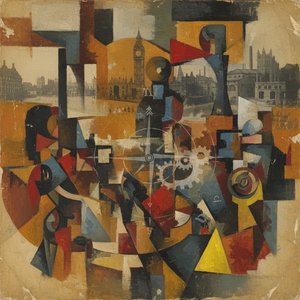 David Bomberg: Reassessing the Pioneering Spirit of Early British AbstractionExplore the groundbreaking work of David Bomberg, a pivotal figure in British abstraction. Discover his artistic evolution, influences, and…