

 Preview
 Send
Send Share
Share
 Details
 Guide
Guide

 Download
 Similars
 X-Ray
X-Ray Diaporama
 Stats
StatsFuneral Procession


 Read More
The artwork displayed on this page is protected by copyright law, which means we cannot legally create or sell an identical reproduction. This protection is enforced under international agreements such as the Berne Convention and by national laws, including those outlined by the U.S. Copyright Law - Title 17.
This method fully complies with copyright regulations because it does not involve copying or duplicating the protected artwork. Instead, it is a creative reinterpretation - a new painting that is influenced by the original but not identical to it.
Giclée / Art Print
Museum-quality giclée or canvas print with fast production and flexible finish options. ( Buy Hand Made Painting Switch to Digital Image)




P118B $10

P118H $10

P118W $10

P438Z $10

P508JH $12

P508YH $12

P805H $10

P805Z $10

P919BZ $10

P919G $10

P919XJ $10

P959ZH $10

P968JZ $12

W106C $8

W218G $10

W218JH $8

W218Y $10

W307PJ $10

W316G $10

W316PJ $8

W316Y $10

W398PJ $8

W4111J $10

W500HY $15

W500JH $15

W692G $12

W849H $8

W940BG $15

W953PJ $8




Pick from our preset sizes that match the artwork's original proportions.

Type the width and the height you need, to fit your frame or your wall. A print can only be cut, never made bigger than the picture, so a size with a different shape loses a part of the image. We send you a digital mockup to approve before we print anything. The picture shown on this page does not show the real cut — only the mockup does.
Worldwide Delivery () in 2 weeks instead of standard 4/5 weeks. (28 October)

Free Worldwide Express Shipping

High-Quality Linen Canvas

Full Shipping Insurance

Customs Tax Refund Guarantee

True Color Matching Guarantee

100-Day Return Policy (Defects Only)

100% Money-Back Guarantee

Bulk Discount Offer
 Glass option is only available in size under 110 CM

Funeral Procession
Giclée / Art Print
Reproduction Size
-


Total Price
$ 81
A Journey Through Memory and Color
In the heart of Louisiana’s Cane River region, memories of a bygone era find their most vibrant expression through the brushstrokes of Clementine Hunter. Her masterpiece, Funeral Procession, is far more than a mere depiction of a somber event; it is a rhythmic, soulful window into the communal life of the Melrose Plantation. As a self-taught artist who began her creative journey in her fifties, Hunter possessed a singular ability to translate the textures of Southern plantation life into a visual language that is both primitive and profoundly sophisticated. In this particular work, dated 1950, we witness a procession moving with purpose from a local church down a gentle slope toward a gravesite, capturing a moment where grief and community ritual intersect.
The composition utilizes a distinctive stacked perspective, a hallmark of Hunter’s oeuvre, which allows the viewer to observe the unfolding story as if peering through layers of time. There is no traditional vanishing point here; instead, the landscape unfolds in tiers, guiding the eye through the movement of the mourners. This technique creates a sense of intimacy and closeness, pulling the observer into the very heart of the crowd. The figures, though stylized and simplified, are imbued with an unmistakable vitality. Each participant—from those carrying delicate flowers to the individuals dressed in their Sunday best—contributes to a dense, bustling tapestry of human connection.
The Vibrancy of Ritual and Tradition
While the subject matter of a funeral might traditionally evoke feelings of melancholy, Hunter’s palette defies the gloom. She employs a bright, celebratory range of colors that illuminates the details of the scene: the crisp whites of clothing, the vivid hues of floral tributes, and the colorful hats that dot the landscape. This intentional use of light and color serves to highlight the reverence and dignity of the occasion rather than its sorrow. It suggests that even in death, there is a celebration of life and a continuation of the spiritual journey that defines the Creole culture she so lovingly documented.
For the discerning collector or interior designer, Funeral Procession offers a profound emotional resonance. The painting functions as a piece of visual storytelling, where every element—the trees framing the path, the distant buildings, and the rhythmic placement of the figures—works in harmony to evoke a sense of peace and historical continuity. It is an artwork that does not merely sit upon a wall but breathes life into a room, offering a conversation piece that speaks of heritage, resilience, and the enduring beauty of everyday rituals. Owning a high-quality reproduction of this work means bringing a fragment of American folk history into the modern home, providing a soulful focal point that inspires contemplation and warmth.
Questions & Answers
Which museum holds the original "Funeral Procession"?
You can see the original "Funeral Procession" at the SCAD Museum of Art, Savannah, United States of America.
What does "Funeral Procession" by Clementine Hunter depict, and in what mood?
"Funeral Procession" shows funeral procession, louisiana creole, plantation life, religious ritual, folk art, southern culture, community, and its recorded mood is nostalgic.
Who is the artist behind "Funeral Procession"?
"Funeral Procession" was created by Clementine Hunter. The information on this page describes Clementine Hunter's original work.
Artist Biography
early life and inspiration
clementine hunter, a self-taught black folk artist, was born in late december 1886 or early january 1887 in the cane river region of louisiana. her life on melrose plantation would later become the inspiration for her artwork.- born into a creole family at hidden hill plantation, near cloutierville, in natchitoches parish, louisiana.
- she began working as a farm laborer at a young age and never learned to read or write.
artistic journey
in her fifties, hunter started painting using brushes and paints left by an artist who visited melrose plantation. this marked the beginning of her career as an artist.- zinnias in a pot, one of her notable works, captures a freshly picked arrangement of zinnias, a common subject in her compositions.
- her artwork documented plantation life in the early 20th century, providing a unique perspective on a bygone era.
notable achievements and recognition
clementine hunter is the first african-american artist to have a solo exhibition at the present-day new orleans museum of art. her work has been exhibited in museums, and by the end of her life, her paintings were sold for thousands of dollars.- granted an honorary doctor of fine arts degree by northwestern state university of louisiana in 1986.
- a new opera, zinnias: the life of clementine hunter, was presented at montclair state university in new jersey in 2013.
artistic style and legacy
hunter's paintings are characterized by their colorful and straightforward scenes, often depicting outdoor activities and still lifes. her unique style has made her one of the most well-known self-taught artists.- melrose quilt, a notable piece, showcases her ability to create art beyond painting.
- her work has been admired for its palette and expressive force, rarely exceeding 18 by 24 inches in size.
relevant links:

Clementine Hunter
1887 - 1988 , United States of America
Quick Facts
- Full Name: Clementine Hunter
- Nationality: Louisiana Creole
- Date Of Birth: 1887
- Date Of Death: 1988
- Place Of Birth: Natchitoches, United States of America
- Notable Artworks:
- Zinnias in a pot
- Melrose quilt
- Funeral procession
- Artistic Movement Or Style: Folk art
- Artists Who Influenced This Artist: ['None],\n "Artists or movements influenced by this artist": [None']
Related Articles

Edward Hicks’ ‘Peaceable Kingdom’: American Folk Art & the Shaping of a National Identity
Explore the profound symbolism & historical context of Edward Hicks’ ‘Peaceable Kingdom.’ Discover how this iconic American folk art masterpiece reflects Quaker values and shaped a nation's identity. Learn more at OriginalUniqueArt.

The Soul of Tradition: A Connoisseur’s Guide to Discovering and Collecting Global Folk Art
Embark on a sophisticated journey through the world of folk art. Our expert guide offers connoisseurs deep insights into discovering, identifying, and collecting meaningful cultural masterpieces that preserve the soul of global traditions.

Echoes of Tradition: Exploring the Enduring Legacy of Folk Art Movements
Explore the rich history of folk art movements worldwide! Discover definitions, notable artists, and the enduring legacy of this captivating tradition. Expert insights & high-quality reproductions at OriginalUniqueArt.
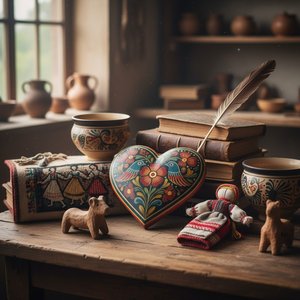
The Heart of Folk Art: Discover the Beauty of Tradition and Storytelling
Explore the profound beauty of folk art through its rich history and storytelling traditions. Discover how Naive Art and cultural heritage preserve ancestral narratives through vibrant color and symbolism for the modern collector.

The Soul of Tradition: Exploring the Vibrant Heritage and Naive Mastery of Global Folk Art
Discover the profound beauty of folk art through a cultural lens. Explore how naive masterpieces and vibrant global traditions preserve heritage, offering timeless inspiration for collectors and art enthusiasts seeking authenticity and soul in every brushstroke.


