The Quaker Roots of Edward Hicks’ Vision
 Wikipedia: Edward Hicks
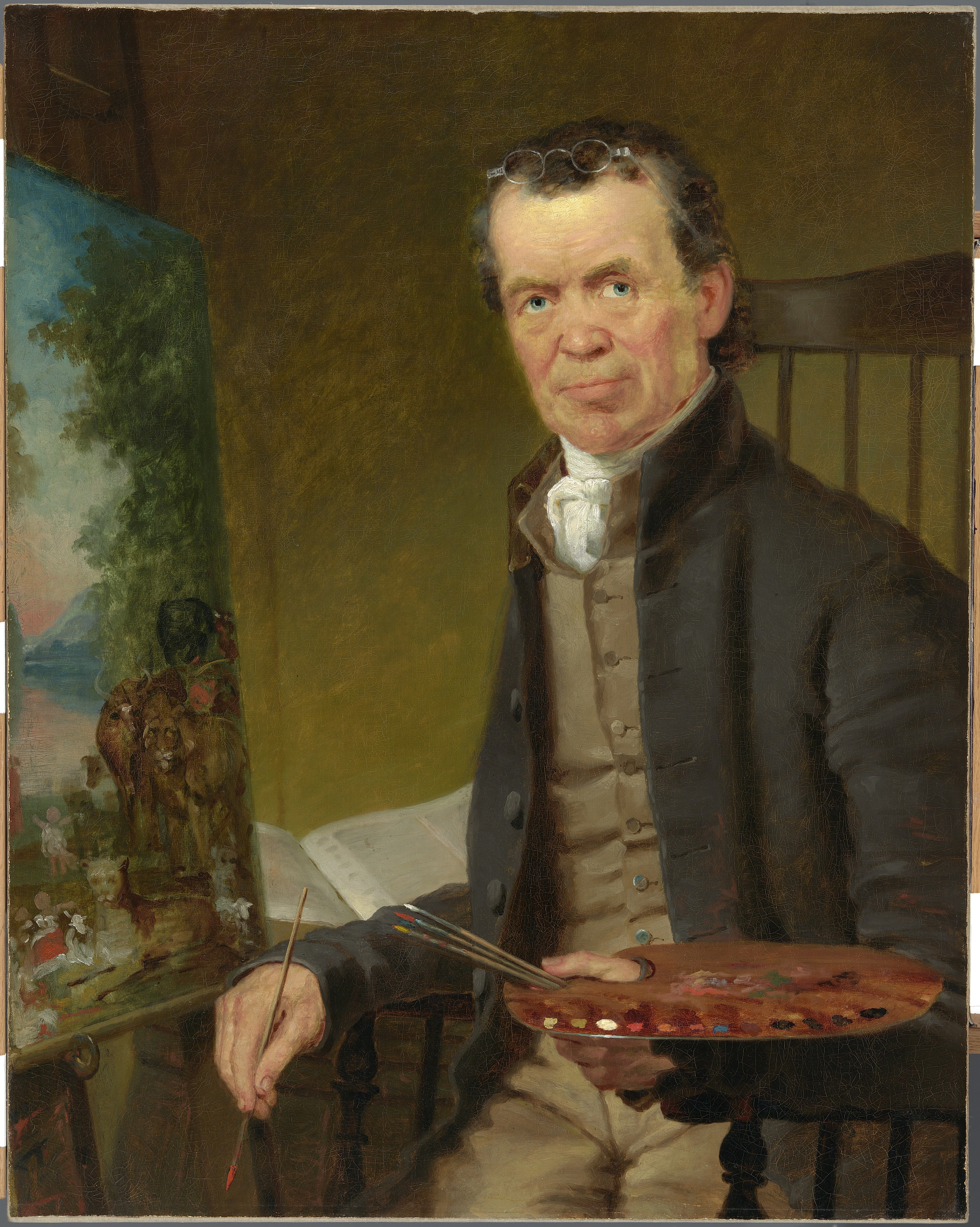
Edward Hicks (April 4, 1780 – August 23, 1849) was an American folk painter and distinguished Christian minister of the Society of Friends (a.k.a. "Quakers"). He became a notable Quaker because of his paintings. == Biography == === Early life ==...
Edward Hicks (1780–1849) occupies a unique position in the annals of American art, straddling the worlds of folk painting, religious ministry, and burgeoning national identity. To understand his most celebrated work, “The Peaceable Kingdom,” one must first delve into the deeply held beliefs of the Society of Friends – the Quakers – that shaped his life and artistic sensibility. Hicks wasn’t merely a painter who occasionally depicted Quaker themes; he was a Quaker minister for whom art became an extension of his faith, a visual sermon intended to convey messages of harmony, unity, and the promise of a divinely ordained peace. Born in Bucks County, Pennsylvania, a region steeped in Quaker tradition, Hicks’s early life was marked by a search for spiritual meaning. His parents were not Quakers, but through the influence of close family friends like Elizabeth Twining, he embraced the tenets of simplicity, pacifism, and the “Inner Light”—the belief that God resides within each individual. This conviction would become the cornerstone of his artistic expression.
The Hicks family experienced financial hardship following the Revolutionary War, leading to a somewhat itinerant upbringing for young Edward. He apprenticed as a coach painter, developing a keen eye for detail and composition—skills he would later refine in his more ambitious easel paintings. However, his early attempts at decorative work often clashed with Quaker ideals of plainness, prompting periods of self-doubt and a temporary abandonment of painting altogether. It was the reconciliation of his artistic talent with his religious convictions that ultimately propelled him toward creating “The Peaceable Kingdom,” not as a commercial endeavor but as an act of devotion.
Isaiah’s Prophecy and the Emergence of ‘The Peaceable Kingdom’
Peaceable Kingdom may refer to Peaceable Kingdom (theology), an eschatological state inferred from texts such as the Book of Isaiah, the Book of Hosea, and the Sermon on the Mount == Art == Peaceable Kingdom, a series of 61 paintings by Edward Hic...
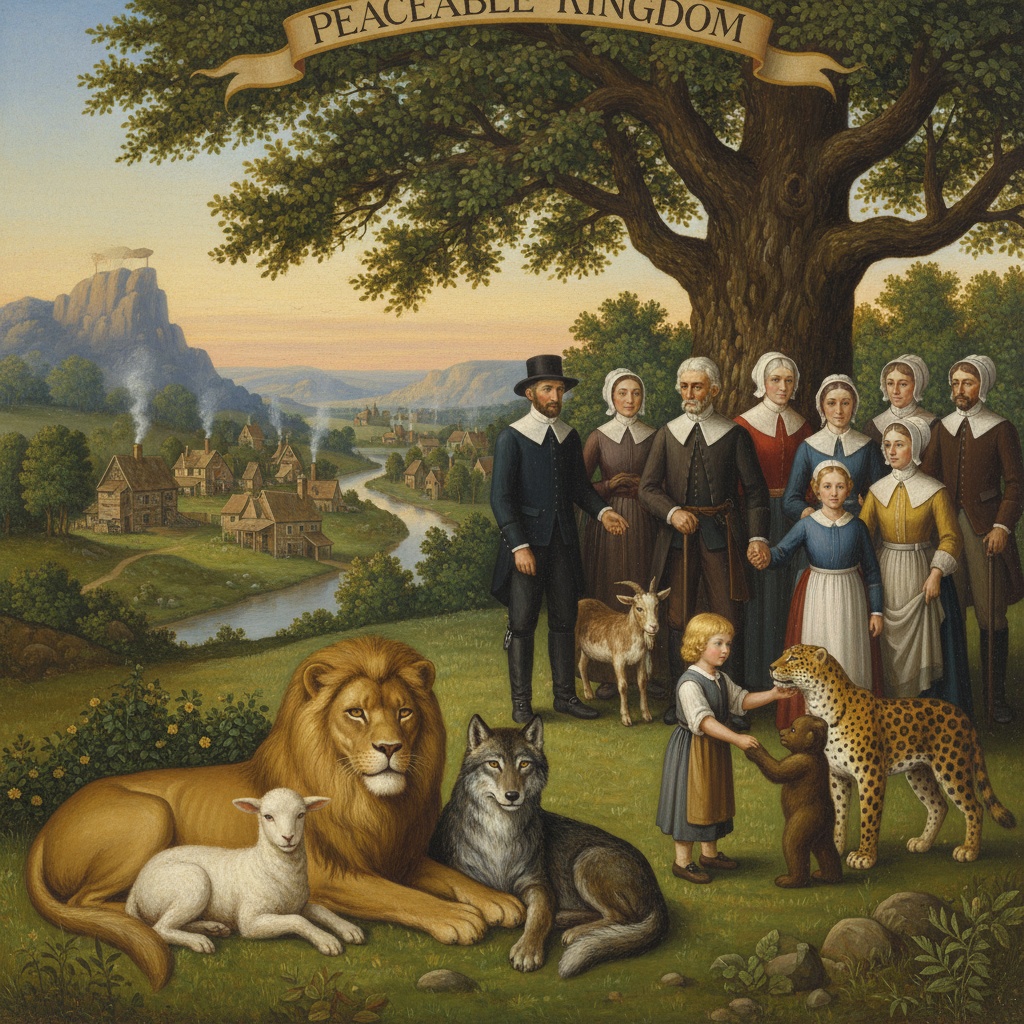
The genesis of “The Peaceable Kingdom” lies in a specific passage from the Book of Isaiah (11:6-9), which foretells a messianic age characterized by unprecedented harmony between predator and prey. “The wolf also shall dwell with the lamb, and the leopard shall lie down with the kid,” reads the evocative verse, painting a vivid image of a world transformed by peace. Hicks first encountered this passage in 1820 and was profoundly moved by its utopian vision. He began to translate this biblical prophecy into visual form, creating over sixty variations of “The Peaceable Kingdom” throughout his career. These paintings weren’t literal depictions but rather allegorical representations of spiritual and earthly redemption.
What sets Hicks's interpretation apart is not simply the subject matter but also its distinctly American context. While rooted in biblical tradition, the landscapes he depicts are unmistakably Pennsylvania—rolling hills, lush forests, and meticulously rendered farmhouses. This grounding in a specific locale imbues the paintings with a sense of familiarity and immediacy, suggesting that the promise of peace wasn’t merely an abstract theological concept but a tangible possibility within the American landscape itself. The early versions often featured Hicks's own property as the backdrop, further personalizing the scene.
Decoding the Symbolism: Animals, Landscapes, and American Identity
A closer examination of “The Peaceable Kingdom” reveals a complex network of symbolism woven into its seemingly idyllic surface. The animals—lions, lambs, bears, oxen, panthers—are not merely decorative elements but represent different aspects of human nature and societal forces. The lion, traditionally associated with power and aggression, lies peacefully alongside the gentle lamb, symbolizing the triumph of compassion over violence. The inclusion of native fauna like the panther and bear speaks to Hicks’s awareness of the American wilderness and his desire for harmony between settlers and the natural world.
The landscapes themselves are laden with meaning. The prominent tree trunk, often split or blasted, is interpreted as a reference to the “stump of Jesse,” a biblical symbol of Christ's lineage. In many versions, Hicks includes figures enacting William Penn’s treaty with the Lenape Native Americans, subtly advocating for peaceful coexistence and justice. This deliberate inclusion underscores the painting’s connection to American history and its implicit critique of colonial violence. The serene beauty of the Pennsylvania countryside is not simply aesthetic; it represents a vision of a nation founded on principles of peace and equality.
Hicks as a Self-Taught Artist: Style, Technique, and Innovation
 Edward Hicks
Discover Edward Hicks (1780-1849), the Quaker minister & folk painter famed for his 'Peaceable Kingdom.' Explore harmonious scenes blending faith, nature & American history in this self-taught artist's unique style.
Edward Hicks was largely self-taught, lacking formal artistic training. This unconventional background contributed to his distinctive style, characterized by meticulous detail, flattened perspective, and a somewhat naive quality. While he initially honed his skills through sign painting and decorative work, his easel paintings demonstrate a remarkable ability to capture the essence of his subjects. He employed a layering technique, building up colors and textures with careful precision. His brushstrokes are visible, lending a sense of authenticity and immediacy to his works.
Hicks’s innovation lies not in technical virtuosity but in his unique vision and ability to convey complex theological ideas through accessible imagery. He wasn't concerned with academic conventions or achieving photorealistic representation; instead, he prioritized clarity of message and emotional resonance. His paintings are often described as “folk art” due to their simplicity and directness, yet they transcend the limitations of that label, offering profound insights into American culture and spirituality. The repetition of the ‘Peaceable Kingdom’ theme allowed him to refine his technique and explore subtle variations in symbolism over time.
The Schism and its Reflection in Hicks' Work
The 1827 schism within the Society of Friends profoundly impacted Hicks and found expression in his art. The division between Hicksites—liberals who emphasized the “Inner Light” and social reform—and Orthodox Friends—more conservative members who adhered to traditional practices—created deep rifts within Quaker communities. Hicks, a staunch advocate for liberal principles, aligned himself with the Hicksite faction. This internal conflict is subtly reflected in many of his “Peaceable Kingdom” paintings through the inclusion of the broken tree trunk, symbolizing the fractured state of the Society.
The shattered wood serves as a poignant reminder of the need for reconciliation and unity—a theme that resonated deeply with Hicks throughout his life. He continued to paint these scenes not as celebrations of peace but as visual pleas for harmony amidst division. The paintings became a means of expressing his yearning for a restored community, grounded in shared faith and mutual respect. This period also saw an increase in the inclusion of specific Quaker figures and landscapes, further emphasizing his commitment to his religious heritage.
Legacy and Influence: The Enduring Appeal of ‘The Peaceable Kingdom’
Edward Hicks died in 1849, largely unknown outside of Quaker circles. It wasn't until the early 20th century that his work began to receive wider recognition, thanks to the efforts of art historians like Carolyn Weekly who championed his unique vision. Today, “The Peaceable Kingdom” is celebrated as a masterpiece of American folk art and a powerful symbol of hope and reconciliation.
Its enduring appeal lies in its timeless message—the possibility of peace amidst conflict, harmony between nature and humanity, and the pursuit of a more just and equitable world. Hicks’s paintings continue to resonate with audiences today, offering a poignant reminder of our shared aspirations for a better future. His work is featured in prominent museums like the Philadelphia Museum of Art and The Metropolitan Museum of Art, ensuring its continued accessibility for generations to come. At OriginalUniqueArt you can explore high-quality reproductions of Hicks’s iconic paintings, bringing a touch of American history and spiritual beauty into your home.