Expressionism · 1906
Self-portrait (August Macke, 1906)
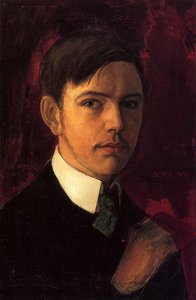
August Macke (1887–1914) made Self-portrait. It dates from 1906. It belongs to the Expressionism movement. It is made in oil. It measures 54 × 35 cm.
- 1906
- Oil
- 54 × 35 cm

 Preview

 Hand Made Oil Painting
 Send
 Share
 Guide


 Download
 Similars
 X-Ray
 Diaporama
 Q&A

 Stats
Self-portrait: the essentials
- Title
- Self-portrait
- Artist
- August Macke (1887–1914)
- Artist born in
- Meschede, Germany
- Date
- 1906
- Medium
- Oil
- Dimensions
- 54 × 35 cm
- Movement
- Expressionism
- Period
- Modern
- Subject
- famous people, men, portraits
What does Self-portrait depict?
A Moment Frozen in Time: The Introspection of August Macke
In the quiet, focused gaze of Self-portrait (1906), we encounter a rare moment of stillness from an artist whose life would soon be swept up in the turbulent currents of German Expressionism. Before the vibrant, kaleidoscopic colors of his later works defined his legacy, this early piece captures August Macke in a state of profound introspection. The painting presents a man with short, neatly groomed hair, dressed in the formal elegance of a white shirt and tie—an attire that suggests a sense of dignity and perhaps a preparation for the public eye. Yet, beneath this composed exterior, there is an unmistakable depth to his expression. His eyes, directed toward the viewer, hold a serious, contemplative weight that invites us to look beyond the surface of the canvas and into the psyche of a young creator on the cusp of greatness.
The composition of this work serves as a masterclass in early twentieth-century portraiture, balancing the intimacy of the subject with a structured, almost architectural background. While the man remains the undeniable focal point, the subtle presence of decorative elements in the periphery hints at an environment rich with culture and aesthetic awareness. The technique employed here reflects Macke’s formative years at the Düsseldorf Art Academy, where he honed his ability to render texture and light with meticulous care. There is a palpable sense of realism in the way the fabric of his shirt catches the light, contrasted against the more shadowed, enigmatic depths of the background. This interplay between clarity and mystery creates a tension that keeps the viewer perpetually engaged, searching for meaning within the artist's steady stare.
For the discerning collector or interior designer, this self-portrait offers much more than mere decoration; it provides a window into the soul of a lost generation. As an era-defining piece from 1906, it carries the historical gravity of the pre-war period, capturing a sense of peace and intellectual rigor before the world was irrevocably changed by conflict. The painting’s sophisticated palette and balanced proportions make it an ideal centerpiece for a curated gallery wall or a refined study. It possesses a timeless emotional impact, evoking feelings of nostalgia, respect, and quiet strength. To possess a reproduction of this work is to bring a piece of art history into one's personal space—a tribute to the enduring power of the human spirit and the transformative beauty of the expressive gaze.
Self-portrait in high resolution

August Macke, Self-portrait (1906). Public domain.
A digital expert checks the colors against the original painting and retouches the file, faithful to the artist's brushwork.
Buy the high-resolution imageQuestions about Self-portrait
How do movement and era meet in "Self-portrait" by August Macke?
In "Self-portrait" by August Macke, the Expressionism movement meets the Modern era.
Can I examine "Self-portrait" in more detail?
"Self-portrait" can be examined layer by layer on the artwork's X-Ray page, a viewer inspired by a conservator's light bench with eleven optical readings of the image.
Is there a factsheet about "Self-portrait" by August Macke for students?
A Guide page is available for "Self-portrait" by August Macke: a printable factsheet about the artwork, designed for students and classroom use.
Is "Self-portrait" by August Macke in the public domain, and why?
"Self-portrait" by August Macke is in the public domain - its copyright has expired. Copyright duration runs from the artist's death, which occurred in 1914.
What is the overall mood of "Self-portrait" by August Macke?
"Self-portrait" by August Macke is described as classic in mood. This classification can help match the work to a setting.
When and with what materials was "Self-portrait" made?
The medium of "Self-portrait" by August Macke is oil, and the work is dated 1906.
What national origin stands behind the Expressionism of "Self-portrait"?
"Self-portrait" was created by August Macke, born in Germany, within the Expressionism movement. The artist's origin links the work to Expressionism as practiced by artists from Germany.
Is "Self-portrait" by August Macke a portrait, landscape or square composition?
"Self-portrait" by August Macke is a portrait composition. The proportions are worth checking before choosing a print size.
Who created "Self-portrait" and in what year?
The author of "Self-portrait" is August Macke, and the work is dated 1906.
About the artist, August Macke
1887–1914, Germany
August Macke
Early Life, Family and Training The story of August Macke begins in the town of Meschede, Germany, where he was born on January 3, 1887. He was the only son born to August Friedrich Hermann Macke, a building contractor and amateur artist, and Maria Florentine. His childhood was shaped by the shifting fortunes of his father’s company, which brought the family to Cologne and later to Bonn. Even as a young boy, the pull of visual expression was evident; he spent his early years sketching and designing sets for school plays, finding a way to translate his surroundings onto paper long before he ever stepped into a formal academy.
Also by August Macke
 Woman in a Green Jacket1913
 Bathing girls with town in the backgraund1913
 The Hat Shop1913
 Portrait of the Artist's Wife with Hat1909
Essays around Self-portrait
 The Inner Landscape: Exploring Themes of Introspection in Visual Art Across Movements & ErasExplore the captivating world of introspective art! Discover how artists across eras – from Rembrandt to Kahlo – used self-portraiture to r…
 Unmasking Emotion: Top 10 Expressionist Masterpieces That Changed Art ForeverExplore iconic Expressionist works by Munch and Kandinsky. Discover the emotion behind the art on OriginalUniqueArt.com.
 August Macke: Expressionist Visions of Harmony & Modern LifeExplore the vibrant Expressionist paintings of August Macke (1887-1914). Discover his key role in Der Blaue Reiter, Fauvist influences, and…