Expressionism
Coloured Forms I (August Macke)
August Macke (1887–1914) made Coloured Forms I. It belongs to the Expressionism movement.

 Preview

 Hand Made Oil Painting
 Send
 Share
 Fact sheet


 Download
 Similars
 X-Ray
 Diaporama
 Q&A

 Stats
Coloured Forms I, in brief
- Title
- Coloured Forms I
- Artist
- August Macke (1887–1914)
- Artist born in
- Meschede, Germany
- Movement
- Expressionism
- Subject
- study
High-resolution images of Coloured Forms I
August Macke, Coloured Forms I. Public domain.
Colours matched to the original by a digital expert, the file finely retouched, faithful to the artist's brushwork.
Own the high-resolution fileQuestions on Coloured Forms I, answered
What is "Coloured Forms I" about?
"Coloured Forms I" by August Macke depicts: study.
Is "Coloured Forms I" free of copyright?
"Coloured Forms I" by August Macke is in the public domain - its copyright has expired. This status governs how the image of the work may be reproduced.
Which artist is "Coloured Forms I" attributed to?
"Coloured Forms I" was created by August Macke. The information on this page describes August Macke's original work.
What art movement does "Coloured Forms I" by August Macke belong to?
The movement associated with "Coloured Forms I" by August Macke is Expressionism. This classification situates the work among related artists and artworks.
Why is the copyright status of "Coloured Forms I" what it is?
"Coloured Forms I" by August Macke is in the public domain - its copyright has expired. Copyright terms are measured from the artist's death, and August Macke died in 1914.
About the artist, August Macke
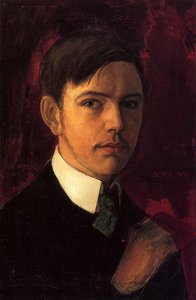
1887–1914, Germany
August Macke
Early Life, Family and Training The story of August Macke begins in the town of Meschede, Germany, where he was born on January 3, 1887. He was the only son born to August Friedrich Hermann Macke, a building contractor and amateur artist, and Maria Florentine. His childhood was shaped by the shifting fortunes of his father’s company, which brought the family to Cologne and later to Bonn. Even as a young boy, the pull of visual expression was evident; he spent his early years sketching and designing sets for school plays, finding a way to translate his surroundings onto paper long before he ever stepped into a formal academy.
Also by August Macke
 Woman in a Green Jacket1913
 Bathing girls with town in the backgraund1913
 The Hat Shop1913
 Portrait of the Artist's Wife with Hat1909
Essays around Coloured Forms I
 Emotional Transmutation in Visual Art: A Study of Affective Representation Through Color, Form, and TextureExplore the fascinating intersection of art & emotion! Discover how color, form, and texture convey feelings in masterpieces. Expert analys…
 The Visceral Turn: Exploring Emotional Intensity in ExpressionismExplore the powerful world of Expressionism with OriginalUniqueArt. Discover key artists like Kirchner & Nolde, understand its emotional im…
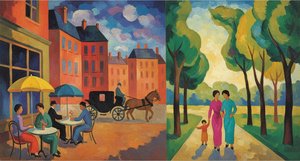 August Macke: Expressionist Visions of Harmony & Modern LifeExplore the vibrant Expressionist paintings of August Macke (1887-1914). Discover his key role in Der Blaue Reiter, Fauvist influences, and…