Portrait of Masolino da Panicale

Masolino da Panicale Paintings: The 33 Most Famous, Through a Gallery's Eye

Updated November 2026 · ranked by our popularity score (searches, visits and orders for each work) · 34 works by Masolino da Panicale in our catalogue

In short

To the gallery's eye, Masolino da Panicale's most famous painting is The Archangel Gabriel (1450), whose original hangs in the National Gallery of Art, Washington. Crucifixion (1428) and The Martyrdom of St Catherine (1428) complete the trio every eye recognises. Of the 34 works by Masolino da Panicale in our catalog, the gallery presents the 33 most famous below, each original with its year, its museum and what makes it unique.

1383 – 1447, Panicale Early renaissance Most works: San Clemente

The gallery's top 10 Masolino da Panicale paintings

1
The Archangel Gabriel (1450) by Masolino da Panicale

The Archangel Gabriel

1450 · Tempera On Panel · National Gallery of Art, Washington

The figure leans forward, a sudden movement frozen in tempera. He is a profile of divine intent, draped in heavy robes of deep crimson and black. Swirling damask patterns climb the fabric, etched with fine, precise lines that catch the light. His wings are a weight of golden yellow, arching behind him with organic curves that contrast against the dark, indistinct void of the background. A halo of gold encircles…

2
Crucifixion (1428) by Masolino da Panicale

Crucifixion

1428 · Fresco · San Clemente, Rome

The Crucifixion by Masolino da Panicale is a significant work of Renaissance art. Created in 1428, this fresco resides within the San Clemente church in Rome, Italy. It represents a moment of profound transition in the history of painting, capturing the shift toward the early Renaissance through its specific handling of form and space.

3
The Martyrdom of St Catherine (1428) by Masolino da Panicale

The Martyrdom of St Catherine

1428 · Fresco · San Clemente, Rome

The Martyrdom of St Catherine is a fresco painted by Masolino da Panicale. Created about 1428, this work occupies a significant place within the Castiglione Chapel, a space also known as the St Catherine Chapel. This chapel is located within the church of San Clemente in Rome. The commission for this decorative cycle was granted by Cardinal Branda Castiglione.

4
The Virgin Annunciate (1450) by Masolino da Panicale

The Virgin Annunciate

1450 · Tempera On Panel · National Gallery of Art, Washington

Step closer and observe the stillness within this panel. Here, we find the Virgin Mary caught in a singular moment of contemplation. There is no grand movement, only a profound sense of presence. She sits slightly off-center, her figure anchored by a deep lapis lazuli blue mantle that falls in rhythmic, curving folds across her form. Beneath this heavy cloak, a warm terracotta tunic provides a soft contrast, grounded by…

5
Saints John the Evangelist(?) and Martin of Tours (1428) by Masolino da Panicale

Saints John the Evangelist(?) and Martin of Tours

1428 · Tempera On Panel · Philadelphia Museum of Art, Philadelphia

Step closer to this panel from 1428 and you can feel the stillness of the International Gothic style. We are looking at two figures, likely Saints John the Evangelist and Martin of Tours, positioned with a symmetrical weight that commands a certain solemnity. They exist within a shallow, celestial space, held against a background of gold leaf that denies any sense of earthly landscape. Instead, the gold creates a divine…

6
Saints Paul and Peter (1427) by Masolino da Panicale

Saints Paul and Peter

1427 · Tempera On Panel · Philadelphia Museum of Art, Philadelphia

This tempera on wood panel painting presents two holy figures, Paul and Peter, positioned side-by-side against a solid gold leaf background. The vertical composition focuses on the figures from their feet to their heads. On the left, the figure of Paul is draped in a blue garment and a red cloak, holding a sword and a book. On the right, the figure of Peter is dressed in ochre and yellow…

7
The Annunciation (1425) by Masolino da Panicale

The Annunciation

1425 · Oil On Panel · National Gallery of Art, Washington

To gaze upon this depiction of The Annunciation is to step directly into the luminous heart of the early Italian Renaissance. Masolino da Panicale, whose genius bridged the lingering echoes of Gothic splendor with the dawning light of humanism, has captured a moment of profound theological weight: the announcement to Mary that she will conceive the Son of God. The scene unfolds with an exquisite sense of poised stillness, yet…

8
The Philosophers of Alexandria (1428) by Masolino da Panicale

The Philosophers of Alexandria

1428 · Fresco · San Clemente, Rome

Within the quiet walls of the Chapelle Barda Castiglioni in San Clemente, a profound dialogue unfolds through the fresco known as The Philosophers of Alexandria. Created by Masolino da Panicale between 1428 and 1430, this work captures a moment of intense intellectual and spiritual exchange. The scene breathes with the energy of a shared thought, pulling the viewer into a space where the pursuit of wisdom feels immediate and alive.

9
Founding of Santa Maria Maggiore (1420) by Masolino da Panicale

Founding of Santa Maria Maggiore

1420 · Tempera On Panel · Museo di Capodimonte, Naples

Masolino da Panicale rendered the Founding of Santa Maria Maggiore to commemorate a specific divine intervention. The central panel illustrates the establishment of the church in Rome, centered on the events of August 5th. This scene captures the moment following a miraculous snowfall, an event that dictated the site's location. The work was produced specifically for the church of Santa Maria Maggiore.

10
St Peter Preaching (detail) (1426) by Masolino da Panicale

St Peter Preaching (detail)

1426 · Fresco

The scene unfolds through a photograph of a fresco painting titled St Peter Preaching (detail). This intimate fragment captures a moment of intense religious fervor and community engagement. We find ourselves standing before the work of Masolino da Panicale, an artist who breathes life into the figures through a delicate touch. The image reveals a gathering of people, a diverse congregation of various ages and genders, all drawn toward the…

Masolino da Panicale paintings, ranked 11 to 33

Masolino da Panicale's famous paintings, period by period

The subjects that held Masolino da Panicale's eye

The four subjects that come back most often in these originals, each with its finest example.

The museums that keep Masolino da Panicale's originals

The 8 museums that hold the most of the paintings on this page.

Museum City Works by Masolino da Panicale Paintings from this list
San Clemente, RomeSan Clemente Rome 5 Crucifixion, The Martyrdom of St Catherine, The Philosophers of Alexandria
National Gallery of Art, WashingtonNational Gallery of Art Washington 4 The Archangel Gabriel, The Virgin Annunciate, The Annunciation
Philadelphia Museum of Art, PhiladelphiaPhiladelphia Museum of Art Philadelphia 2 Saints John the Evangelist(?) and Martin of Tours, Saints Paul and Peter
Baptistry, Castelnuovo BoccaioniBaptistry Castelnuovo Boccaioni 2 Banquet of Herod, Banquet of Herod (detail)
National Gallery, LondonNational Gallery London 2 Pope Gregory the Great (.) and St Matthias, A Pope (Saint Gregory?) and Saint Matthias
Museo di Capodimonte, NaplesMuseo di Capodimonte Naples 1 Founding of Santa Maria Maggiore
Musée Ingres Bourdelle, MontaubanMusée Ingres Bourdelle Montauban 1 Scenes from the Life of St Julien
Alte Pinakothek, MunichAlte Pinakothek Munich 1 Madonna with the Child

Masolino da Panicale, the signature paintings of each year

16 years of Masolino da Panicale's art, 1420 to 1435: the gallery follows them year by year, through the most famous originals of each.

Works per year

Pick a year to see its originals.

Masolino da Panicale's paintings: the gallery answers

Which Masolino da Panicale painting is the most famous of all?Reveal the answer

The Archangel Gabriel (1450), National Gallery of Art, Washington. Crucifixion (1428) and The Martyrdom of St Catherine (1428) come next.

Which are Masolino da Panicale's top 10 paintings?Reveal the answer

The Archangel Gabriel, Crucifixion, The Martyrdom of St Catherine, The Virgin Annunciate, Saints John the Evangelist(?) and Martin of Tours, Saints Paul and Peter, The Annunciation, The Philosophers of Alexandria, Founding of Santa Maria Maggiore and St Peter Preaching (detail). The ranking above gives each one's year and museum.

How many works did Masolino da Panicale create?Reveal the answer

Our catalog holds 34 works by Masolino da Panicale, dated from 1420 to 1435.

Where do Masolino da Panicale's most famous originals hang?Reveal the answer

Mostly in San Clemente (Rome), National Gallery of Art (Washington) and Philadelphia Museum of Art (Philadelphia). The museum table above lists them all.

When did Masolino da Panicale create the most famous paintings?Reveal the answer

In 1426: 8 of the 33 works on this page were made then, St Peter Preaching (detail) among them.

Which are Masolino da Panicale's earliest and latest famous works?Reveal the answer

On this page, the earliest is Founding of Santa Maria Maggiore (1420) and the latest Banquet of Herod (1435).

Which subjects did Masolino da Panicale return to most?Reveal the answer

Woman (10), People (9) and Man (8), across the 33 works on this page.

Which medium did Masolino da Panicale work in most?Reveal the answer

Fresco, for 16 of the 33 works on this page.

Which movement is Masolino da Panicale associated with?Reveal the answer

Early renaissance, judging by the originals on this page.

Which Masolino da Panicale originals does the San Clemente hold?Reveal the answer

Crucifixion, The Martyrdom of St Catherine and The Philosophers of Alexandria: the San Clemente, Rome holds 5 of the works on this page.

Masolino da Panicale: the artist

The Lyrical Grace of Masolino da Panicale

In the vibrant, transformative atmosphere of the early Florentine Renaissance, few artists captured the delicate transition from Gothic elegance to humanistic realism as poignantly as Masolino da Panicale. Known affectionately by some as “Little Tom,” this master was far more than a mere bridge between eras; he was a painter of profound lyricism and light. Born in the quiet Italian town of Panicale around 1383, his artistic soul was forged in the workshops of Florence, where the shadows of the Middle Ages were beginning to retreat before the dawn of a new, scientifically-minded era. His early training, likely under the legendary Ghiberti, instilled in him a reverence for fine detail and sculptural form that would remain a hallmark of his expressive hand throughout his career.

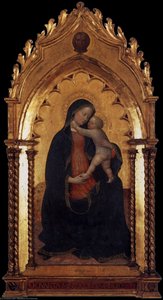
The essence of Masolino’s genius lies in his ability to marry the spiritual sweetness of the International Gothic style with the emerging structural innovations of the Renaissance. While his contemporaries began to obsess over the rigid mathematics of perspective, Masolino maintained a connection to the emotive and the ethereal. This is perhaps most beautifully realized in works such as his Madonna with the Child, where a sense of serene humility and tender devotion radiates from the canvas. In these compositions, the figures possess a soft, rhythmic grace that invites the viewer into a state of quiet contemplation, making him a master of the devotional atmosphere.

A Revolutionary Collaboration

The history of Western art was irrevocably altered by the period between 1424 and 1428, when Masolino shared the monumental task of decorating the Brancacci Chapel in Florence with the formidable Masaccio. This partnership is often viewed through the lens of a stylistic duel, yet it was actually a profound synthesis of two different worlds. While Masaccio pushed the boundaries of heavy, volumetric realism and dramatic light, Masolino provided the necessary lyrical balance. His contributions to the chapel, such as his delicate depiction of Mary Magdalene, offer a breathtaking contrast to the more rugged compositions of his collaborator, injecting a sense of movement and grace that prevented the frescoes from becoming overly austere.

Beyond the walls of the Brancacci Chapel, Masolino’s technical curiosity led him toward the frontiers of medium and method. He is frequently cited as one of the earliest pioneers to experiment with oil painting techniques, a development that allowed for a new depth of color and a more nuanced rendering of light and texture. This experimentation is vividly evident in masterpieces like The Annunciation, where the use of oil lends an unprecedented luminosity to the biblical narrative, capturing the divine moment with a clarity that feels both miraculous and tangibly real.

Legacy and Artistic Significance

The enduring significance of Masolino da Panicale rests in his role as a guardian of beauty during a time of radical change. He did not simply follow the path toward realism; he enriched it with a sense of poetic charm that might otherwise have been lost to the cold precision of geometry. His ability to navigate the complexities of both fresco and early oil painting allowed him to leave behind a body of work that speaks to the multifaceted nature of the human experience—both its physical weight and its spiritual lightness.

As we look back upon his life and achievements, several key elements define his place in the pantheon of great masters:

  • The Synthesis of Styles: His unique ability to blend Gothic decorative beauty with Renaissance structural innovation.
  • Technical Pioneering: His early and influential experimentation with oil mediums to achieve greater luminosity.
  • Collaborative Brilliance: The creation of a transformative artistic dialogue through his work alongside Masaccio in the Brancacci Chapel.
  • Emotional Depth: A mastery of depicting religious subjects with a profound, accessible tenderness that resonated with the humanist ideals of his age.

Though his name is sometimes overshadowed by the more radical figures of the Florentine revolution, Masolino remains an indispensable figure. He provided the soul and the grace that allowed the Renaissance to flourish, ensuring that as art moved toward the real, it never lost its connection to the divine.