Portrait of Francesco Primaticcio

Francesco Primaticcio Paintings: The 16 Most Famous, Through a Gallery's Eye

Updated October 2026 · ranked by our popularity score (searches, visits and orders for each work) · 16 works by Francesco Primaticcio in our catalogue

In short

To the gallery's eye, Francesco Primaticcio's most famous painting is Ulysses and Penelope (1545), whose original hangs in the Toledo Museum of Art, Toledo. The Masquerade of Persepolis (1541) and Andromache Learning of the Death of Hector (1570) complete the trio every eye recognises. Of the 16 works by Francesco Primaticcio in our catalog, the gallery presents the 16 most famous below, each original with its year, its museum and what makes it unique.

1504 – 1570, Bologna Mannerism Most works: Apartments of the Duchesse d'Étampes

The gallery's top 10 Francesco Primaticcio paintings

1
Ulysses and Penelope (1545) by Francesco Primaticcio

Ulysses and Penelope

1545 · Oil On Canvas · Toledo Museum of Art, Toledo

Ulysses and Penelope is an oil on canvas by Francesco Primaticcio. The work focuses on the mythological figures of Ulysses and Penelope from Greek mythology. This specific composition is an oil version of a panel originally intended for the Galerie d'Ulysse in Fontainebleau.

2
The Masquerade of Persepolis (1541) by Francesco Primaticcio

The Masquerade of Persepolis

1541 · Oil On Canvas · The Louvre, Paris

To gaze upon The Masquerade of Persepolis is to step directly into the heart of an imagined, glorious past—a world where celebration knows no bounds and artifice reigns supreme. This magnificent work by Francesco Primaticcio transports us to a courtly spectacle, a scene so densely populated with life and movement that it feels less like a painting and more like a captured moment from a grand Renaissance ball. The composition…

3
Andromache Learning of the Death of Hector (1570) by Francesco Primaticcio

Andromache Learning of the Death of Hector

1570 · Oil On Canvas · Rhode Island School of Design Museum of Art, Providence

This large-scale oil on canvas, dated 1570, presents a dense and complex arrangement of figures within a classical architectural setting. The scene is characterized by a swirling, rhythmic movement that directs the eye through a crowded field of bodies. Figures are rendered with elongated limbs and strained, graceful poses, a hallmark of the Mannerist style. The color palette relies on earthy tones of ochre, terracotta, and deep reds, which contrast…

4
The Holy Family with Sts Elisabeth and John the Baptist (1541) by Francesco Primaticcio

The Holy Family with Sts Elisabeth and John the Baptist

1541 · Oil On Canvas · Hermitage Museum, Saint Petersburg

To gaze upon The Holy Family with Sts Elisabeth and John the Baptist by Francesco Primaticcio is to step directly into the opulent, spiritually charged atmosphere of the Italian High Renaissance. This magnificent canvas captures not merely a grouping of figures, but a moment suspended between the earthly and the divine. At its heart resides the tender nucleus of Mary, Joseph, and the Christ Child—a perennial source of artistic devotion.…

5
The Rape of Helene (1530) by Francesco Primaticcio

The Rape of Helene

1530 · Oil On Canvas · Bowes Museum, Barnard Castle

In this large oil on canvas from 1530, a group of at least thirteen figures is caught in a state of intense physical and psychological upheaval. The composition centers on a woman, Helene, who is surrounded by several men in a state of aggressive movement. The scene is characterized by a crowded, swirling arrangement of bodies that breaks away from the balanced proportions of the High Renaissance. Instead, the figures…

6
The Nile (1540) by Francesco Primaticcio

The Nile

To stand before a depiction such as Francesco Primaticcio's The Nile is to step directly into the vibrant, dramatic heart of the Italian Renaissance. This chalk painting from 1540 is far more than a mere historical or mythological scene; it is a profound meditation on human endeavor, struggle, and the enduring spirit of triumph. The composition immediately arrests the viewer with its palpable energy. At the core stands a muscular…

7
Ceres (1552) by Francesco Primaticcio

Ceres

1552 · Acrylic On Canvas · Condé Museum, Chantilly

Ceres: A Symphony of Line and Myth Francesco Primaticcio’s “Ceres,” painted in 1552, stands as a cornerstone of Mannerist art—a testament to the period's fascination with illusionistic depth and dramatic gesture. More than just a depiction of Roman mythology, it embodies the artistic spirit of its time, reflecting a profound shift away from the serene idealism of High Renaissance Florence towards a more emotionally charged aesthetic. The photograph captures a…

Francesco Primaticcio paintings, ranked 11 to 16

The subjects that held Francesco Primaticcio's eye

The four subjects that come back most often in these originals, each with its finest example.

The museums that keep Francesco Primaticcio's originals

The 8 museums that hold the most of the paintings on this page.

Museum City Works by Francesco Primaticcio Paintings from this list
Apartments of the Duchesse d'Étampes, FontainebleauApartments of the Duchesse d'Étampes Fontainebleau 4 Royal Staircase (detail), Royal Staircase (detail), Royal Staircase (detail) (8)
Toledo Museum of Art, ToledoToledo Museum of Art Toledo 1 Ulysses and Penelope
The Louvre, ParisThe Louvre Paris 1 The Masquerade of Persepolis
Rhode Island School of Design Museum of Art, ProvidenceRhode Island School of Design Museum of Art Providence 1 Andromache Learning of the Death of Hector
Hermitage Museum, Saint PetersburgHermitage Museum Saint Petersburg 1 The Holy Family with Sts Elisabeth and John the Baptist
Bowes Museum, Barnard CastleBowes Museum Barnard Castle 1 The Rape of Helene
École Nationale Supérieure des Beaux-Arts, ParisÉcole Nationale Supérieure des Beaux-Arts Paris 1 The Nile
Condé Museum, ChantillyCondé Museum Chantilly 1 Ceres

Francesco Primaticcio, one signature painting per decade

Works per decade

Pick a decade to see the original that defines it.

Francesco Primaticcio's paintings: the gallery answers

Which Francesco Primaticcio painting is the most famous of all?Reveal the answer

Ulysses and Penelope (1545), Toledo Museum of Art, Toledo. The Masquerade of Persepolis (1541) and Andromache Learning of the Death of Hector (1570) come next.

How old was Francesco Primaticcio on completing Ulysses and Penelope?Reveal the answer

41 years old: Ulysses and Penelope dates from 1545, and Francesco Primaticcio was born in 1504.

Which are Francesco Primaticcio's top 10 paintings?Reveal the answer

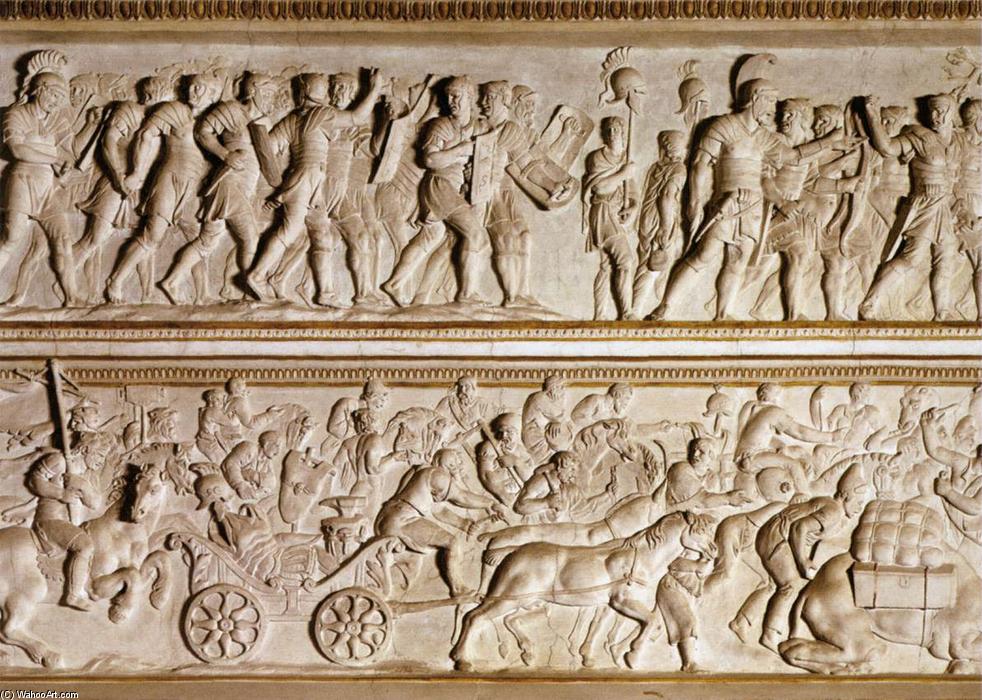
Ulysses and Penelope, The Masquerade of Persepolis, Andromache Learning of the Death of Hector, The Holy Family with Sts Elisabeth and John the Baptist, The Rape of Helene, The Nile, Ceres, Frieze, Ceiling decoration and Royal Staircase (detail). The ranking above gives each one's year and museum.

How many works did Francesco Primaticcio create?Reveal the answer

Our catalog holds 16 works by Francesco Primaticcio, dated from 1530 to 1570.

Where do Francesco Primaticcio's most famous originals hang?Reveal the answer

Mostly in Apartments of the Duchesse d'Étampes (Fontainebleau), Toledo Museum of Art (Toledo) and The Louvre (Paris). The museum table above lists them all.

When did Francesco Primaticcio create the most famous paintings?Reveal the answer

In 1530s: 8 of the 16 works on this page were made then, The Rape of Helene among them.

Which are Francesco Primaticcio's earliest and latest famous works?Reveal the answer

On this page, the earliest is The Rape of Helene (1530) and the latest Andromache Learning of the Death of Hector (1570).

Which subjects did Francesco Primaticcio return to most?Reveal the answer

Mythology (4), Buildings (4) and Woman (3), across the 16 works on this page.

Which medium did Francesco Primaticcio work in most?Reveal the answer

Oil On Canvas, for 5 of the 16 works on this page.

Which movement is Francesco Primaticcio associated with?Reveal the answer

Mannerism, judging by the originals on this page.

Which Francesco Primaticcio originals does the Apartments of the Duchesse d'Étampes hold?Reveal the answer

Royal Staircase (detail), Royal Staircase (detail) and Royal Staircase (detail) (8): the Apartments of the Duchesse d'Étampes, Fontainebleau holds 4 of the works on this page.

Francesco Primaticcio: the artist

The Master of Fontainebleau

Francesco Primaticcio stands as a towering figure of the Italian Mannerist tradition, a polymath whose creative reach extended far beyond the canvas to encompass the realms of architecture and sculpture. Born in Bologna, Italy, his artistic journey began under the rigorous guidance of Giulio Romano in Mantua, where he absorbed the complex, tension-filled aesthetics that would later define his career. This early training instilled in him a profound understanding of classical forms, yet Primaticcio was never content with mere imitation; instead, he sought to infuse these classical ideals with a sense of Mannerist intensity, characterized by elongated limbs, emotional extremity, and a deliberate departure from the serene balance of the High Renaissance.

His career reached its most significant zenith in France, where he became a central pillar of the First School of Fontainebleau. After securing a position in the court of Francis I in 1532, Primaticcio worked alongside Rosso Fiorentino to transform the Chateau Fontainebleau into a pinnacle of European elegance. Following the death of Rosso, Primaticcio assumed leadership of the artistic direction at the palace, managing a talented team of painters and stuccators. His influence was instrumental in shaping the French courtly aesthetic, as he provided designs for tapestries, ephemeral decorations for grand masques, and even directed the creation of bronze casts of Roman sculptures to adorn the royal gardens.

A Legacy of Line and Motion

The work of Primaticcio is a captivating study in controlled chaos and opulent grandeur. His compositions often feature a swirling vortex of human figures, where the boundaries of order are frequently breached by dramatic movement and psychological upheaval. In masterpieces such as The Rape of Helene, one observes his masterful use of chiaroscary, where deep shadows swallow the periphery to cast a harsh, dramatic light upon central struggles. This technique, combined with the characteristic long-legged canon of beauty, created an atmosphere of thick, palpable tension that would influence French art for the remainder of the century.

Beyond his narrative paintings, Primaticcio’s versatility allowed him to leave an indelible mark on the physical landscape of France through architecture. His later years were marked by a transition toward architectural pursuits, most notably seen in his work on the Valois Chapel at the Abbey of Saint-Denis. Whether through the delicate line work of a chalk drawing like Ceres or the monumental scale of fresco fragments such as Ulysses Winning the Archery Contest in the Presence of Penelope, Primaticcio’s oeuvre remains a testament to an artist who could navigate the complexities of myth, majesty, and the human psyche with unparalleled grace.