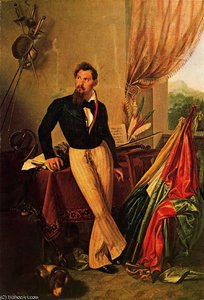
Portrait of Francesco Hayez

The 100 Most Famous Francesco Hayez Paintings, Each One of a Kind

Updated November 2026 · ranked by our popularity score (searches, visits and orders for each work) · 208 works by Francesco Hayez in our catalogue

In short

The Kiss (1859) is the Francesco Hayez painting that draws the most eyes; the original belongs to the Pinacoteca di Brera, Milan. After it, the eye goes to Cunnilingus, or oral sex performed on a woman and Sicilian Vespers scene 3 (1846). Among the 208 works of Francesco Hayez in our catalog, these 100 are the most famous, each a unique original presented with its year, its museum and the reason it endures.

1791 – 1882, Venice Romanticism Most works: Pinacoteca di Brera

Top 10 paintings by Francesco Hayez, through the gallery's eye

1
The Kiss (1859) by Francesco Hayez

The Kiss

1859 · Oil · Pinacoteca di Brera, Milan

Francesco Hayez's "The Kiss," painted in 1859, isn’t merely a depiction of a romantic embrace; it’s a potent distillation of the Italian Romantic movement and a poignant reflection of the Risorgimento – Italy’s struggle for unification. This iconic work transcends its immediate subject matter to become a symbol of passionate longing, patriotic fervor, and the enduring power of love amidst turmoil. Commissioned by Alfonso Maria Visconti di Saliceto, it quickly…

2
Cunnilingus, or oral sex performed on a woman by Francesco Hayez

Cunnilingus, or oral sex performed on a woman

Lithograph

This black and white lithograph presents a close-up view of two figures engaged in an intimate sexual act. The scene is set within a bedroom, indicated by the presence of a bed or couch and a nightstand positioned to the right of the frame. The figures are arranged diagonally across the composition, creating a sense of physical tension. One figure is positioned above the other, focused on performing oral sex.…

3
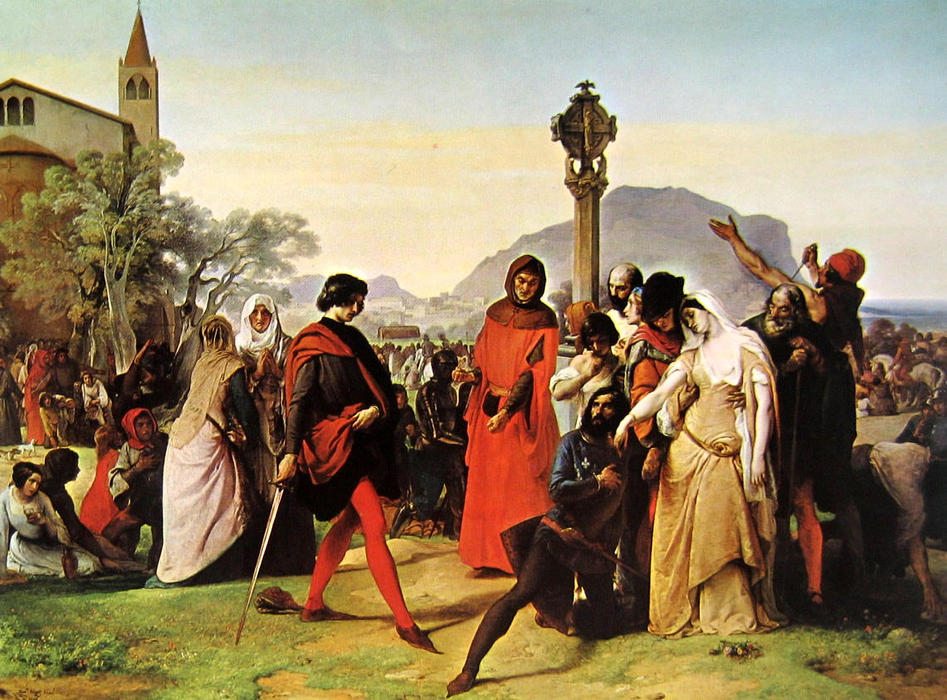
Sicilian Vespers scene 3 (1846) by Francesco Hayez

Sicilian Vespers scene 3

1846 · Oil On Canvas · Galleria Nazionale d'Arte Moderna, Rome

Francesco Hayez's "Sicilian Vespers" (1846) isn’t merely a historical painting; it’s a visceral eruption of conflict, a meticulously crafted tableau of political intrigue and simmering rebellion. The canvas explodes with the energy of a sudden uprising, capturing not just an event but the very essence of chaos and determination. It's a scene ripped from the annals of 13th-century Sicily, where dynastic ambitions collided with papal authority, resulting in a protracted…

4
Sexual intercourse by Francesco Hayez

Sexual intercourse

Charcoal

In this intimate drawing titled Sexual intercourse, the Italian painter Francesco Hayez moves away from his grand historical narratives to explore the raw mechanics of human desire. The subject matter is overtly sexual, presenting a scene of figures engaged in profound intimacy. It is a work that confronts taboo subjects through a direct, unvarnished lens. Rather than focusing on the aftermath, the sketch captures the tension of the moment. Both…

5
The Marriage of Romeo and Juliet (1830) by Francesco Hayez

The Marriage of Romeo and Juliet

1830 · Oil On Canvas

Created in 1830, The Marriage of Romeo and Juliet by Francesco Hayez translates a pivotal scene from William Shakespeare's play into a visual narrative. The work captures the union of the two central figures, focusing on the emotional gravity of their clandestine wedding. Hayez utilizes his technical command to render the essence of the literary tale through a structured, historical lens.

6
Portrait, Matilde Juva-Branca (1851) by Francesco Hayez

Portrait, Matilde Juva-Branca

1851 · Oil On Canvas · Civica Galleria d'Arte Moderna, Milan

In 1851, Francesco Hayez captures the presence of Matilde Branca in the oil-on-canvas work titled Portrait, Matilde Juva-Branca. She moves through the frame not merely as a sitter, but as a woman of significant social standing, known to history as Matilde Juva by her marriage. As a celebrated opera singer, her voice once filled the air of her father's salon, a space that functioned as a central hub for musical…

7
Wall Decoration (detail) (1817) by Francesco Hayez

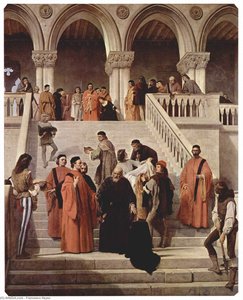
Wall Decoration (detail)

1817 · Oil On Canvas · Museo Correr, Venice

Within the serene halls of the Museo Correr in Venice, Italy, resides a captivating tableau – “Wall Decoration (detail),” a tempera painting masterfully crafted by the esteemed Italian artist Francesco Hayez in 1817. More than just a decorative element, this work offers a poignant window into the artistic sensibilities and historical currents of its time, blending elements of Romanticism with Neoclassical restraint. The piece immediately draws the eye with its…

8
Cunnilingus, or oral sex performed on a woman by Francesco Hayez

Cunnilingus, or oral sex performed on a woman

Pencil

In this monochromatic sketch, we find ourselves in a private, unvarnished moment of human connection. The work is rendered with the raw immediacy of a preparatory study, utilizing the delicate, expressive language of pencil on paper. There is a certain honesty in the loose lines and the visible hatching that defines the forms, suggesting a scene captured in a moment of spontaneous observation rather than a polished, formal composition. The…

10
Nude woman lying from the back (1860) by Francesco Hayez

Nude woman lying from the back

1860 · Oil On Canvas · Pinacoteca di Brera, Milan

In the quietude of Francesco Hayez’s “Nude Woman Lying From The Back,” created around 1860, we encounter a profound moment of stillness that transcends the boundaries of time. This masterpiece of Italian Romanticism invites the viewer into an intimate sanctuary, where the soft contours of the female form are captured in a state of absolute repose. As one gazes upon the canvas, there is an immediate sense of serene vulnerability;…

Francesco Hayez's famous paintings, numbers 11 to 100

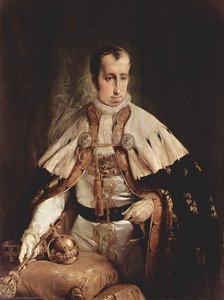
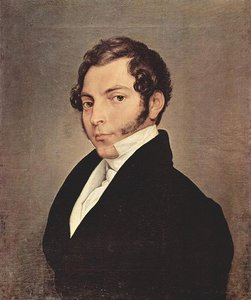
11Self-portrait with Tiger and Lion (1830) by Francesco HayezSelf-portrait with Tiger and Lion1830 · Museo Poldi Pezzoli 12The Kiss (1859) by Francesco HayezThe Kiss1859 13Wall Decoration (detail) (1817) by Francesco HayezWall Decoration (detail)1817 · Museo Correr 14Pietro Rossi called to command the Venetian army (1820) by Francesco HayezPietro Rossi called to command the Venetian army1820 · Pinacoteca di Brera 15Secret accusation (1847) by Francesco HayezSecret accusation1847 · Musei Civici 16Portrait of a Venetian woman (1852) by Francesco HayezPortrait of a Venetian woman1852 17The Kiss (1859) by Francesco HayezThe Kiss1859 18Back view of a bather (1859) by Francesco HayezBack view of a bather1859 19Portrait of Antoniet Vitali Sola (1823) by Francesco HayezPortrait of Antoniet Vitali Sola1823 20Portrait of Carlo Della Bianca (1823) by Francesco HayezPortrait of Carlo Della Bianca1823 · Pinacoteca di Brera 21Overlapping wife back position on the swing by Francesco HayezOverlapping wife back position on the swing 22The meditation by Francesco HayezThe meditation 23The last kiss of Romeo and Juliet (1823) by Francesco HayezThe last kiss of Romeo and Juliet1823 24Valenza Gradenigo faints in front of her father, the Inquisitor (1832) by Francesco HayezValenza Gradenigo faints in front of her father, the Inquisitor1832 · Villa Carlotta 25Ruth (1835) by Francesco HayezRuth1835 26Ruth (1835) by Francesco HayezRuth1835 · Museum of John Paul II Collection 27Christ and the woman taken in adultery (1841) by Francesco HayezChrist and the woman taken in adultery1841 · Walters Art Museum 28The woman from Ciociaria (1842) by Francesco HayezThe woman from Ciociaria1842 29Portrait of Gian Giacomo Poldi Pezzoli (detail) (1851) by Francesco HayezPortrait of Gian Giacomo Poldi Pezzoli (detail)1851 · Museo Poldi Pezzoli 30Portrait of Countess Antonietta Negroni Prati Morosini by Francesco HayezPortrait of Countess Antonietta Negroni Prati MorosiniGalleria d'Arte Moderna 31Priest Orlando of Parma sent by Arrigo IV of Germany and defended by Gregory VII against the just indignation of the Roman synod (1857) by Francesco HayezPriest Orlando of Parma sent by Arrigo IV of Germany and defended by Gregory VII against the just indignation of the Roman synod1857 32Portrait of Antoniet Negroni Prati Morosini (1872) by Francesco HayezPortrait of Antoniet Negroni Prati Morosini1872 33Girl with folded hands (1880) by Francesco HayezGirl with folded hands1880 34Portrait of Giovanni Battista Birago (1823) by Francesco HayezPortrait of Giovanni Battista Birago1823 · Ca’ Granda – Ospedale Maggiore Policlinico 35Ephraim (1843) by Francesco HayezEphraim1843 36Portrait of Pietro Francesco Visconti Borromeo (1824) by Francesco HayezPortrait of Pietro Francesco Visconti Borromeo1824 · Ca’ Granda – Ospedale Maggiore Policlinico 37Portrait of Pompeo Marchesi (1830) by Francesco HayezPortrait of Pompeo Marchesi1830 38Portrait of Gian Giacomo Poldi Pezzoli (1851) by Francesco HayezPortrait of Gian Giacomo Poldi Pezzoli1851 · Museo Poldi Pezzoli 39The Last Moments of Doge Marin Faliero (1867) by Francesco HayezThe Last Moments of Doge Marin Faliero1867 · Pinacoteca di Brera 40Portrait of Carlo Calvi (1820) by Francesco HayezPortrait of Carlo Calvi1820 · Ca’ Granda – Ospedale Maggiore Policlinico 41Venetian women (1853) by Francesco HayezVenetian women1853 42Badende (1832) by Francesco HayezBadende1832 43Portrait, Camillo Benso Conte of Cavour (1864) by Francesco HayezPortrait, Camillo Benso Conte of Cavour1864 44The Refugees of Parga (1831) by Francesco HayezThe Refugees of Parga1831 · Pinacoteca Civica 45Family portrait (1807) by Francesco HayezFamily portrait1807 46Portrait of Don Giulio Vigoni as a child (1830) by Francesco HayezPortrait of Don Giulio Vigoni as a child1830 47Woman from Ciociaria by Francesco HayezWoman from Ciociaria 48The last moments of the Doge Marin Faliero by Francesco HayezThe last moments of the Doge Marin Faliero 49Portrait of Princess Di Sant 'Antimo (1842) by Francesco HayezPortrait of Princess Di Sant 'Antimo1842 50Portrait of Ferdinand I of Austria (1840) by Francesco HayezPortrait of Ferdinand I of Austria1840 51Family portrait (1807) by Francesco HayezFamily portrait1807 52Aristoteles (1811) by Francesco HayezAristoteles1811 53Odalisque with Book (1866) by Francesco HayezOdalisque with Book1866 54Portrait, Giuseppe Roberti (1819) by Francesco HayezPortrait, Giuseppe Roberti1819 55Portrait of Familie Stampa di Soncino (1822) by Francesco HayezPortrait of Familie Stampa di Soncino1822 56Portrait, Conte Ninni (1825) by Francesco HayezPortrait, Conte Ninni1825 57Giovanni David sulla scena de Gli arabi nelle Gallie'''' (1830) by Francesco HayezGiovanni David sulla scena de Gli arabi nelle Gallie''''1830 58Portrait of Countess Luigia Douglas Scotti d'Adda (1830) by Francesco HayezPortrait of Countess Luigia Douglas Scotti d'Adda1830 59Bathsheba (1827) by Francesco HayezBathsheba1827 60Portrait of a man (1834) by Francesco HayezPortrait of a man1834 61Portrait of Cristina di Belgiojoso Trivulzio (1832) by Francesco HayezPortrait of Cristina di Belgiojoso Trivulzio1832 62Ritratto della contessa Teresa Zumali Marsili con il figlio Giuseppe (1833) by Francesco HayezRitratto della contessa Teresa Zumali Marsili con il figlio Giuseppe1833 63Lot and His Daughters (1833) by Francesco HayezLot and His Daughters1833 64The Seventh Crusade before Jerusalem (1838) by Francesco HayezThe Seventh Crusade before Jerusalem1838 65Reclining Odalisque (1839) by Francesco HayezReclining Odalisque1839 66Melancholic Thoughts (1842) by Francesco HayezMelancholic Thoughts1842 67Un Pensiero Malinconico (1842) by Francesco HayezUn Pensiero Malinconico1842 68Ephraim (1843) by Francesco HayezEphraim1843 69Caterina Cornaro Deposed from the Throne of Cyprus (1842) by Francesco HayezCaterina Cornaro Deposed from the Throne of Cyprus1842 70Portrait of Teresa Borri (1848) by Francesco HayezPortrait of Teresa Borri1848 71Portrait of Felicina Caglio Perego di Cremnago (1842) by Francesco HayezPortrait of Felicina Caglio Perego di Cremnago1842 72Portrait of Antoniet Tarsis Basilico (1851) by Francesco HayezPortrait of Antoniet Tarsis Basilico1851 73The Two Foscari (1852) by Francesco HayezThe Two Foscari1852 · Palazzo Pitti 74Portrait of Massimo d'Azeglio (1860) by Francesco HayezPortrait of Massimo d'Azeglio1860 75Portrait of Conte Baglioni (1860) by Francesco HayezPortrait of Conte Baglioni1860 76Female nude (1859) by Francesco HayezFemale nude1859 · Pinacoteca di Brera 77Carolina Zucchi (La Malata) (1825) by Francesco HayezCarolina Zucchi (La Malata)1825 78Inside the Harem (1867) by Francesco HayezInside the Harem1867 79Portrait of Gioacchino Rossini (1870) by Francesco HayezPortrait of Gioacchino Rossini1870 80Odalisque (1867) by Francesco HayezOdalisque1867 81Self Portrait (1878) by Francesco HayezSelf Portrait1878 82Vengeance is Sworn (1851) by Francesco HayezVengeance is Sworn1851 83Socrates discovers Alcibiades in a brothel by Francesco HayezSocrates discovers Alcibiades in a brothel 84Mutual masturbation by Francesco HayezMutual masturbation 85Self portrait by Francesco HayezSelf portraitPinacoteca di Brera 86untitled (5969) by Francesco Hayezuntitled (5969) 87The Portrait of Alessandro Manzoni by Francesco HayezThe Portrait of Alessandro Manzoni 88Malinconia by Francesco HayezMalinconia 89untitled (585) by Francesco Hayezuntitled (585) 90untitled (2952) by Francesco Hayezuntitled (2952) 91untitled (3206) by Francesco Hayezuntitled (3206) 92untitled (5760) by Francesco Hayezuntitled (5760) 93untitled (3822) by Francesco Hayezuntitled (3822) 94Jacob and Esau by Francesco HayezJacob and Esau 95Portrait of Sir Carolina Grassi and Bignami White, sisters Gabrini by Francesco HayezPortrait of Sir Carolina Grassi and Bignami White, sisters Gabrini 96untitled (4623) by Francesco Hayezuntitled (4623) 97Peter the Hermit preached to the crusaders by Francesco HayezPeter the Hermit preached to the crusaders 98Odalisque 1 by Francesco HayezOdalisque 1 99The last kiss given to Juliet by Romeo by Francesco HayezThe last kiss given to Juliet by Romeo 100The Kiss by Francesco HayezThe Kiss

Francesco Hayez's famous paintings, period by period

The subjects that held Francesco Hayez's eye

The four subjects that come back most often in these originals, each with its finest example.

The museums that keep Francesco Hayez's originals

The 8 museums that hold the most of the paintings on this page.

Museum City Works by Francesco Hayez Paintings from this list
Pinacoteca di Brera, MilanPinacoteca di Brera Milan 15 The Kiss, Nude woman lying from the back, Pietro Rossi called to command the Venetian army
Museo Poldi Pezzoli, MilanMuseo Poldi Pezzoli Milan 5 Self-Portrait in a Group of Friends (detail), Self-portrait with Tiger and Lion, Portrait of Gian Giacomo Poldi Pezzoli (detail)
Ca’ Granda – Ospedale Maggiore Policlinico, MilanCa’ Granda – Ospedale Maggiore Policlinico Milan 3 Portrait of Giovanni Battista Birago, Portrait of Pietro Francesco Visconti Borromeo, Portrait of Carlo Calvi
Museo Correr, VeniceMuseo Correr Venice 4 Wall Decoration (detail), Wall Decoration (detail)
Civica Galleria d'Arte Moderna, MilanCivica Galleria d'Arte Moderna Milan 2 Portrait, Matilde Juva-Branca
Villa Carlotta, TremezzinaVilla Carlotta Tremezzina 2 Valenza Gradenigo faints in front of her father, the Inquisitor
Galleria Nazionale d'Arte Moderna, RomeGalleria Nazionale d'Arte Moderna Rome 1 Sicilian Vespers scene 3
Musei Civici, PaviaMusei Civici Pavia 1 Secret accusation

Francesco Hayez across the decades: one unique original for each

Works per decade

Pick a decade to see the original that defines it.

Francesco Hayez's paintings: questions for the gallery

What is the single most famous work of Francesco Hayez?Reveal the answer

The Kiss (1859), Pinacoteca di Brera, Milan. Cunnilingus, or oral sex performed on a woman and Sicilian Vespers scene 3 (1846) come next.

At what age did Francesco Hayez create The Kiss?Reveal the answer

68 years old: The Kiss dates from 1859, and Francesco Hayez was born in 1791.

Which ten paintings by Francesco Hayez are the most famous?Reveal the answer

The Kiss, Cunnilingus, or oral sex performed on a woman, Sicilian Vespers scene 3, Sexual intercourse, The Marriage of Romeo and Juliet, Portrait, Matilde Juva-Branca, Wall Decoration (detail), Cunnilingus, or oral sex performed on a woman, Self-Portrait in a Group of Friends (detail) and Nude woman lying from the back. The ranking above gives each one's year and museum.

How many works by Francesco Hayez are known?Reveal the answer

Our catalog holds 208 works by Francesco Hayez, dated from 1807 to 1880.

Where can the most famous Francesco Hayez originals be seen?Reveal the answer

Mostly in Pinacoteca di Brera (Milan), Museo Poldi Pezzoli (Milan) and Ca’ Granda – Ospedale Maggiore Policlinico (Milan). The museum table above lists them all.

During which period did Francesco Hayez create the best-known paintings?Reveal the answer

In 1830s: 17 of the 100 works on this page were made then, The Marriage of Romeo and Juliet among them.

Which famous Francesco Hayez painting is the earliest, and which the latest?Reveal the answer

On this page, the earliest is Family portrait (1807) and the latest Girl with folded hands (1880).

What subjects did Francesco Hayez favour?Reveal the answer

Woman (23), Man (16) and Portrait (15), across the 100 works on this page.

What materials did Francesco Hayez paint with most?Reveal the answer

Oil On Canvas, for 40 of the 100 works on this page.

Which movement does the work of Francesco Hayez belong to?Reveal the answer

Romanticism, judging by the originals on this page.

What Francesco Hayez originals can I see at the Pinacoteca di Brera?Reveal the answer

The Kiss, Nude woman lying from the back and Pietro Rossi called to command the Venetian army: the Pinacoteca di Brera, Milan holds 7 of the works on this page.

Francesco Hayez: a portrait of the artist

Early Life, Family and Training

In the city of Venice, where the light dances upon the canals, Francesco Hayez entered the world on February 10, 1791. He was the youngest of five sons born to a family of modest means. His father, Giovanni, carried the blood of France, while his mother, Chiara Torcella, was a daughter of Murano. Even as a child, it was evident that the boy possessed a natural inclination toward drawing, a gift that would eventually lead him away from the simple life of his kin toward the complexities of the canvas.

His path toward the arts began not in a grand academy, but in the quiet, meticulous workshop of his uncle, Giovanni Binasco. As an apprentice to this art restorer, the young Francesco learned the discipline of observation and the patience required to handle the works of others. This early labor provided a foundation of technical skill that would support his later ambitions. By 1806, his talent had grown enough to lead him to Milan, where he enrolled in the new academy of fine arts. There, he sought the guidance of Teodoro Matteini, a teacher who would help shape the early movements of his developing hand.

Artistic Training and Roman Influence

After his early years in Venice, the young artist sought to refine his hand through the guidance of masters. He spent time studying the use of colour in classes held by Lattanzio Querena, a painter from Bergamo. This technical foundation prepared him for the great competition he would eventually win in 1809. This victory granted him a year of study at the Accademia di San Luca in Rome, a period that would fundamentally alter the course of his development. In the Eternal City, he moved through circles of great talent, seeking to understand the secrets of form and light.

Rome offered him more than just classroom instruction; it provided the chance to witness greatness in person. He spent many hours within the Vatican Stanze, studying the works of Raphael to learn how to compose complex narratives. He also sought out the workshop of the sculptor Antonio Canova, watching how the master worked with marble. These encounters with the classical and the Renaissance helped shape his vision. His formal education reached its conclusion through visits to the Galleria Farsetti in Venice, where he could observe the great traditions of his home city once more.

Technique and Artistic Style

In the way he applied his brush, Hayez remained a man of discipline, even when his subjects stirred the soul. While his choice of themes often leaned toward the emotional fervor of Romanticism, his actual technique held fast to the clarity of his training. He favored clear outlines that spoke of his time in Rome, where he moved within the circles of Canova and Ingres. This preference for precision allowed him to navigate between the rigid grace of Neoclassicism and the more expressive demands of his era. He worked with oil and watercolor, mastering the ability to render both the grand scale of history and the intimate details of a face.

There was a certain tension in his compositions, a quiet yearning that he achieved through the skillful use of light and shadow. He employed dramatic chiaroscuro to pull his figures from the darkness, using expressive brushstrokes to breathe life into his scenes. This method was particularly effective in his grand historical paintings and political allegories, where he used the past to whisper truths about the present. Even in his portraits, which were noted for being exceptionally fine, he sought to capture more than a mere likeness, aiming instead for the very essence of the person sitting before him.

Notable Works and Masterpieces

The artist’s hand found its most profound expression in works that stirred the soul through historical and romantic drama. In 1859, he produced The Kiss, a painting that his contemporaries held in the highest regard. This work captures a couple in a passionate embrace upon steps overlooking a cityscape, a scene that many felt embodied the very spirit of the era's political struggles. His ability to weave narrative into a single frame is further seen in Rinaldo and Armida, which draws its tension from a pivotal scene in Torquato Tasso’s epic poem Gerusalemme Liberata. Here, the painter depicts the tumultuous romance between a prince and a sorceress amidst a detailed Venetian forest.

Beyond these romantic encounters, he turned his attention to the weight of history and the gravity of sacred stories. He rendered the biblical figure of Ruth in an 1853 oil painting, capturing the essence of the Moabite woman. His skill in historical narrative is evident in Pope Urban II Preaching the First Crusade in the Square of Clermont, a piece that demonstrates his command over large-scale, dramatic compositions. Later in his life, around 1867, he painted The Last Moments of Doge Marin Faliero, a work that reflects the somber gravity of his later years.

Professional Roles and Patrons

Beyond the quiet solitude of the studio, Hayez moved within the most influential circles of Milanese society. His talent and steady hand earned him a place of authority at the Brera Academy, where he served as a Professor of Painting. His devotion to the institution grew as the years passed, eventually leading to his appointment as the Director of the Brera Academy in 1860. Through these roles, he shaped the hands and minds of many who sought to master the art of his era.

The demand for his work came from those who sought to capture their own history and sentiment through his brush. Alfonso Maria Visconti di Saliceto commissioned the famous scene of a couple embracing, a work that would later find its home in the Pinacoteca di Brera. Other patrons sought his skill for more intimate or religious subjects, such as Severino Bonora of Bologna, who requested the depiction of Ruth. These commissions were not merely transactions but were deeply tied to the social and political currents of the time.

The popularity of his imagery even led to multiple versions of a single subject. While the first version of his most famous embrace was destined for a noble collection, the Mylius family commissioned a second version in 1861. Such requests demonstrate how his vision resonated with the families and collectors of the nineteenth century, securing his place in the private halls of the Italian elite.

Legacy and Impact on Art

The influence of Francesco Hayez upon Italian Romanticism remains undeniable, for he acted as the bridge between two eras. He was the most significant figure in the transition from the structured clarity of Neoclassicism to the emotional depth of Romanticism in Italian painting. While his technique often retained the clear outlines and precision he learned in Rome, his heart belonged to the dramatic narratives and political allegories that defined a changing nation. He understood how to use the language of the past to speak to the passions of the present, often disguising the fervent ideals of the Risorgimento within historical scenes to avoid the eyes of censors.

His canvases have long been a subject of study for art historians and enthusiasts who seek to understand the shifting soul of nineteenth-century Italy. By blending the formal training of the Academy with a new, expressive sensibility, he provided a visual vocabulary for a period of intense national awakening. This ability to marry classical discipline with romantic sentiment ensured that his work would not merely fade into history but would continue to inspire new generations of artists who sought to capture the human spirit in flux.

Where to See His Works Today

To walk through the halls of Milan is to encounter the spirit of Hayez in many forms. The Pinacoteca di Brera remains a primary destination for those seeking his hand, holding works that reflect his deep connection to the city's artistic life. Nearby, the Civica Galleria d'Arte Moderna also preserves an impressive collection, ensuring his presence in the local landscape remains strong. One might also find his brushwork within the Museo Poldi Pezzoli, where several of his paintings are kept for public view.

His reach extends beyond the borders of Milan, reaching into the heart of Rome. There, the Accademia di San Luca preserves the work Ulysses at the Court of Alcinous, a piece that speaks to the classical training he received during his youth. These collections allow the viewer to see how his style evolved from the academic traditions of his training into the more emotive narratives of his maturity.