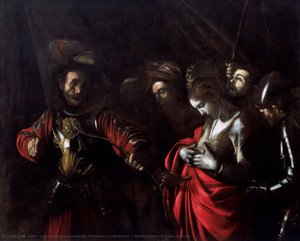
Portrait of Cecco del Caravaggio

The 53 Most Famous Cecco del Caravaggio Paintings, a Gallery Selection

Updated November 2026 · ranked by our popularity score (searches, visits and orders for each work) · 73 works by Cecco del Caravaggio in our catalogue

In short

Of all the originals Cecco del Caravaggio left, the most famous is Beheading of Saint John the Baptist (1608), in the collection of the St John's Co-Cathedral, Valletta. Close behind it come The Martyrdom of Saint Matthew (1600) and Madonna of Loreto (1604). Our catalog holds 73 works by Cecco del Caravaggio; the gallery has kept the 53 the world admires most, each shown with its date, its museum and its story.

1589 – 1620 Baroque Most works: Galleria Borghese

Cecco del Caravaggio's top 10 paintings: the gallery's choice

1
Beheading of Saint John the Baptist (1608) by Cecco del Caravaggio

Beheading of Saint John the Baptist

1608 · Oil On Canvas · St John's Co-Cathedral, Valletta

The scene centers on the violent instant of martyrdom. A man lies trussed like a lamb, his throat cut as the executioner prepares to finish the task. Near the center, a knife catches the light. To the left, a bowl waits in the shadows. The air is heavy with the presence of those gathered to witness the end. Soldiers of King Herod move through the gloom, their actions driving the…

2
The Martyrdom of Saint Matthew (1600) by Cecco del Caravaggio

The Martyrdom of Saint Matthew

1600 · Oil On Canvas · San Luigi dei Francesi, Rome

In the heart of the composition lies a moment of profound, visceral tension, where the earthly and the divine collide in a scene of violent transition. The Martyrdom of Saint Matthew captures the precise, harrowing instant of the saint's passing, presenting a tableau that is as much about the spiritual struggle as it is about physical upheaval. The central figure of Saint Matthew is depicted lying upon the ground, his…

3
Madonna of Loreto (1604) by Cecco del Caravaggio

Madonna of Loreto

1604 · Oil On Canvas · Basilica of St. Augustine in Campo Marzio, Rome

The air in the doorway feels heavy, thick with the dust of a long road. We find ourselves standing before a weathered, crumbling brick wall that marks a threshold between the mundane and the divine. A woman stands within this frame, her feet bare and touching the earth, holding a naked infant who reaches out to bless the weary. This is not a scene of celestial splendor, but one of…

4
The Fortune Teller (1599) by Cecco del Caravaggio

The Fortune Teller

1599 · Oil On Canvas · The Louvre, Paris

is an oil on canvas work by the Italian artist Cecco del Caravaggio. Created in 1599, the piece measures 99 x 131 cm. It belongs to the Baroque period, reflecting the naturalism and dramatic lighting characteristic of the era.

5
Saint Jerome Writing (1605) by Cecco del Caravaggio

Saint Jerome Writing

1605 · Oil On Canvas · Galleria Borghese, Rome

In the quiet, heavy atmosphere of a Roman night, a single source of light pierces through the gloom to reveal a moment of profound intellectual and spiritual labor. Saint Jerome Writing, painted in 1605 by the enigmatic Cecco del Caravaggio, is not merely a portrait of a scholar; it is an immersive experience in Tenebrism. As the eye wanders across the canvas, one is immediately struck by the dramatic interplay…

6
David and Goliath (1599) by Cecco del Caravaggio

David and Goliath

1599 · Oil · Museo del Prado, Madrid

In the heart of the late sixteenth century, a profound shift in the visual language of Europe was taking place, and few works capture this transition with such visceral intensity as Cecco del Caravaggio’s David and Goliath. This painting is not merely a depiction of a biblical triumph; it is a theatrical performance frozen in oil. The scene captures the breathless moment following the fall of the Philistine giant, where…

7
David with the Head of Goliath (1610) by Cecco del Caravaggio

David with the Head of Goliath

1610 · Oil On Canvas · Kunsthistorisches Museum, Vienna

David with the Head of Goliath is an oil on canvas work by Cecco del Caravaggio, dated 1610. The painting is held at the Galleria Borghese in Rome. It belongs to the Baroque period, specifically the Early Modern era, and reflects the stylistic influence of the Caravaggisti movement.

8
Burial of Saint Lucy (1608) by Cecco del Caravaggio

Burial of Saint Lucy

1608 · Oil · Bellomo Palace Regional Gallery, Syracuse

In this large-scale work from 1608, we find ourselves drawn into the quiet, heavy atmosphere of a church in Syracuse. Cecco del Caravaggio has composed a scene of profound communal grief, centered upon the deceased Saint Lucy. The composition is populated by at least thirteen figures, a gathering of souls caught in the immediate aftermath of loss. Some are kneeling in prayer, their bodies bowed by the gravity of the…

9
Madonna of the Rosary (Madonna del Rosario) (1607) by Cecco del Caravaggio

Madonna of the Rosary (Madonna del Rosario)

1607 · Oil On Canvas · Kunsthistorisches Museum, Vienna

In the quiet, hallowed atmosphere of the early seventeenth century, a profound spiritual intimacy emerges from the canvas of Cecco del Caravaggio. His Madonna of the Rosary is not merely a religious depiction but a visceral experience of devotion, where the boundaries between the earthly and the divine seem to dissolve. At the heart of this monumental composition sits the Virgin Mary, her presence both commanding and tender as she…

10
Resurrection of Lazarus (1609) by Cecco del Caravaggio

Resurrection of Lazarus

1609 · Oil On Canvas · Museo Nazionale, Messina

In this large-scale oil on canvas from 1609, we find ourselves witnessing a moment of profound spiritual upheaval. The scene captures the precise instant Jesus calls Lazarus from the grave, a miracle that pulls the figures from the shadows of death into the light of existence. The composition is intensely dynamic, centered on the figure of Jesus, whose presence acts as the catalyst for the movement surrounding him. A crowd…

The Cecco del Caravaggio selection continues, 11 to 53

11Conversion of Saint Paul (1600) by Cecco del CaravaggioConversion of Saint Paul1600 12Mary Magdalen in Ecstasy (1606) by Cecco del CaravaggioMary Magdalen in Ecstasy1606 13Denial of Saint Peter (1610) by Cecco del CaravaggioDenial of Saint Peter1610 · Metropolitan Museum of Art 14Salome with the Head of John the Baptist (1609) by Cecco del CaravaggioSalome with the Head of John the Baptist1609 · Royal Palace of Madrid 15David with the Head of Goliath (1610) by Cecco del CaravaggioDavid with the Head of Goliath1610 · Galleria Borghese 16The Death of the Virgin (1603) by Cecco del CaravaggioThe Death of the Virgin1603 · The Louvre 17Narcissus (1599) by Cecco del CaravaggioNarcissus1599 · Galleria Nazional d Art Antica 18Salome with the Head of John the Baptist (1607) by Cecco del CaravaggioSalome with the Head of John the Baptist1607 · National Gallery 19Madonna and Child with St. Anne (1606) by Cecco del CaravaggioMadonna and Child with St. Anne1606 · Galleria Borghese 20The Seven Works of Mercy (1607) by Cecco del CaravaggioThe Seven Works of Mercy1607 · Pio Monte della Misericordia 21Calling of Saint Matthew (1600) by Cecco del CaravaggioCalling of Saint Matthew1600 · San Luigi dei Francesi 22Supper at Emmaus (1606) by Cecco del CaravaggioSupper at Emmaus1606 · Pinacoteca di Brera 23Supper at Emmaus (1602) by Cecco del CaravaggioSupper at Emmaus1602 · National Gallery 24Ecce Homo (1605) by Cecco del CaravaggioEcce Homo1605 · Palazzo Rosso 25John the Baptist (1604) by Cecco del CaravaggioJohn the Baptist1604 26Carrying of the Cross (1610) by Cecco del CaravaggioCarrying of the Cross1610 · Slovak National Gallery 27Sleeping Cupid (1608) by Cecco del CaravaggioSleeping Cupid1608 · Palazzo Pitti 28The Flute Player (1615) by Cecco del CaravaggioThe Flute Player1615 · Ashmolean Museum 29The Penitent Magdalen by Cecco del CaravaggioThe Penitent MagdalenNationalmuseum 30Woman with a Dove (1615) by Cecco del CaravaggioWoman with a Dove1615 · Museo del Prado 31Still Life with Flowers and Fruit (1601) by Cecco del CaravaggioStill Life with Flowers and Fruit1601 · Galleria Borghese 32Saint Francis in Meditation (1606) by Cecco del CaravaggioSaint Francis in Meditation1606 · Museo Civico Ala Ponzone 33Entombment of Christ (1603) by Cecco del CaravaggioEntombment of Christ1603 34Christ on the Mount of Olives (1605) by Cecco del CaravaggioChrist on the Mount of Olives1605 35Taking of Christ (1602) by Cecco del CaravaggioTaking of Christ1602 36Saint Matthew and the Angel (1602) by Cecco del CaravaggioSaint Matthew and the Angel1602 37Saint Francis in Prayer (1610) by Cecco del CaravaggioSaint Francis in Prayer1610 · Museum and Crypt of Capuchins 38Martyrdom of Saint Ursula (1610) by Cecco del CaravaggioMartyrdom of Saint Ursula1610 · Palazzo Zevallos Stigliano 39Nativity with St. Francis and St. Lawrence (1609) by Cecco del CaravaggioNativity with St. Francis and St. Lawrence1609 · Oratory of San Lorenzo 40Woman with a Dove (1610) by Cecco del CaravaggioWoman with a Dove1610 · Museo del Prado 41Portrait of Fra Antionio Martelli (1608) by Cecco del CaravaggioPortrait of Fra Antionio Martelli1608 · Palazzo Pitti 42Guardian Angel with Sts Ursula and Thomas by Cecco del CaravaggioGuardian Angel with Sts Ursula and ThomasMuseo del Prado 43Cleansing of the temple by Cecco del CaravaggioCleansing of the temple 44Martyrdom of Saint Sebastian. by Cecco del CaravaggioMartyrdom of Saint Sebastian.National Museum in Warsaw 45Christ expulses the money changers out of the temple by Cecco del CaravaggioChrist expulses the money changers out of the templeGemäldegalerie 46Saint Jerome in Meditation (1606) by Cecco del CaravaggioSaint Jerome in Meditation1606 · Santa Maria de Montserrat Abbey 47John the Baptist (1602) by Cecco del CaravaggioJohn the Baptist1602 · Capitoline Museums 48John the Baptist (1610) by Cecco del CaravaggioJohn the Baptist1610 · Galleria Borghese 49The Calling of Saints Peter and Andrew (1606) by Cecco del CaravaggioThe Calling of Saints Peter and Andrew1606 · Royal Collection 50Still Life with Fruit (1603) by Cecco del CaravaggioStill Life with Fruit1603 · Denver Art Museum 51Judith Beheading Holofernes (1610) by Cecco del CaravaggioJudith Beheading Holofernes1610 · Palazzo Zevallos Stigliano 52John the Baptist (Reclining Baptist) (1610) by Cecco del CaravaggioJohn the Baptist (Reclining Baptist)1610 53The resurrection by Cecco del CaravaggioThe resurrectionArt Institute of Chicago

Cecco del Caravaggio's famous paintings, period by period

The subjects that held Cecco del Caravaggio's eye

The four subjects that come back most often in these originals, each with its finest example.

The museums that keep Cecco del Caravaggio's originals

The 8 museums that hold the most of the paintings on this page.

Museum City Works by Cecco del Caravaggio Paintings from this list
Galleria Borghese, RomeGalleria Borghese Rome 5 Saint Jerome Writing, David with the Head of Goliath, Madonna and Child with St. Anne
Museo del Prado, MadridMuseo del Prado Madrid 4 David and Goliath, Woman with a Dove, Woman with a Dove
San Luigi dei Francesi, RomeSan Luigi dei Francesi Rome 2 The Martyrdom of Saint Matthew, Calling of Saint Matthew
The Louvre, ParisThe Louvre Paris 2 The Fortune Teller, The Death of the Virgin
Kunsthistorisches Museum, ViennaKunsthistorisches Museum Vienna 2 David with the Head of Goliath, Madonna of the Rosary (Madonna del Rosario)
National Gallery, LondonNational Gallery London 2 Salome with the Head of John the Baptist, Supper at Emmaus
Palazzo Pitti, FlorencePalazzo Pitti Florence 2 Sleeping Cupid, Portrait of Fra Antionio Martelli
Palazzo Zevallos Stigliano, NaplesPalazzo Zevallos Stigliano Naples 2 Martyrdom of Saint Ursula, Judith Beheading Holofernes

Cecco del Caravaggio decade by decade: the original that defines each

Works per decade

Pick a decade to see the original that defines it.

Collectors' questions about Cecco del Caravaggio's paintings

Which work is Cecco del Caravaggio most famous for?Reveal the answer

Beheading of Saint John the Baptist (1608), St John's Co-Cathedral, Valletta. The Martyrdom of Saint Matthew (1600) and Madonna of Loreto (1604) come next.

What age was Cecco del Caravaggio when Beheading of Saint John the Baptist was made?Reveal the answer

19 years old: Beheading of Saint John the Baptist dates from 1608, and Cecco del Caravaggio was born in 1589.

What are the ten most famous Cecco del Caravaggio paintings?Reveal the answer

Beheading of Saint John the Baptist, The Martyrdom of Saint Matthew, Madonna of Loreto, The Fortune Teller, Saint Jerome Writing, David and Goliath, David with the Head of Goliath, Burial of Saint Lucy, Madonna of the Rosary (Madonna del Rosario) and Resurrection of Lazarus. The ranking above gives each one's year and museum.

How many paintings did Cecco del Caravaggio leave?Reveal the answer

Our catalog holds 73 works by Cecco del Caravaggio, dated from 1599 to 1615.

In which museums do Cecco del Caravaggio's masterpieces hang?Reveal the answer

Mostly in Galleria Borghese (Rome), Museo del Prado (Madrid) and San Luigi dei Francesi (Rome). The museum table above lists them all.

In which years did Cecco del Caravaggio paint the most famous works?Reveal the answer

In 1600s: 32 of the 53 works on this page were made then, Beheading of Saint John the Baptist among them.

What are the first and the last famous originals of Cecco del Caravaggio?Reveal the answer

On this page, the earliest is The Fortune Teller (1599) and the latest The Flute Player (1615).

Which subjects did Cecco del Caravaggio choose most often?Reveal the answer

Man (18), Woman (15) and People (12), across the 53 works on this page.

Which technique did Cecco del Caravaggio use most?Reveal the answer

Oil On Canvas, for 36 of the 53 works on this page.

To which art movement does Cecco del Caravaggio belong?Reveal the answer

Baroque and Caravaggism, judging by the originals on this page.

Which Cecco del Caravaggio works hang at the Galleria Borghese?Reveal the answer

Saint Jerome Writing, David with the Head of Goliath and Madonna and Child with St. Anne: the Galleria Borghese, Rome holds 5 of the works on this page.

Cecco del Caravaggio: life and work

The Shadowy Genius: Unveiling Cecco del Caravaggio

In the dimly lit corridors of Baroque art history, few figures possess a mystique as profound as Francesco Buoneri, known to posterity by the intimate diminutive Cecco del Caravaggio. To study his life is to navigate a landscape of shadows and half-truths, where the boundaries between historical fact and artistic legend blur. Emerging in the early seventeenth century, Cecco was far more than a mere shadow cast by the greatness of Michelangelo Merisi da Caravaggio; he was a vital pulse in the movement known as the Caravaggisti. While his name suggests a close-knit, perhaps even familial connection to the master, recent scholarship suggests a complex relationship where the student did not merely mimic the teacher but absorbed his revolutionary naturalism to forge a voice of startling psychological intensity.

The very essence of Cecco’s identity is woven into the fabric of Rome's turbulent artistic scene. The name Cecco, a diminutive of Francesco, hints at a level of familiarity that has led many historians to speculate he may have been the "boy Francesco" who assisted Caravaggio during the master's final, fugitive years in the city. This personal connection likely served as the crucible for his development, allowing him to witness firsthand the birth of tenebrism—that dramatic, high-contrast interplay of light and dark that would become his signature. His early training, potentially influenced by the Mannerist traditions of Pietro Testa, provided him with a foundation in classical composition, yet it was the raw, visceral reality of Caravaggio’s influence that ultimately pulled him toward a more profound, humanistic truth.

A Mastery of Light and Human Vulnerability

Cecco’s oeuvre is characterized by an uncompromising commitment to dramatic realism. He possessed a rare ability to use light not merely as a tool for visibility, but as a spiritual protagonist capable of illuminating the deepest recesses of the human soul. In his most celebrated works, such as the monumental The Resurrection, one observes an exaggeration of the bold contrasts pioneered by Caravaggio. Here, the light does not simply fall upon the figures; it erupts through the darkness, carving out forms with a sculptural weight that commands the viewer's attention and evokes a sense of divine intervention amidst earthly struggle.

Beyond the grand religious narratives, Cecco’s talent extended to capturing the quiet, often unsettling moments of human existence. His paintings frequently explore themes of:

  • Sacred Suffering: Works like Ecce Homo utilize deep shadows to emphasize the physical and emotional agony of Christ, making the divine feel palpably present.
  • Biblical Drama: In pieces such as Salome with the Head of John the Baptist, he employs a tragic realism that highlights the chilling intersection of beauty and brutality.
  • Intimate Devotion: His depictions of figures like Saint Jerome Writing or John the Baptist showcase a mastery of texture and flesh, where the tactile reality of skin and parchment is rendered with breathtaking precision.
This technical prowess allowed him to bridge the gap between the celestial and the terrestrial, making the miraculous feel as though it were occurring in the very room of the spectator.

Legacy Amidst the Shadows

Though his active period was relatively brief, spanning from roughly 1610 to the mid-1620s, Cecco del Caravaggio left an indelible mark on the trajectory of Baroque painting. He stood at a pivotal moment in art history, acting as a bridge between the dying gasps of Mannerism and the full-throated emotionalism of the seventeenth century. While some early historians relegated him to the status of a mere follower, modern eyes recognize a painter who understood that true realism requires more than just accurate anatomy; it requires the courage to embrace the darkness.

His historical significance lies in his role as a custodian of the Caravaggisti spirit. By refining the techniques of chiaroscuro and infusing them with a unique, often melancholic tenderness, he helped ensure that the revolutionary naturalism of Caravaggio would endure through subsequent generations. Today, as we look upon his surviving masterpieces in collections like the Art Institute of Chicago or the Galleria Borghese, we do not see a mere imitator, but an artist who found profound meaning in the interplay of light and void, proving that even in the deepest shadows, a brilliant truth can be found.