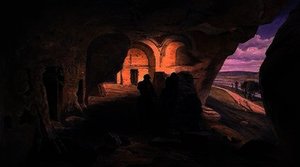
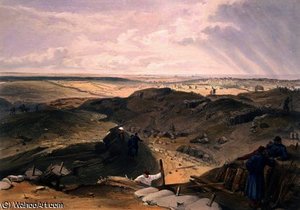
Portrait of William Simpson

William Simpson Paintings: The 100 Most Famous, Through a Gallery's Eye

Updated November 2026 · ranked by our popularity score (searches, visits and orders for each work) · 195 works by William Simpson in our catalogue

In short

To the gallery's eye, William Simpson's most famous painting is Lama in a monastery working the prayer wheels (1861), whose original hangs in the Victoria and Albert Museum, London. The Bull Nandi in the courtyard of the Golden Temple, Benares (1864) and View of the Kaiser Bagh in Lucknow (1864) complete the trio every eye recognises. Of the 195 works by William Simpson in our catalog, the gallery presents the 100 most famous below, each original with its year, its museum and what makes it unique.

1823 – 1899, Glasgow Romanticism Most works: Victoria and Albert Museum

The gallery's top 10 William Simpson paintings

1
Lama in a monastery working the prayer wheels (1861) by William Simpson

Lama in a monastery working the prayer wheels

1861 · Watercolor · Victoria and Albert Museum, London

A solitary monk sits within the quietude of a monastery, likely located in the Ladakh region. He is engaged in the rhythmic, spiritual practice of spinning prayer wheels, a central act of Buddhist devotion. The composition centers on a large, ornate cylindrical wheel that dominates the mid-ground, its form contrasting with the organic silhouette of the seated figure. Light enters through arched openings to the left, casting a soft glow…

2
The Bull Nandi in the courtyard of the Golden Temple, Benares (1864) by William Simpson

The Bull Nandi in the courtyard of the Golden Temple, Benares

1864 · Watercolor · Victoria and Albert Museum, London

In "The Bull Nandi in the courtyard of the Golden Temple, Benares" by William Simpson, a profound sense of quietude settles over a sacred space. The scene unfolds within a serene courtyard in Benares, where the eye is immediately drawn to the center of the composition. There, a massive, white Nandi bull statue rests, its pale form anchoring the mid-ground of the view. This religious and cultural subject occupies the…

3
View of the Kaiser Bagh in Lucknow (1864) by William Simpson

View of the Kaiser Bagh in Lucknow

1864 · Watercolor · Victoria and Albert Museum, London

The scene unfolds in the watercolor painting titled View of the Kaiser Bagh in Lucknow. This work, rendered by the artist William Simpson, captures a moment of intense struggle amidst the grand architecture of the city. The artist, William Simpson, brings a sense of immediacy to the canvas, documenting the unfolding chaos of the Siege of Lucknow through his delicate yet precise application of pigment.

4
The Temple of Poseidon, Sunium by William Simpson

The Temple of Poseidon, Sunium

Watercolor

The Temple of Poseidon, Sunium by William Simpson captures a quiet moment at the edge of the Attica peninsula. The ancient Greek temple of Poseidon sits under a sky heavy with clouds, catching the fading light of a sunset. This celestial display casts a dramatic glow over the stone architecture, turning the scene into a study of light and shadow. The atmosphere feels still, as if the world is holding…

5
Circassia. Teherkess Of The Soubash by William Simpson

Circassia. Teherkess Of The Soubash

Oil

The oil painting titled Circassia. Teherkess Of The Soubash is a work by the artist William Simpson. He was born in Glasgow, United Kingdom, in 1823. His brush captured a specific moment in the mid-19th century, documenting a world of dirt roads and traditional robes. He remained an observer of distant lands until his death in 1899.

6
The Gate Of Huldah The Prophetess, Jerusalem by William Simpson

The Gate Of Huldah The Prophetess, Jerusalem

The painting titled The Gate Of Huldah The Prophetess, Jerusalem is a work by the artist William Simpson. The subject of the piece is the gate of Huldah the prophetess located in Jerusalem. This architectural feature serves as the central focus of the composition.

7
Pheel Khana, Or Elephants Quarters by William Simpson

Pheel Khana, Or Elephants Quarters

Watercolor

In Pheel Khana, Or Elephants Quarters, William Simpson captures a specific moment of repose and labor within an Indian encampment. The composition centers on several large elephants gathered around a cluster of tents. These massive animals form the structural weight of the scene, their heavy bodies anchored near the canvas fabric. Some individuals are perched high upon the backs of the elephants, looking out over the camp, while others move…

8
Kailasanatha temple, Ellora (1862) by William Simpson

Kailasanatha temple, Ellora

1862 · Watercolor · Victoria and Albert Museum, London

This artwork is titled Kailasanatha temple, Ellora, and was executed by the artist William Simpson. The work focuses on the Kailasanatha temple located in Ellora, Maharashtra, India. The subject is a monolithic rock temple, a structure carved directly from the living stone. The painting captures the architectural scale of this free-standing rock temple situated within a rock pit.

9
Worship of the Devi at Kothi, near Chini (1860) by William Simpson

Worship of the Devi at Kothi, near Chini

1860 · Watercolor · Victoria and Albert Museum, London

The scene unfolds in the Worship of the Devi at Kothi, near Chini, a work that captures a moment of intense devotion. Painted by William Simpson around 1860, the image brings us into the heart of a religious gathering. We find ourselves amidst a crowd of devotees, their presence felt through the collective energy of the assembly. Musicians move through the throng, their long horns and drums providing a rhythmic…

10
The Sanchi tope, Tanjore (1861) by William Simpson

The Sanchi tope, Tanjore

1861 · Watercolor · Victoria and Albert Museum, London

In this landscape watercolor, William Simpson presents "The Sanchi tope, Tanjore," a work dating from about 1861. The composition adopts a wide view, looking across a rugged, debris-strewn foreground toward the monument. From this slightly low angle, the large, hemispherical dome of the stupa occupies the center of the frame, positioned slightly to the right. The structure is surrounded by the organic shapes of foliage and the weathered textures of…

William Simpson paintings, ranked 11 to 100

11Buddhist stupa at Sarnath, Benaras (1864) by William SimpsonBuddhist stupa at Sarnath, Benaras1864 · Victoria and Albert Museum 12Gateway of the Buddhist Top at Sanchi (1865) by William SimpsonGateway of the Buddhist Top at Sanchi1865 · Victoria and Albert Museum 13Akalis at the Holy Tank, Umritsar by William SimpsonAkalis at the Holy Tank, Umritsar 14Temple Of Minerva Sunium by William SimpsonTemple Of Minerva Sunium 15Portrait Of Mary Seacole by William SimpsonPortrait Of Mary Seacole 16The Oxford ^ Cambridge Boat Race by William SimpsonThe Oxford ^ Cambridge Boat Race 17Sevastopol by William SimpsonSevastopol 18Prinsep's Ghat, Calcutta by William SimpsonPrinsep's Ghat, Calcutta 19Circassians At The Fort Of Waia by William SimpsonCircassians At The Fort Of Waia 20Graves At The Head Of The Harbour Of Balaklava by William SimpsonGraves At The Head Of The Harbour Of Balaklava 21Attack On The Malakoff by William SimpsonAttack On The Malakoff 22The Field of Inkermann by William SimpsonThe Field of Inkermann 23Elephant Battery by William SimpsonElephant Battery 24Camp of the Fourth Division by William SimpsonCamp of the Fourth Division 25Bastion du Mat from the Central Bastion by William SimpsonBastion du Mat from the Central Bastion 26Yosemite Falls by William SimpsonYosemite Falls 27The Camp of the First Division by William SimpsonThe Camp of the First Division 28Ditch of the Bastion du Mat by William SimpsonDitch of the Bastion du Mat 29Mine In The Bastion Du Mat - by William SimpsonMine In The Bastion Du Mat - 30Second Charge of the Guards at Inkerman by William SimpsonSecond Charge of the Guards at Inkerman 31Shalimar Gardens. Cashmere. by William SimpsonShalimar Gardens. Cashmere. 32The plains, landour church, mussoorie by William SimpsonThe plains, landour church, mussoorie 33Mongolia. Group Near The Great Wall Of China. by William SimpsonMongolia. Group Near The Great Wall Of China. 34Quarantine Cemetery and Church by William SimpsonQuarantine Cemetery and Church 35The graves on cathcart's hill of the officers of the fourth division who fell at inkerman by William SimpsonThe graves on cathcart's hill of the officers of the fourth division who fell at inkerman 36The Maristan Or Mosque-hospital Of Kalaun, Cairo by William SimpsonThe Maristan Or Mosque-hospital Of Kalaun, Cairo 37The river chenab, punjab by William SimpsonThe river chenab, punjab 38Pheel Khan, Or Elephants' Quarters, Holcar's Camp by William SimpsonPheel Khan, Or Elephants' Quarters, Holcar's Camp 39The wellesley monument, bombay by William SimpsonThe wellesley monument, bombay 40Excavated Church in the Caverns of Inkerman by William SimpsonExcavated Church in the Caverns of Inkerman 41Interior Of Fort Nicholas, Sebastopol by William SimpsonInterior Of Fort Nicholas, Sebastopol 42Interior of Lord Raglan's Head Quarters by William SimpsonInterior of Lord Raglan's Head Quarters 43Lintel Of Barclay's Doorway by William SimpsonLintel Of Barclay's Doorway 44Mine of the Bastion du Mat by William SimpsonMine of the Bastion du Mat 45Wilson's arch, jerusalem, by William SimpsonWilson's arch, jerusalem, 46Fallen Voussoirs of Robinson's Arch, Jerusalem by William SimpsonFallen Voussoirs of Robinson's Arch, Jerusalem 47The Church Of Ecce Homo, Convent Of The Soeurs De Sion, Jerusalem by William SimpsonThe Church Of Ecce Homo, Convent Of The Soeurs De Sion, Jerusalem 48Glen Massen by William SimpsonGlen Massen 49Dahad Ziaret by William SimpsonDahad Ziaret 50Kyleakin, Skye by William SimpsonKyleakin, Skye 51The Siege Of Rome by William SimpsonThe Siege Of Rome 52The Shah Nujeef by William SimpsonThe Shah Nujeef 53Ghelenjik by William SimpsonGhelenjik 54A Hot Day in the Batteries by William SimpsonA Hot Day in the Batteries 55An Album Of Sketches Of India by William SimpsonAn Album Of Sketches Of India 56Sentinel of the Zouaves by William SimpsonSentinel of the Zouaves 57Kertch from the north by William SimpsonKertch from the north 58Buddhist Rock Cut Temple, Ajanta by William SimpsonBuddhist Rock Cut Temple, Ajanta 59Cavalry camp by William SimpsonCavalry camp 60The Pir Panjal Pass Into Kashmir by William SimpsonThe Pir Panjal Pass Into Kashmir 61The admiralty, sebastopol by William SimpsonThe admiralty, sebastopol 62The Chitpore Road by William SimpsonThe Chitpore Road 63Fortress of Yenikale by William SimpsonFortress of Yenikale 64Ditch of the Malakoff by William SimpsonDitch of the Malakoff 65Camp of the 3rd Division by William SimpsonCamp of the 3rd Division 66Hospital and cemetry at Scutari by William SimpsonHospital and cemetry at Scutari 67Balaklava Harbour Scene by William SimpsonBalaklava Harbour Scene 68The Old Tower At Cannes by William SimpsonThe Old Tower At Cannes 69A Tibetan Weaver by William SimpsonA Tibetan Weaver 70A Scene From Rob Roy, Theatre Royal, Edinburgh by William SimpsonA Scene From Rob Roy, Theatre Royal, Edinburgh 71Battle of the Tchernaya by William SimpsonBattle of the Tchernaya 72Church Of St. Peter And St. Paul by William SimpsonChurch Of St. Peter And St. Paul 73Camp of the Naval Brigade by William SimpsonCamp of the Naval Brigade 74The Village Welll by William SimpsonThe Village Welll 75Leh, The Capital Of Tibet by William SimpsonLeh, The Capital Of Tibet 76One of the wards of the hospital at Scutari by William SimpsonOne of the wards of the hospital at Scutari 77Bastion du Mat by William SimpsonBastion du Mat 78Valley of the Tchernaya by William SimpsonValley of the Tchernaya 79The Ruins of Inkerman by William SimpsonThe Ruins of Inkerman 80Docks At Sebastopol With Ruins Of Fort St Paul by William SimpsonDocks At Sebastopol With Ruins Of Fort St Paul 81Disembarkation Of The Expedition To Kertch At Kamish by William SimpsonDisembarkation Of The Expedition To Kertch At Kamish 82The Cow's Mouth Glacier, India by William SimpsonThe Cow's Mouth Glacier, India 83The Camp of the Second Division by William SimpsonThe Camp of the Second Division 84Highland brigade camp by William SimpsonHighland brigade camp 85Head of the harbour, Sebastopol by William SimpsonHead of the harbour, Sebastopol 86Interior Of The Malakoff by William SimpsonInterior Of The Malakoff 87The Cavalry Affair of the Heights of Bulganak by William SimpsonThe Cavalry Affair of the Heights of Bulganak 88Interior of the Mamelon Vert by William SimpsonInterior of the Mamelon Vert 89Huts and war clothing for the army by William SimpsonHuts and war clothing for the army 90The Blessing Of The Suez Canal by William SimpsonThe Blessing Of The Suez Canal 91Lord Raglan's Head Quarters At Khutor-karagatch - by William SimpsonLord Raglan's Head Quarters At Khutor-karagatch - 92The Sun Temple Of Martand, Kashmir by William SimpsonThe Sun Temple Of Martand, Kashmir 93The Landing At Calimita Bay by William SimpsonThe Landing At Calimita Bay 94A Hot Night In The Batteries by William SimpsonA Hot Night In The Batteries 95Sketch in the interior of the Mamelon Vert by William SimpsonSketch in the interior of the Mamelon Vert 96Russian Rifle Pit by William SimpsonRussian Rifle Pit 97A Christmas Dinner On The Heights Before Sebastopol by William SimpsonA Christmas Dinner On The Heights Before Sebastopol 98Town batteries by William SimpsonTown batteries 99Sebastopol From The Sea by William SimpsonSebastopol From The Sea 100A Quiet Night In The Batteries by William SimpsonA Quiet Night In The Batteries

The subjects that held William Simpson's eye

The four subjects that come back most often in these originals, each with its finest example.

The museums that keep William Simpson's originals

The museum that holds the most of the paintings on this page.

Museum City Works by William Simpson Paintings from this list
Victoria and Albert Museum, LondonVictoria and Albert Museum London 8 Lama in a monastery working the prayer wheels, The Bull Nandi in the courtyard of the Golden Temple, Benares, View of the Kaiser Bagh in Lucknow

William Simpson, the signature paintings of each year

6 years, 1860 to 1865, hold William Simpson's whole dated career on this page: a short one, seen here year by year through its most famous originals.

Works per year

Pick a year to see its originals.

William Simpson's paintings: the gallery answers

Which William Simpson painting is the most famous of all?Reveal the answer

Lama in a monastery working the prayer wheels (1861), Victoria and Albert Museum, London. The Bull Nandi in the courtyard of the Golden Temple, Benares (1864) and View of the Kaiser Bagh in Lucknow (1864) come next.

How old was William Simpson on completing Lama in a monastery working the prayer wheels?Reveal the answer

38 years old: Lama in a monastery working the prayer wheels dates from 1861, and William Simpson was born in 1823.

Which are William Simpson's top 10 paintings?Reveal the answer

Lama in a monastery working the prayer wheels, The Bull Nandi in the courtyard of the Golden Temple, Benares, View of the Kaiser Bagh in Lucknow, The Temple of Poseidon, Sunium, Circassia. Teherkess Of The Soubash, The Gate Of Huldah The Prophetess, Jerusalem, Pheel Khana, Or Elephants Quarters, Kailasanatha temple, Ellora, Worship of the Devi at Kothi, near Chini and The Sanchi tope, Tanjore. The ranking above gives each one's year and museum.

How many works did William Simpson create?Reveal the answer

Our catalog holds 195 works by William Simpson, dated from 1860 to 1865.

Where do William Simpson's most famous originals hang?Reveal the answer

Mostly in Victoria and Albert Museum (London). The museum table above lists them all.

When did William Simpson create the most famous paintings?Reveal the answer

In 1864: 3 of the 100 works on this page were made then, The Bull Nandi in the courtyard of the Golden Temple, Benares among them.

Which are William Simpson's earliest and latest famous works?Reveal the answer

On this page, the earliest is Worship of the Devi at Kothi, near Chini (1860) and the latest Gateway of the Buddhist Top at Sanchi (1865).

Which subjects did William Simpson return to most?Reveal the answer

Sky (7), Landscape (7) and Crimean war (6), across the 100 works on this page.

Which medium did William Simpson work in most?Reveal the answer

Watercolor, for 10 of the 100 works on this page.

Which movement is William Simpson associated with?Reveal the answer

Romanticism, judging by the originals on this page.

Which William Simpson originals does the Victoria and Albert Museum hold?Reveal the answer

Lama in a monastery working the prayer wheels, The Bull Nandi in the courtyard of the Golden Temple, Benares and View of the Kaiser Bagh in Lucknow: the Victoria and Albert Museum, London holds 8 of the works on this page.

William Simpson: the artist

A Life Etched in Conflict and Culture

William Simpson, a name forever linked to the stark realities of the Crimean War—often whispered as “Crimean Simpson”—was far more than a mere war artist. He was a visual chronicler, an intrepid observer who documented a 19th-century world undergoing rapid transformation. Born into the grinding poverty of Glasgow in 1823, his journey from hardship to prominence stands as a testament to both innate talent and unwavering tenacity. His early life was shadowed by a difficult family situation; an abusive and alcoholic father led him to seek refuge with his grandmother in Perth at age ten—a move that, while offering stability, limited formal schooling but ignited within him a lifelong dedication to self-directed learning. This pursuit of knowledge continued through apprenticeships at the Glasgow lithographic firm of Macfarlane, which he later described as pivotal, and evening studies at the Andersonian University and Mechanics' Institute. These formative years laid the groundwork for a career that would seamlessly blend artistic skill with an insatiable curiosity about the world beyond Britain’s shores.

Witness to War: The Crimean Revelation

The outbreak of the Crimean War (1853-1856) irrevocably altered Simpson's trajectory. Initially commissioned to create a lithograph based on secondhand accounts of the Battle of Alma, his talent quickly caught the attention of Colnaghi & Son, who dispatched him directly to Crimea in November 1854. This wasn’t simply about illustrating battles; it was about *experiencing* them and translating that experience onto paper with meticulous detail. Simpson didn't shy away from depicting the grim realities of war—the mud, the suffering, the sheer exhaustion etched on the faces of soldiers. His watercolors weren't romanticized visions but unflinching records of a brutal conflict. These images were then transformed into lithographs for publications like The Illustrated London News, bringing the horrors and heroism of the Crimean War directly into British homes. He became known as “Crimean Simpson” not just for his presence there, but for the authenticity and immediacy he brought to his depictions. His work provided a crucial visual narrative during a war that was otherwise distant and abstract for many back home. The Seat of War in the East, his seminal series of lithographs from these sketches, remains a landmark achievement in war reporting and visual storytelling—a testament to his courage and artistic skill under fire.

Beyond Crimea: India, Exploration, and Artistic Ambition

Simpson’s success in Crimea opened doors to further assignments as a special artist and correspondent for The Illustrated London News. In the late 1850s, he embarked on an extensive journey to India, documenting the aftermath of the Sepoy Revolt of 1857. This expedition wasn't simply about recording military events; it was a deep dive into Indian landscapes, culture, and daily life. He captured bustling marketplaces, serene temples, majestic palaces, and portraits of local people with remarkable sensitivity. His watercolors from India reveal a nuanced understanding of the subcontinent—a far cry from the often-simplistic depictions prevalent at the time. Simpson envisioned a comprehensive illustrated volume on India, an ambitious project that unfortunately fell through due to financial difficulties faced by Day & Son, the intended publisher. Despite this setback, his Indian watercolors remain invaluable records of a pivotal moment in British colonial history, showcasing not only the grandeur of the subcontinent but also the complexities and tensions inherent in imperial rule. He continued to travel extensively, documenting scenes from Russia, China, and beyond, always bringing back detailed observations rendered with remarkable skill.

Legacy and Lasting Influence

William Simpson’s legacy extends far beyond his stunning visual documentation of 19th-century events. He helped establish the role of the “special artist”—an embedded observer who provided firsthand visual reporting from conflict zones and distant lands. His work wasn't just art; it was journalism, history, and cultural observation all rolled into one. Simpson enjoyed the patronage of Queen Victoria herself, a testament to the esteem his artistry garnered. He was elected an associate of the Institute of Painters in Water Colours in 1874 and became a full member five years later. His detailed watercolors and lithographs continue to be studied by historians and art enthusiasts alike, offering invaluable insights into the past. He was, as some called him, a “Prince of Pictorial Correspondents,” whose work continues to resonate with audiences today.

Notable Works

Simpson’s ability to capture both the grandeur and the suffering inherent in human conflict cemented his place as a significant figure in Victorian art and history—a visual storyteller whose work continues to inform and inspire.