Orientalist
Shalimar Gardens. Cashmere. (William Simpson)
William Simpson (1823–1899) made Shalimar Gardens. Cashmere.. It belongs to the Orientalist movement.

 Preview

 Hand Made Oil Painting
 Send
 Share
 Fact sheet


 Download
 Similars
 X-Ray
 Diaporama
 Q&A

 Stats
Shalimar Gardens. Cashmere., in brief
- Title
- Shalimar Gardens. Cashmere.
- Artist
- William Simpson (1823–1899)
- Artist born in
- Glasgow, United Kingdom
- Movement
- Orientalist
- Subject
- eastern intrigue, romantic encounter, luxury setting, secret meeting, vibrant colors, opulent interior
High-resolution images of Shalimar Gardens. Cashmere.
William Simpson, Shalimar Gardens. Cashmere.. Public domain.
Questions on Shalimar Gardens. Cashmere., answered
What does "Shalimar Gardens. Cashmere." by William Simpson depict?
The subjects of "Shalimar Gardens. Cashmere." are eastern intrigue, romantic encounter, luxury setting, secret meeting, vibrant colors, opulent interior, 19th century style.
Is "Shalimar Gardens. Cashmere." free of copyright?
"Shalimar Gardens. Cashmere." by William Simpson is in the public domain - its copyright has expired. This status governs how the image of the work may be reproduced.
Which artist is "Shalimar Gardens. Cashmere." attributed to?
"Shalimar Gardens. Cashmere." is attributed to William Simpson.
What art movement does "Shalimar Gardens. Cashmere." by William Simpson belong to?
"Shalimar Gardens. Cashmere." by William Simpson belongs to the Orientalist movement. This movement provides the stylistic context of the work.
Which period of William Simpson's career does "Shalimar Gardens. Cashmere." belong to?
"Shalimar Gardens. Cashmere." represents the Mature Period of William Simpson.
Is "Shalimar Gardens. Cashmere." by William Simpson in the public domain, and why?
The copyright status of "Shalimar Gardens. Cashmere." - in the public domain - its copyright has expired - follows from the artist's death in 1899.
Where does "Shalimar Gardens. Cashmere." sit within William Simpson's body of work?
Within William Simpson's output, "Shalimar Gardens. Cashmere." sits in the Orientalist style, alongside the themes of crimean war scenes, travel diaries", illustrated london news, romanticism, orientalism, war correspondance, exotic romance, power & intrigue.
How does the subject of "Shalimar Gardens. Cashmere." relate to William Simpson's usual themes?
William Simpson's recurring themes include crimean war scenes, travel diaries", illustrated london news, romanticism, orientalism, war correspondance, exotic romance, power & intrigue; "Shalimar Gardens. Cashmere." focuses on eastern intrigue, romantic encounter, luxury setting, secret meeting, vibrant colors, opulent interior, 19th century style.
About the artist, William Simpson
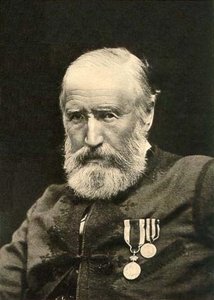
1823–1899, United Kingdom
William Simpson
A Life Etched in Conflict and Culture William Simpson, a name forever linked to the stark realities of the Crimean War—often whispered as “Crimean Simpson”—was far more than a mere war artist. He was a visual chronicler, an intrepid observer who documented a 19th-century world undergoing rapid transformation. Born into the grinding poverty of Glasgow in 1823, his journey from hardship to prominence stands as a testament to both innate talent and unwavering tenacity. His early life was shadowed by a difficult family situation; an abusive and alcoholic father led him to seek refuge with his grandmother in Perth at age ten—a move that, while offering stability, limited formal schooling but ignited within him a lifelong dedication to self-directed learning.
Also by William Simpson
 Lama in a monastery working the prayer wheels1861
 View of the Kaiser Bagh in Lucknow1864
 The Bull Nandi in the courtyard of the Golden Temple, Benares1864
 The Temple of Poseidon, Sunium
Essays around Shalimar Gardens. Cashmere.
 Masterpieces of Light: The Top 25 Artworks by James McNeill WhistlerExplore the iconic masterpieces of James McNeill Whistler. Discover the essence of Tonalism and fine art on OriginalUniqueArt.com.
 Abstract Harmony: How to Pair Impressionist Textures with Modern Interior FinishesDiscover how to elegantly pair the luminous textures of Impressionist masterpieces with modern interior finishes. Our expert guide offers s…
 John Singer Sargent's 25 Masterpieces: Portraits & Beyond | OriginalUniqueArtExplore 25 iconic John Singer Sargent paintings – from dazzling portraits to Impressionist landscapes. Discover the stories behind Madame X…