

1

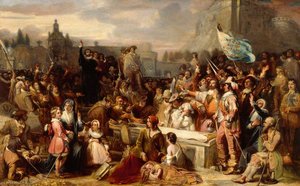
The Slave Market, Constantinople
The painting titled The Slave Market, Constantinople is a work by the artist William Allan. This specific piece was created about 1838. The canvas measures 129 x 198 cm.

Updated November 2026 · ranked by our popularity score (searches, visits and orders for each work) · 56 works by William Allan in our catalogue
In short
To the gallery's eye, William Allan's most famous painting is The Slave Market, Constantinople (1838), whose original hangs in the Scottish National Gallery, Edinburgh. The Signing of the National Covenant in Greyfriars Kirkyard, Edinburgh (1838) and Tartar Robbers Dividing Spoil (1817) complete the trio every eye recognises. Of the 56 works by William Allan in our catalog, the gallery presents the 48 most famous below, each original with its year, its museum and what makes it unique.
The painting titled The Slave Market, Constantinople is a work by the artist William Allan. This specific piece was created about 1838. The canvas measures 129 x 198 cm.

The oil painting titled The Signing of the National Covenant in Greyfriars Kirkyard, Edinburgh is a work by the artist William Allan. Created in 1838, this piece depicts the historical event of the signing of the National Covenant within the Greyfriars Kirkyard in Edinburgh. The scene captures a specific moment of religious and political significance in Scottish history.

The scene unfolds in Tartar Robbers Dividing Spoil, a work painted by William Allan around 1817. Within the shadows of a cavernous space, the tension of a sudden encounter hangs heavy in the air. The composition centers on the interaction between two men, their presence illuminated against the dark, textured stone of their surroundings. Every brushstroke captures a moment of high drama, frozen in time as the figures negotiate their…

This large-scale oil painting, created in 1824, presents a crowded and dynamic street scene reminiscent of a public disturbance or uprising. The composition is defined by a diagonal thrust, driven by a central group of people and a horse, which creates a sense of instability and movement. Within this chaotic scene, numerous figures are engaged in various actions; some are seen falling, others are gesturing, and many are observing the…

The air inside the room feels thick with the scent of woodsmoke and spilled ale. Shadows dance across the walls, cast by the flickering light of candles and the glowing embers of a fireplace. In this crowded, rustic space, a lively chaos unfolds as figures press together in a moment of boisterous celebration. There is a sense of movement in every corner; some guests lean in to share a whispered…

This black and white pen and ink drawing presents a study of form and gesture, focusing on a single male figure depicted in profile. The subject is a gentleman dressed in formal attire, including a hat and a coat, and he is shown holding what appears to be a walking stick or cane. The composition is characterized by its simplicity, placing the figure against a neutral background to emphasize the…

An older gentleman sits anchored at a desk, his presence filling the frame with a heavy, quiet gravity. The light falls across his features with a dramatic intensity, carving deep shadows into the folds of his coat and the lines of his face. He gazes outward, his eyes meeting the viewer in a direct, intimate connection that feels almost intrusive, as if we have stumbled upon a private moment of…

This work, titled Study for 'The Murder of David Rizzio', was painted by William Allan in 1833. It offers a glimpse into the artist's process, capturing a moment of intense preparation for a larger historical scene. The piece reflects the specific interests of an artist deeply engaged with the dramatic narratives of the nineteenth century.

The air thickens with the weight of a historical drama in The Murder of David Rizzio. Painted by William Allan in 1833, this work captures a moment of profound betrayal and royal tragedy. The scene freezes the violent 1566 assassination of David Rizzio, the Italian secretary to Mary Queen of Scots. Chaos erupts within the palace, a sudden fracture in the order of the court that leaves the viewer suspended…

 Matthew Hardie, Violin Maker1822
12
 Matthew Hardie (1755–1826), Violin Maker1822 · Scottish National Portrait Gallery
13
 William Hey (1736–1819)1815 · Leeds General Infirmary
14
 The Black Dwarf1831 · Scottish National Gallery
15
 Sir Walter Scott in His Study with His Dog 'Maida'1831 · Abbotsford House
16
 William Blackwood (1776–1834), Publisher1830 · Scottish National Portrait Gallery
17
 Sir Walter Scott (1771–1832), Novelist and Poet – Gala Day at Abbotsford1827 · Scottish National Portrait Gallery
18
 Sir Walter Scott with One of his Daughters1826 · Scottish National Portrait Gallery
19
 Sir Walter Scott, 1st Bt1831 · National Portrait Gallery
20
 The Facade of Abbotsford, seen through the Entrance Gate1832 · Scottish National Gallery
21
 The Shepherd's Grace1835
22
 The Bride of Abydos (from the poem by Byron)1836
23
 The Stirrup Cup1836 · Royal Scottish Academy of Art - Architecture
24
 Heroism and Humanity1840
25
 The Battle of Waterloo1843 · English Heritage
26
 The Recovery of the Stolen Child1841
27
 Sir Walter Scott (1771–1832), Novelist and Poet1844
28
 The Visit of Queen Victoria and Prince Albert to Hawthornden, 14 September 18421844 · Scottish National Portrait Gallery
29
 William Henry Murray (1790–1852), Actor and Manager of Theatre Royal, Edinburgh1848 · Scottish National Portrait Gallery
30
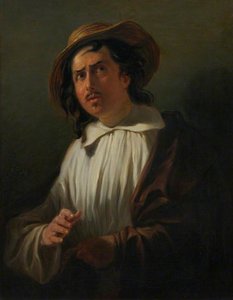 William Henry Murray (1790–1852), Actor and Manager of Theatre Royal, Edinburgh, as 'Paul Pry' (Crombie Sketchbook, fo.4)1843 · Scottish National Portrait Gallery
31
 An Officer of the 18th Regiment of (Light) Dragoons (Hussars), c.18151840
32
 Sir Walter Scott Dictating to His Daughter, Anne, in the Armoury at Abbotsford1844 · The National Trust For Scotland
33
 Highland Gillie and His Pony1850 · The Stirling Smith Art Gallery - Museum
34
 Frederick William Robert Stewart (1805–1872), Viscount Castlereagh, Later 4th Marquess of Londonderry, Wearing Hunting Costume1823 · National Trust
35
 Fair Maid of Perth
36
 The Ballad of Old Robin Gray1826
37
 The Battle of Bannockburn1850 · Royal Scottish Academy of Art - Architecture
38
 Bude harbour, DevonNational Maritime Museum
39
 Fair Maid of PerthUniversity of Edinburgh Fine Art Collection
40
 Field of Waterloo
41
 Christmas Eve
42
 The Battle of Cape St Vincent, 14 February 1797National Maritime Museum
43
 Mr Mackay of the Edinburgh Theatre as Baillie Nicol JarvieAbbotsford House
44
 James Russell, the ActorAbbotsford House
45
 The Bashkirs1814 · Hermitage Museum
46
 The Murder of David Rizzio1833 · Scottish National Gallery
47
 The Orphan1838 · Royal Collection
48
 Frontier Guards (Circassian Prince on Horseback Selling Two Boys)1814 · Hermitage Museum
The four subjects that come back most often in these originals, each with its finest example.
The 8 museums that hold the most of the paintings on this page.
| Museum | City | Works by William Allan | Paintings from this list |
|---|---|---|---|
 Scottish National Portrait Gallery |
Edinburgh | 8 | James Hogg (1770–1835), Poet (The Ettrick Shepherd) (The Ettrick Shepherd's House Heating or The Celebration of his Birthday), Matthew Hardie (1755–1826), Violin Maker, William Blackwood (1776–1834), Publisher |
 Scottish National Gallery |
Edinburgh | 7 | The Slave Market, Constantinople, Compositional Sketch for 'Death of the Regent Moray', Study for 'The Murder of David Rizzio' |
 Royal Scottish Academy of Art - Architecture |
Edinburgh | 3 | Self Portrait, The Stirrup Cup, The Battle of Bannockburn |
 Abbotsford House |
Malvern | 3 | Sir Walter Scott in His Study with His Dog 'Maida', Mr Mackay of the Edinburgh Theatre as Baillie Nicol Jarvie, James Russell, the Actor |
 National Maritime Museum |
London | 2 | Bude harbour, Devon, The Battle of Cape St Vincent, 14 February 1797 |
 Hermitage Museum |
Saint Petersburg | 2 | The Bashkirs, Frontier Guards (Circassian Prince on Horseback Selling Two Boys) |
 The Company of Merchants of The City of Edinburgh |
Edinburgh | 1 | John Robertson |
 Leeds General Infirmary |
Leeds | 1 | William Hey (1736–1819) |
Pick a decade to see the original that defines it.
The scene unfolds in Tartar Robbers Dividing Spoil, a work painted by William Allan around 1817. Within the shadows of a cavernous space, the tension of a sudden encounter hangs heavy in the air. The composition centers on the interaction between two men, their presence illuminated against the dark, textured stone of their surroundings. Every brushstroke captures a moment of high drama, frozen in time as the figures negotiate their…
This large-scale oil painting, created in 1824, presents a crowded and dynamic street scene reminiscent of a public disturbance or uprising. The composition is defined by a diagonal thrust, driven by a central group of people and a horse, which creates a sense of instability and movement. Within this chaotic scene, numerous figures are engaged in various actions; some are seen falling, others are gesturing, and many are observing the…
The painting titled The Slave Market, Constantinople is a work by the artist William Allan. This specific piece was created about 1838. The canvas measures 129 x 198 cm.


The Slave Market, Constantinople (1838), Scottish National Gallery, Edinburgh. The Signing of the National Covenant in Greyfriars Kirkyard, Edinburgh (1838) and Tartar Robbers Dividing Spoil (1817) come next.
56 years old: The Slave Market, Constantinople dates from 1838, and William Allan was born in 1782.
The Slave Market, Constantinople, The Signing of the National Covenant in Greyfriars Kirkyard, Edinburgh, Tartar Robbers Dividing Spoil, Compositional Sketch for 'Death of the Regent Moray', James Hogg (1770–1835), Poet (The Ettrick Shepherd) (The Ettrick Shepherd's House Heating or The Celebration of his Birthday), Joseph Mallord William Turner, Self Portrait, Study for 'The Murder of David Rizzio', The Murder of David Rizzio and John Robertson. The ranking above gives each one's year and museum.
Our catalog holds 56 works by William Allan, dated from 1803 to 1850.
Mostly in Scottish National Portrait Gallery (Edinburgh), Scottish National Gallery (Edinburgh) and Royal Scottish Academy of Art - Architecture (Edinburgh). The museum table above lists them all.
In 1830s: 16 of the 48 works on this page were made then, The Slave Market, Constantinople among them.
On this page, the earliest is John Robertson (1803) and the latest Highland Gillie and His Pony (1850).
Men (5), Historical scene (4) and People (3), across the 48 works on this page.
Oil On Canvas, for 7 of the 48 works on this page.
Romanticism, judging by the originals on this page.
James Hogg (1770–1835), Poet (The Ettrick Shepherd) (The Ettrick Shepherd's House Heating or The Celebration of his Birthday), Matthew Hardie (1755–1826), Violin Maker and William Blackwood (1776–1834), Publisher: the Scottish National Portrait Gallery, Edinburgh holds 8 of the works on this page.
Sir William Allan (1782-1850) stands as a pivotal figure in 19th-century Scottish art, a master of historical painting who skillfully blended meticulous realism with an evocative sense of drama. Born into a prominent merchant family in Edinburgh, his artistic journey was largely self-directed, nurtured by early exposure to the burgeoning art scene and later guided by the mentorship of Sir Henry Raeburn, a leading figure of the Scottish Enlightenment. Allan’s work transcends mere portraiture; it's a vibrant tapestry woven with threads of Scottish culture, Russian intrigue, and the romantic spirit of his era. His legacy extends far beyond individual paintings, shaping the identity of the National Gallery of Scotland and influencing generations of artists who followed.
Allan’s formative years were steeped in the traditions of Edinburgh's artistic circles. While formal training was limited, he absorbed influences from John Graham at the Trustees’ Academy, alongside the techniques of David Wilkie and Alexander George Fraser. This early exposure instilled a deep appreciation for detail and composition – hallmarks that would define his distinctive style. Crucially, Raeburn recognized Allan’s talent and offered guidance, fostering an understanding of capturing not just likeness but also character and emotion. This connection to the Scottish Enlightenment profoundly shaped Allan's artistic vision, emphasizing observation, intellectual curiosity, and a desire to represent the world with accuracy and nuance.
A defining moment in Allan’s career was his decision to travel to Russia in 1805. Driven by a fascination with Eastern cultures and a desire for artistic inspiration, he embarked on an extended sojourn that would profoundly impact his work. Allan immersed himself in the daily life of Cossacks, Circassians, and Tartars, meticulously documenting their customs, clothing, and social interactions. He wasn’t merely sketching; he was actively engaging with these communities, earning their trust and gaining access to scenes rarely seen by Western artists. This immersive experience resulted in a series of paintings that offered unprecedented insights into Russian society – a subject largely unexplored by European art at the time.
His most celebrated works from this period include “The Circassian Captives,” a poignant depiction of a group of women awaiting their fate, and “Russian Peasants Keeping Their Holiday,” which captures the vibrant energy of a rural celebration. These paintings are notable not only for their technical skill but also for their empathetic portrayal of marginalized communities. Allan’s approach was revolutionary; he sought to represent these cultures with respect and understanding, moving beyond stereotypical depictions often found in earlier works.
Allan's artistic style is characterized by a remarkable blend of realism and romanticism. He possessed an exceptional ability to render textures – from the rough wool of Cossack clothing to the shimmering surface of Circassian jewelry – with astonishing detail. His compositions are often dynamic, employing dramatic lighting and carefully arranged figures to create a sense of movement and narrative. Color plays a crucial role in his work, used not merely for decorative effect but to convey mood and atmosphere.
Key works such as “Portrait of John Renny” exemplify his skill in capturing the likeness and personality of his subjects. The self-portrait, painted later in life, reveals a contemplative gaze and a subtle awareness of his own aging. “The Ballad of Old Robin Gray,” a haunting depiction of an elderly man recalling his past, showcases Allan’s ability to evoke emotion through gesture and expression. These paintings, alongside others housed at the Scottish National Gallery, demonstrate a remarkable evolution in his artistic style – from the early influences of John Opie to a more mature and nuanced approach.
Sir William Allan's impact on Scottish art extends far beyond his individual achievements. He played a vital role in establishing the Scottish National Portrait Gallery, contributing significantly to its collection and shaping its identity as a repository of Scottish artistic heritage. His work helped elevate the status of Scottish painting within the broader European art world, challenging prevailing notions of what constituted “serious” art.
Allan’s legacy is also reflected in the works of subsequent generations of Scottish artists. He demonstrated the importance of studying local culture and traditions, encouraging a more nuanced and authentic representation of Scotland on canvas. His commitment to detail, his ability to capture emotion, and his willingness to explore unconventional subjects continue to inspire artists today. The enduring appeal of Allan’s paintings lies not only in their technical brilliance but also in their profound insights into the human condition and the rich tapestry of Scottish and Russian life.

