Portrait of William Hogarth

William Hogarth Paintings: The 100 Most Famous, Through a Gallery's Eye

Updated October 2026 · ranked by our popularity score (searches, visits and orders for each work) · 307 works by William Hogarth in our catalogue

In short

To the gallery's eye, William Hogarth's most famous painting is Plate one, from A Rake's Progress. Plate six, from A Rake's Progress and Gin Lane (1750) complete the trio every eye recognises. Of the 307 works by William Hogarth in our catalog, the gallery presents the 100 most famous below, each original with its year, its museum and what makes it unique.

1697 – 1764, London Most works: Sir John Soane's Museum

The gallery's top 10 William Hogarth paintings

1
Plate one, from A Rake's Progress by William Hogarth

Plate one, from A Rake's Progress

Engraving

The Scene: A Glimpse into Creative Chaos Immerse yourself in the vibrant energy of an artist's studio with "Plate one, from A Rake's Progress." This intricate engraving by William Hogarth captures a bustling scene teeming with activity and detail. At the center, a man in elegant attire engages with an artwork on an easel, surrounded by figures diligently working or conversing. The composition is rich with layers of interaction, from…

2
Plate six, from A Rake's Progress by William Hogarth

Plate six, from A Rake's Progress

Engraving

A Glimpse into 18th-Century Satire Immerse yourself in the vibrant chaos of "Plate six, from A Rake's Progress," a masterful engraving by William Hogarth. This intricate black-and-white scene captures the frenetic energy of a bustling tavern, offering a vivid snapshot of 18th-century social life and moral commentary. Composition and Style Hogarth's signature style shines through in this detailed composition, where every figure and object tells a story. The monochromatic palette…

3
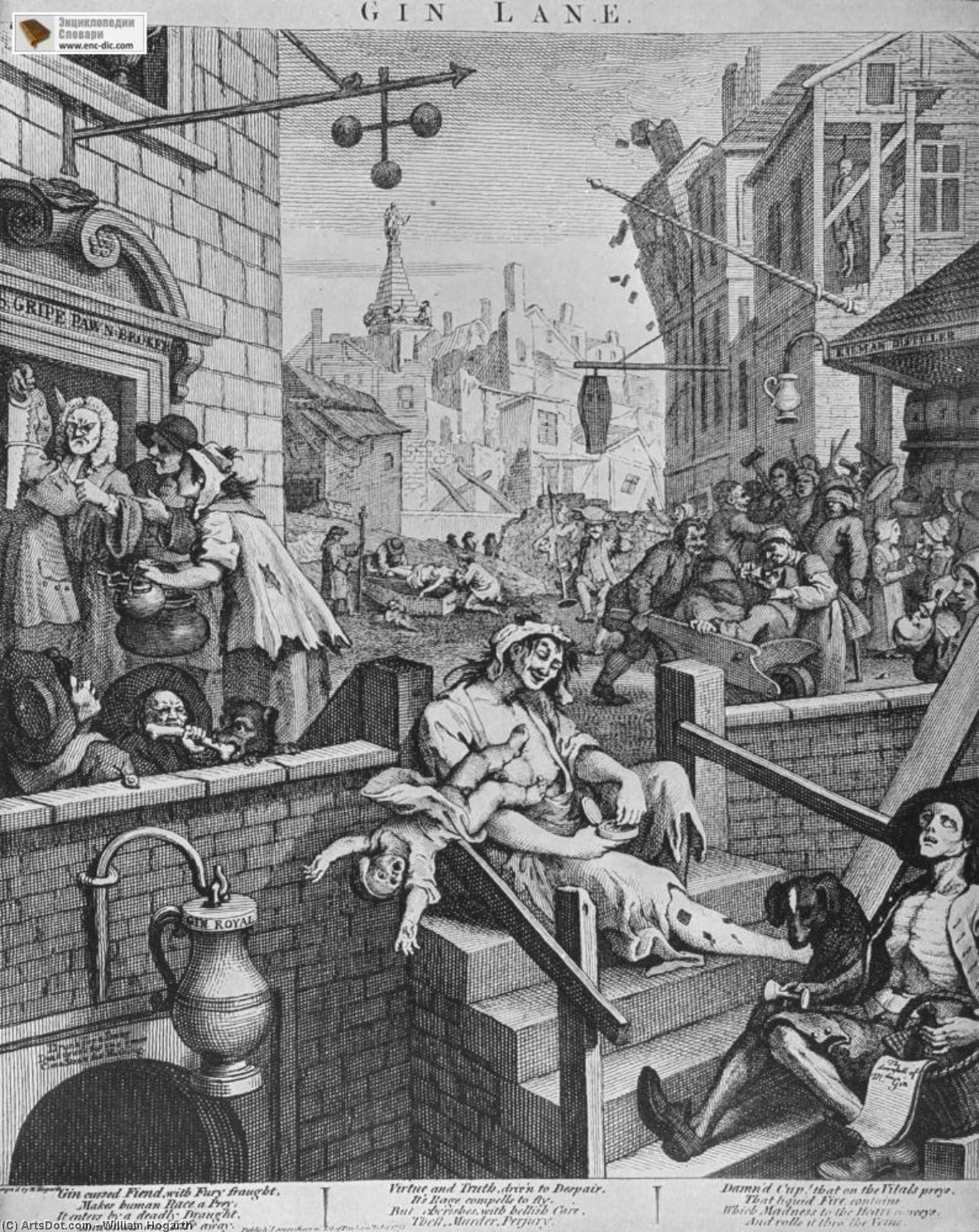
Gin Lane (1750) by William Hogarth

Gin Lane

1750 · Engraving

In the heart of 18th-century London, amidst the swirling fog and the growing shadows of social upheaval, William Hogarth captured a moment of profound human tragedy that continues to haunt the viewer centuries later. His masterpiece, Gin Lane, is far more than a mere engraving; it is a visceral, breathing chronicle of a city in the throes of moral and physical decay. Completed in 1751, this work serves as a…

4
The Marriage Contract (1745) by William Hogarth

The Marriage Contract

1745 · Acrylic On Canvas

A Window Into Georgian Society In the heart of 1745, William Hogarth captured more than a mere domestic arrangement; he froze a pivotal moment of social negotiation in "The Marriage Contract." This meticulously crafted tableau invites the viewer into a room thick with the palpable anxieties and lofty aspirations of Georgian England. As we gaze upon the central table where a man proposes to his prospective bride, we are not…

5
The Banquet (1755) by William Hogarth

The Banquet

1755 · Oil On Canvas · Sir John Soane's Museum, London

A Revelrous Scene of 18th-Century Life: Unpacking William Hogarth’s *The Banquet* (1755) William Hogarth’s *The Banquet*, painted in 1755, is a vibrant and densely populated oil painting that offers a fascinating glimpse into the social customs of Georgian England. Measuring 101 x 127 cm, this large-scale work isn't merely a depiction of a feast; it’s a carefully constructed commentary on society, indulgence, and the often-chaotic nature of human interaction. Subject…

6
Satan, Sin and Death (A Scene from Milton (1735) by William Hogarth

Satan, Sin and Death (A Scene from Milton

1735 · Oil On Canvas · Tate Britain, London

William Hogarth's "Satan, Sin, and Death," painted in 1735, is far more than a mere illustration from John Milton’s epic poem, *Paradise Lost*; it’s a meticulously crafted moral allegory that plunges the viewer into a world of temptation, consequence, and eternal conflict. This oil on canvas, currently residing at the Tate Britain in London, measures 74 x 61 cm and offers a remarkably intimate glimpse into Hogarth's profound understanding of…

7
The Painter and his Pug (1745) by William Hogarth

The Painter and his Pug

1745 · Oil On Canvas · Tate Gallery, London

The Painter and his Pug is a self-portrait by the artist William Hogarth. Completed in 1745, the oil on canvas captures a quiet moment of companionship. The sitter is the artist himself, seated alongside his pug, Trump. This animal companion rests near the man, anchoring the scene in a sense of domesticity.

8
The Suicide of the Countess by William Hogarth

The Suicide of the Countess

Oil On Canvas

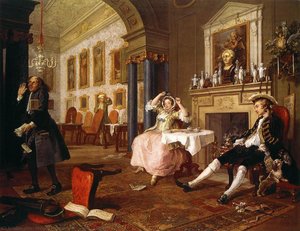
William Hogarth's "The Suicide of the Countess," part of his renowned series "Marriage A-la-Mode," offers a stark and poignant commentary on the societal ills of 18th-century England. Created between 1743 and 1745, this painting serves as a powerful culmination to a narrative exploring the destructive consequences of marriages based on financial gain rather than genuine affection.

9
The Four Times of Day: Night (1738) by William Hogarth

The Four Times of Day: Night

1738 · Engraving · Cleveland Museum of Art, Cleveland

William Hogarth's "The Four Times of Day: Night," painted in 1738, isn’t merely a depiction of a London street scene; it’s a meticulously crafted window into the social and moral landscape of eighteenth-century England. This remarkable work, now immortalized through WahooArt’s hand-painted reproductions, captures a moment of revelry – or perhaps reckless abandon – with an unparalleled level of detail and satirical observation that defines Hogarth's unique artistic legacy. The…

10
A Harlot's Progress: Quarrels with her Jewish Protector (1743) by William Hogarth

A Harlot's Progress: Quarrels with her Jewish Protector

1743 · Oil On Canvas · Ascott House, Leighton Buzzard

The room holds a sudden, sharp noise. A tea-table tilts, porcelain clatters, and the heavy weight of an argument settles over the fine fabrics. Mary, known as Moll Hackabout, moves with a violent intent, her arm a decisive line against the opulent interior. She kicks at the furniture to draw eyes away from the doorway, where a lover slips quietly into the shadows. A black serving boy stands near, a…

William Hogarth paintings, ranked 11 to 100

11Self portrait (1757) by William HogarthSelf portrait1757 · National Portrait Gallery 12Soliciting Votes (1754) by William HogarthSoliciting Votes1754 · Sir John Soane's Museum 13The heir (1735) by William HogarthThe heir1735 · Sir John Soane's Museum 14A Scene from The Beggar's Opera (1729) by William HogarthA Scene from The Beggar's Opera1729 · National Gallery of Art 15South Sea Scheme by William HogarthSouth Sea Scheme 16Marriage à la Mode (1743) by William HogarthMarriage à la Mode1743 · National Gallery 17Plate two, from A Rake's Progress by William HogarthPlate two, from A Rake's Progress 18The rake's progress_ The rake in Bedlam by William HogarthThe rake's progress_ The rake in Bedlam 19Hudibras by William HogarthHudibras 20Visit with the Quack Doctor (1745) by William HogarthVisit with the Quack Doctor1745 21A Harlot's Progress, plate 4 of 6 by William HogarthA Harlot's Progress, plate 4 of 6 22The Times, plate 2 (1763) by William HogarthThe Times, plate 21763 23Mary Toft, apparently giving birth to rabbits (1726) by William HogarthMary Toft, apparently giving birth to rabbits1726 24Self portrait (1745) by William HogarthSelf portrait1745 25Miss Mary Edwards (1742) by William HogarthMiss Mary Edwards1742 · The Frick Collection 26The Battle of the Pictures (1743) by William HogarthThe Battle of the Pictures1743 27Suicide of the Countess (1745) by William HogarthSuicide of the Countess1745 28Canvassing for Votes by William HogarthCanvassing for Votes 29The Countess's Morning Levee (1745) by William HogarthThe Countess's Morning Levee1745 30The Ball (1745) by William HogarthThe Ball1745 31The Bench (1758) by William HogarthThe Bench1758 32The Bruiser Charles Churchill, once the Reverend, in the Character of a Russian Hercules (1763) by William HogarthThe Bruiser Charles Churchill, once the Reverend, in the Character of a Russian Hercules1763 33The Denunciation (1729) by William HogarthThe Denunciation1729 34The Four Times of Day: Night (1736) by William HogarthThe Four Times of Day: Night1736 35Plate seven, from A Rake's Progress by William HogarthPlate seven, from A Rake's Progress 36Self-Portrait by William HogarthSelf-PortraitNational Gallery of Ireland 37Shortly After the Marriage by William HogarthShortly After the Marriage 38The triumph of Representatives (1755) by William HogarthThe triumph of Representatives1755 · Sir John Soane's Museum 39The Death of the Earl by William HogarthThe Death of the Earl 40Emblematical print of the South Sea Scheme (1721) by William HogarthEmblematical print of the South Sea Scheme1721 41A Harlot's Progress, plate 1 by William HogarthA Harlot's Progress, plate 1 42Second stage of cruelty (1751) by William HogarthSecond stage of cruelty1751 43Plate three, from A Rake's Progress by William HogarthPlate three, from A Rake's Progress 44David Garrick as Richard III (1745) by William HogarthDavid Garrick as Richard III1745 45The Reward of Cruelty (1751) by William HogarthThe Reward of Cruelty1751 46Simon, Lord Lovat by William HogarthSimon, Lord Lovat 47A Scene from the Beggar's Opera (1728) by William HogarthA Scene from the Beggar's Opera1728 · National Gallery of Art 48Scholars at a Lecture by William HogarthScholars at a Lecture 49Cruelty in perfection (1751) by William HogarthCruelty in perfection1751 50Sarah Malcolm in Prison by William HogarthSarah Malcolm in Prison 51Gerard Anne Edwards in His Cradle (1733) by William HogarthGerard Anne Edwards in His Cradle1733 52Gin Lane (1751) by William HogarthGin Lane1751 53The murder of the count (1745) by William HogarthThe murder of the count1745 54The Enraged Musician (1741) by William HogarthThe Enraged Musician1741 55The Bathos by William HogarthThe Bathos 56Falstaff Examining His Recruits (1728) by William HogarthFalstaff Examining His Recruits1728 57A Harlot's Progress, plate 6 by William HogarthA Harlot's Progress, plate 6 58The Roast Beef of Old England by William HogarthThe Roast Beef of Old England 59The Beggar's Opera (1729) by William HogarthThe Beggar's Opera1729 · Yale Center for British Art 60A Harlot's Progress, plate 4 by William HogarthA Harlot's Progress, plate 4 61Moses Brought to the Pharaoh's Daughter (1752) by William HogarthMoses Brought to the Pharaoh's Daughter1752 62Lame theater by William HogarthLame theater 63Southwark Fair by William HogarthSouthwark Fair 64Self Portrait by William HogarthSelf Portrait 65Credulity, Superstition, and Fanaticism by William HogarthCredulity, Superstition, and Fanaticism 66A Harlot's Progress, plate 2 by William HogarthA Harlot's Progress, plate 2 67The Committee, plate ten from Hudibras by William HogarthThe Committee, plate ten from Hudibras 68An Election Entertainment, plate one from Four Prints of an Election by William HogarthAn Election Entertainment, plate one from Four Prints of an Election 69Plate five, from A Rake's Progress by William HogarthPlate five, from A Rake's Progress 70A Harlot's Progress, plate 6 of 6 by William HogarthA Harlot's Progress, plate 6 of 6 71The March of the Guards to Finchley (1750) by William HogarthThe March of the Guards to Finchley1750 72Tyburn Large by William HogarthTyburn Large 73The Theft of a Watch (1731) by William HogarthThe Theft of a Watch1731 74Royalty, Episcopacy and Law by William HogarthRoyalty, Episcopacy and Law 75A prisoner of the Fleet being examined before a committee of the House of Commons by William HogarthA prisoner of the Fleet being examined before a committee of the House of CommonsFitzwilliam Museum 76The Mackinen Children (1747) by William HogarthThe Mackinen Children1747 · National Gallery of Ireland 77Engraving of John Wilkes by William HogarthEngraving of John Wilkes 78An Evening at the Rose Tavern, Scene III (1733) by William HogarthAn Evening at the Rose Tavern, Scene III1733 · The Nelson-Atkins Museum of Art 79The Four Times of Day: Night (1736) by William HogarthThe Four Times of Day: Night1736 · Upton House 80An Unknown Lady, possibly Miss Woodley, later Mrs Henry Vaughan (not Mrs Jane Hogarth) (1738) by William HogarthAn Unknown Lady, possibly Miss Woodley, later Mrs Henry Vaughan (not Mrs Jane Hogarth)1738 · Ascott House 81The Family of John, 2nd Duke of Montagu and an attendant (1735) by William HogarthThe Family of John, 2nd Duke of Montagu and an attendant1735 · Yale Center for British Art 82Richard Mouteney (1746) by William HogarthRichard Mouteney1746 · Bavarian State Painting Collections 83Thomas Herring, Archbishop of Canterbury (1745) by William HogarthThomas Herring, Archbishop of Canterbury1745 84A Harlot's Progress, plate 3 of 6 by William HogarthA Harlot's Progress, plate 3 of 6 85Times of the Day: Morning by William HogarthTimes of the Day: Morning 86Satire on False Perspective by William HogarthSatire on False Perspective 87John Henley with five unknown figures by William HogarthJohn Henley with five unknown figures 88Analisis of Beauty by William HogarthAnalisis of Beauty 89Self portrait (from the Gate of Calais) by William HogarthSelf portrait (from the Gate of Calais) 90Gerard Anne Edwards Hamilton (1732–1773) in his Cradle (1732) by William HogarthGerard Anne Edwards Hamilton (1732–1773) in his Cradle1732 · Upton House 91William Augustus, Duke of Cumberland (1732) by William HogarthWilliam Augustus, Duke of Cumberland1732 · Yale Center for British Art 92Thomas Pellett, M.D. (1737) by William HogarthThomas Pellett, M.D.1737 93William Cavendish, Marquess of Hartington, Later fourth Duke of Devonshire (1741) by William HogarthWilliam Cavendish, Marquess of Hartington, Later fourth Duke of Devonshire1741 · Yale Center for British Art 94Self-Portrait (1735) by William HogarthSelf-Portrait1735 · Yale Center for British Art 95The Lottery by William HogarthThe Lottery 96A Harlot's Progress, plate 3 by William HogarthA Harlot's Progress, plate 3 97Scene from John Gay's The Beggar's Opera (1727) by William HogarthScene from John Gay's The Beggar's Opera1727 · Birmingham Museum and Art Gallery 98Beer Street (1751) by William HogarthBeer Street1751 99Rake's Progress' The Gaming House (1735) by William HogarthRake's Progress' The Gaming House1735 · Sir John Soane's Museum 100George II, King of England and his Family (1732) by William HogarthGeorge II, King of England and his Family1732 · National Gallery of Ireland

William Hogarth's famous paintings, period by period

The subjects that held William Hogarth's eye

The four subjects that come back most often in these originals, each with its finest example.

The museums that keep William Hogarth's originals

The 8 museums that hold the most of the paintings on this page.

Museum City Works by William Hogarth Paintings from this list
Sir John Soane's Museum, LondonSir John Soane's Museum London 14 The Banquet, Soliciting Votes, The heir
Yale Center for British Art, New HavenYale Center for British Art New Haven 11 The Beggar's Opera, The Family of John, 2nd Duke of Montagu and an attendant, William Augustus, Duke of Cumberland
National Gallery of Ireland, Dublin CityNational Gallery of Ireland Dublin City 7 Self-Portrait, The Mackinen Children, George II, King of England and his Family
Upton House, BanburyUpton House Banbury 3 The Four Times of Day: Night, Gerard Anne Edwards Hamilton (1732–1773) in his Cradle
Ascott House, Leighton BuzzardAscott House Leighton Buzzard 2 A Harlot's Progress: Quarrels with her Jewish Protector, An Unknown Lady, possibly Miss Woodley, later Mrs Henry Vaughan (not Mrs Jane Hogarth)
National Gallery of Art, WashingtonNational Gallery of Art Washington 2 A Scene from The Beggar's Opera, A Scene from the Beggar's Opera
National Gallery, LondonNational Gallery London 9 Marriage à la Mode
Fitzwilliam MuseumFitzwilliam Museum 9 A prisoner of the Fleet being examined before a committee of the House of Commons

William Hogarth, one signature painting per decade

Works per decade

Pick a decade to see the original that defines it.

William Hogarth's paintings: the gallery answers

Which William Hogarth painting is the most famous of all?Reveal the answer

Plate one, from A Rake's Progress. Plate six, from A Rake's Progress and Gin Lane (1750) come next.

Which are William Hogarth's top 10 paintings?Reveal the answer

Plate one, from A Rake's Progress, Plate six, from A Rake's Progress, Gin Lane, The Marriage Contract, The Banquet, Satan, Sin and Death (A Scene from Milton, The Painter and his Pug, The Suicide of the Countess, The Four Times of Day: Night and A Harlot's Progress: Quarrels with her Jewish Protector. The ranking above gives each one's year and museum.

How many works did William Hogarth create?Reveal the answer

Our catalog holds 307 works by William Hogarth, dated from 1721 to 1763.

Where do William Hogarth's most famous originals hang?Reveal the answer

Mostly in Sir John Soane's Museum (London), Yale Center for British Art (New Haven) and National Gallery of Ireland (Dublin City). The museum table above lists them all.

When did William Hogarth create the most famous paintings?Reveal the answer

In 1740s: 18 of the 100 works on this page were made then, The Marriage Contract among them.

Which are William Hogarth's earliest and latest famous works?Reveal the answer

On this page, the earliest is Emblematical print of the South Sea Scheme (1721) and the latest The Times, plate 2 (1763).

Which subjects did William Hogarth return to most?Reveal the answer

Social commentary (35), Satire (32) and 18th century (31), across the 100 works on this page.

Which medium did William Hogarth work in most?Reveal the answer

Oil On Canvas, for 37 of the 100 works on this page.

Which William Hogarth originals does the Sir John Soane's Museum hold?Reveal the answer

The Banquet, Soliciting Votes and The heir: the Sir John Soane's Museum, London holds 5 of the works on this page.

William Hogarth: the artist

The Life of William Hogarth

London, 1697. The air in Bartholomew Close is thick with the sounds of a growing metropolis. Here, William Hogarth enters a world of precarious stability. His father, Richard Hogarth, struggles to make a living as a Latin schoolmaster and textbook writer. The family's finances fluctuate; at one point, Richard faces the harsh reality of imprisonment for debt in the Fleet Prison. This early exposure to the instability of urban life leaves a mark. William Hogarth grows up watching the gap between the social classes, a perspective that will eventually define his career as a painter, engraver, satirist, cartoonist, and writer.

The boy's path is not one of inherited wealth or easy patronage. Instead, it is a life shaped by the grit of the city. He moves through the streets of London, observing the characters that populate the coffee houses and the fairs. His mother, Anne Gibbons, provides the domestic anchor to a life often marked by the economic shifts of the era. By the time he begins to make his mark, he is already a man of many disciplines, using ink and paint to dissect the very society that raised him.

Early Life, Family and Training

London, 1697. The son of Richard Hogarth, a Latin schoolmaster and occasional writer, William grows up amidst the shifting fortunes of a man struggling to maintain a footing in the city. The instability of the household takes a sharp turn when Richard is imprisoned in the Fleet Prison for five years due to unpaid debts. This period of hardship, marked by the precariousness of the family's finances, leaves a lasting impression on the young observer of the metropolis.

By 1714, the focus shifts to the technicalities of craft. Hogarth enters an apprenticeship with Ellis Gamble, a gold and silver engraver operating in Leicester Fields. He learns the precision required for trade cards and similar products, developing a fundamental command of the copper plate. This technical grounding provides the tools for a career that will eventually move beyond mere commercial reproduction.

The trajectory changes as he moves toward formal artistic study. In 1720, he enrolls at the St Martin's Lane Academy. His training expands further under Sir James Thornhill, the serjeant painter to George I. Under Thornhill, the focus shifts from the small-scale precision of engraving to the broader complexities of painting and composition. He moves from the meticulous work of a craftsman toward the grander scale of fine art.

Technique and Artistic Style

Hogarth moves between the precision of realistic portraiture and the rapid, sequential energy of comic strip-like series. He does not merely paint; he constructs narratives. This approach finds its peak in his development of "modern moral subjects," a method where he uses visual storytelling to critique the social fabric. He treats the canvas and the copper plate as stages for unfolding drama, often utilizing a blend of humor and biting satire to drive his points home.

The technical foundation of his work lies in his mastery of engraving. He understands the weight of a line and the power of a print to reach a mass audience. In 1753, he shifts from the visual to the theoretical with the publication of his Analysis of Beauty. Here, he moves beyond mere observation to codify his aesthetic theories, specifically stressing the importance of the "serpentine line" as a fundamental principle of beauty and movement.

Key Works and Series

The narrative power of his work finds its peak in the "modern moral subjects," a series of paintings designed to function like visual novels. In 1731/1732, A Harlot's Progress traces the tragic downfall of a young woman arriving in London, only to succumb to the city's temptations. This pattern of social descent continues in 1735 with A Rake's Progress, which follows Tom Rakewell as he squanders an inheritance on gambling and debauchery. These works do not merely depict scenes; they chart the consequences of moral decay through meticulous detail and symbolic elements.

The focus shifts from individual ruin to the collision of social classes in the series Marriage A-la-Mode, produced between 1743 and 1745. Here, the artist skewers the disastrous results of arranged marriages and the pursuit of status. The tension between the opulent interiors of the wealthy and the squalid realities of the poor becomes a recurring theme. Even in his later years, the commentary remains sharp. In 1748, O the Roast Beef of Old England addresses national identity, while 1750's The March of the Guards to Finchley presents a chaotic, boisterous view of military life, contrasting disciplined ranks in the distance with the raucous behavior of soldiers in the foreground.

Legacy and Lasting Impact

The 18th century sees the emergence of a distinctly British school of art, a movement helped into being by Hogarth's refusal to rely on Continental models. He moves beyond the mere imitation of foreign styles to establish a visual language rooted in the streets of London. This shift is significant; he becomes the most important English artist of his generation. His influence is so pervasive that the term "Hogarthian" enters the lexicon to describe his specific brand of satirical observation.

The commercial reality of his success brings a new kind of conflict. As his prints gain massive popularity, they also attract a wave of unauthorized reproductions. Plagiarism becomes a constant threat to his livelihood. This tension forces a legal confrontation that changes the landscape of intellectual property. He lobbies for the Copyright Act of 1735, a move that secures the rights of creators against those who would profit from their labor without permission.

His method of storytelling through sequential imagery creates a blueprint for future media. He functions as a direct precursor to the modern political cartoon and the comic strip. By using a series of images to dissect social behavior, he provides a template for visual narratives that rely on reading rather than just looking. His influence stretches from the satirical prints of the 1700s into the very foundations of popular culture.

Where to See the Works Today

The physical traces of Hogarth's social critiques remain scattered across major institutions. In London, the National Gallery houses pieces from the Marriage à la Mode series, where the visual narrative of social decay is preserved. Nearby, Tate Britain holds Satan, Sin and Death (A Scene from Milton), a work that highlights his ability to translate complex literary themes into visual form. The Foundling Museum also maintains a presence in the city, holding The March of the Guards to Finchley, a piece that captures the chaotic energy of 18th-century military life.

The reach of his work extends beyond the United Kingdom. In New York City, the Frick Collection preserves Miss Mary Edwards, a portrait that reflects his skill in capturing individual character. These collections offer a way to encounter the specific details of his engravings and paintings in their original contexts. Visitors can find his influence in the way these institutions manage the tension between fine art and popular satire.