Switch to Print
 Read More







































 For artworks or reproductions larger than 105 cm (approximately 41 inches) on any side, the frame will be shipped as a kit, disassembled. This method ensures safe delivery and prevents damage during transport.


A Masterpiece of Satire and Social Critique
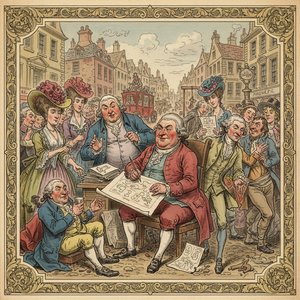
In the grand tapestry of eighteenth-century British art, few works possess the biting wit and narrative depth of William Hogarth’s Marriage à la Mode. Completed in 1743, this extraordinary series serves as a searing indictment of the social conventions that defined the Georgian era. Rather than offering an idealized vision of domestic bliss, Hogarth presents a meticulously crafted drama—a theatrical exploration of how ambition and greed can corrode the very foundations of human connection. The painting captures a moment of profound tension within a lavishly appointed room, where the opulence of the setting stands in stark, ironic contrast to the moral decay unfolding beneath the surface of high society.
The scene is a masterclass in storytelling through detail. As viewers gaze upon the richly decorated interior, they are drawn into a world of heavy fabrics, ornate furniture, and gilded accents that reflect the era's obsession with status. Hogarth’s technique, rooted in his expertise as an engraver, allows for an astonishing level of precision. Every texture—from the cool sheen of silk to the rough grain of wood—is rendered with such clarity that the room feels almost tangible. This meticulous attention to detail is not merely decorative; it is essential to Hogarth’s method of visual storytelling, where every object serves as a character in his larger social tragedy.
The Language of Symbolism and Social Decay
To truly appreciate this work, one must look beyond the surface elegance and decode the symbols embedded within the composition. Hogarth was a pioneer of using art as a vehicle for social commentary, and in Marriage à la Mode, every element is heavy with meaning. The central focus often rests on the tragic consequences of arranged alliances, where marriage is treated not as a union of souls, but as a strategic transaction to secure inheritance and elevate social standing. The presence of luxury goods and fine dining elements underscores the hollow materialism that Hogarth so relentlessly scrutinized.
The emotional impact of the piece lies in its ability to provoke contemplation on the fragility of reputation and the cost of vanity. For the discerning collector or interior designer, this artwork offers more than just a beautiful focal point; it provides a conversation piece that invites deep intellectual engagement. The interplay between the sophisticated atmosphere and the underlying themes of tragedy creates a hauntingly beautiful tension. It is a work that demands attention, pulling the observer into a complex web of historical truth and human frailty, making it an enduring icon of British Rococo art.
An Essential Addition to any Curated Collection
For those seeking to infuse their spaces with historical gravity and narrative intrigue, a high-quality reproduction of Hogarth’s masterpiece is an incomparable choice. Whether placed in a formal study, a grand dining room, or a contemporary gallery setting, the painting brings with it a sense of timelessness and intellectual depth. It appeals to the connoisseur who appreciates the fine line between beauty and satire, and to the designer looking to anchor a room with a work of profound cultural significance.
Owning a piece of this caliber allows one to participate in the legacy of Hogarth’s visual history. The artwork does not merely decorate a wall; it transforms an environment, offering a window into the heart of 18th-century London and a permanent reminder of the power of art to hold a mirror up to society.
Questions & Answers
How popular is "Marriage à la Mode" within Baroque Realism?
Within the Baroque Realism movement, "Marriage à la Mode" has an iconic popularity level.
How does the subject of "Marriage à la Mode" relate to William Hogarth's usual themes?
Among William Hogarth's recorded themes - moral critique, aristocratic society, baroque tradition, psychological depth, hogarth’s legacy - "Marriage à la Mode" brings its own focus on portraiture, domesticity, satire, social commentary, family life, death rituals, baroque style.
How was "Marriage à la Mode" made, and how big is it?
The medium of "Marriage à la Mode" by William Hogarth is oil on canvas, and its recorded dimensions are 70 x 91 cm.
More about this painting
 Preview
 Send
Send Share
Share
 Details
 Guide
Guide

 Download
 Similars
 X-Ray
X-Ray Diaporama
 Q&A
Q&A Stats
Stats