Portrait of Simon Vouet

The 100 Most Famous Simon Vouet Paintings, a Gallery Selection

Updated October 2026 · ranked by our popularity score (searches, visits and orders for each work) · 166 works by Simon Vouet in our catalogue

In short

Of all the originals Simon Vouet left, the most famous is Venus and Adonis (1642), in the collection of the J. Paul Getty Museum, Los Angeles. Close behind it come The Muses of Urania and Calliope (1634) and Annunciation (1640). Our catalog holds 166 works by Simon Vouet; the gallery has kept the 100 the world admires most, each shown with its date, its museum and its story.

1590 – 1649, Paris Baroque Most works: The Louvre

Simon Vouet's top 10 paintings: the gallery's choice

1
Venus and Adonis (1642) by Simon Vouet

Venus and Adonis

1642 · Acrylic On Canvas · J. Paul Getty Museum, Los Angeles

Simon Vouet’s “Venus and Adonis,” painted in 1642, is a striking example of French Baroque art, showcasing the artist’s mastery of color, composition, and his assimilation of Italian artistic trends. This evocative scene depicts the poignant moment from Ovid's *Metamorphoses* where the mortal Adonis, captivated by hunting, rejects Venus’s advances, foreshadowing his tragic demise. The painting isn't merely a depiction of mythology; it's an exploration of love, desire, and mortality…

2
The Muses of Urania and Calliope (1634) by Simon Vouet

The Muses of Urania and Calliope

1634 · Acrylic On Canvas · National Gallery of Art, Washington

Simon Vouet’s “The Muses Urania and Calliope”: A Symphony of Baroque Grace Simon Vouet (1590-1649) stands as a pivotal figure in the artistic landscape of 17th-century France, marking the decisive transition from Mannerism to the opulent grandeur of the Baroque style. His legacy resides not merely in his prolific output but also in his unwavering dedication to mastering Italian influences—a pursuit that fundamentally reshaped French painting and cemented Vouet’s place…

3
Annunciation (1640) by Simon Vouet

Annunciation

1640 · Oil On Canvas · Galleria degli Uffizi, Florence

Simon Vouet's "Annunciation," painted in 1640, is more than just a religious depiction; it’s a masterful orchestration of light, shadow, and human emotion. This captivating work transports the viewer to an intimate interior space, where the momentous announcement of Mary’s divine conception unfolds with breathtaking drama. The painting immediately draws the eye to the kneeling figure of the Virgin Mary, bathed in a warm, golden glow emanating from the right…

4
The Fortuneteller (detail) (1617) by Simon Vouet

The Fortuneteller (detail)

1617 · Oil On Canvas · Galleria Nazional d Art Antica, Rome

In the heart of 1617, amidst the vibrant and transformative atmosphere of Roman artistic circles, Simon Vouet captured a moment of profound human connection in his masterpiece, The Fortuneteller. This work, particularly when viewed in its intimate details, serves as much more than a mere portrait; it is an emblem of the burgeoning Baroque style that was beginning to reshape the visual landscape of Europe. The scene unfolds with a…

5
Sleeping Venus (1630) by Simon Vouet

Sleeping Venus

1630 · Acrylic On Canvas · Szépművészeti Múzeum, Budapest

Simon Vouet's "Sleeping Venus," painted around 1630, is not merely a depiction of a reclining nude; it’s an exquisite distillation of Renaissance ideals and the burgeoning Baroque aesthetic. This captivating work transcends simple portraiture, offering instead a profound meditation on beauty, repose, and the delicate balance between earthly pleasure and spiritual contemplation. The painting immediately draws the viewer into a world of hushed tranquility, inviting us to share in the…

6
Allegory of Virtue (1634) by Simon Vouet

Allegory of Virtue

1634 · Acrylic On Canvas · The Louvre, Paris

Simon Vouet’s “Allegory of Virtue,” completed around 1634, stands as a testament to the burgeoning Baroque aesthetic infiltrating French artistic circles during Louis XIII's reign. More than just a portrait—though it undeniably depicts a woman radiating grace and authority—the painting delves into profound philosophical concepts rooted in humanist ideals prevalent at the time.

7
The Entombment (1638) by Simon Vouet

The Entombment

1638 · Oil On Canvas · Fitzwilliam College, Cambridge

Simon Vouet's "The Entombment," painted in 1635–1638, is not merely a depiction of a biblical scene; it’s an exquisitely rendered meditation on grief, faith, and the profound dignity of sacrifice. This monumental work, currently residing within the collection of the Fitzwilliam Museum in Cambridge, transcends its subject matter to become a powerful testament to the Baroque era's ability to evoke intense emotion through masterful technique and carefully considered symbolism. Vouet,…

8
Angels with Attributes of the Passion: Angel Holding the Vessel and Towel for washing the hands of Pontius Pilate (1624) by Simon Vouet

Angels with Attributes of the Passion: Angel Holding the Vessel and Towel for washing the hands of Pontius Pilate

1624 · Oil · Minneapolis Institute of Art, Minneapolis

A single celestial figure emerges from a deep, near-black void, commanding the space with an intimate and monumental presence. This angel, caught in a moment of profound spiritual devotion, gazes upward with eyes full of soulful contemplation or sorrow. The light descends from the upper left, carving the figure out of the darkness and casting soft, tender shadows across a face etched with emotion. Every detail feels immediate, from the…

9
Saint John (1623) by Simon Vouet

Saint John

1623 · Oil On Canvas · Philadelphia Museum of Art, Philadelphia

A young man turns his face toward a light that remains unseen. His eyes, wide and searching, catch a glimmer that pulls his gaze upward, away from the dark, murky depths of the background. Thick, dark curls frame a pale face, creating a sharp contrast against the heavy shadows that swallow the space around him. He is caught in a moment of sudden, quiet realization. The light does not merely…

10
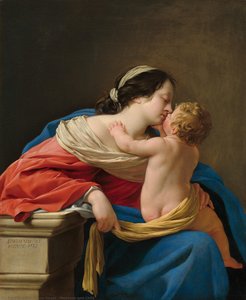
Virgin and Child, with an Angel (1642) by Simon Vouet

Virgin and Child, with an Angel

1642 · Oil On Panel · Philadelphia Museum of Art, Philadelphia

The light falls softly upon the skin of the Virgin Mary, catching the curve of her cheek and the small, smooth hands of the Christ Child. They sit within a triangular arrangement that anchors the composition, surrounded by the deep shadows of a dense woodland. An angel leans into this intimate circle, its robes glowing with warm yellows and golds that contrast against the heavy, dark trees behind them. At…

The Simon Vouet selection continues, 11 to 100

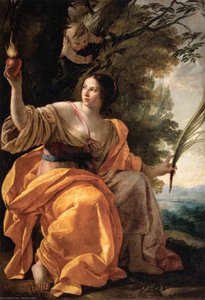
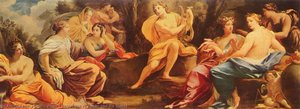
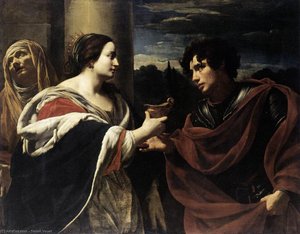
11Madonna with Child (1625) by Simon VouetMadonna with Child1625 · Hermitage Museum 12Time Discovering the Love of Venus and Mars (1640) by Simon VouetTime Discovering the Love of Venus and Mars1640 · John and Mable Ringling Museum of Art 13The Rapture of Saint Theodore (1627) by Simon VouetThe Rapture of Saint Theodore1627 · Staatliche Kunstsammlungen Dresden 14Heavenly Charity (1640) by Simon VouetHeavenly Charity1640 · The Louvre 15Allegory (1640) by Simon VouetAllegory1640 · Capitoline Museums 16Parnassus or Apollo and the Muses (1640) by Simon VouetParnassus or Apollo and the Muses1640 · Szépművészeti Múzeum 17Sacrifice of Isaac (1642) by Simon VouetSacrifice of Isaac1642 · Milwaukee Art Museum 18Angels with Attributes of the Passion, the Superscription from the Cross (1624) by Simon VouetAngels with Attributes of the Passion, the Superscription from the Cross1624 · Minneapolis Institute of Art 19The Holy Family with the Infant Saint John the Baptist (1626) by Simon VouetThe Holy Family with the Infant Saint John the Baptist1626 · Fine Arts Museums of San Francisco 20Ceres and Harvesting Cupids (1634) by Simon VouetCeres and Harvesting Cupids1634 · National Gallery 21Suicide of Lucrece (1625) by Simon VouetSuicide of Lucrece1625 · National Gallery Prague 22The Muse Clio (1640) by Simon VouetThe Muse Clio1640 · Staatliche Kunsthalle Karlsruhe 23Allegory with Venus, Mars, Cupid, and Time (1626) by Simon VouetAllegory with Venus, Mars, Cupid, and Time1626 · John and Mable Ringling Museum of Art 24Vanitas (1621) by Simon VouetVanitas1621 · National Museum in Warsaw 25Lovers (1614) by Simon VouetLovers1614 · Pushkin State Museum 26Martyrdom of Saint Catherine (1620) by Simon VouetMartyrdom of Saint Catherine1620 · Musée Des Beaux 27The Halberdier (1617) by Simon VouetThe Halberdier1617 · Dayton Art Institute 28Saint Jerome (c.347–420) (1620) by Simon VouetSaint Jerome (c.347–420)1620 · National Library of Wales 29self-portrait (1620) by Simon Vouetself-portrait1620 30Saint Agnes (1618) by Simon VouetSaint Agnes1618 · Blanton Museum of Art 31Annunciation to Mary (1617) by Simon VouetAnnunciation to Mary1617 · Gemäldegalerie 32Psyche and Cupid (1626) by Simon VouetPsyche and Cupid1626 · Museum of Fine Arts of Lyon 33The Nativity (1632) by Simon VouetThe Nativity1632 34Squire-at-arms - Saint Guillaume d'Aquitaine (1625) by Simon VouetSquire-at-arms - Saint Guillaume d'Aquitaine1625 · The Art Museum RIGA BOURSE 35The Entombment (1635) by Simon VouetThe Entombment1635 · Fitzwilliam Museum 36Saint Catherine (1625) by Simon VouetSaint Catherine1625 · Slovak National Gallery 37Saint Sebastian (1625) by Simon VouetSaint Sebastian1625 · Museum of Fine Arts 38Model for Altarpiece in St. Peter's (1625) by Simon VouetModel for Altarpiece in St. Peter's1625 · Los Angeles County Museum of Art 39Model for Altarpiece in St. Peter's (1625) by Simon VouetModel for Altarpiece in St. Peter's1625 · Los Angeles County Museum of Art 40Saint Cecilia (1626) by Simon VouetSaint Cecilia1626 · Blanton Museum of Art 41Portrait of Virginia da Vezzo (1625) by Simon VouetPortrait of Virginia da Vezzo1625 · Gemäldegalerie 42The Charity (1635) by Simon VouetThe Charity1635 43Saint Sebastian (1623) by Simon VouetSaint Sebastian1623 44Christ at the Column (1637) by Simon VouetChrist at the Column1637 45The Holy Family with Saint Elizabeth and the young Saint John (1642) by Simon VouetThe Holy Family with Saint Elizabeth and the young Saint John1642 46The Four Seasons (1644) by Simon VouetThe Four Seasons1644 · National Gallery of Ireland 47Head of a Bearded Man (1639) by Simon VouetHead of a Bearded Man1639 · Hatchlands Park 48The Entombment (1637) by Simon VouetThe Entombment1637 · Musée d'Art Roger-Quilliot 49Artemisia Building the Mausolaeum (1640) by Simon VouetArtemisia Building the Mausolaeum1640 · Nationalmuseum 50Allegory of Prudence (1645) by Simon VouetAllegory of Prudence1645 · Musée Fabre 51The Rest of the Holy Family (1650) by Simon VouetThe Rest of the Holy Family1650 · Musée de Grenoble 52Christ Appearing to Saint Anthony Abbot, Falsely Called Christ Healing a Possessed Person (1650) by Simon VouetChrist Appearing to Saint Anthony Abbot, Falsely Called Christ Healing a Possessed Person1650 · Musée de Grenoble 53The Virgin Taking the Society of Jesus Under Her Protection (1650) by Simon VouetThe Virgin Taking the Society of Jesus Under Her Protection1650 54Olivier de Clisson (1650) by Simon VouetOlivier de Clisson1650 · Musée Départemental Dobrée 55The Muses Urania and Calliope (1634) by Simon VouetThe Muses Urania and Calliope1634 · National Gallery of Art 56Time Vanquished by Love, Hope and Fame, 1640-1645 by Simon VouetTime Vanquished by Love, Hope and Fame, 1640-1645Grand Palais 57Portrait of a Young Man (Le Spadassin) (1617) by Simon VouetPortrait of a Young Man (Le Spadassin)1617 · Herzog Anton Ulrich Museum 58POLYMNIE, MUSE DE L'ELOQUENCE by Simon VouetPOLYMNIE, MUSE DE L'ELOQUENCEThe Louvre 59Angel with dice and tunic (1620) by Simon VouetAngel with dice and tunic1620 · Museo di Capodimonte 60Saint Catherine of Alexandria (1620) by Simon VouetSaint Catherine of Alexandria1620 · National Museum of Western Art 61Mary Adoring the Christ child (1623) by Simon VouetMary Adoring the Christ child1623 · Museum Boijmans Van Beuningen 62The Virgin and Child (of the Column) (1640) by Simon VouetThe Virgin and Child (of the Column)1640 · The Ashmolean Museum of Art And Archaeology 63Parnassus or Apollo and the Muses (detail) (1640) by Simon VouetParnassus or Apollo and the Muses (detail)1640 · Szépművészeti Múzeum 64Toilet of Venus (1628) by Simon VouetToilet of Venus1628 · Art Museum 65Self-Portrait (1615) by Simon VouetSelf-Portrait1615 · Musée Réattu 66LA VICTOIRE by Simon VouetLA VICTOIREThe Louvre 67The Rape of Europa (1640) by Simon VouetThe Rape of Europa1640 · Thyssen-Bornemisza Museum 68Sophonisba Receiving the Poisoned Chalice (1623) by Simon VouetSophonisba Receiving the Poisoned Chalice1623 · Staatliche Museen 69St Catherine (1614) by Simon VouetSt Catherine1614 · Quirinal Palace 70Prince Marcantonio Doria (1621) by Simon VouetPrince Marcantonio Doria1621 · The Louvre 71The Holy Family with Sts Elizabeth, John the Baptist and Catherine (1614) by Simon VouetThe Holy Family with Sts Elizabeth, John the Baptist and Catherine1614 · Museo del Prado 72Diana on the Hunt (1619) by Simon VouetDiana on the Hunt1619 · Bavarian State Painting Collections 73The Last Supper (1615) by Simon VouetThe Last Supper1615 · Palazzo Apostolico 74Birth of the Virgin (1620) by Simon VouetBirth of the Virgin1620 · San Francesco a Ripa 75The Triumph of Galatea (1642) by Simon VouetThe Triumph of Galatea1642 · National Gallery of Canada 76Virgin and Child by Simon VouetVirgin and ChildMusée Des Beaux 77Saturn, Conquered by Amor, Venus and Hope (1645) by Simon VouetSaturn, Conquered by Amor, Venus and Hope1645 · Musée du Berry 78Self-Portrait (1699) by Simon VouetSelf-Portrait1699 · Museum de Fundatie 79The Holy Family (1630) by Simon VouetThe Holy Family1630 · Kunsthalle Bremen 80Madonna and Child (1633) by Simon VouetMadonna and Child1633 · National Gallery of Art 81LA MISE AU TOMBEAU by Simon VouetLA MISE AU TOMBEAUThe Louvre 82Allegory of Peace (1627) by Simon VouetAllegory of Peace1627 · Galleria Nazional d Art Antica 83Allegory of Wealth (1630) by Simon VouetAllegory of Wealth1630 · The Louvre 84Eight Satyrs Admiring the Anamorphosis of an Elephant (1625) by Simon VouetEight Satyrs Admiring the Anamorphosis of an Elephant1625 · Hessisches Landesmuseum 85LA PRESENTATION AU TEMPLE by Simon VouetLA PRESENTATION AU TEMPLEThe Louvre 86Parnassus or Apollo and the Muses (detail) (1640) by Simon VouetParnassus or Apollo and the Muses (detail)1640 · Szépművészeti Múzeum 87The Fortune Teller (1618) by Simon VouetThe Fortune Teller1618 · National Gallery of Canada 88Saint Guillaume d'Aquitaine ( ) by Simon VouetSaint Guillaume d'Aquitaine ( )The Louvre 89Apollo and the Muses (1875) by Simon VouetApollo and the Muses1875 · Bratislava City Gallery 90LA PRUDENCE AMENE LA PAIX ET L'ABONDANCE by Simon VouetLA PRUDENCE AMENE LA PAIX ET L'ABONDANCEThe Louvre 91Gaucher de Châtillon, Connétable (1632) by Simon VouetGaucher de Châtillon, Connétable1632 · The Louvre 92Caritas Romana by Simon VouetCaritas RomanaNational Museum in Warsaw 93St Jerome and the Angel (1622) by Simon VouetSt Jerome and the Angel1622 · National Gallery of Art 94The Fortune Teller (1617) by Simon VouetThe Fortune Teller1617 · Galleria Nazional d Art Antica 95LE CHRIST EN CROIX by Simon VouetLE CHRIST EN CROIXThe Louvre 96Adoration of the Shepherds (Adoration des bergers) by Simon VouetAdoration of the Shepherds (Adoration des bergers)La Sauvegarde de l'Art Francais 97David with the head of Goliath by Simon VouetDavid with the head of GoliathPalazzo Bianco 98The Continence of Scipio by Simon VouetThe Continence of ScipioShipley Art Gallery 99Phaethon in His Chariot with Time by Simon VouetPhaethon in His Chariot with TimeManchester Art Gallery 100The Conversion of the Magdalen by Simon VouetThe Conversion of the MagdalenThe Hunterian Museum and Art Gallery

Simon Vouet's famous paintings, period by period

The subjects that held Simon Vouet's eye

The four subjects that come back most often in these originals, each with its finest example.

The museums that keep Simon Vouet's originals

The 8 museums that hold the most of the paintings on this page.

Museum City Works by Simon Vouet Paintings from this list
The Louvre, ParisThe Louvre Paris 20 Allegory of Virtue, Heavenly Charity, POLYMNIE, MUSE DE L'ELOQUENCE
Szépművészeti Múzeum, BudapestSzépművészeti Múzeum Budapest 5 Sleeping Venus, Parnassus or Apollo and the Muses, Parnassus or Apollo and the Muses (detail)
National Gallery of Art, WashingtonNational Gallery of Art Washington 4 The Muses of Urania and Calliope, The Muses Urania and Calliope, Madonna and Child
Galleria Nazional d Art Antica, RomeGalleria Nazional d Art Antica Rome 4 The Fortuneteller (detail), Allegory of Peace, The Fortune Teller
National Museum in Warsaw, WarsawNational Museum in Warsaw Warsaw 4 Vanitas, Caritas Romana
Los Angeles County Museum of Art, Los AngelesLos Angeles County Museum of Art Los Angeles 3 Model for Altarpiece in St. Peter's, Model for Altarpiece in St. Peter's
Minneapolis Institute of Art, MinneapolisMinneapolis Institute of Art Minneapolis 2 Angels with Attributes of the Passion: Angel Holding the Vessel and Towel for washing the hands of Pontius Pilate, Angels with Attributes of the Passion, the Superscription from the Cross
Philadelphia Museum of Art, PhiladelphiaPhiladelphia Museum of Art Philadelphia 2 Saint John, Virgin and Child, with an Angel

Simon Vouet decade by decade: the original that defines each

Works per decade

Pick a decade to see the original that defines it.

Collectors' questions about Simon Vouet's paintings

Which work is Simon Vouet most famous for?Reveal the answer

Venus and Adonis (1642), J. Paul Getty Museum, Los Angeles. The Muses of Urania and Calliope (1634) and Annunciation (1640) come next.

What age was Simon Vouet when Venus and Adonis was made?Reveal the answer

52 years old: Venus and Adonis dates from 1642, and Simon Vouet was born in 1590.

What are the ten most famous Simon Vouet paintings?Reveal the answer

Venus and Adonis, The Muses of Urania and Calliope, Annunciation, The Fortuneteller (detail), Sleeping Venus, Allegory of Virtue, The Entombment, Angels with Attributes of the Passion: Angel Holding the Vessel and Towel for washing the hands of Pontius Pilate, Saint John and Virgin and Child, with an Angel. The ranking above gives each one's year and museum.

How many paintings did Simon Vouet leave?Reveal the answer

Our catalog holds 166 works by Simon Vouet, dated from 1614 to 1645.

In which museums do Simon Vouet's masterpieces hang?Reveal the answer

Mostly in The Louvre (Paris), Szépművészeti Múzeum (Budapest) and National Gallery of Art (Washington). The museum table above lists them all.

In which years did Simon Vouet paint the most famous works?Reveal the answer

In 1620s: 31 of the 100 works on this page were made then, Angels with Attributes of the Passion: Angel Holding the Vessel and Towel for washing the hands of Pontius Pilate among them.

What are the first and the last famous originals of Simon Vouet?Reveal the answer

On this page, the earliest is Lovers (1614) and the latest Allegory of Prudence (1645).

Which subjects did Simon Vouet choose most often?Reveal the answer

Woman (15), Renaissance (12) and Mythology (9), across the 100 works on this page.

Which technique did Simon Vouet use most?Reveal the answer

Oil On Canvas, for 40 of the 100 works on this page.

To which art movement does Simon Vouet belong?Reveal the answer

Baroque, judging by the originals on this page.

Which Simon Vouet works hang at the The Louvre?Reveal the answer

Allegory of Virtue, Heavenly Charity and POLYMNIE, MUSE DE L'ELOQUENCE: the The Louvre, Paris holds 12 of the works on this page.

Can I commission a reproduction of a Simon Vouet painting?Reveal the answer

Yes, as a reproduction: the original stays in its museum, but any painting on this page can be painted by hand for you, made to order one at a time, from the painting's own page.

Simon Vouet: life and work

Simon Vouet: A Pioneer of French Baroque Painting

  • Born: January 9, 1590, Paris, France
  • Died: June 30, 1649, Paris, France

Simon Vouet was a pivotal figure in the transition of French painting from Mannerism to the Baroque style. Born into an artistic family – his father Laurent was a painter and his brother Aubin also pursued art – Vouet received early training that laid the foundation for his future success. His grandson, Ludovico Dorigny, would continue the family’s artistic legacy.

Early Career and Italian Influences (1608-1627)

  • Early Portraiture: Vouet began his career as a portraitist, demonstrating early talent.
  • Travel to England (1608): At the young age of 14, he traveled to England to paint a commissioned portrait, showcasing his burgeoning reputation.
  • Ottoman Empire and Venice: In 1611, Vouet joined the entourage of Baron de Sancy, French ambassador to the Ottoman Empire, again for portraiture work. This journey took him through Constantinople and then to Venice in 1612.
  • Rome (1614-1627): His time in Rome proved transformative. He remained there for thirteen years, immersing himself in the vibrant artistic scene of the burgeoning Baroque period.

During his Italian sojourn, Vouet absorbed a diverse range of influences. He studied the dramatic lighting techniques pioneered by Caravaggio, embraced elements of Italian Mannerism, and meticulously analyzed the color palettes and di sotto in su (foreshortened perspective) employed by Paolo Veronese. He also drew inspiration from the works of Carracci, Guercino, Lanfranco, and Guido Reni, synthesizing these diverse styles into a unique artistic vision.

Development of Vouet’s Distinctive Style

  • Election to Accademia di San Luca (1624): His success in Rome culminated in his election as president of the prestigious Accademia di San Luca, a testament to his skill and recognition within the Italian art world.
  • Synthesis of Influences: Vouet’s style was characterized by its ability to absorb and distill various artistic influences. He didn't simply copy; he integrated these elements into a cohesive and distinctly Italianate Baroque aesthetic.
  • Introduction of Baroque to France: Upon his return to France in 1627, Vouet played a crucial role in introducing the Italian Baroque style to French painting, significantly impacting the artistic landscape of the country.

Major Achievements and Legacy

  • Premier Peintre du Roi: Vouet was appointed Premier peintre du Roi (First Painter to the King) – a position of considerable prestige and influence.
  • Prolific Workshop: He maintained a large and active workshop, training numerous artists who would shape the subsequent generation of French painters.
  • Notable Pupils: Among his most influential pupils were Charles Le Brun (who later organized all decorative painting at Versailles), Valentin de Boulogne, Charles Alphonse du Fresnoy, Pierre Mignard, Eustache Le Sueur, and Claude Mellan.
  • Influence on French Art: Vouet’s impact extended beyond his own works; his students carried his style and techniques throughout France, establishing a distinctively Baroque school of painting. His influence is particularly evident in the grand decorative schemes commissioned by Louis XIV.

Historical Significance

Simon Vouet's legacy rests on his pivotal role as a bridge between Italian and French art. He successfully imported the dynamism and grandeur of the Italian Baroque, transforming it into a style that resonated with the tastes of the French court and aristocracy. His influence is undeniable in the development of French painting during the 17th century, and his contributions continue to be recognized by art historians today.

All 166 works by Simon Vouet →