Portrait of Joseph Vernet

The 100 Most Famous Joseph Vernet Paintings, a Gallery Selection

Updated November 2026 · ranked by our popularity score (searches, visits and orders for each work) · 226 works by Joseph Vernet in our catalogue

In short

Of all the originals Joseph Vernet left, the most famous is Sunset (1760), in the collection of the Fitzwilliam College, Cambridge. Close behind it come A Seashore (detail) (1776) and A Landscape at Sunset. Our catalog holds 226 works by Joseph Vernet; the gallery has kept the 100 the world admires most, each shown with its date, its museum and its story.

1714 – 1789, Avignon Rococo Most works: Uppark

Joseph Vernet's top 10 paintings: the gallery's choice

1
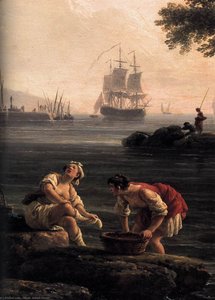
Sunset (1760) by Joseph Vernet

Sunset

1760 · Oil On Canvas · Fitzwilliam College, Cambridge

To gaze upon Claude Joseph Vernet's "Sunset" is to surrender to a profound sense of peace. This 1760 masterpiece does more than merely depict a coastal scene; it captures a fleeting, perfect moment where the vastness of nature meets the gentle rhythm of human life. The air itself seems thick with the warm, golden light spilling across the water as the sun dips below the horizon. One can almost hear…

2
A Seashore (detail) (1776) by Joseph Vernet

A Seashore (detail)

1776 · Oil On Copper · National Gallery, London

In the delicate dance between land and sea, Claude Joseph Vernet captures a moment of profound stillness that transcends the centuries. His 1776 masterpiece, A Seashore (detail), is far more than a mere coastal observation; it is an evocative window into the Enlightenment era, where the boundaries between scientific curiosity and romantic wonder began to blur. As one gazes upon this exquisite copper print, the viewer is immediately transported to…

3
A Landscape at Sunset by Joseph Vernet

A Landscape at Sunset

Oil On Canvas

A Landscape at Sunset is a French oil painting executed by Joseph Vernet in 1773. The work captures a specific atmospheric moment where light meets the water, establishing a serene mood through the interplay of sky and river. Vernet, a significant figure in eighteenth-century maritime art, utilizes the medium of oil on canvas to render the subtle transitions of a setting sun.

4
Seascape: Calm (1735) by Joseph Vernet

Seascape: Calm

1735 · Oil On Canvas · The Louvre, Paris

In the vast annals of maritime art, few works capture the ephemeral magic of the sea with as much grace as Claude Joseph Vernet’s “Seascape: Calm.” Created in 1735, this masterpiece serves as a breathtaking window into an era where the horizon was not merely a boundary, but a stage for the divine interplay of light and water. The painting presents a serene coastal scene, likely caught in the soft,…

5
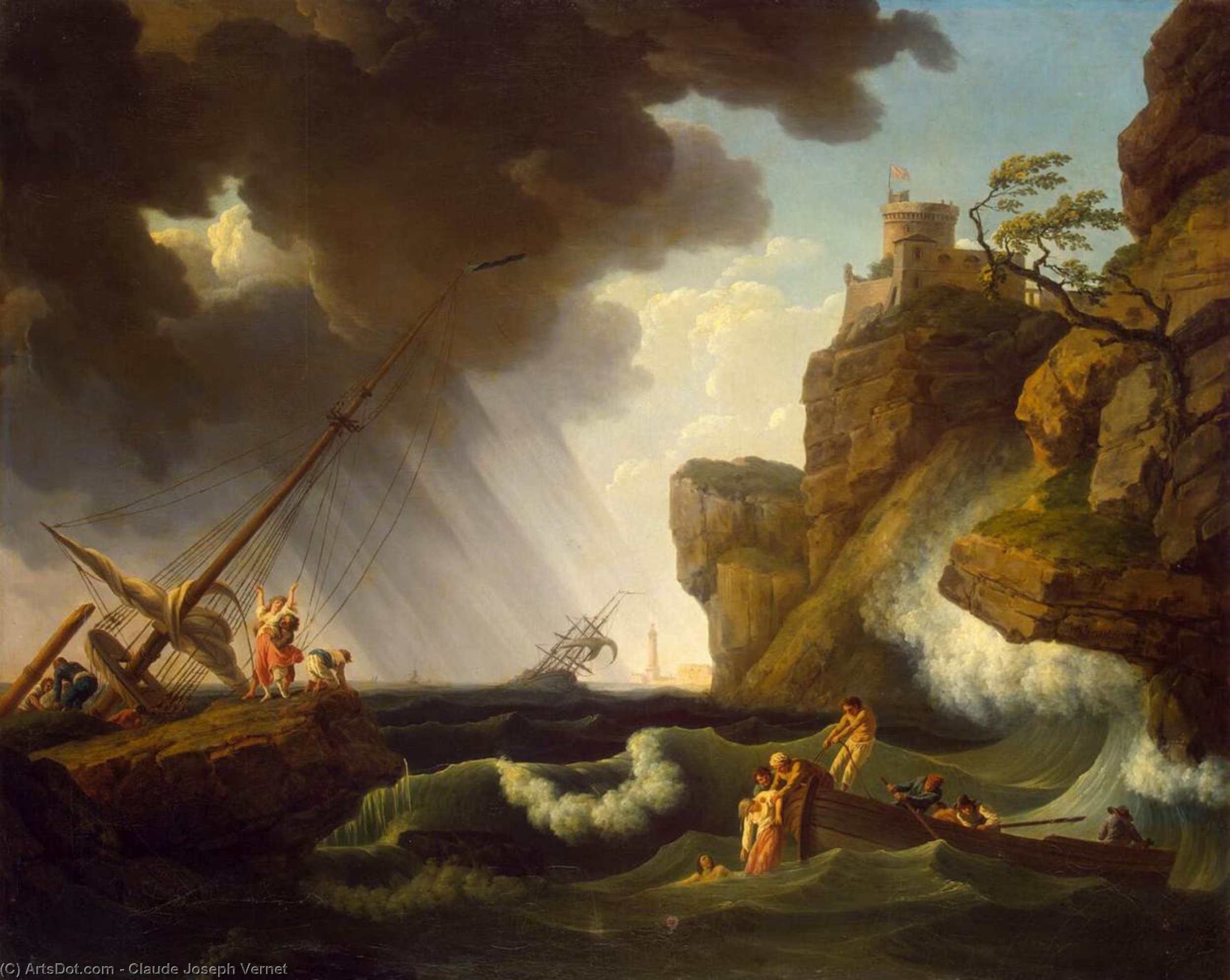
Shipwreck (1763) by Joseph Vernet

Shipwreck

1763 · Oil On Canvas · Hermitage Museum, Saint Petersburg

Claude Joseph Vernet’s “Shipwreck” is far more than a mere depiction of maritime disaster; it is a profound cornerstone of Romantic landscape painting that captures the very essence of human vulnerability. Completed in 1763, this oil on canvas masterpiece invites viewers into a world where the boundaries between awe and terror dissolve. The scene unfolds with a panoramic intensity, dominated by turbulent, churning seas and brooding, heavy skies that seem…

6
River Scene with Bathers (1770) by Joseph Vernet

River Scene with Bathers

1770 · Oil On Canvas · The Ashmolean Museum of Art And Archaeology, Oxford

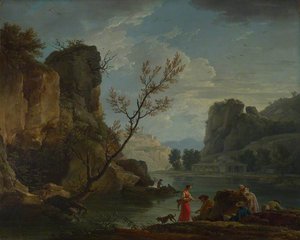
The river flows with a quiet, rhythmic pulse. In this scene, completed between 1768 and 1770, the water catches the diffused luminescence of a soft sky. Figures move through the shallows, their bodies breaking the surface in a slow dance of summer heat. A dog rests near the center, its presence grounding the pastoral dream, while sheep graze upon the hillside, their white forms scattered like fallen clouds against the…

7
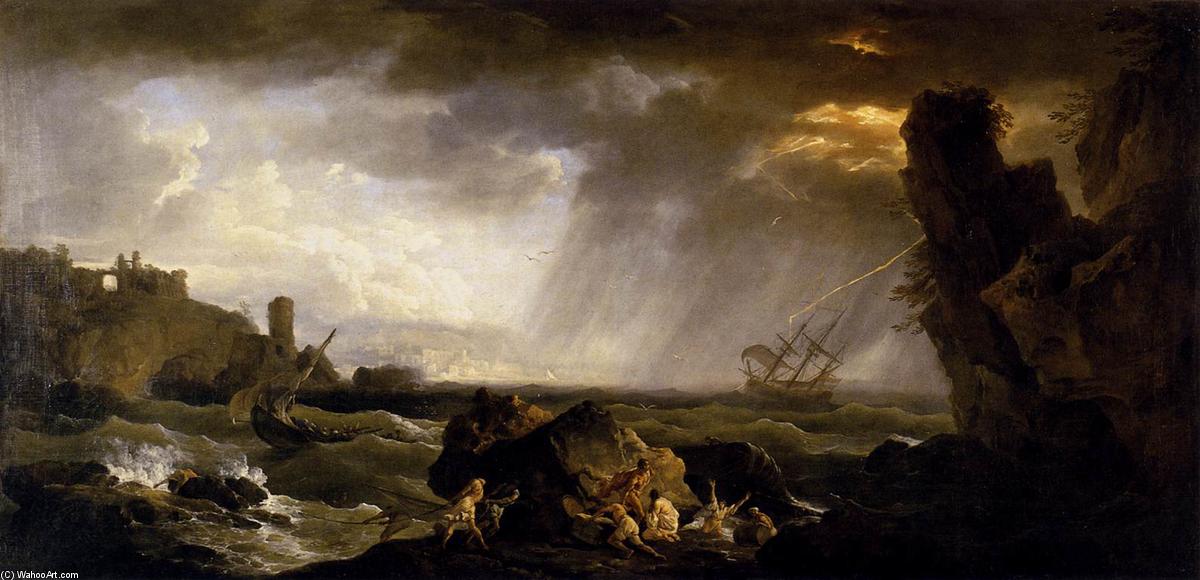
Genoa Lighthouse and the Temple of Minerva Medica (1746) by Joseph Vernet

Genoa Lighthouse and the Temple of Minerva Medica

1746 · Oil On Canvas · Bristol Museum - Art Gallery, Bristol

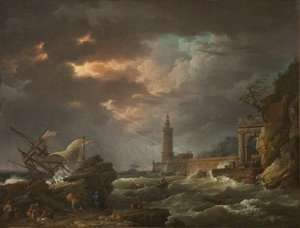
A turbulent seascape dominates the canvas, where the sea is a churning mass of white spray and dark, heavy currents. A small sailing vessel struggles against the weight of the water, its crew working to secure the hull against the pull of the tide. Above this maritime struggle, a rocky promontory rises from the foam. Upon this height, the Genoa Lighthouse pierces the gloom, its beam cutting through the salt-heavy…

9
Seascape: Tempest (1735) by Joseph Vernet

Seascape: Tempest

1735 · Oil On Canvas · The Louvre, Paris

Claude-Joseph Vernet's "Seascape: Tempest," painted in 1735, isn’t merely a depiction of a storm at sea; it’s a visceral embodiment of nature’s raw power and the precariousness of human existence. More than two centuries after its creation, this oil on canvas continues to resonate with viewers, drawing them into the heart of the tempestuous scene with an immediacy rarely achieved in landscape painting. Vernet, a master of maritime light and…

10
Coastal Scene (La nuit) (1750) by Joseph Vernet

Coastal Scene (La nuit)

1750 · Acrylic On Canvas · The Ashmolean Museum of Art And Archaeology, Oxford

Claude-Joseph Vernet’s “Coastal Scene (La nuit),” painted circa 1750-53, stands as a cornerstone of maritime landscape painting and exemplifies the burgeoning Romantic movement's fascination with dramatic natural phenomena. Executed in oil on canvas, this artwork transcends mere depiction; it strives to capture not just what is seen but how it feels—the palpable tension between calm sea surface and turbulent sky.

The Joseph Vernet selection continues, 11 to 100

11Calm (1735) by Joseph VernetCalm1735 · Musée Comtadin-Duplessis 12Italian Landscape (1738) by Joseph VernetItalian Landscape1738 · Dulwich Picture Gallery 13The four times of day: Evening (1757) by Joseph VernetThe four times of day: Evening1757 · Art Gallery of South Australia 14Morning, Fishing (1750) by Joseph VernetMorning, Fishing1750 15Portrait of Simon-Mathurin Lantara (1750) by Joseph VernetPortrait of Simon-Mathurin Lantara1750 16The Cascade at Tivoli (1750) by Joseph VernetThe Cascade at Tivoli1750 · Birmingham Museum of Art 17The Waterfalls at Tivoli, with the Villa of Maecenas (1750) by Joseph VernetThe Waterfalls at Tivoli, with the Villa of Maecenas1750 · Mauritshuis 18An Italian Harbour in Stormy Weather (1750) by Joseph VernetAn Italian Harbour in Stormy Weather1750 · Mauritshuis 19Port (1750) by Joseph VernetPort1750 · National Museum of Fine Arts of Cuba 20Night Rocky Inlet with Fisherfolk Setting Their Nets, Cooking and Drinking by Moonlight (1751) by Joseph VernetNight Rocky Inlet with Fisherfolk Setting Their Nets, Cooking and Drinking by Moonlight1751 · Uppark 21A Sea Bay at Setting Sun (1760) by Joseph VernetA Sea Bay at Setting Sun1760 · Bavarian State Painting Collections 22Landscape. Moonlight Effect (1759) by Joseph VernetLandscape. Moonlight Effect1759 23Landscape with Washerwomen (1763) by Joseph VernetLandscape with Washerwomen1763 · Petit Palais 24The Cascades of Tivoli (1760) by Joseph VernetThe Cascades of Tivoli1760 · Dayton Art Institute 25Good Fishing (1758) by Joseph VernetGood Fishing1758 26The Four Times of Day: Morning (1757) by Joseph VernetThe Four Times of Day: Morning1757 · Art Gallery of South Australia 27Fishermen Under the Castle Ruin (La pêche à la ligne - copy) (1770) by Joseph VernetFishermen Under the Castle Ruin (La pêche à la ligne - copy)1770 · Ernest Zmeták Art Gallery 28Nymphs Bathing, the Time is the Morning (1771) by Joseph VernetNymphs Bathing, the Time is the Morning1771 · Bowes Museum 29A Shipwreck on a Rocky Coast (1775) by Joseph VernetA Shipwreck on a Rocky Coast1775 30Seaport at Sunrise (1767) by Joseph VernetSeaport at Sunrise1767 · Dulwich Picture Gallery 31Mediterranean Harbor at Sunset (1788) by Joseph VernetMediterranean Harbor at Sunset1788 32Soldiers in a Mountain Gorge, with a Storm (1789) by Joseph VernetSoldiers in a Mountain Gorge, with a Storm1789 33The four times of day: Night (1757) by Joseph VernetThe four times of day: Night1757 · Art Gallery of South Australia 34Night: Mediterranean Coast Scene with Fishermen and Boats (1753) by Joseph VernetNight: Mediterranean Coast Scene with Fishermen and Boats1753 · Thyssen-Bornemisza Museum 35A Storm (1762) by Joseph VernetA Storm1762 · National Museum in Warsaw 36Landscape with Waterfall and Figures (1768) by Joseph VernetLandscape with Waterfall and Figures1768 · Walters Art Museum 37A River Scene (1781) by Joseph VernetA River Scene1781 · Wallace Collection 38The Italian Gondola (1785) by Joseph VernetThe Italian Gondola1785 · Scottish National Gallery 39A Storm on a Mediterranean Coast (1767) by Joseph VernetA Storm on a Mediterranean Coast1767 · J. Paul Getty Museum 40Oriental Seaport at Sunrise (1755) by Joseph VernetOriental Seaport at Sunrise1755 · Alte Pinakothek 41Naples (1737) by Joseph VernetNaples1737 · Royal Museum of Fine Arts Antwerp 42View of Posillipo near Naples (1742) by Joseph VernetView of Posillipo near Naples1742 43Tivoli Landscape (1741) by Joseph VernetTivoli Landscape1741 · Petit Palais 44The Waterfalls at Tivoli (1737) by Joseph VernetThe Waterfalls at Tivoli1737 · Cleveland Museum of Art 45The Storm (1735) by Joseph VernetThe Storm1735 · Musée Comtadin-Duplessis 46A Storm at Sea (1740) by Joseph VernetA Storm at Sea1740 · Museum of Western and Oriental Art 47Harbour landscape (1739) by Joseph VernetHarbour landscape1739 48The Storm (1752) by Joseph VernetThe Storm1752 · Staatliche Kunsthalle Karlsruhe 49Shipwreck at Evening (1751) by Joseph VernetShipwreck at Evening1751 · Bavarian State Painting Collections 50Evening Walk (1748) by Joseph VernetEvening Walk1748 · Bavarian State Painting Collections 51Party in the Morning (1748) by Joseph VernetParty in the Morning1748 · Bavarian State Painting Collections 52Morning Mist at Sunrise (1748) by Joseph VernetMorning Mist at Sunrise1748 · Bavarian State Painting Collections 53Seascape, Sunset (1753) by Joseph VernetSeascape, Sunset1753 54Seascape, Sunset; Fishermen Pushing a Boat (1750) by Joseph VernetSeascape, Sunset; Fishermen Pushing a Boat1750 55Seascape, Landscape and Sunset (1753) by Joseph VernetSeascape, Landscape and Sunset1753 56Marine (with three masts) (1750) by Joseph VernetMarine (with three masts)1750 57Shipwreck (1750) by Joseph VernetShipwreck1750 58Departure from the Port in the Morning Freshness (1749) by Joseph VernetDeparture from the Port in the Morning Freshness1749 · Musée Calvet 59A View of Tivoli with the Anio Novus Aqueduct (1751) by Joseph VernetA View of Tivoli with the Anio Novus Aqueduct1751 · Uppark 60The Shipwreck (1753) by Joseph VernetThe Shipwreck1753 · Musée Calvet 61The Italian Gondola (1750) by Joseph VernetThe Italian Gondola1750 · Musée Calvet 62Storm (1750) by Joseph VernetStorm1750 · Musée Calvet 63Sea view (1750) by Joseph VernetSea view1750 · National Gallery of Armenia 64Morning in Castellammare (1750) by Joseph VernetMorning in Castellammare1750 65Moonlight (1753) by Joseph VernetMoonlight1753 · Musée Comtadin-Duplessis 66Marine, Calm (1745) by Joseph VernetMarine, Calm1745 · Musée Fabre 67Marine by Calm Weather, Sunset Effect (1748) by Joseph VernetMarine by Calm Weather, Sunset Effect1748 · Palais des Beaux-Arts de Lille 68Imaginary Landscape, Italian Harbor Scene (1746) by Joseph VernetImaginary Landscape, Italian Harbor Scene1746 · Minneapolis Institute of Art 69A Storm (1748) by Joseph VernetA Storm1748 · Musée Des Beaux 70View of Naples vith Mount Vesuvius (1748) by Joseph VernetView of Naples vith Mount Vesuvius1748 71The Port of Marseille (1754) by Joseph VernetThe Port of Marseille1754 72The Ponte Rotto, Rome (1745) by Joseph VernetThe Ponte Rotto, Rome1745 73L'Arc en Ciel (1749) by Joseph VernetL'Arc en Ciel1749 74Mediterranean Port at Dawn (1750) by Joseph VernetMediterranean Port at Dawn1750 75Coastal Landscape (1747) by Joseph VernetCoastal Landscape1747 76Nocturnal Seastorm (1752) by Joseph VernetNocturnal Seastorm1752 77Morning A Port in the Mist – Fishermen Hauling in Their Boat (1751) by Joseph VernetMorning A Port in the Mist – Fishermen Hauling in Their Boat1751 · Uppark 78A River Landscape with a Town above (1751) by Joseph VernetA River Landscape with a Town above1751 · Uppark 79Evening Habour Scene with Boats Being Unloaded and Spectators (1751) by Joseph VernetEvening Habour Scene with Boats Being Unloaded and Spectators1751 · Uppark 80Midday A Ship Offshore, Foundering in a Storm (1751) by Joseph VernetMidday A Ship Offshore, Foundering in a Storm1751 · Uppark 81An Italianate Harbour Scene (1749) by Joseph VernetAn Italianate Harbour Scene1749 · Dulwich Picture Gallery 82A River with Fishermen (1751) by Joseph VernetA River with Fishermen1751 83The Tempest (Storm off the Coast) (1754) by Joseph VernetThe Tempest (Storm off the Coast)1754 · Haworth Art Gallery 84Figures in a Landscape (1750) by Joseph VernetFigures in a Landscape1750 85The Islands of the Archipelago (1751) by Joseph VernetThe Islands of the Archipelago1751 · Academy of Fine Arts Vienna 86Seascape, Moonlight (1762) by Joseph VernetSeascape, Moonlight1762 87The South, a Storm (1765) by Joseph VernetThe South, a Storm1765 88Evening (1765) by Joseph VernetEvening1765 89The Night, a Moonlight (1765) by Joseph VernetThe Night, a Moonlight1765 90The Morning (1762) by Joseph VernetThe Morning1762 · Opera House 91The Night (1762) by Joseph VernetThe Night1762 · Opera House 92The Evening (1762) by Joseph VernetThe Evening1762 · Opera House 93The South (1762) by Joseph VernetThe South1762 · Opera House 94Scene on the Tiber (1760) by Joseph VernetScene on the Tiber1760 95Castel Sant'Angelo, Rome (1760) by Joseph VernetCastel Sant'Angelo, Rome1760 96View of Bordeaux Harbor (1759) by Joseph VernetView of Bordeaux Harbor1759 97Rocky coast with sailors pushing a boat ashore (1764) by Joseph VernetRocky coast with sailors pushing a boat ashore1764 98A Shipwreck (1759) by Joseph VernetA Shipwreck1759 · Statens Museum For Kunst 99Harbour Scene (1759) by Joseph VernetHarbour Scene1759 · Statens Museum For Kunst 100Seascape, Gale (1762) by Joseph VernetSeascape, Gale1762 · Statens Museum For Kunst

Joseph Vernet's famous paintings, period by period

The subjects that held Joseph Vernet's eye

The four subjects that come back most often in these originals, each with its finest example.

The museums that keep Joseph Vernet's originals

The 8 museums that hold the most of the paintings on this page.

Museum City Works by Joseph Vernet Paintings from this list
UpparkUppark 6 Night Rocky Inlet with Fisherfolk Setting Their Nets, Cooking and Drinking by Moonlight, A View of Tivoli with the Anio Novus Aqueduct, Morning A Port in the Mist – Fishermen Hauling in Their Boat
Bavarian State Painting Collections, MunichBavarian State Painting Collections Munich 10 A Sea Bay at Setting Sun, Shipwreck at Evening, Evening Walk
Musée Calvet, AvignonMusée Calvet Avignon 9 Departure from the Port in the Morning Freshness, The Shipwreck, The Italian Gondola
Opera House, VersaillesOpera House Versailles 4 The Morning, The Night, The Evening
Dulwich Picture Gallery, LondonDulwich Picture Gallery London 6 Italian Landscape, Seaport at Sunrise, An Italianate Harbour Scene
Statens Museum For Kunst, CopenhagenStatens Museum For Kunst Copenhagen 6 A Shipwreck, Harbour Scene, Seascape, Gale
Musée Comtadin-Duplessis, CarpentrasMusée Comtadin-Duplessis Carpentras 4 Calm, The Storm, Moonlight
Art Gallery of South Australia, AdelaideArt Gallery of South Australia Adelaide 4 The four times of day: Evening, The Four Times of Day: Morning, The four times of day: Night

Joseph Vernet decade by decade: the original that defines each

Works per decade

Pick a decade to see the original that defines it.

Collectors' questions about Joseph Vernet's paintings

Which work is Joseph Vernet most famous for?Reveal the answer

Sunset (1760), Fitzwilliam College, Cambridge. A Seashore (detail) (1776) and A Landscape at Sunset come next.

What age was Joseph Vernet when Sunset was made?Reveal the answer

46 years old: Sunset dates from 1760, and Joseph Vernet was born in 1714.

What are the ten most famous Joseph Vernet paintings?Reveal the answer

Sunset, A Seashore (detail), A Landscape at Sunset, Seascape: Calm, Shipwreck, River Scene with Bathers, Genoa Lighthouse and the Temple of Minerva Medica, Marine dit aussi Les pêcheurs des monts Pyrénées soirée, Seascape: Tempest and Coastal Scene (La nuit). The ranking above gives each one's year and museum.

How many paintings did Joseph Vernet leave?Reveal the answer

Our catalog holds 226 works by Joseph Vernet, dated from 1735 to 1789.

In which museums do Joseph Vernet's masterpieces hang?Reveal the answer

Mostly in Uppark, Bavarian State Painting Collections (Munich) and Musée Calvet (Avignon). The museum table above lists them all.

In which years did Joseph Vernet paint the most famous works?Reveal the answer

In 1750s: 43 of the 100 works on this page were made then, Coastal Scene (La nuit) among them.

What are the first and the last famous originals of Joseph Vernet?Reveal the answer

On this page, the earliest is Seascape: Calm (1735) and the latest Soldiers in a Mountain Gorge, with a Storm (1789).

Which subjects did Joseph Vernet choose most often?Reveal the answer

Sky (62), Sea (45) and Water (39), across the 100 works on this page.

Which technique did Joseph Vernet use most?Reveal the answer

Oil On Canvas, for 84 of the 100 works on this page.

To which art movement does Joseph Vernet belong?Reveal the answer

Rococo and Romanticism, judging by the originals on this page.

Which Joseph Vernet works hang at the Uppark?Reveal the answer

Night Rocky Inlet with Fisherfolk Setting Their Nets, Cooking and Drinking by Moonlight, A View of Tivoli with the Anio Novus Aqueduct and Morning A Port in the Mist – Fishermen Hauling in Their Boat: the Uppark holds 6 of the works on this page.

Joseph Vernet: life and work

A Master of Maritime Light: The Life and Art of Claude-Joseph Vernet

Claude-Joseph Vernet, born in Bordeaux in 1714, wasn’t initially destined for the grand landscapes and dramatic seascapes that would define his legacy. His earliest artistic inclinations revealed a fascination with horses—a passion evident even in childhood, sketching these noble creatures from the tender age of five. This early devotion to animal anatomy, particularly equine form, would subtly inform his later work, lending a dynamic energy and realism to figures within broader compositions. Vernet’s formal training began under his father, Antoine Vernet, a decorative painter, and Nicolas-Bernard Lépicié, providing him with a solid academic foundation before he ventured towards the artistic heart of Europe: Rome. It was in Italy that Vernet truly discovered his calling, captivated not only by classical landscapes but also by the raw power and beauty of the sea. The sight of whales off the coast of Marseille proved pivotal, igniting a lifelong obsession with maritime subjects.

From Roman Studies to Royal Commissions

Vernet’s time in Rome wasn't merely about replicating existing styles; it was an immersive study of light, atmosphere, and the interplay between humanity and nature. He absorbed influences from masters like Claude Lorrain and Salvator Rosa, blending their approaches into a uniquely personal vision. While Lorrain offered idealized serenity, Rosa provided dramatic intensity—Vernet skillfully synthesized these elements, creating scenes that were both visually stunning and emotionally resonant. Upon his return to France in 1753, Vernet’s talent quickly gained recognition. A pivotal moment arrived with a commission from Louis XV to paint a series of views of French seaports. This ambitious project—eventually encompassing fifteen paintings—established Vernet as the premier marine painter of his time. These weren't simply topographical records; they were evocative portrayals of national pride, showcasing France’s maritime power and its connection to the sea. Intérieur du port de Marseille (1754), for example, isn’t just a depiction of a bustling harbor—it’s an ode to commerce, industry, and the vibrant lifeblood of the city.

A Legacy Forged in Light and Tempest

Vernet's artistic skill lay not only in his precise rendering of ships and harbors but also in his masterful handling of light and atmosphere. He understood how sunlight glinted off water, how clouds gathered before a storm, and how these elements could dramatically alter the mood of a scene. His paintings often feature dramatic skies, turbulent waters, and figures caught in moments of both peril and resilience. A View of the Port of Naples with Mount Vesuvius in the Background (1774), exemplifies this talent—the imposing presence of Vesuvius looms over the bustling port, a reminder of nature’s power while simultaneously highlighting human activity. This ability to balance grandeur and intimacy is a hallmark of his work. Beyond maritime scenes, Vernet also explored landscapes and hunting subjects, always maintaining a keen eye for detail and an understanding of animal anatomy—a skill honed in his youth.

Family, Influence, and Enduring Significance

The artistic lineage continued with Vernet’s son, Antoine Charles Horace Vernet (also known as Carle Vernet), who followed in his father's footsteps, achieving renown for his own dynamic battle scenes and hunting art. This familial connection underscores the importance of tradition and mentorship within the French artistic community of the 18th century. Claude-Joseph Vernet’s influence extended beyond his immediate family; he helped to elevate landscape painting to a position of prominence in French art. His work paved the way for later generations of artists, inspiring them to explore the beauty and power of the natural world. Though he passed away in 1789, on the cusp of revolutionary change, Vernet’s legacy endures. His paintings continue to captivate viewers with their atmospheric depth, technical brilliance, and evocative storytelling—a testament to a life dedicated to capturing the essence of light, sea, and the human spirit.