Portrait of Hans Holbein The Elder

Hans Holbein The Elder Paintings: The 65 Most Famous, Through a Gallery's Eye

Updated November 2026 · ranked by our popularity score (searches, visits and orders for each work) · 65 works by Hans Holbein The Elder in our catalogue

In short

To the gallery's eye, Hans Holbein The Elder's most famous painting is Grey Passion (1500), whose original hangs in the Staatsgalerie Stuttgart, Stuttgart. Kaisheim Descent from the Cross (1500) and Katherine Altar: Martyrdom of Saint Peter (1512) complete the trio every eye recognises. Of the 65 works by Hans Holbein The Elder in our catalog, the gallery presents the 65 most famous below, each original with its year, its museum and what makes it unique.

1465 – 1524, Augsburg Northern renaissance Most works: Bavarian State Painting Collections

The gallery's top 10 Hans Holbein The Elder paintings

1
Grey Passion (1500) by Hans Holbein The Elder

Grey Passion

1500 · Oil · Staatsgalerie Stuttgart, Stuttgart

The Grey Passion is a series of twelve panels created by Hans Holbein the Elder between 1494 and 1500. These paintings illustrate the Passion of Christ, forming the wings of a larger altarpiece. The original structure was a triptych, designed to surround a central element. This centerpiece consisted of a sculpture by Gregor Erhart, which is now lost.

2
Kaisheim Descent from the Cross (1500) by Hans Holbein The Elder

Kaisheim Descent from the Cross

1500 · Oil On Panel · Bavarian State Painting Collections, Munich

A heavy silence hangs over the wooden beams. The body of Christ hangs limp, a pale weight being lowered from the cross. Shadows cling to the deep folds of crimson and dark green drapery, swallowing the periphery in a somber gloom. Every line follows the downward pull of gravity, tracing the path from the rigid geometry of the timber to the slumped, organic curves of the mourners. At the base,…

3
Katherine Altar: Martyrdom of Saint Peter (1512) by Hans Holbein The Elder

Katherine Altar: Martyrdom of Saint Peter

1512 · Oil On Panel · Bavarian State Painting Collections, Munich

Created in 1512, this work belongs to the Northern Renaissance. It reflects the transition from late Gothic traditions toward a more realistic, humanistic approach. The painting emphasizes the visceral details of the human body and the specific textures of material goods. This style is characteristic of early 16th-century German painting, where precision in draftsmanship was a primary concern. The subject matter focuses on religious devotion through the depiction of sacrifice…

4
Kaisheim Crucifixion (1500) by Hans Holbein The Elder

Kaisheim Crucifixion

1500 · Oil On Panel · Bavarian State Painting Collections, Munich

The Kaisheim Crucifixion is a dramatic religious painting from 1500 that captures a moment of profound sorrow. The composition is defined by a strong verticality, centering on the figure of Christ on the cross against a dark, near-black background. This high-contrast setting serves to illuminate his pale body, making him the focal point of the work. The color palette is composed of deep reds, stark whites, and heavy blacks, accented…

6
Burial of Kaisheim (1500) by Hans Holbein The Elder

Burial of Kaisheim

1500 · Oil On Panel · Bavarian State Painting Collections, Munich

In this somber composition from 1500, we find ourselves drawn into a tight, vertical arrangement of mourning. The scene depicts the Lamentation, a moment of profound sorrow where the physical presence of the deceased Christ is the focal point. There is a palpable sense of claustrophobia here; the figures are packed closely together, their grief pressing inward upon the viewer. The color palette relies on deep, saturated tones—crimson reds, dark…

7
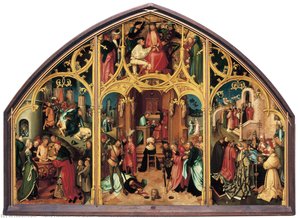
Epitaph of the Vetter Sisters (1499) by Hans Holbein The Elder

Epitaph of the Vetter Sisters

1499 · Oil On Panel · Bavarian State Painting Collections, Munich

The Epitaph of the Vetter Sisters emerges from the shadows of the late Gothic era, a large-scale altarpiece that commands the space it occupies. Painted by Hans Holbein The Elder, this work dates to about 1499. It exists as a complex, multi-tiered narrative, unfolding through a series of interconnected vignettes that guide the eye across its structured, pointed, arched frame. The scale of the piece carries a weight that demands…

8
Frankfurt Dominican Altarpiece: Flagellation (1501) by Hans Holbein The Elder

Frankfurt Dominican Altarpiece: Flagellation

1501 · Mixed Technique · Städel Museum, Frankfurt

The Frankfurt Dominican Altarpiece: Flagellation is a significant work by Hans Holbein The Elder, dating to 1501. This painting was originally commissioned by the Dominican Convent for the High Altar of the Dominican Church in Frankfurt am Main. It remains a profound example of the artist's early period, executed during a time when his technical precision was already becoming a defining characteristic of his hand.

10
Frankfurt Dominican Altarpiece: Ecce Homo (1501) by Hans Holbein The Elder

Frankfurt Dominican Altarpiece: Ecce Homo

1501 · Oil On Panel · Städel Museum, Frankfurt

Frankfurt Dominican Altarpiece: Ecce Homo is a work by Hans Holbein The Elder, executed in 1501. The piece belongs to the Northern Renaissance tradition, emerging from the artist's early career in the German region. It was created during a period when the transition from Late Gothic sensibilities toward Renaissance humanism was reshaping the visual language of religious art.

Hans Holbein The Elder paintings, ranked 11 to 65

11Frankfurt Dominican Altarpiece: The Cleansing of the Temple (1501) by Hans Holbein The ElderFrankfurt Dominican Altarpiece: The Cleansing of the Temple1501 · Städel Museum 12Frankfurt Dominican Altarpiece: Christ’s Arrest (1501) by Hans Holbein The ElderFrankfurt Dominican Altarpiece: Christ’s Arrest1501 · Städel Museum 13Frankfurt Dominican Altarpiece: Christ Washing St Peter's Feet (1501) by Hans Holbein The ElderFrankfurt Dominican Altarpiece: Christ Washing St Peter's Feet1501 · Städel Museum 14Frankfurt Dominican Altarpiece: Christ before Pontius Pilate (1501) by Hans Holbein The ElderFrankfurt Dominican Altarpiece: Christ before Pontius Pilate1501 · Städel Museum 15Frankfurt Dominican Altarpiece: Christ Crowned with Thorns (1501) by Hans Holbein The ElderFrankfurt Dominican Altarpiece: Christ Crowned with Thorns1501 · Städel Museum 16Frankfurt Dominican Altarpiece: Bearing of the Cross (1501) by Hans Holbein The ElderFrankfurt Dominican Altarpiece: Bearing of the Cross1501 · Städel Museum 17Frankfurt Dominican Altarpiece: The Agony in the Garden (1501) by Hans Holbein The ElderFrankfurt Dominican Altarpiece: The Agony in the Garden1501 · Städel Museum 18Frankfurt Dominican Altarpiece: Tree of Jesse (lower part) (1501) by Hans Holbein The ElderFrankfurt Dominican Altarpiece: Tree of Jesse (lower part)1501 · Städel Museum 19Frankfurt Dominican Altarpiece: Resurrection (1501) by Hans Holbein The ElderFrankfurt Dominican Altarpiece: Resurrection1501 · Städel Museum 20Frankfurt Dominican Altarpiece: Lineage of the Dominican Order (lower part) (1501) by Hans Holbein The ElderFrankfurt Dominican Altarpiece: Lineage of the Dominican Order (lower part)1501 · Städel Museum 21Frankfurt Dominican Altarpiece: Sunday view (1501) by Hans Holbein The ElderFrankfurt Dominican Altarpiece: Sunday view1501 · Städel Museum 22Frankfurt Dominican Altarpiece: Tree of Jesse (upper part) (1501) by Hans Holbein The ElderFrankfurt Dominican Altarpiece: Tree of Jesse (upper part)1501 · Städel Museum 23Basilica Santa Maria Maggiore (1499) by Hans Holbein The ElderBasilica Santa Maria Maggiore1499 · Bavarian State Painting Collections 24The Virgin Mary as the Mother of Sorrows (1495) by Hans Holbein The ElderThe Virgin Mary as the Mother of Sorrows1495 · Gemäldegalerie 25Good Deeds of Empress Kunigunde (1506) by Hans Holbein The ElderGood Deeds of Empress Kunigunde1506 · Bavarian State Painting Collections 26Kaisheim Altar: Birth of Christ (1502) by Hans Holbein The ElderKaisheim Altar: Birth of Christ1502 · Bavarian State Painting Collections 27Kaisheim Altar: Christ before Pilate (1502) by Hans Holbein The ElderKaisheim Altar: Christ before Pilate1502 · Bavarian State Painting Collections 28Epitaph of the Walther Sisters: Feeding of the Five Thousand (1502) by Hans Holbein The ElderEpitaph of the Walther Sisters: Feeding of the Five Thousand1502 · Bavarian State Painting Collections 29Epitaph of the Walther Sisters: Healing of the Possessed (1502) by Hans Holbein The ElderEpitaph of the Walther Sisters: Healing of the Possessed1502 · Bavarian State Painting Collections 30Votive Image of Ulrich Schwarz: Christ and Mary as Intercessors before God the Father (1503) by Hans Holbein The ElderVotive Image of Ulrich Schwarz: Christ and Mary as Intercessors before God the Father1503 · Bavarian State Painting Collections 31Kaisheim Altar: Annunciation of Mary (1502) by Hans Holbein The ElderKaisheim Altar: Annunciation of Mary1502 · Bavarian State Painting Collections 32Kaisheim Altar: Capture of Christ (1502) by Hans Holbein The ElderKaisheim Altar: Capture of Christ1502 · Bavarian State Painting Collections 33Kaisheim Altar: Crowning of Christ with Thorns (1502) by Hans Holbein The ElderKaisheim Altar: Crowning of Christ with Thorns1502 · Bavarian State Painting Collections 34Emperor Henry Condemns the Empress to Trial by Ordeal (1506) by Hans Holbein The ElderEmperor Henry Condemns the Empress to Trial by Ordeal1506 · Bavarian State Painting Collections 35Emperor Henry Asks the Empress for Forgiveness (1506) by Hans Holbein The ElderEmperor Henry Asks the Empress for Forgiveness1506 · Bavarian State Painting Collections 36Epitaph of the Walther Sisters: Transfiguration of Christ (1502) by Hans Holbein The ElderEpitaph of the Walther Sisters: Transfiguration of Christ1502 · Bavarian State Painting Collections 37Death of Emperor Heinrich (1506) by Hans Holbein The ElderDeath of Emperor Heinrich1506 · Bavarian State Painting Collections 38Devils Inform a Hermit That They Could Not Lay Hold of the Soul of the Emperor (1506) by Hans Holbein The ElderDevils Inform a Hermit That They Could Not Lay Hold of the Soul of the Emperor1506 · Bavarian State Painting Collections 39The Devil in the Form of a Youth in the Chamber of Empress Kunigunde (1506) by Hans Holbein The ElderThe Devil in the Form of a Youth in the Chamber of Empress Kunigunde1506 · Bavarian State Painting Collections 40Katharinenaltar: Saint Ulrich and Conrad (1512) by Hans Holbein The ElderKatharinenaltar: Saint Ulrich and Conrad1512 · Bavarian State Painting Collections 41Kaisheim Altar: Visitation of Mary (1502) by Hans Holbein The ElderKaisheim Altar: Visitation of Mary1502 · Bavarian State Painting Collections 42Kaisheim Altar: Carrying of the Cross of Christ (1502) by Hans Holbein The ElderKaisheim Altar: Carrying of the Cross of Christ1502 · Bavarian State Painting Collections 43Kaisheim Altar: Presentation in the Temple (1502) by Hans Holbein The ElderKaisheim Altar: Presentation in the Temple1502 · Bavarian State Painting Collections 44Kaisheim Altar: Christ on the Mount of Olives (1502) by Hans Holbein The ElderKaisheim Altar: Christ on the Mount of Olives1502 · Bavarian State Painting Collections 45Kaisheim Altar: Resurrection of Christ (1502) by Hans Holbein The ElderKaisheim Altar: Resurrection of Christ1502 · Bavarian State Painting Collections 46Kaisheim Altar: Adoration of the Magi (1502) by Hans Holbein The ElderKaisheim Altar: Adoration of the Magi1502 · Bavarian State Painting Collections 47Empress Kunigunde Accused of Adultery (1506) by Hans Holbein The ElderEmpress Kunigunde Accused of Adultery1506 · Bavarian State Painting Collections 48Kaisheim Altar: Death of Mary (1502) by Hans Holbein The ElderKaisheim Altar: Death of Mary1502 · Bavarian State Painting Collections 49Kaisheim Altar: Temple Walk of Mary (1502) by Hans Holbein The ElderKaisheim Altar: Temple Walk of Mary1502 · Bavarian State Painting Collections 50Kaisheim Altar: Ecce Homo (1502) by Hans Holbein The ElderKaisheim Altar: Ecce Homo1502 · Bavarian State Painting Collections 51Kaisheim Altar: Circumcision of Christ (1502) by Hans Holbein The ElderKaisheim Altar: Circumcision of Christ1502 · Bavarian State Painting Collections 52Empress Kunigunde Walks Over Glowing Plowshares (1506) by Hans Holbein The ElderEmpress Kunigunde Walks Over Glowing Plowshares1506 · Bavarian State Painting Collections 53Catherine Altar: Martyrdom of Saint Catherine (1512) by Hans Holbein The ElderCatherine Altar: Martyrdom of Saint Catherine1512 · Bavarian State Painting Collections 54Kaisheim Altar: Flagellation of Christ (1502) by Hans Holbein The ElderKaisheim Altar: Flagellation of Christ1502 · Bavarian State Painting Collections 55Mary with the Child (1502) by Hans Holbein The ElderMary with the Child1502 · Bavarian State Painting Collections 56Virgin with Child by Hans Holbein the Elder, Museu Nacional de Arte Antiga (1519) by Hans Holbein The ElderVirgin with Child by Hans Holbein the Elder, Museu Nacional de Arte Antiga1519 · National Museum of Ancient Art 57Portrait of a Member of the Weiss Family of Augsburg (1522) by Hans Holbein The ElderPortrait of a Member of the Weiss Family of Augsburg1522 · Städel Museum 58Basilica San Paolo Fuori Le Mura (1504) by Hans Holbein The ElderBasilica San Paolo Fuori Le Mura1504 · Bavarian State Painting Collections 59Ecce Homo (Grey Passion-6) (1500) by Hans Holbein The ElderEcce Homo (Grey Passion-6)1500 · Staatsgalerie Stuttgart 60Bildnis Der Nonne Veronika Vetter (1499) by Hans Holbein The ElderBildnis Der Nonne Veronika Vetter1499 61Christ in silence (Grey Passion-9) (1500) by Hans Holbein The ElderChrist in silence (Grey Passion-9)1500 · Staatsgalerie Stuttgart 62Maria Der Verkündigung (Sebastiansaltar) (1516) by Hans Holbein The ElderMaria Der Verkündigung (Sebastiansaltar)1516 · Bavarian State Painting Collections 63Portrait of a Wife of An Unknown Stonemason (1505) by Hans Holbein The ElderPortrait of a Wife of An Unknown Stonemason1505 64Grey Passion (1500) by Hans Holbein The ElderGrey Passion1500 · Staatsgalerie Stuttgart 65The crown of thorns (Grey Passion-5) (1500) by Hans Holbein The ElderThe crown of thorns (Grey Passion-5)1500 · Staatsgalerie Stuttgart

Hans Holbein The Elder's famous paintings, period by period

The subjects that held Hans Holbein The Elder's eye

The four subjects that come back most often in these originals, each with its finest example.

The museums that keep Hans Holbein The Elder's originals

The 5 museums that hold the most of the paintings on this page.

Museum City Works by Hans Holbein The Elder Paintings from this list
Bavarian State Painting Collections, MunichBavarian State Painting Collections Munich 40 Kaisheim Descent from the Cross, Katherine Altar: Martyrdom of Saint Peter, Kaisheim Crucifixion
Städel Museum, FrankfurtStädel Museum Frankfurt 16 Frankfurt Dominican Altarpiece: Flagellation, Frankfurt Dominican Altarpiece: The Entry into Jerusalem, Frankfurt Dominican Altarpiece: Ecce Homo
Staatsgalerie Stuttgart, StuttgartStaatsgalerie Stuttgart Stuttgart 5 Grey Passion, Ecce Homo (Grey Passion-6), Christ in silence (Grey Passion-9)
Gemäldegalerie, BerlinGemäldegalerie Berlin 1 The Virgin Mary as the Mother of Sorrows
National Museum of Ancient Art, LisbonNational Museum of Ancient Art Lisbon 1 Virgin with Child by Hans Holbein the Elder, Museu Nacional de Arte Antiga

Hans Holbein The Elder, one signature painting per decade

Works per decade

Pick a decade to see the original that defines it.

Hans Holbein The Elder's paintings: the gallery answers

Which Hans Holbein The Elder painting is the most famous of all?Reveal the answer

Grey Passion (1500), Staatsgalerie Stuttgart, Stuttgart. Kaisheim Descent from the Cross (1500) and Katherine Altar: Martyrdom of Saint Peter (1512) come next.

How old was Hans Holbein The Elder on completing Grey Passion?Reveal the answer

35 years old: Grey Passion dates from 1500, and Hans Holbein The Elder was born in 1465.

Which are Hans Holbein The Elder's top 10 paintings?Reveal the answer

Grey Passion, Kaisheim Descent from the Cross, Katherine Altar: Martyrdom of Saint Peter, Kaisheim Crucifixion, Katherine Altar: Saint Anne Self-Third, Burial of Kaisheim, Epitaph of the Vetter Sisters, Frankfurt Dominican Altarpiece: Flagellation, Frankfurt Dominican Altarpiece: The Entry into Jerusalem and Frankfurt Dominican Altarpiece: Ecce Homo. The ranking above gives each one's year and museum.

How many works did Hans Holbein The Elder create?Reveal the answer

Our catalog holds 65 works by Hans Holbein The Elder, dated from 1495 to 1522.

Where do Hans Holbein The Elder's most famous originals hang?Reveal the answer

Mostly in Bavarian State Painting Collections (Munich), Städel Museum (Frankfurt) and Staatsgalerie Stuttgart (Stuttgart). The museum table above lists them all.

When did Hans Holbein The Elder create the most famous paintings?Reveal the answer

In 1500s: 54 of the 65 works on this page were made then, Grey Passion among them.

Which are Hans Holbein The Elder's earliest and latest famous works?Reveal the answer

On this page, the earliest is The Virgin Mary as the Mother of Sorrows (1495) and the latest Portrait of a Member of the Weiss Family of Augsburg (1522).

Which subjects did Hans Holbein The Elder return to most?Reveal the answer

People (21), Drapery (18) and Figures (15), across the 65 works on this page.

Which medium did Hans Holbein The Elder work in most?Reveal the answer

Oil On Panel, for 40 of the 65 works on this page.

Which movement is Hans Holbein The Elder associated with?Reveal the answer

Northern renaissance, judging by the originals on this page.

Which Hans Holbein The Elder originals does the Bavarian State Painting Collections hold?Reveal the answer

Kaisheim Descent from the Cross, Katherine Altar: Martyrdom of Saint Peter and Kaisheim Crucifixion: the Bavarian State Painting Collections, Munich holds 40 of the works on this page.

Hans Holbein The Elder: the artist

The Master of Northern Renaissance Portraiture: Hans Holbein the Elder

Hans Holbein the Elder, a name synonymous with meticulous detail and profound psychological insight, stands as one of the most important figures in the transition from late Gothic to High Renaissance art. Born in Augsburg, Germany, around 1465 – though precise dates remain elusive – he flourished during a period of immense artistic change, bridging the gap between the religious fervor of the medieval world and the burgeoning humanism of the Renaissance. His early life is somewhat shrouded in mystery; however, it’s known that he received his initial training within the workshop of his father, Hans Holbein the Younger (not to be confused with his more famous son), a respected painter and graphic artist. This familial foundation instilled in him a deep appreciation for precise draftsmanship and an early mastery of techniques like tempera and oil painting. Augsburg itself was a vibrant artistic center, fostering a climate where innovation thrived alongside established traditions. Holbein’s initial works reflect this environment – detailed altarpieces and devotional panels characterized by intricate ornamentation and a distinctly Northern European sensibility. He quickly gained recognition for his ability to render textures with astonishing realism, from the delicate folds of fabric to the sheen of polished metal.

A Journey Through Germany: Basel and Beyond

Holbein’s career took him on a journey through several important German cities, each leaving its mark on his artistic development. He worked in Ulm, Cologne, and eventually settled in Basel in 1516. This period proved pivotal. Basel was a hotbed of humanist thought, attracting scholars, printers, and artists alike. Holbein’s style began to evolve, influenced by the Italian Renaissance masters whose works were circulating through the city via prints and visiting artists. While he continued to produce religious paintings, his focus increasingly shifted towards portraiture – a genre that allowed him to explore the complexities of human character with unprecedented depth. He became highly sought after by Basel’s elite, capturing their likenesses in portraits that were not merely representations but psychological studies. His use of color became more sophisticated, and he began experimenting with new compositional techniques, often placing his subjects against neutral backgrounds to emphasize their individuality. This period also saw Holbein delve into woodcut book illustration, notably for the *Dance of Death* series, a powerful meditation on mortality that showcased his graphic skills and social commentary. The *Dance of Death*, with its stark imagery and allegorical figures, cemented his reputation as an artist capable of addressing profound philosophical themes.

The English Court and Artistic Triumph

In 1526, Holbein embarked on his first journey to England, a trip that would dramatically alter the course of his career. He initially sought patronage from Sir Thomas More, a prominent humanist scholar and statesman. This connection led to commissions from other members of the English court, including Henry VIII and various nobles. Holbein’s portraits of the Tudor elite are arguably his most famous works – masterpieces of realism, diplomacy, and psychological insight. He possessed an uncanny ability to capture not only the physical likeness of his subjects but also their personalities, ambitions, and social standing. His portrait of Henry VIII, for example, is a powerful statement of royal authority, conveying the king’s imposing presence and unwavering power. Holbein's technique in England involved layering thin glazes of oil paint over meticulously prepared panels, creating surfaces that shimmered with life-like detail. He also became adept at incorporating symbolic elements into his portraits, subtly communicating messages about his subjects’ status and beliefs. His success at the English court led to a period of relative prosperity and artistic freedom.

Legacy and Enduring Influence

Hans Holbein the Elder died in Augsburg in 1543, leaving behind a legacy that continues to inspire artists today. While his son, Hans Holbein the Younger, achieved even greater fame, the elder Holbein’s contributions were foundational to the development of Northern Renaissance portraiture and graphic art. His meticulous technique, psychological depth, and ability to capture the complexities of human character set him apart from his contemporaries. His influence can be seen in the works of later artists, including Rembrandt and Van Dyck, who admired his mastery of light and shadow and his ability to convey personality through portraiture. The Dance of Death series remains a powerful testament to his graphic skills and social commentary. Furthermore, Holbein’s portraits of the Tudor elite provide invaluable insights into the personalities and power dynamics of 16th-century England. He wasn't simply a painter; he was a chronicler of an era, capturing its spirit in brushstrokes and woodcuts.
  • Masterful realism and attention to detail.
  • Pioneering psychological insight in portraiture.
  • Significant contributions to book illustration with the *Dance of Death* series.
  • Bridging the gap between Gothic and Renaissance artistic styles.
His work continues to be celebrated for its technical brilliance, intellectual depth, and enduring beauty.