Portrait of David Burliuk

David Burliuk Paintings: The 100 Most Famous, Through a Gallery's Eye

Updated October 2026 · ranked by our popularity score (searches, visits and orders for each work) · 504 works by David Burliuk in our catalogue

In short

To the gallery's eye, David Burliuk's most famous painting is Peasant and horse (1910). Eilshemius in his Studio (1935) and The Artist's Wife (Marussia Burliuk) (1932) complete the trio every eye recognises. Of the 504 works by David Burliuk in our catalog, the gallery presents the 100 most famous below, each original with its year, its museum and what makes it unique.

1882 – 1967, Semyrotivschyna Post-impressionism Most works: The Phillips Collection

The gallery's top 10 David Burliuk paintings

1
Peasant and horse (1910) by David Burliuk

Peasant and horse

1910 · Oil

Peasant and horse is a painting by David Burliuk created in 1910. The work presents a portrait of a woman positioned in a field. She stands beside a horse, a quiet companion in the open space. A bucket rests in her hands, suggesting a moment of daily labor amidst the grass.

David Burliuk paintings, ranked 11 to 100

11Russian Peasant (1925) by David BurliukRussian Peasant1925 12A Horse and a Groom (1925) by David BurliukA Horse and a Groom1925 13Vladimir Mayakovsky (1925) by David BurliukVladimir Mayakovsky1925 14Nicholai Cikovsky (1925) by David BurliukNicholai Cikovsky1925 15Marusia (Portrait of the Artist's Wife) (1928) by David BurliukMarusia (Portrait of the Artist's Wife)1928 16In a Russian Village (1926) by David BurliukIn a Russian Village1926 17Shells (1930) by David BurliukShells1930 · The Phillips Collection 18Portrait of Nicholas Roerich (1929) by David BurliukPortrait of Nicholas Roerich1929 19Artist at Easel (Raphael Soyer) (1930) by David BurliukArtist at Easel (Raphael Soyer)1930 20Village Street (1930) by David BurliukVillage Street1930 21Russian Man on Sled Pulled by Horse (1940) by David BurliukRussian Man on Sled Pulled by Horse1940 22Dead End café (1948) by David BurliukDead End café1948 23Barbershop (1946) by David BurliukBarbershop1946 24Walking by countryside (1944) by David BurliukWalking by countryside1944 25Frank Kleinholtz (1950) by David BurliukFrank Kleinholtz1950 26June G. (1950) by David BurliukJune G.1950 27Cowboy in the Organ mountains, New Mexico (1949) by David BurliukCowboy in the Organ mountains, New Mexico1949 28Portrait of a man (1960) by David BurliukPortrait of a man1960 29Tea Party (1960) by David BurliukTea Party1960 30Marusia (1960) by David BurliukMarusia1960 · Westfälishes Landesmuseum 31Red and green horses in a stable (1956) by David BurliukRed and green horses in a stable1956 32Still Life Tribute to Vermeer by David BurliukStill Life Tribute to Vermeer 33The stand (1946) by David BurliukThe stand1946 34Landscape in New Mexico (1942) by David BurliukLandscape in New Mexico1942 35Scientist (1952) by David BurliukScientist1952 36Woman with a duck (1964) by David BurliukWoman with a duck1964 37In a park (1900) by David BurliukIn a park1900 38Blue Mountain in Denville by David BurliukBlue Mountain in DenvilleJohn and Mable Ringling Museum of Art 39The Windmill by David BurliukThe Windmill 40Two Girls in a Farmyard with Ducks and a Windmill by David BurliukTwo Girls in a Farmyard with Ducks and a Windmill 41Spring on Long Island by David BurliukSpring on Long Island 42Van Gogh With L'arlesienne And Ancient Greek Man by David BurliukVan Gogh With L'arlesienne And Ancient Greek Man 43The artist's wife with a still life of flowers by David BurliukThe artist's wife with a still life of flowers 44A Street Scene by David BurliukA Street Scene 45Landscape (1909) by David BurliukLandscape1909 46Man With Dog by David BurliukMan With Dog 47Autumn In Hampton Bays by David BurliukAutumn In Hampton Bays 48Mount Zion, Israel by David BurliukMount Zion, Israel 49Portrait of actor Tiagunov (1910) by David BurliukPortrait of actor Tiagunov1910 50Spring (1907) by David BurliukSpring1907 51Broadway, New York by David BurliukBroadway, New York 52Night rider (1911) by David BurliukNight rider1911 53New York by David BurliukNew York 54Surrealist Scene by David BurliukSurrealist Scene 55Dedication to Cezanne (1910) by David BurliukDedication to Cezanne1910 56Landscape with a Pink House (1910) by David BurliukLandscape with a Pink House1910 57Bridge (1911) by David BurliukBridge1911 58A song of youth by David BurliukA song of youth 59Dniester River Rapids (1910) by David BurliukDniester River Rapids1910 60Peasants By A Duck Pond by David BurliukPeasants By A Duck Pond 61The Time (1910) by David BurliukThe Time1910 62A House in the Steppe (1908) by David BurliukA House in the Steppe1908 63Stonemason (1910) by David BurliukStonemason1910 64Man and Cow by David BurliukMan and Cow 65Portrait Of Shaya Budin by David BurliukPortrait Of Shaya Budin 66Life of cossack (1910) by David BurliukLife of cossack1910 67Siberian Flotilla (1911) by David BurliukSiberian Flotilla1911 68Horses (1908) by David BurliukHorses1908 69Morning. Wind. (1908) by David BurliukMorning. Wind.1908 70Nude by David BurliukNude 71A horse-lightning (1907) by David BurliukA horse-lightning1907 72Abstraction (1910) by David BurliukAbstraction1910 73Horses (1910) by David BurliukHorses1910 74Bridge. Landscape from Four Points of View (1911) by David BurliukBridge. Landscape from Four Points of View1911 75Woman with neckerchief (1910) by David BurliukWoman with neckerchief1910 76A plowman (1910) by David BurliukA plowman1910 77Landscape with a flowerbed (1906) by David BurliukLandscape with a flowerbed1906 78Futuristic woman (1911) by David BurliukFuturistic woman1911 79Horses (1908) by David BurliukHorses1908 80Summer forest (1906) by David BurliukSummer forest1906 81Miami Beach by David BurliukMiami Beach 82Landscape with a road (1910) by David BurliukLandscape with a road1910 83Landscape with trees (1910) by David BurliukLandscape with trees1910 84Don Quixote and Sancho Panza by David BurliukDon Quixote and Sancho Panza 85Abstraction (1910) by David BurliukAbstraction1910 86Two tastes in one (1908) by David BurliukTwo tastes in one1908 87Illustration for the almanac "A Trap for Judges" (1913) by David BurliukIllustration for the almanac "A Trap for Judges"1913 88Illustration for the almanac "A Trap for Judges" (1913) by David BurliukIllustration for the almanac "A Trap for Judges"1913 89Rural landscape (1915) by David BurliukRural landscape1915 90Harvesting (1915) by David BurliukHarvesting1915 91Path in the garden (1912) by David BurliukPath in the garden1912 92Woman with four eyes and hen (1912) by David BurliukWoman with four eyes and hen1912 93Ukrainians (1912) by David BurliukUkrainians1912 94Landscape (1912) by David BurliukLandscape1912 95Cossack Mamai (1912) by David BurliukCossack Mamai1912 96Advent of spring and summer (1914) by David BurliukAdvent of spring and summer1914 97Abstract Composition (1914) by David BurliukAbstract Composition1914 98Collage (1914) by David BurliukCollage1914 99Spring in countryside (1917) by David BurliukSpring in countryside1917 100Composition with sickle (1917) by David BurliukComposition with sickle1917

David Burliuk's famous paintings, period by period

Early Period

1908 – 1922 · 3 works in this list

The subjects that held David Burliuk's eye

The four subjects that come back most often in these originals, each with its finest example.

The museums that keep David Burliuk's originals

The 3 museums that hold the most of the paintings on this page.

Museum City Works by David Burliuk Paintings from this list
The Phillips Collection, Washington, D.C.The Phillips Collection Washington, D.C. 7 Shells
Westfälishes Landesmuseum, MunsterWestfälishes Landesmuseum Munster 1 Marusia
John and Mable Ringling Museum of Art, SarasotaJohn and Mable Ringling Museum of Art Sarasota 1 Blue Mountain in Denville

David Burliuk, one signature painting per decade

Works per decade

Pick a decade to see the original that defines it.

David Burliuk's paintings: the gallery answers

Which David Burliuk painting is the most famous of all?Reveal the answer

Peasant and horse (1910). Eilshemius in his Studio (1935) and The Artist's Wife (Marussia Burliuk) (1932) come next.

How old was David Burliuk on completing Peasant and horse?Reveal the answer

28 years old: Peasant and horse dates from 1910, and David Burliuk was born in 1882.

Which are David Burliuk's top 10 paintings?Reveal the answer

Peasant and horse, Eilshemius in his Studio, The Artist's Wife (Marussia Burliuk), A Lakeshore, Quick Frozen Fish, Florida, Surrealistic Composition, The Gardener, Revolution, American workers and Vladimir Mayakovsky. The ranking above gives each one's year and museum.

How many works did David Burliuk create?Reveal the answer

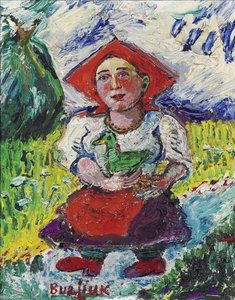
Our catalog holds 504 works by David Burliuk, dated from 1900 to 1964.

Where do David Burliuk's most famous originals hang?Reveal the answer

Mostly in The Phillips Collection (Washington, D.C.), Westfälishes Landesmuseum (Munster) and John and Mable Ringling Museum of Art (Sarasota). The museum table above lists them all.

When did David Burliuk create the most famous paintings?Reveal the answer

In 1910s: 35 of the 100 works on this page were made then, Peasant and horse among them.

Which are David Burliuk's earliest and latest famous works?Reveal the answer

On this page, the earliest is In a park (1900) and the latest Woman with a duck (1964).

Which subjects did David Burliuk return to most?Reveal the answer

Men (12), Landscape (11) and Horses (10), across the 100 works on this page.

Which movement is David Burliuk associated with?Reveal the answer

Post-impressionism, judging by the originals on this page.

David Burliuk: the artist

The Wild Steppe Horse: A Life Forged in Futurism

David Davidovich Burliuk, a name synonymous with the explosive birth of Russian Futurism, was more than just an artist; he was a provocateur, a poet, and a tireless champion of the new. Born on July 21, 1882, in the small Ukrainian village of Semyrotivka, his lineage hinted at the spirited character to come – descended from Ukrainian Cossacks who once held positions of power within the Hetmanate. This heritage instilled in him a sense of independence and a connection to the land that would permeate his artistic vision. His mother, of Belarusian descent, further enriched this cultural tapestry. From an early age, Burliuk displayed an exuberant energy, a quality recognized by his professor Anton Ažbe at the Royal Academy in Munich, who famously dubbed him a “wonderful wild steppe horse.” This wasn’t merely a descriptor of personality; it captured the untamed force that would define his artistic trajectory.

Burliuk's formal training began at art schools in Kazan and Odesa before leading him to Munich and later Paris. These experiences exposed him to the burgeoning avant-garde movements sweeping across Europe – Fauvism, Cubism – but he didn’t simply adopt these styles; he synthesized them with his own unique sensibility, deeply rooted in Ukrainian folklore and a fascination with Scythian art. He wasn't content to merely reflect reality; he sought to shatter it, to reconstruct it into something dynamic and utterly new. This desire for radical change led him to become a pivotal figure in the formation of Hylaea, an artistic collective that embraced experimentation and challenged conventional notions of beauty.

A Slap in the Face: Pioneering Russian Futurism

The early 20th century was a period of intense social and political upheaval, and art became a battleground for new ideas. Burliuk, along with fellow artists like Vladimir Mayakovsky and Vasily Kamensky, recognized this potential. In 1912, they published the manifesto “A Slap in the Face of Public Taste,” a defiant declaration that rejected traditional artistic values and embraced the energy of modernity. This wasn’t simply an aesthetic statement; it was a call to arms, a rejection of bourgeois complacency, and a demand for art to reflect the dynamism of the machine age. The Futurists weren't just creating paintings; they were staging performances, shocking audiences with their unconventional attire – gaudy waistcoats, painted faces, even radishes worn as lapel pins – and challenging the very definition of what constituted art.

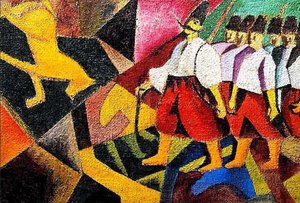
Burliuk’s artistic style during this period was a vibrant fusion of influences. He employed bold colors reminiscent of Fauvism, fragmented forms inspired by Cubism, and incorporated elements of Ukrainian folk art and Scythian motifs. His paintings weren't merely representations of objects; they were explorations of movement, energy, and the underlying forces that shaped reality. Works like Time (1918/1919) and Carrousel (1921) exemplify this approach, showcasing his mastery of cubist techniques while retaining a distinctly personal vision. He produced an astonishing volume of work – approximately 30,000 paintings throughout his career – demonstrating an unrelenting creative drive.

From Russia to America: A Life in Exile

The Russian Revolution brought immense upheaval and ultimately forced Burliuk into exile. He journeyed through Siberia, Japan, where he introduced Futurism to a new audience, before finally settling in the United States in 1922. This relocation marked a significant shift in his life and work. While he continued to paint prolifically, adapting his style to reflect his new surroundings, he also took on various roles – art editor for the Russian-language newspaper The Russian Voice, teacher, and tireless promoter of modern art.

Despite facing challenges as an émigré artist, Burliuk remained committed to his artistic vision. His later works often depicted American landscapes and scenes from everyday life, but they retained the energy and experimentation that characterized his earlier paintings. He continued to explore themes of vitality, transformation, and the interconnectedness of all things. He never abandoned his love for Ukrainian culture, weaving elements of its folklore and history into his art even while living thousands of miles away.

A Lasting Legacy: The Father of Russian Futurism

David Burliuk passed away on January 15, 1967, in Southampton, New York, leaving behind a vast and diverse body of work that continues to inspire artists and scholars today. His contributions to the development of Russian Futurism were immense, and his influence can be seen in the works of countless subsequent generations of artists. He wasn’t just an artist who painted pictures; he was a cultural force who challenged conventions, sparked debate, and helped to redefine the boundaries of art itself.

Today, Burliuk's paintings are held in numerous museums around the world, including the Museum Fridericia in Denmark, which boasts an impressive collection of his work. His legacy as the “father of Russian Futurism” is secure, a testament to his unwavering commitment to innovation and his enduring belief in the power of art to transform the world. He remains a compelling figure – a wild steppe horse who galloped fearlessly into the future, leaving an indelible mark on the history of modern art.