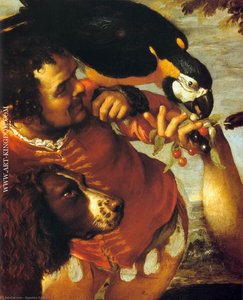
Portrait of Agostino Carracci

Agostino Carracci Paintings: The 37 Most Famous, Through a Gallery's Eye

Updated November 2026 · ranked by our popularity score (searches, visits and orders for each work) · 38 works by Agostino Carracci in our catalogue

In short

To the gallery's eye, Agostino Carracci's most famous painting is The Last Supper (1593), whose original hangs in the Museo del Prado, Madrid. Titian (1587) and Venus and Amor with a Satyr (1598) complete the trio every eye recognises. Of the 38 works by Agostino Carracci in our catalog, the gallery presents the 37 most famous below, each original with its year, its museum and what makes it unique.

1557 – 1602, Bologna Baroque Most works: Statens Museum For Kunst

The gallery's top 10 Agostino Carracci paintings

1
The Last Supper (1593) by Agostino Carracci

The Last Supper

1593 · Oil On Canvas · Museo del Prado, Madrid

A long table, draped in white cloth, anchors the composition. Around it, a group of men is caught in a state of agitation and contemplation. The scene captures the biblical institution of the Eucharist, a moment defined by tension and spiritual gravity. Light emanates from an unseen source above the left, casting deep shadows that define the anatomical forms and the heavy folds of drapery. This directional lighting creates a…

2
Titian (1587) by Agostino Carracci

Titian

1587 · Engraving · Staatliche Museen zu Berlin, Berlin

To stand before this masterful engraving is to encounter a moment suspended in the amber glow of the late sixteenth century. This portrait, executed with the meticulous precision characteristic of printmaking from the era, draws us intimately close to the subject—a man whose bearing speaks volumes without uttering a single word. The composition centers him formally, yet his slight turn of the head injects a subtle, captivating dynamism into what…

3
Venus and Amor with a Satyr (1598) by Agostino Carracci

Venus and Amor with a Satyr

1598 · Oil On Canvas · Kunsthistorisches Museum, Vienna

In Venus and Amor with a Satyr by Agostino Carracci, the composition is dominated by the reclining figure of Venus. Set within an intimate environment, the scene brings together the goddess, Cupid (Amor), and a Satyr. The arrangement utilizes a close-up, shallow depth view that pulls the viewer into the immediate space of the figures. This proximity emphasizes the interaction between the divine presence of Venus and Cupid and the…

4
The Ecstasy of Saint Catherine of Siena (1590) by Agostino Carracci

The Ecstasy of Saint Catherine of Siena

1590 · Oil On Canvas · Galleria Borghese, Rome

The painting titled The Ecstasy of Saint Catherine of Siena was executed by the artist Agostino Carracci in 1590. This religious work depicts a significant episode from the life of Saint Catherine of Siena, a member of the Dominican order. The composition focuses on the saint during a moment of spiritual experience, specifically referencing the sacred stigmata she is said to have received in 1375.

5
St. Catherine, from the episode "Holy Women" (1578) by Agostino Carracci

St. Catherine, from the episode "Holy Women"

1578 · Engraving

St. Catherine, from the episode "Holy Women" is an engraving by Agostino Carracci. Created in 1578, the work belongs to a period when the artist was establishing his presence within the Italian art scene. Carracci was born in 1557 in Bologna, Italy.

6
Male Portrait (1589) by Agostino Carracci

Male Portrait

In this "Male Portrait" by Agostino Carracci, dating from about 1589, we are presented with a single male figure captured in a close-up, three-quarter view. The subject is positioned slightly off-center, creating a subtle tension within the frame. He meets the viewer at eye-level, his piercing gaze establishing an immediate and intimate connection. There is a profound sense of psychological presence in his expression, one that suggests a moment of…

7
Nuditet med mand og kvinde (1587) by Agostino Carracci

Nuditet med mand og kvinde

1587 · Oil On Canvas · Statens Museum For Kunst, Copenhagen

A single light source spills from the upper left, carving the anatomy of two figures out of a heavy, dark interior. The man and woman are locked in a seated embrace, their limbs intertwining to form a singular, organic shape. Warm, earthy tones define the skin, while deep purples and blues anchor the composition through the heavy folds of drapery and bedding. Every curve of muscle and every soft contour…

9
Christ on the Cross (1587) by Agostino Carracci

Christ on the Cross

1587 · Oil On Canvas · Statens Museum For Kunst, Copenhagen

is an oil painting by the Italian artist Agostino Carracci. The work dates to 1587. This piece depicts the biblical Crucifixion, focusing on the central figure of Jesus Christ upon the cross. The subject matter is presented through a somber and dramatic lens, utilizing a composition that places the crucified figure at the apex of a pyramidal arrangement.

10
Annunciation (1587) by Agostino Carracci

Annunciation

1587 · Oil On Canvas

The composition is split between two distinct realms. On the right, the earthly plane is occupied by the Virgin Mary, her figure draped in a heavy, deep blue mantle. To the left and above, the heavenly sphere erupts in a dynamic, upward-reaching movement. Clouds and a host of cherubs fill the upper atmosphere, creating a sense of divine presence that descends toward the terrestrial scene. The Archangel Gabriel is captured…

Agostino Carracci paintings, ranked 11 to 37

The subjects that held Agostino Carracci's eye

The four subjects that come back most often in these originals, each with its finest example.

The museums that keep Agostino Carracci's originals

The 8 museums that hold the most of the paintings on this page.

Museum City Works by Agostino Carracci Paintings from this list
Statens Museum For Kunst, CopenhagenStatens Museum For Kunst Copenhagen 3 Nuditet med mand og kvinde, Nuditet med mand og kvinde, Christ on the Cross
Kunsthistorisches Museum, ViennaKunsthistorisches Museum Vienna 2 Venus and Amor with a Satyr, Stigmatization of Saint Francis of Assisi
Museo di Capodimonte, NaplesMuseo di Capodimonte Naples 2 Hairy Harry, Mad Peter and Tiny Amon (detail), Hairy Harry, Mad Peter and Tiny Amon
Palazzo Ducale del Giardino, ParmaPalazzo Ducale del Giardino Parma 2 Jupiter, Jupiter
Museo del Prado, MadridMuseo del Prado Madrid 1 The Last Supper
Staatliche Museen zu Berlin, BerlinStaatliche Museen zu Berlin Berlin 1 Titian
Galleria Borghese, RomeGalleria Borghese Rome 1 The Ecstasy of Saint Catherine of Siena
Bavarian State Painting Collections, MunichBavarian State Painting Collections Munich 1 Male Portrait

Agostino Carracci, one signature painting per decade

Works per decade

Pick a decade to see the original that defines it.

Agostino Carracci's paintings: the gallery answers

Which Agostino Carracci painting is the most famous of all?Reveal the answer

The Last Supper (1593), Museo del Prado, Madrid. Titian (1587) and Venus and Amor with a Satyr (1598) come next.

How old was Agostino Carracci on completing The Last Supper?Reveal the answer

36 years old: The Last Supper dates from 1593, and Agostino Carracci was born in 1557.

Which are Agostino Carracci's top 10 paintings?Reveal the answer

The Last Supper, Titian, Venus and Amor with a Satyr, The Ecstasy of Saint Catherine of Siena, St. Catherine, from the episode "Holy Women", Male Portrait, Nuditet med mand og kvinde, Nuditet med mand og kvinde, Christ on the Cross and Annunciation. The ranking above gives each one's year and museum.

How many works did Agostino Carracci create?Reveal the answer

Our catalog holds 38 works by Agostino Carracci, dated from 1578 to 1602.

Where do Agostino Carracci's most famous originals hang?Reveal the answer

Mostly in Statens Museum For Kunst (Copenhagen), Kunsthistorisches Museum (Vienna) and Museo di Capodimonte (Naples). The museum table above lists them all.

When did Agostino Carracci create the most famous paintings?Reveal the answer

In 1590s: 11 of the 37 works on this page were made then, The Last Supper among them.

Which are Agostino Carracci's earliest and latest famous works?Reveal the answer

On this page, the earliest is St. Catherine, from the episode "Holy Women" (1578) and the latest Allegory of Abundance and Peace (1602).

Which subjects did Agostino Carracci return to most?Reveal the answer

Woman (10), Drapery (7) and Man (7), across the 37 works on this page.

Which medium did Agostino Carracci work in most?Reveal the answer

Oil On Canvas, for 12 of the 37 works on this page.

Which movement is Agostino Carracci associated with?Reveal the answer

Baroque, judging by the originals on this page.

Which Agostino Carracci originals does the Statens Museum For Kunst hold?Reveal the answer

Nuditet med mand og kvinde, Nuditet med mand og kvinde and Christ on the Cross: the Statens Museum For Kunst, Copenhagen holds 3 of the works on this page.

Agostino Carracci: the artist

The Architect of Naturalism: The Life and Legacy of Agostino Carracci

Agostino Carracci stands as a pivotal figure in the burgeoning Baroque movement within Bologna, Italy. Often overshadowed by his more celebrated brother, Annibale, Agostino’s artistic vision—characterized by a deliberate rejection of Mannerist formalism and an embrace of classical ideals—established him as a crucial innovator who profoundly impacted the stylistic trajectory of Bolognese painting. He was not merely a craftsman but a visionary pedagogue, shaping the future generation of artists through the Accademia degli Incamminati, alongside Annibale and Ludovico Carracci. This academy became a crucible for a new era of art, moving away from the artificiality of the late Renaissance toward a more profound connection with reality. Born in Bologna in 1557 to Giovanni Battista Carracci and Lucrezia Panciatichi, Agostino’s artistic journey began under the tutelage of Domenico Tiberiadi. This early training instilled in him a foundational understanding of disegno—the humanist concept of drawing—which was essential for mastering classical proportions and perspective. While his contemporaries often leaned into the stylized forms and exaggerated poses of Mannerism, Agostino sought inspiration from the enduring strength of antiquity. He looked toward Roman sculpture and architecture as the ultimate models for achieving artistic excellence, believing that true beauty resided in the balance between idealized form and natural truth.

The Mastery of Line and Light

Before he achieved renown for monumental frescoes and portraits, Carracci’s career found its footing through the intricate medium of engraving. This period was transformative, as he utilized the printmaker's tool to reproduce masterpieces by titans such as Federico Barocci, Tintoretto, Veronese, and Correggio. For Agostino, engraving was far more than a method of reproduction; it was a vital intellectual exercise in disseminating artistic knowledge across Europe. His prints demonstrated an acute sensitivity to tonal variations and chiaroscuro—the dramatic interplay of light and shadow—which would later become a hallmark of the Baroque style. Through these meticulous lines, he translated the fluid textures of paint into the permanent language of ink, elevating the status of printmaking within the fine arts. His technical prowess is perhaps most intimately captured in his preparatory works, where the boundary between study and masterpiece dissolves. In works such as his Study of a Spaniel’s Head, one can witness the artist's commitment to naturalism. Created around 1598, this drawing avoids all artifice, presenting the subject with remarkable realism—from the attentive eyes to the textured, curly fur of the ears. Such studies served as the essential building blocks for his larger compositions, proving that his devotion to the minute details of the natural world was the foundation upon which his grander, more classical visions were built.

A Lasting Impression on the Baroque Era

The historical significance of Agostino Carracci lies in his role as a bridge between two eras. By challenging the intellectualized complexity of Mannerism with a renewed focus on clarity and natural observation, he helped midwife the birth of the Bolognese School. His ability to blend the classical elegance of the Renaissance with the emotional depth and dramatic lighting of the Baroque provided a blueprint for generations of painters. Whether through the ethereal beauty found in his The Three Graces or the familial intimacy captured in portraits of himself and his brothers, Agostino’s work remains a testament to a period of profound transition. Though his life was tragically short, ending in 1602, his influence endured far beyond his years. Through the Accademia degli Incamminati, he helped establish a pedagogical tradition that prioritized direct observation and classical study, ensuring that the principles of naturalism would become a cornerstone of Western art. His legacy is not found merely in individual canvases, but in the very way we perceive light, shadow, and the human form—a legacy of precision, passion, and an unwavering pursuit of truth in art.