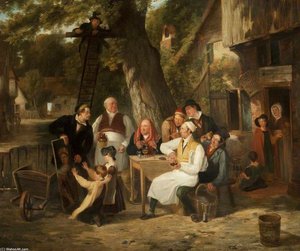
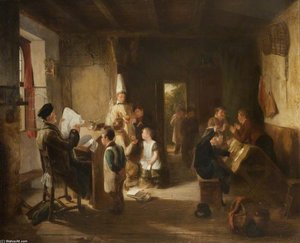
Portrait of Thomas Webster

The 89 Most Famous Thomas Webster Paintings, Each One of a Kind

Updated November 2026 · ranked by our popularity score (searches, visits and orders for each work) · 89 works by Thomas Webster in our catalogue

In short

Dotheboy's Hall (1848) is the Thomas Webster painting that draws the most eyes; the original belongs to the Harvard Art Museums, Cambridge. After it, the eye goes to The Card Players and Football -. Among the 89 works of Thomas Webster in our catalog, these 89 are the most famous, each a unique original presented with its year, its museum and the reason it endures.

1800 – 1886, London Most works: Harvard Art Museums

Top 10 paintings by Thomas Webster, through the gallery's eye

1
Dotheboy's Hall (1848) by Thomas Webster

Dotheboy's Hall

1848 · Watercolor · Harvard Art Museums, Cambridge

The painting Dotheboy's Hall is a work by the British painter Thomas Webster. Born in Ranelagh Street, Pimlico, London, Webster spent his formative years navigating the structured halls of artistic training. He entered the Royal Academy as a student in 1821, a period that would define his technical foundation and his place within the English tradition of genre painting.

2
The Card Players by Thomas Webster

The Card Players

Oil

The air in the room feels heavy with the scent of old wood and the quiet tension of a game in progress. Sunlight streams through a window, cutting through the dimness of the rustic interior to illuminate a wooden table where life unfolds in small, deliberate movements. Six figures occupy this space, their presence felt through the textures of their working-class attire—the heavy fabric of jackets, the crispness of lace…

Thomas Webster's famous paintings, numbers 11 to 89

11A Village Choir - by Thomas WebsterA Village Choir - 12Tussle Outside The Schoolroom by Thomas WebsterTussle Outside The Schoolroom 13The Artist's Father And Mother by Thomas WebsterThe Artist's Father And Mother 14Beating For Recruits (rocking The Cradle) by Thomas WebsterBeating For Recruits (rocking The Cradle) 15The Gypsy by Thomas WebsterThe Gypsy 16Late At School by Thomas WebsterLate At School 17The New Sign by Thomas WebsterThe New Sign 18The New Recruit by Thomas WebsterThe New RecruitTe Whare O Rehua Sarjeant Gallery 19Hop Garden by Thomas WebsterHop Garden 20Goodnight by Thomas WebsterGoodnight 21Contrary Winds by Thomas WebsterContrary Winds 22Sunday Evening by Thomas WebsterSunday Evening 23Study For 'the Village Choir' by Thomas WebsterStudy For 'the Village Choir' 24An Impressive Still Life Of Flowers On A Stone Ledge by Thomas WebsterAn Impressive Still Life Of Flowers On A Stone Ledge 25William Miles by Thomas WebsterWilliam Miles 26The Jewelry Seller by Thomas WebsterThe Jewelry Seller 27Going To The Fair by Thomas WebsterGoing To The Fair 28A Dame's School by Thomas WebsterA Dame's School 29Youth And Age by Thomas WebsterYouth And Age 30The Sewing Lesson by Thomas WebsterThe Sewing Lesson 31Sickness And Health; A Sketch by Thomas WebsterSickness And Health; A Sketch 32The Young Volunteer by Thomas WebsterThe Young Volunteer 33A musical evening by Thomas WebsterA musical evening 34Reading The News by Thomas WebsterReading The News 35A school playground by Thomas WebsterA school playground 36Sickness And Health by Thomas WebsterSickness And Health 37Maternal Affection by Thomas WebsterMaternal Affection 38Returning From The Fair by Thomas WebsterReturning From The Fair 39Roses, Tulips, Daisies, Chrysanthemums And Other Flowers In A Glass Vase On A Stone Ledge by Thomas WebsterRoses, Tulips, Daisies, Chrysanthemums And Other Flowers In A Glass Vase On A Stone Ledge 40Chasing the cat by Thomas WebsterChasing the cat 41The Smile by Thomas WebsterThe Smile 42Roast Pig by Thomas WebsterRoast Pig 43Good Night by Thomas WebsterGood Night 44Football by Thomas WebsterFootball 45Peonies, Roses, Delphiniums, Poppies And Other Flowers, On A Ledge by Thomas WebsterPeonies, Roses, Delphiniums, Poppies And Other Flowers, On A LedgeNiedersächsisches Landesmuseum 46The Frown by Thomas WebsterThe Frown 47Summer Flowers And Fruit In A Wicker Basket, An Extensive Landscape Beyond by Thomas WebsterSummer Flowers And Fruit In A Wicker Basket, An Extensive Landscape Beyond 48Robbing The Orchard by Thomas WebsterRobbing The Orchard 49Parrot Tulips, Roses, Snow Drops And Alstroemeria Arranged Around An Alcove, by Thomas WebsterParrot Tulips, Roses, Snow Drops And Alstroemeria Arranged Around An Alcove, 50Hollyhocks, Roses And Other Flowers In A Vase by Thomas WebsterHollyhocks, Roses And Other Flowers In A Vase 51Pink Peonies, Morning Glory, Hollyhocks, Plums And Grapes by Thomas WebsterPink Peonies, Morning Glory, Hollyhocks, Plums And Grapes 52Sickness And Health - by Thomas WebsterSickness And Health - 53The Battle Of The Nile by Thomas WebsterThe Battle Of The Nile 54The Letter by Thomas WebsterThe Letter 55The Early Lesson by Thomas WebsterThe Early Lesson 56The Market Cart by Thomas WebsterThe Market Cart 57Study For 'the Connoisseurs' by Thomas WebsterStudy For 'the Connoisseurs' 58The Artist's Father And Mothe by Thomas WebsterThe Artist's Father And Mothe 59Roses, Parrot Tulips, Plums, Pumpkins, And Butterflies In A Landscape by Thomas WebsterRoses, Parrot Tulips, Plums, Pumpkins, And Butterflies In A Landscape 60The Lesson by Thomas WebsterThe Lesson 61A Study Of 'the Schoolroom' by Thomas WebsterA Study Of 'the Schoolroom' 62Tulips, Peonies, Roses And Other Flowers In An Urn, An Extensive Landscape Beyond by Thomas WebsterTulips, Peonies, Roses And Other Flowers In An Urn, An Extensive Landscape Beyond 63Roses, Camellia, Iris, Parrot Tulips And Morning Glory In A Glass Vase, With Peaches by Thomas WebsterRoses, Camellia, Iris, Parrot Tulips And Morning Glory In A Glass Vase, With Peaches 64Parrot Tulips, Narcissus, Peonies, Chrysanthemums, Carnations, Lilies And Roses In An Urn With Fruit To The Side, On A Stone Ledge by Thomas WebsterParrot Tulips, Narcissus, Peonies, Chrysanthemums, Carnations, Lilies And Roses In An Urn With Fruit To The Side, On A Stone Ledge 65Study For 'a Letter From The Colonies' by Thomas WebsterStudy For 'a Letter From The Colonies' 66First Steps by Thomas WebsterFirst Steps 67The Playground by Thomas WebsterThe Playground 68The Boy With Many Friends by Thomas WebsterThe Boy With Many Friends 69'in Sickness And Health by Thomas Webster'in Sickness And Health 70Genius by Thomas WebsterGenius 71A Letter From The Colonies by Thomas WebsterA Letter From The Colonies 72Roses, Crysanthemums, Parrot Tulips, Carnations, Larkspur, And Butterlies On A Stone Ledge by Thomas WebsterRoses, Crysanthemums, Parrot Tulips, Carnations, Larkspur, And Butterlies On A Stone Ledge 73Roses, Irises, Morning Glory, Narcissi, Chrysanthemums And Two Butterflies, Under A Stone Fountain by Thomas WebsterRoses, Irises, Morning Glory, Narcissi, Chrysanthemums And Two Butterflies, Under A Stone Fountain 74Returning From The Fair by Thomas WebsterReturning From The Fair 75The School Room by Thomas WebsterThe School Room 76The Post Office (hope Deferred Makes The Heart Sick) by Thomas WebsterThe Post Office (hope Deferred Makes The Heart Sick) 77Beating For Recruits by Thomas WebsterBeating For Recruits 78A Tea Party by Thomas WebsterA Tea Party 79A Village Choir by Thomas WebsterA Village ChoirVictoria and Albert Museum 80Portrait Of George Goldney, Small Full-length, In Montem Costume, Eton College Beyond by Thomas WebsterPortrait Of George Goldney, Small Full-length, In Montem Costume, Eton College Beyond 81Saying Grace by Thomas WebsterSaying Grace 82Contrary Winds by Thomas WebsterContrary Winds 83Parrot Tulips, Chrysanthemums, Roses, Corn Flowers, Lilies And Narcissus In An Urn, With Fruit In Wicker Baskets And On A Platter To The Side, On A Stone Ledge by Thomas WebsterParrot Tulips, Chrysanthemums, Roses, Corn Flowers, Lilies And Narcissus In An Urn, With Fruit In Wicker Baskets And On A Platter To The Side, On A Stone Ledge 84A Crucifix Paperweight, Quill, Lilies, Roses, Morning Glory, Parrot Tulips, Grapes, Plumbs, With A Tazza And Some Glasses, On A Stone Ledge by Thomas WebsterA Crucifix Paperweight, Quill, Lilies, Roses, Morning Glory, Parrot Tulips, Grapes, Plumbs, With A Tazza And Some Glasses, On A Stone Ledge 85Reading The Scriptures by Thomas WebsterReading The Scriptures 86Roses, Tulips, Peonies, Grapes, Lemons And Butterflies, With A Roemer On A Ledge; And Roses, Grapes, Peaches, Thistles And Corn, With A Roemer On A Ledge by Thomas WebsterRoses, Tulips, Peonies, Grapes, Lemons And Butterflies, With A Roemer On A Ledge; And Roses, Grapes, Peaches, Thistles And Corn, With A Roemer On A Ledge 87Sunday Afternoon by Thomas WebsterSunday Afternoon 88Summer Flowers, Including Tulips, Poppies, Peonies And Petunia's In A Vase; And Roses, Tulips, Poppies, Narcissi And Other Flowers In A Vase by Thomas WebsterSummer Flowers, Including Tulips, Poppies, Peonies And Petunia's In A Vase; And Roses, Tulips, Poppies, Narcissi And Other Flowers In A Vase 89A Pinch Of Snuff by Thomas WebsterA Pinch Of Snuff

Thomas Webster's famous paintings, period by period

The subjects that held Thomas Webster's eye

The four subjects that come back most often in these originals, each with its finest example.

The museums that keep Thomas Webster's originals

The 6 museums that hold the most of the paintings on this page.

Museum City Works by Thomas Webster Paintings from this list
Harvard Art Museums, CambridgeHarvard Art Museums Cambridge 1 Dotheboy's Hall
Royal Collection, LondonRoyal Collection London 1 Roses, Peonies, Daisies And Other Flowers In A Basket, On A Ledge, A Landscape Beyond
Yale Center for British Art, New HavenYale Center for British Art New Haven 1 Ring O' Roses
Te Whare O Rehua Sarjeant GalleryTe Whare O Rehua Sarjeant Gallery 1 The New Recruit
Niedersächsisches Landesmuseum, HanoverNiedersächsisches Landesmuseum Hanover 1 Peonies, Roses, Delphiniums, Poppies And Other Flowers, On A Ledge
Victoria and Albert Museum, LondonVictoria and Albert Museum London 1 A Village Choir

Thomas Webster across the years: the unique originals of each

All the dated Thomas Webster originals shown here belong to a single year, 1848: they appear in order of fame.

Works per year

Pick a year to see its originals.

Thomas Webster's paintings: questions for the gallery

What is the single most famous work of Thomas Webster?Reveal the answer

Dotheboy's Hall (1848), Harvard Art Museums, Cambridge. The Card Players and Football - come next.

At what age did Thomas Webster create Dotheboy's Hall?Reveal the answer

48 years old: Dotheboy's Hall dates from 1848, and Thomas Webster was born in 1800.

Which ten paintings by Thomas Webster are the most famous?Reveal the answer

Dotheboy's Hall, The Card Players, Football -, Children At Prayer, Roses, Peonies, Daisies And Other Flowers In A Basket, On A Ledge, A Landscape Beyond, Ring O' Roses, A Football Game, Feeding Time, A Village Choir and The See-saw. The ranking above gives each one's year and museum.

How many works by Thomas Webster are known?Reveal the answer

Our catalog holds 89 works by Thomas Webster.

Where can the most famous Thomas Webster originals be seen?Reveal the answer

Mostly in Harvard Art Museums (Cambridge), Royal Collection (London) and Yale Center for British Art (New Haven). The museum table above lists them all.

What subjects did Thomas Webster favour?Reveal the answer

Flowers (13), 19th century life (7) and Domestic scene (6), across the 89 works on this page.

Thomas Webster: a portrait of the artist

The Shadow of Industry: Exploring the Art of William Frederick Lutkin (1800-1886)

William Frederick Lutkin, born in 1800 and passing away in 1886, was a pivotal figure in the transition from Neoclassicism to Romanticism within British art. His career spanned nearly eight decades, witnessing profound shifts in artistic sensibilities and reflecting the burgeoning industrial landscape of Victorian England. While not as widely celebrated as some of his contemporaries – Turner, Constable, or even David – Lutkin’s meticulous realism, coupled with a keen observation of everyday life and a subtle engagement with social commentary, establishes him as a significant chronicler of his era. His work offers a unique window into the lives and landscapes of 19th-century Britain, revealing both its beauty and its growing complexities.

Early Years and Artistic Training

Lutkin’s early life remains somewhat shrouded in mystery, though it's known he received his initial artistic training from his father, William Lutkin Sr., a portrait painter who also ran an art school in London. This familial connection provided him with a solid foundation in traditional techniques and subject matter – primarily portraits and historical scenes. However, young William quickly demonstrated a distinct inclination towards landscape painting, a genre increasingly gaining popularity during this period. He spent several years studying under John Brett at the Suffolk School of Art, a renowned institution that championed a more naturalistic approach to landscape depiction, moving away from the idealized forms favored by earlier generations. This exposure to Brett’s work profoundly influenced Lutkin's style, encouraging him to prioritize accurate representation and detailed observation over purely decorative elements.

A Realist Approach: Capturing the Everyday

Lutkin distinguished himself through his commitment to realism – a characteristic that set him apart from many of his Romantic contemporaries who often prioritized emotional expression or dramatic vistas. He eschewed grand, sweeping landscapes in favor of meticulously rendered scenes of rural life, industrial activity, and urban settings. His paintings are characterized by an almost photographic precision, capturing the textures of brickwork, the sheen of metal, and the weariness of working hands with remarkable detail. He wasn’t interested in glorifying nature or romanticizing hardship; instead, he presented a straightforward, unvarnished view of the world around him. This realism was further informed by his travels throughout England, documenting diverse regional landscapes and industrial centers. His work in Yorkshire, for example, showcases the rugged beauty of the moors alongside the stark realities of mining communities.

Themes and Social Commentary

While Lutkin’s primary focus remained on depicting scenes of everyday life, his paintings often carried subtle social commentary. He frequently portrayed working-class individuals – miners, factory workers, and agricultural laborers – capturing their physical labor and the hardships they endured. His depictions of industrial landscapes, such as those found in his series of paintings of the Leeds Foundry, offer a poignant reflection on the rapid changes brought about by the Industrial Revolution. These works aren’t overtly critical, but rather invite viewers to contemplate the human cost of progress. His later works increasingly focused on the effects of urbanization and the displacement of rural communities, reflecting anxieties prevalent during this period of significant social upheaval.

Legacy and Historical Significance

William Frederick Lutkin's contribution to British art lies in his ability to bridge the gap between Neoclassicism and Romanticism while maintaining a distinctly realist approach. He wasn’t a flamboyant innovator, but rather a diligent observer and skilled recorder of his time. His meticulous detail and honest portrayal of working-class life provide valuable insights into Victorian England – a period often romanticized in art but rarely depicted with such unflinching realism. While he may not be as widely recognized as some of his more celebrated contemporaries, Lutkin’s work remains an important testament to the social and artistic transformations occurring during the 19th century, offering a compelling visual record of a nation grappling with industrialization and its consequences. His paintings are now housed in several major collections, including the Tate Britain and the National Gallery, ensuring that his unique perspective continues to be appreciated by art enthusiasts and historians alike.