Portrait of Samuel Prout

The 100 Most Famous Samuel Prout Paintings, a Gallery Selection

Updated November 2026 · ranked by our popularity score (searches, visits and orders for each work) · 111 works by Samuel Prout in our catalogue

In short

Of all the originals Samuel Prout left, the most famous is Nuremberg. Close behind it come Marketplace at Bruges (1817) and Tivoli, Temple Of The Sibyl. Our catalog holds 111 works by Samuel Prout; the gallery has kept the 100 the world admires most, each shown with its date, its museum and its story.

1783 – 1852, Plymouth Romanticism Most works: Birmingham Museum and Art Gallery

Samuel Prout's top 10 paintings: the gallery's choice

1
Nuremberg by Samuel Prout

Nuremberg

Watercolor

In Nuremberg, Samuel Prout captures a bustling street scene that breathes with the energy of 19th-century Germany. The urban landscape unfolds before the viewer, revealing the intricate architectural character of the city through its weathered facades and historic structures. People move through the thoroughfares, their various activities suggesting a community in constant motion. This depiction of daily life transforms a simple street into a living narrative of a bygone era.

2
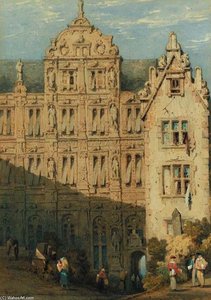
Marketplace at Bruges (1817) by Samuel Prout

Marketplace at Bruges

1817 · Watercolor · Smithsonian American Art Museum, Washington, D.C.

In this watercolor, Marketplace at Bruges by Samuel Prout, we find ourselves amidst a bustling historical marketplace. The composition is anchored on the center-right by an ornate, multi-story Gothic-style building, its surface detailed with elaborate carvings and timber framing. To the left, a darker, more weathered structure frames the view, providing a sense of depth through overlapping planes. In the distance, a tall, slender church spire reaches into a pale,…
3
Tivoli, Temple Of The Sibyl by Samuel Prout

Tivoli, Temple Of The Sibyl

Watercolor

The scene unfolds through Tivoli, Temple Of The Sibyl, a work rendered by the hand of Samuel Prout. This piece invites the viewer into a quiet moment of observation, where the weight of history rests upon the circular columns and ornate entablature of the ancient structure. The light catches the edges of the stone, casting long shadows that dance across the landscape of rolling hills and soft, drifting clouds.

The Samuel Prout selection continues, 11 to 100

11Devonshire Characters And Strange Events by Samuel ProutDevonshire Characters And Strange Events 12The Palazzo Pisani Moretta On The Grand Canal, Venice by Samuel ProutThe Palazzo Pisani Moretta On The Grand Canal, Venice 13Bayenturm Cologne And Siegburg House by Samuel ProutBayenturm Cologne And Siegburg House 14Petrarch's House At Arqua - Da - Roscoe by Samuel ProutPetrarch's House At Arqua - Da - Roscoe 15Frankf. Sachsenhausen by Samuel ProutFrankf. Sachsenhausen 16Palazzo Ducale, Venice by Samuel ProutPalazzo Ducale, Venice 17Borghese Palace Rome Engraving by Samuel ProutBorghese Palace Rome Engraving 18Verona Bridge by Samuel ProutVerona Bridge 19Figures At A Market Before A Continental Cathedral by Samuel ProutFigures At A Market Before A Continental Cathedral 20Prague Old Town Bridge Tower by Samuel ProutPrague Old Town Bridge Tower 21Beach scene by Samuel ProutBeach scene 22Basle, On The Rhine by Samuel ProutBasle, On The Rhine 23Rouen Cathedral by Samuel ProutRouen Cathedral 24Milan Cathedral by Samuel ProutMilan Cathedral 25An Alpine Village by Samuel ProutAn Alpine Village 26The Cathedral At Worms by Samuel ProutThe Cathedral At Worms 27Forum Of Nerva, Rome by Samuel ProutForum Of Nerva, Rome 28Figures Bathed In Sunlight On A Continental Street by Samuel ProutFigures Bathed In Sunlight On A Continental Street 29Castle of Chillon, Lake of Geneva, Switzerland by Samuel ProutCastle of Chillon, Lake of Geneva, Switzerland 30Watching The Gondolier, Venice by Samuel ProutWatching The Gondolier, Venice 31Milan, The Cathedral Square by Samuel ProutMilan, The Cathedral Square 32Old Cottages, Devonshire by Samuel ProutOld Cottages, Devonshire 33Shipwrecked by Samuel ProutShipwrecked 34View Of The Courtyard Of Corbeau In Strasbourg by Samuel ProutView Of The Courtyard Of Corbeau In Strasbourg 35Heidelberg by Samuel ProutHeidelberg 36Anglers Fishing Before A Derelict Watermill by Samuel ProutAnglers Fishing Before A Derelict Watermill 37The Church Tower by Samuel ProutThe Church Tower 38Church Of St. Wolfram At Abbeville by Samuel ProutChurch Of St. Wolfram At Abbeville 39Frankfurt dom by Samuel ProutFrankfurt dom 40The rialto bridge, venice; and view of basle by Samuel ProutThe rialto bridge, venice; and view of basle 41Figures By The Coast At Durdle Door, Dorset by Samuel ProutFigures By The Coast At Durdle Door, Dorset 42A trading brig at anchor off the coast by Samuel ProutA trading brig at anchor off the coast 43The Piazetta Of St Marks, Venice by Samuel ProutThe Piazetta Of St Marks, Venice 44The Breakwater by Samuel ProutThe Breakwater 45A Beached Fishing Vessel, With Fishermen Beyond by Samuel ProutA Beached Fishing Vessel, With Fishermen Beyond 46River Scene by Samuel ProutRiver Scene 47The Doge's Palace, Venice by Samuel ProutThe Doge's Palace, Venice 48Doge's Palace, Venice by Samuel ProutDoge's Palace, Venice 49Figures Watching A Passing Storm by Samuel ProutFigures Watching A Passing Storm 50The Lake of Como, Italy by Samuel ProutThe Lake of Como, Italy 51Temple Of Vespasian by Samuel ProutTemple Of Vespasian 52Near Saltash, Cornwall by Samuel ProutNear Saltash, Cornwall 53Figures Before A Thatched Cottage, Devon by Samuel ProutFigures Before A Thatched Cottage, Devon 54Cologne by Samuel ProutCologne 55The Town Market by Samuel ProutThe Town Market 56Britton's Architectural Antiquities by Samuel ProutBritton's Architectural Antiquities 57Fishing Smacks Off Dover by Samuel ProutFishing Smacks Off Dover 58Scene From A Church Porch by Samuel ProutScene From A Church Porch 59Landscape, With River And Village by Samuel ProutLandscape, With River And Village 60Wurtzburg by Samuel ProutWurtzburg 61The Charles Bridge, Prague by Samuel ProutThe Charles Bridge, Prague 62A View In Nuremberg by Samuel ProutA View In Nuremberg 63Dresden zwinger kronentor by Samuel ProutDresden zwinger kronentor 64Utrecht Town Hall by Samuel ProutUtrecht Town Hall 65Figures In A Fishing Boat Approaching An Anchored Man-o-war by Samuel ProutFigures In A Fishing Boat Approaching An Anchored Man-o-war 66A Corner Of A Church by Samuel ProutA Corner Of A Church 67A Continental Street Scene by Samuel ProutA Continental Street Scene 68An Ornamental Coach by Samuel ProutAn Ornamental Coach 69The Bishop's Palace, Wurzburg by Samuel ProutThe Bishop's Palace, Wurzburg 70The Grand Canal; And View Towards Santa Maria Salute by Samuel ProutThe Grand Canal; And View Towards Santa Maria Salute 71The Molo And The Doges' Palace, Venice by Samuel ProutThe Molo And The Doges' Palace, Venice 72The Scaliger Monument, Verona, Italy by Samuel ProutThe Scaliger Monument, Verona, Italy 73On A Venetian Backwater; And Figures On A Continental Street by Samuel ProutOn A Venetian Backwater; And Figures On A Continental Street 74Nuremberg Executioner Tower Water Tower by Samuel ProutNuremberg Executioner Tower Water Tower 75Looe, Cornwall, from 'Village Scenery' by Samuel ProutLooe, Cornwall, from 'Village Scenery' 76Porch Of Regensburg Cathedral by Samuel ProutPorch Of Regensburg Cathedral 77Arch Of Constantine by Samuel ProutArch Of Constantine 78Figures On The Beach by Samuel ProutFigures On The Beach 79Venetians Resting Under The Arches by Samuel ProutVenetians Resting Under The Arches 80Shipping Vessels Beached By An Old Wharf With A Town Beyond by Samuel ProutShipping Vessels Beached By An Old Wharf With A Town Beyond 81Harbour Scene - by Samuel ProutHarbour Scene - 82Salving From The Wreck by Samuel ProutSalving From The Wreck 83Temple Of Pallas, Forum Of Nerva, Rome by Samuel ProutTemple Of Pallas, Forum Of Nerva, Rome 84Merchants Selling Their Wares On The Italian Lakes by Samuel ProutMerchants Selling Their Wares On The Italian Lakes 85Ilford church by Samuel ProutIlford church 86Rudiments of Landscape, pl. - (52) by Samuel ProutRudiments of Landscape, pl. - (52) 87Harbour Scene by Samuel ProutHarbour Scene 88A Dutch Street Scene by Samuel ProutA Dutch Street Scene 89Plympton Grammar School by Samuel ProutPlympton Grammar School 90A Shipyard at Blackwall by Samuel ProutA Shipyard at Blackwall 91The Crypt Of Canterbury Cathedral by Samuel ProutThe Crypt Of Canterbury Cathedral 92Wuerzburg Mainbruecke Und Festung by Samuel ProutWuerzburg Mainbruecke Und Festung 93Domo D'ossola, Italy by Samuel ProutDomo D'ossola, Italy 94Farm Scene No.1 by Samuel ProutFarm Scene No.1 95Palazzo Contarini Fasan On The Grand Canal by Samuel ProutPalazzo Contarini Fasan On The Grand Canal 96Ulm Cathedral Portal by Samuel ProutUlm Cathedral Portal 97Cottages Near St. Michael's Mount, Cornwall by Samuel ProutCottages Near St. Michael's Mount, Cornwall 98Old Mill, Near Monmouth by Samuel ProutOld Mill, Near Monmouth 99Market Day by Samuel ProutMarket Day 100The Arch Of Constantine, Rome, From The South-east by Samuel ProutThe Arch Of Constantine, Rome, From The South-east

The subjects that held Samuel Prout's eye

The four subjects that come back most often in these originals, each with its finest example.

The museums that keep Samuel Prout's originals

The 3 museums that hold the most of the paintings on this page.

Museum City Works by Samuel Prout Paintings from this list
Birmingham Museum and Art Gallery, BirminghamBirmingham Museum and Art Gallery Birmingham 2 Temple Of Pallas , Rome, Interior Of A Cathedral
Smithsonian American Art Museum, Washington, D.C.Smithsonian American Art Museum Washington, D.C. 1 Marketplace at Bruges
Yale Center for British Art, New HavenYale Center for British Art New Haven 1 The Wreck of the Dutton, An East Indiaman

Samuel Prout year by year: the originals that define each

From 1815 to 1817, just 3 years, come all the dated Samuel Prout works in this selection: here is each year at its finest.

Works per year

Pick a year to see its originals.

Collectors' questions about Samuel Prout's paintings

Which work is Samuel Prout most famous for?Reveal the answer

Nuremberg. Marketplace at Bruges (1817) and Tivoli, Temple Of The Sibyl come next.

What are the ten most famous Samuel Prout paintings?Reveal the answer

Nuremberg, Marketplace at Bruges, Tivoli, Temple Of The Sibyl, The Temple Of Saturn And The Temple Of Vespasian, The Forum, Rome, Temple Of Pallas , Rome, Interior Of A Cathedral, The Wreck of the Dutton, An East Indiaman, Oyster Boats, Dover, A Donkey Resting In A Barn and At Cologne - Hotel De Prague. The ranking above gives each one's year and museum.

How many paintings did Samuel Prout leave?Reveal the answer

Our catalog holds 111 works by Samuel Prout, dated from 1815 to 1817.

In which museums do Samuel Prout's masterpieces hang?Reveal the answer

Mostly in Birmingham Museum and Art Gallery (Birmingham), Smithsonian American Art Museum (Washington, D.C.) and Yale Center for British Art (New Haven). The museum table above lists them all.

In which years did Samuel Prout paint the most famous works?Reveal the answer

In 1817: 3 of the 100 works on this page were made then, Marketplace at Bruges among them.

What are the first and the last famous originals of Samuel Prout?Reveal the answer

On this page, the earliest is The Wreck of the Dutton, An East Indiaman (1815) and the latest Marketplace at Bruges (1817).

Which subjects did Samuel Prout choose most often?Reveal the answer

Italy (14), Temples (12) and Scenes (8), across the 100 works on this page.

Which technique did Samuel Prout use most?Reveal the answer

Watercolor, for 3 of the 100 works on this page.

To which art movement does Samuel Prout belong?Reveal the answer

Romanticism, judging by the originals on this page.

Which Samuel Prout works hang at the Birmingham Museum and Art Gallery?Reveal the answer

Temple Of Pallas , Rome and Interior Of A Cathedral: the Birmingham Museum and Art Gallery, Birmingham holds 2 of the works on this page.

Samuel Prout: life and work

The Master of Atmospheric Architecture

In the golden age of British watercolour, few names evoke the romantic splendor of a bygone era quite like Samuel Prout. A virtuoso of light and shadow, Prout possessed a singular ability to breathe life into stone, transforming cold architectural ruins and bustling European streetscapes into emotive, living narratives. His work does not merely document a location; it captures the very soul of a place, draped in the soft, melanchative mists of the Romantic movement. To gaze upon a Prout original is to step through a portal into the 19th century, where the interplay of sunlight and shadow tells stories of ancient grandeur and quiet, everyday resilience.

Born in the maritime air of Plymouth in 1783, Prout’s early years were shaped by the rugged beauty of the Devon coast. The son of a naval outfitter, his childhood was marked by both the industrious rhythms of the dockyards and a profound connection to the natural world. Though a severe bout of sunstroke in his early childhood left him prone to lifelong physical struggles, it perhaps sharpened his internal vision, forcing him to find solace in the meticulous observation of his surroundings. Under the nurturing guidance of his headmaster, John Bidlake, and alongside his lifelong friend Benjamin Robert Haydon, Prout began to translate the picturesque cottages and winding valleys of Cornwall into delicate sketches, laying the foundation for a career that would eventually captivate royalty.

A Journey Through Light and Line

Prout’s artistic evolution was a masterful ascent, fueled by a relentless pursuit of tonal subtlety and atmospheric depth. After moving to London in 1802, he entered a vibrant circle of illustrators and masters, absorbing the techniques of legends such as J.M.W. Turner and Thomas Girtin. While his early training provided him with a rigorous command of line, it was his later development that allowed him to pioneer the genre of the "grand street scene." He moved beyond simple topographical recording, instead utilizing watercolour to create vast, immersive environments where the architecture felt as though it were emerging from a dreamlike haze.

His travels across continental Europe—most notably through the winding canals of Venice and the historic streets of Germany—became the crucible for his greatest achievements. In these landscapes, Prout mastered the art of the picturesque, balancing intricate architectural details with expansive, atmospheric washes of colour. His ability to render the weathered texture of ancient walls and the shimmering reflections in stagnant canal waters earned him the profound respect of his peers. Indeed, the great critic John Ruskin, who would later become a titan of art history, found such inspiration in Prout’s work that he famously remarked that while he might tire of Turner, he could never tire of Prout.

Legacy and Royal Recognition

The significance of Samuel Prout extends far beyond the borders of his beautiful sketches; he was a foundational figure who helped define the aesthetic standards of British watercolour painting. His technical prowess and ability to evoke emotion through architectural landscape earned him the highest honors of his time, including the prestigious appointment as Painter in Water-Colours in Ordinary to King George IV and subsequently to Queen Victoria. This royal patronage solidified his status as a premier artist of the Victorian era.

Prout’s influence can be traced through several key aspects of his enduring legacy:

  • The Invention of the Grand Street Scene: He transformed architectural painting from static documentation into a dynamic, narrative-driven genre.
  • Mentorship and Influence: His meticulous approach to light and tone served as a vital precursor and inspiration for the works of John Ruskin.
  • Atmospheric Mastery: He bridged the gap between topographical accuracy and Romantic expressionism, making the atmosphere itself a central character in his compositions.

Today, the works of Samuel Prout remain cherished by collectors and historians alike. They serve as a poignant reminder of a period when art sought to find the sublime within the crumbling ruins of history and the quiet beauty of the everyday. Through his brush, the stones of Europe continue to speak, whispering tales of light, shadow, and the eternal passage of time.