A Pioneer of Atmospheric Watercolour: The Life and Art of Thomas Girtin
Thomas Girtin, a name perhaps less immediately recognizable than his contemporary J.M.W. Turner, nevertheless occupies a pivotal position in the history of British art. Born in Southwark, London, in 1775, Girtin’s brief but intensely productive career fundamentally altered perceptions of watercolour painting, elevating it from a primarily topographical pursuit to a medium capable of profound emotional expression and grand artistic ambition. His early life was marked by loss; the death of his father, a prosperous brushmaker of Huguenot heritage, led him to live with an uncle in Brentford. It was here, amidst the quiet landscapes of Middlesex, that Girtin’s innate artistic talent began to blossom. He initially trained as a landscape draughtsman, exhibiting sketches in his father's shop window – a humble beginning for an artist who would later command attention and respect within London’s burgeoning art scene.Formative Years and the Rise of a Unique Style
Girtin’s artistic development was inextricably linked to his friendship, and often perceived rivalry, with J.M.W. Turner. The two young artists first met while students at the Royal Academy Schools, and their early works reveal a shared fascination with topographical subjects and the dramatic effects of light and atmosphere. However, Girtin quickly distinguished himself through a distinctive approach that prioritized expressive colour washes and an almost abstract rendering of form. While Turner meticulously detailed architectural structures and maritime scenes, Girtin favoured broader compositions, focusing on capturing the *feeling* of a place rather than its precise physical characteristics. He embraced a looser technique, employing layers of translucent watercolour to create luminous skies and evocative landscapes that hinted at the sublime power of nature. This innovative style, characterized by its atmospheric depth and emotional resonance, challenged conventional artistic norms and paved the way for a new era in British landscape painting.Landscapes of Imagination and Observation
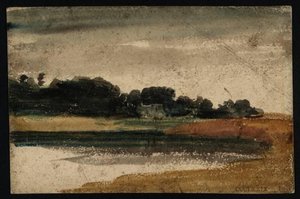
Girtin’s oeuvre is remarkably diverse, encompassing both meticulously observed views of London and the surrounding countryside, and highly imaginative compositions inspired by literary sources and his own poetic sensibility. Works like Estuary, a painting that exemplifies his mastery of watercolour technique, showcases his ability to convey the vastness and fluidity of the natural world through subtle gradations of colour and light. Similarly, Southampton, a landscape demonstrating his capacity to capture the essence of a specific location, reveals a keen eye for detail combined with an overarching concern for atmospheric effect. He wasn’t merely recording what he saw; he was interpreting it, imbuing each scene with a sense of mood and emotion. His paintings often feature turbulent skies, dramatic lighting, and a palpable sense of movement – qualities that would later become hallmarks of the Romantic aesthetic.A Lasting Legacy: Influence and Historical Significance
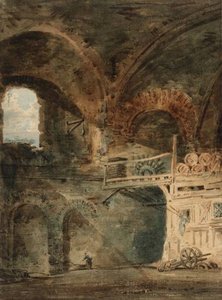
Despite his untimely death at the age of 27 in 1802, Thomas Girtin left an indelible mark on British art. His innovative use of watercolour, coupled with his expressive approach to landscape painting, profoundly influenced a generation of artists, most notably J.M.W. Turner, who continued to explore and develop many of the themes and techniques pioneered by Girtin. He helped establish watercolour as a legitimate and respected art form, capable of conveying complex emotions and grand artistic ideas. Today, his paintings are held in prominent collections such as the Tate Britain, where Southampton remains on display, offering viewers a glimpse into the visionary world of this remarkable artist. His contribution continues to be celebrated by scholars and enthusiasts alike, ensuring that his legacy endures as a testament to the power of imagination, observation, and the transformative potential of watercolour painting. Further exploration of Girtin’s work can be found at OriginalUniqueArt.com and OriginalUniqueArt.com. For a broader understanding of his artistic context, resources are available at OriginalUniqueArt.com and Wikipedia.Questions & Answers
Where are Thomas Girtin's artworks mapped by subject?
The Subject Atlas page maps Thomas Girtin's artworks by subject.
Where is Thomas Girtin from?
Thomas Girtin was born in United Kingdom.
Can I visit a virtual museum of Thomas Girtin's works?
The 3D Museum of Thomas Girtin is a page that displays the artist's artworks in a virtual three-dimensional gallery.